 Add to Chrome
 Add to Firefox
 Add to Edge
CoWAM: Coordination Contracts for Selective Policy Intervention with WAMs
Aug 03, 2026
World Action Models (WAMs) augment robot policies with action-conditioned predicted futures, but a plausible future alone does not justify changing the action that a bimanual policy would execute. We present CoWAM, a selective intervention layer that expresses synchronization, role compatibility, and collision convergence as coordination contracts. Each contract combines typed admissibility checks with event-conditioned verification and calibrated intervention gates. CoWAM preserves the nominal action unless an alternative satisfies every active obligation and provides a clear, low-risk improvement; when the nominal action is also inadmissible, it invokes a predefined abstention fallback. To separate selector quality from proposal quality, all methods operate on identical candidate pools and commit their decisions before shared oracle labeling. Across eight simulated bimanual tasks, CoWAM improves coordination-valid selection by 16.7 percentage points over the contract-only variant and raises closed-loop success by 9.6 percentage points over the strongest selective baseline, while keeping harmful interventions below 1%. Together, these results establish coordination contracts as an effective interface for conservative policy intervention with predicted world-action evidence across coordination-rich bimanual tasks.

The Gate, Not the Cache: Gate Provenance Bounds the Closed-Loop Reliability of Training-Free VLA Token Skipping
Aug 01, 2026Token skipping is a widely used training-free way to accelerate vision--language--action (VLA) models by bypassing computation for most visual tokens at each control step according to a gate. When the next gate is harvested from the previous accelerated forward, however, the tokens skipped at one step are also the ones least visible to the next gate, and the damage can compound across control steps until the task fails. We study the two mechanisms this class is built on, reuse and deletion, crossing each against where its gate signal comes from on identical episodes. At a skip ratio of 0.9 on LIBERO-Object, both collapse when the gate comes from the model's own accelerated forwards, to 0.68 under reuse and to 0.31 under deletion against a dense 1.00, and the collapse is invisible to the action-level detectors we evaluate. What separates collapse from dense-level operation is not the mechanism but whether the gate is clean, computed by a forward that skipped nothing. We therefore propose actuation-slack refresh, one dense pass run while the robot executes its current action chunk, off the critical path, that hands the next step a clean gate and a fresh KV base. Since the measured detectors do not reliably reveal the failure, the refresh is unconditional rather than triggered. Both mechanisms then recover to 0.98, keeping the speed of skipping and the information of a dense pass. We then integrate the refresh into state-of-the-art caching and pruning methods across two VLA policies, 4 LIBERO suites, and 4 SIMPLER tasks, where it repairs every collapse caused by using a self-harvested gate. Serve latency drops 18--22\% below dense, measured both in simulation and on a physical robot. Where the gate signal comes from, not how tokens are skipped, decides closed-loop reliability for accelerated VLAs.
OmniVAE: An Audio-Video VAE with Cross-Modal Alignment for Joint Generation
Jul 26, 2026Recent generative models are moving beyond silent video or standalone audio synthesis toward the joint generation of synchronized audio and video. Despite this progress, jointly generating audio and video with fine-grained cross-modal correspondence remains challenging due to their fundamental structural differences. Most existing methods use audio and video VAEs trained separately. As a result, the two latent spaces lack cross-modal alignment, leaving the downstream generative model to learn cross-modal synchronization from scratch. We present OmniVAE, a jointly trained audio-video VAE that learns fine-grained semantic alignment between audio and video latent representations. Beyond reconstruction, OmniVAE uses a segment-level audio-video contrastive objective to capture temporal-semantic correspondence and align the two latent spaces. In parallel, it distills features from pretrained modality-specific semantic encoders into each modality, improving the downstream learnability of both latent spaces. Extensive experiments show that both objectives consistently improve the learnability of the latent spaces, translating into higher generation quality and more accurate cross-modal synchronization in downstream text-to-audio-video generation. These findings underscore the importance of learning unified representations as a foundation for omnimodal modeling.1
Utility-Aware Data Pricing: Token-Level Quality and Empirical Training Gain for LLMs
Apr 24, 2026Traditional data valuation methods based on ``row-count $\times$ quality coefficient'' paradigms fail to capture the nuanced, nonlinear contributions that data makes to Large Language Model (LLM) capabilities. This paper presents a dynamic data valuation framework that transitions from static accounting to utility-based pricing. Our approach operates on three layers: (1) token-level information density metrics using Shannon entropy and Data Quality Scores; (2) empirical training gain measurement through influence functions, proxy model strategies, and Data Shapley values; and (3) cryptographic verifiability through hash-based commitments, Merkle trees, and a tamper-evident training ledger. We provide comprehensive experimental validation on three real domains (instruction following, mathematical reasoning, and code summarization), demonstrating that proxy-based empirical gain achieves near-perfect ranking alignment with realized utility, substantially outperforming row-count and token-count baselines. This framework enables a fair Data-as-a-Service economy where high-reasoning data is priced according to its actual contribution to model intelligence, while providing the transparency and auditability necessary for trustworthy data markets.
Graph-Aware Text-Only Backdoor Poisoning for Text-Attributed Graphs
Mar 20, 2026Many learning systems now use graph data in which each node also contains text, such as papers with abstracts or users with posts. Because these texts often come from open platforms, an attacker may be able to quietly poison a small part of the training data and later make the model produce wrong predictions on demand. This paper studies that risk in a realistic setting where the attacker edits only node text and does not change the graph structure. We propose TAGBD, a text-only backdoor attack for text-attributed graphs. TAGBD first finds training nodes that are easier to influence, then generates natural-looking trigger text with the help of a shadow graph model, and finally injects the trigger by either replacing the original text or appending a short phrase. Experiments on three benchmark datasets show that the attack is highly effective, transfers across different graph models, and remains strong under common defenses. These results demonstrate that text alone is a practical attack channel in graph learning systems and suggest that future defenses should inspect both graph links and node content.
DualSentinel: A Lightweight Framework for Detecting Targeted Attacks in Black-box LLM via Dual Entropy Lull Pattern
Mar 02, 2026Recent intelligent systems integrate powerful Large Language Models (LLMs) through APIs, but their trustworthiness may be critically undermined by targeted attacks like backdoor and prompt injection attacks, which secretly force LLMs to generate specific malicious sequences. Existing defensive approaches for such threats typically rely on high access rights, impose prohibitive costs, and hinder normal inference, rendering them impractical for real-world scenarios. To solve these limitations, we introduce DualSentinel, a lightweight and unified defense framework that can accurately and promptly detect the activation of targeted attacks alongside the LLM generation process. We first identify a characteristic of compromised LLMs, termed Entropy Lull: when a targeted attack successfully hijacks the generation process, the LLM exhibits a distinct period of abnormally low and stable token probability entropy, indicating it is following a fixed path rather than making creative choices. DualSentinel leverages this pattern by developing an innovative dual-check approach. It first employs a magnitude and trend-aware monitoring method to proactively and sensitively flag an entropy lull pattern at runtime. Upon such flagging, it triggers a lightweight yet powerful secondary verification based on task-flipping. An attack is confirmed only if the entropy lull pattern persists across both the original and the flipped task, proving that the LLM's output is coercively controlled. Extensive evaluations show that DualSentinel is both highly effective (superior detection accuracy with near-zero false positives) and remarkably efficient (negligible additional cost), offering a truly practical path toward securing deployed LLMs. The source code can be accessed at https://doi.org/10.5281/zenodo.18479273.
MOVA: Towards Scalable and Synchronized Video-Audio Generation
Feb 09, 2026Audio is indispensable for real-world video, yet generation models have largely overlooked audio components. Current approaches to producing audio-visual content often rely on cascaded pipelines, which increase cost, accumulate errors, and degrade overall quality. While systems such as Veo 3 and Sora 2 emphasize the value of simultaneous generation, joint multimodal modeling introduces unique challenges in architecture, data, and training. Moreover, the closed-source nature of existing systems limits progress in the field. In this work, we introduce MOVA (MOSS Video and Audio), an open-source model capable of generating high-quality, synchronized audio-visual content, including realistic lip-synced speech, environment-aware sound effects, and content-aligned music. MOVA employs a Mixture-of-Experts (MoE) architecture, with a total of 32B parameters, of which 18B are active during inference. It supports IT2VA (Image-Text to Video-Audio) generation task. By releasing the model weights and code, we aim to advance research and foster a vibrant community of creators. The released codebase features comprehensive support for efficient inference, LoRA fine-tuning, and prompt enhancement.
Multi-hop Reasoning via Early Knowledge Alignment
Dec 23, 2025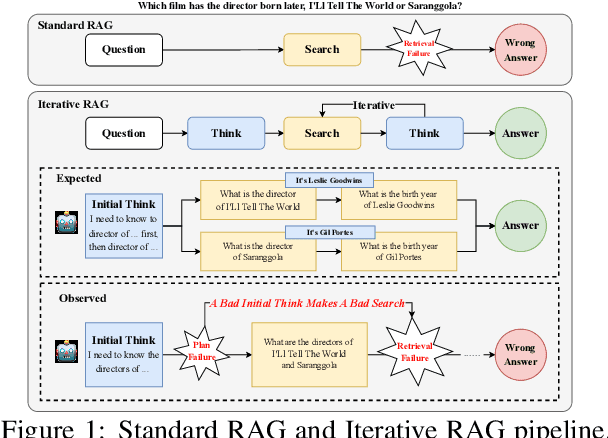
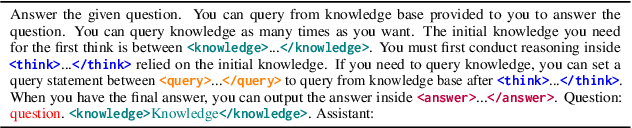
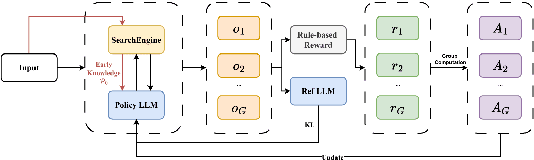
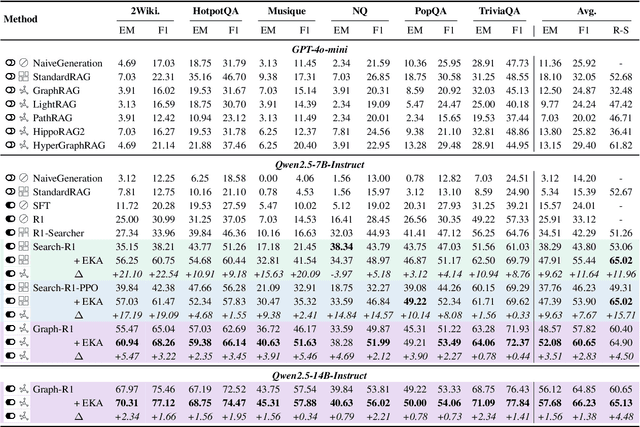
Retrieval-Augmented Generation (RAG) has emerged as a powerful paradigm for Large Language Models (LLMs) to address knowledge-intensive queries requiring domain-specific or up-to-date information. To handle complex multi-hop questions that are challenging for single-step retrieval, iterative RAG approaches incorporating reinforcement learning have been proposed. However, existing iterative RAG systems typically plan to decompose questions without leveraging information about the available retrieval corpus, leading to inefficient retrieval and reasoning chains that cascade into suboptimal performance. In this paper, we introduce Early Knowledge Alignment (EKA), a simple but effective module that aligns LLMs with retrieval set before planning in iterative RAG systems with contextually relevant retrieved knowledge. Extensive experiments on six standard RAG datasets demonstrate that by establishing a stronger reasoning foundation, EKA significantly improves retrieval precision, reduces cascading errors, and enhances both performance and efficiency. Our analysis from an entropy perspective demonstrate that incorporating early knowledge reduces unnecessary exploration during the reasoning process, enabling the model to focus more effectively on relevant information subsets. Moreover, EKA proves effective as a versatile, training-free inference strategy that scales seamlessly to large models. Generalization tests across diverse datasets and retrieval corpora confirm the robustness of our approach. Overall, EKA advances the state-of-the-art in iterative RAG systems while illuminating the critical interplay between structured reasoning and efficient exploration in reinforcement learning-augmented frameworks. The code is released at \href{https://github.com/yxzwang/EarlyKnowledgeAlignment}{Github}.
Terahertz Signal Coverage Enhancement in Hall Scenarios Based on Single-Hop and Dual-Hop Reconfigurable Intelligent Surfaces
Dec 16, 2025Terahertz (THz) communication offers ultra-high data rates and has emerged as a promising technology for future wireless networks. However, the inherently high free-space path loss of THz waves significantly limits the coverage range of THz communication systems. Therefore, extending the effective coverage area is a key challenge for the practical deployment of THz networks. Reconfigurable intelligent surfaces (RIS), which can dynamically manipulate electromagnetic wave propagation, provide a solution to enhance THz coverage. To investigate multi-RIS deployment scenarios, this work integrates an antenna array-based RIS model into the ray-tracing simulation platform. Using an indoor hall as a representative case study, the enhancement effects of single-hop and dual-hop RIS configurations on indoor signal coverage are evaluated under various deployment schemes. The developed framework offers valuable insights and design references for optimizing RIS-assisted indoor THz communication and coverage estimation.
GUIDE: Gaussian Unified Instance Detection for Enhanced Obstacle Perception in Autonomous Driving
Nov 17, 2025In the realm of autonomous driving, accurately detecting surrounding obstacles is crucial for effective decision-making. Traditional methods primarily rely on 3D bounding boxes to represent these obstacles, which often fail to capture the complexity of irregularly shaped, real-world objects. To overcome these limitations, we present GUIDE, a novel framework that utilizes 3D Gaussians for instance detection and occupancy prediction. Unlike conventional occupancy prediction methods, GUIDE also offers robust tracking capabilities. Our framework employs a sparse representation strategy, using Gaussian-to-Voxel Splatting to provide fine-grained, instance-level occupancy data without the computational demands associated with dense voxel grids. Experimental validation on the nuScenes dataset demonstrates GUIDE's performance, with an instance occupancy mAP of 21.61, marking a 50\% improvement over existing methods, alongside competitive tracking capabilities. GUIDE establishes a new benchmark in autonomous perception systems, effectively combining precision with computational efficiency to better address the complexities of real-world driving environments.