 Add to Chrome
 Add to Firefox
 Add to Edge
FUSAR-R1: A Large-Scale Reasoning Model for Intelligent Interpretation of SAR Images
Jul 18, 2026
In recent years, large-scale vision-language models have been driving a paradigm shift in intelligent remote sensing image interpretation. By incorporating textual semantic information, the cognitive expression, semantic understanding, and human-computer interaction capabilities of interpretation models have been significantly improved, achieving initial progress in the field of Synthetic Aperture Radar (SAR) image interpretation. However, SAR images are affected by factors such as coherent imaging mechanisms, complex scattering characteristics, speckle noise interference, and target-background coupling, resulting in complex and variable image features with significant uncertainties and specializations. Existing SAR vision-language models do not yet possess the step-by-step analysis, logical judgment, and self-correction capabilities of human experts, making it difficult to support reliable intelligent interpretation in complex scenarios. To address this issue, this paper proposes a large-scale reasoning model, FUSAR-R1, for intelligent interpretation of SAR images. The model first constructs explicit chain-of-thought reasoning data by simulating the interpretation process of human experts and uses this data to guide instruction learning, thereby endowing the model with basic reasoning capabilities. Subsequently, a reinforcement learning strategy is introduced to optimize the model's outputs based on inference results, enabling self-correction and more reliable reasoning. Experimental results demonstrate that FUSAR-R1 consistently outperforms existing multimodal large-scale models across various SAR interpretation tasks, including target detection, target counting and classification, and land-cover category recognition.

Hy-MT2: A Family of Fast, Efficient and Powerful Multilingual Translation Models in the Wild
May 21, 2026Hy-MT2 is a family of fast-thinking multilingual translation models designed for complex real-world scenarios. It includes three model sizes: 1.8B, 7B, and 30B-A3B (MoE), all of which support translation among 33 languages and effectively follow translation instructions in multiple languages. For on-device deployment, with AngelSlim 1.25-bit extreme quantization, the 1.8B model requires only 440 MB of storage and improves inference speed by 1.5x. Multi-dimensional evaluations show that Hy-MT2 delivers outstanding performance across general, real-world business, domain-specific, and instruction-following translation tasks. The 7B and 30B models outperform open-source models such as DeepSeek-V4-Pro and Kimi K2.6 in fast-thinking mode, while the lightweight 1.8B model also surpasses mainstream commercial APIs from providers such as Microsoft and Doubao overall.
Premier: Personalized Preference Modulation with Learnable User Embedding in Text-to-Image Generation
Mar 21, 2026Text-to-image generation has advanced rapidly, yet it still struggles to capture the nuanced user preferences. Existing approaches typically rely on multimodal large language models to infer user preferences, but the derived prompts or latent codes rarely reflect them faithfully, leading to suboptimal personalization. We present Premier, a novel preference modulation framework for personalized image generation. Premier represents each user's preference as a learnable embedding and introduces a preference adapter that fuses the user embedding with the text prompt. To enable accurate and fine-grained preference control, the fused preference embedding is further used to modulate the generative process. To enhance the distinctness of individual preference and improve alignment between outputs and user-specific styles, we incorporate a dispersion loss that enforces separation among user embeddings. When user data are scarce, new users are represented as linear combinations of existing preference embeddings learned during training, enabling effective generalization. Experiments show that Premier outperforms prior methods under the same history length, achieving stronger preference alignment and superior performance on text consistency, ViPer proxy metrics, and expert evaluations.
FUSAR-GPT : A Spatiotemporal Feature-Embedded and Two-Stage Decoupled Visual Language Model for SAR Imagery
Feb 26, 2026Research on the intelligent interpretation of all-weather, all-time Synthetic Aperture Radar (SAR) is crucial for advancing remote sensing applications. In recent years, although Visual Language Models (VLMs) have demonstrated strong open-world understanding capabilities on RGB images, their performance is severely limited when directly applied to the SAR field due to the complexity of the imaging mechanism, sensitivity to scattering features, and the scarcity of high-quality text corpora. To systematically address this issue, we constructed the inaugural SAR Image-Text-AlphaEarth feature triplet dataset and developed FUSAR-GPT, a VLM specifically for SAR. FUSAR-GPT innovatively introduces a geospatial baseline model as a 'world knowledge' prior and embeds multi-source remote-sensing temporal features into the model's visual backbone via 'spatiotemporal anchors', enabling dynamic compensation for the sparse representation of targets in SAR images. Furthermore, we designed a two-stage SFT strategy to decouple the knowledge injection and task execution of large models. The spatiotemporal feature embedding and the two-stage decoupling paradigm enable FUSAR-GPT to achieve state-of-the-art performance across several typical remote sensing visual-language benchmark tests, significantly outperforming mainstream baseline models by over 12%.
FramePainter: Endowing Interactive Image Editing with Video Diffusion Priors
Jan 14, 2025
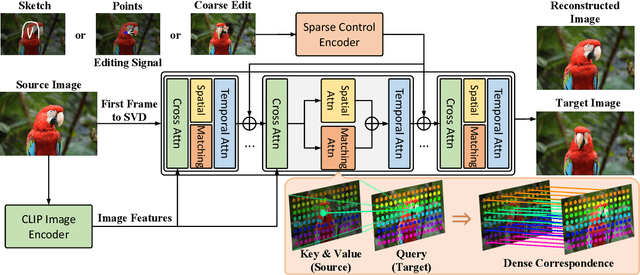

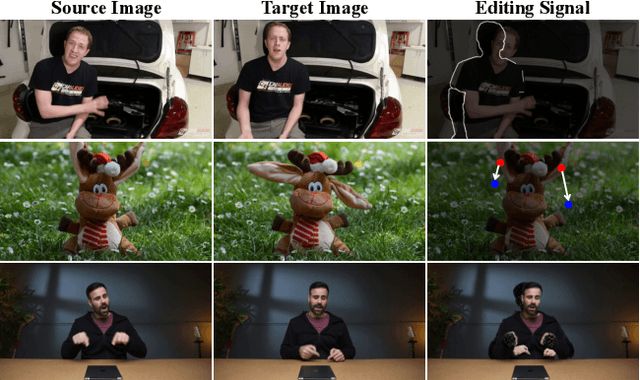
Interactive image editing allows users to modify images through visual interaction operations such as drawing, clicking, and dragging. Existing methods construct such supervision signals from videos, as they capture how objects change with various physical interactions. However, these models are usually built upon text-to-image diffusion models, so necessitate (i) massive training samples and (ii) an additional reference encoder to learn real-world dynamics and visual consistency. In this paper, we reformulate this task as an image-to-video generation problem, so that inherit powerful video diffusion priors to reduce training costs and ensure temporal consistency. Specifically, we introduce FramePainter as an efficient instantiation of this formulation. Initialized with Stable Video Diffusion, it only uses a lightweight sparse control encoder to inject editing signals. Considering the limitations of temporal attention in handling large motion between two frames, we further propose matching attention to enlarge the receptive field while encouraging dense correspondence between edited and source image tokens. We highlight the effectiveness and efficiency of FramePainter across various of editing signals: it domainantly outperforms previous state-of-the-art methods with far less training data, achieving highly seamless and coherent editing of images, \eg, automatically adjust the reflection of the cup. Moreover, FramePainter also exhibits exceptional generalization in scenarios not present in real-world videos, \eg, transform the clownfish into shark-like shape. Our code will be available at https://github.com/YBYBZhang/FramePainter.
DELIA: Diversity-Enhanced Learning for Instruction Adaptation in Large Language Models
Aug 19, 2024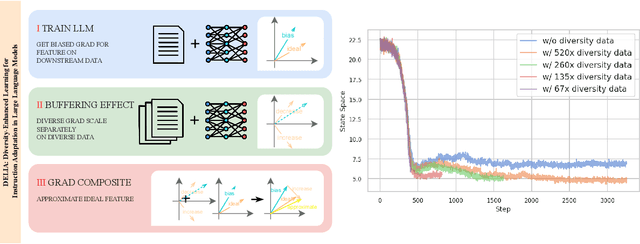

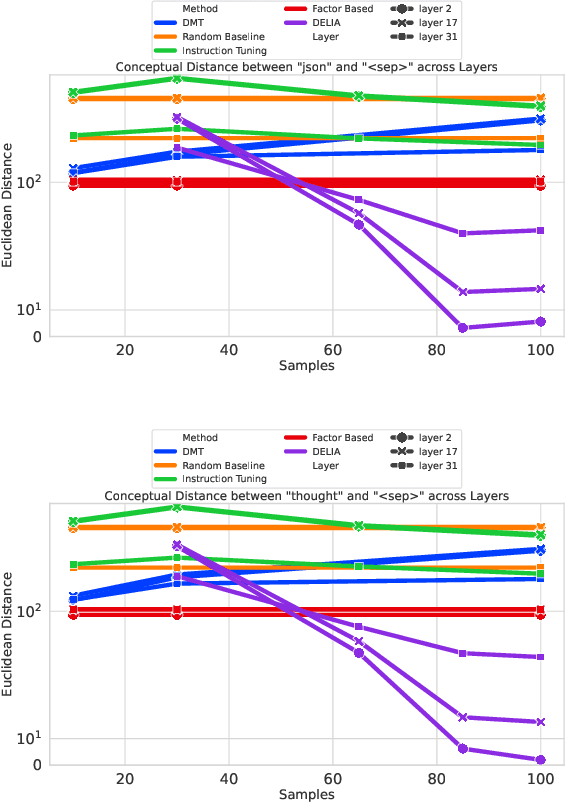
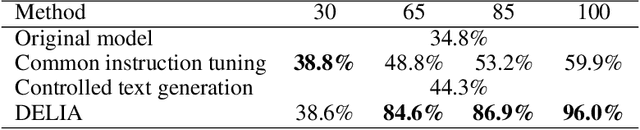
Although instruction tuning is widely used to adjust behavior in Large Language Models (LLMs), extensive empirical evidence and research indicates that it is primarily a process where the model fits to specific task formats, rather than acquiring new knowledge or capabilities. We propose that this limitation stems from biased features learned during instruction tuning, which differ from ideal task-specfic features, leading to learn less underlying semantics in downstream tasks. However, ideal features are unknown and incalculable, constraining past work to rely on prior knowledge to assist reasoning or training, which limits LLMs' capabilities to the developers' abilities, rather than data-driven scalable learning. In our paper, through our novel data synthesis method, DELIA (Diversity-Enhanced Learning for Instruction Adaptation), we leverage the buffering effect of extensive diverse data in LLMs training to transform biased features in instruction tuning into approximations of ideal features, without explicit prior ideal features. Experiments show DELIA's better performance compared to common instruction tuning and other baselines. It outperforms common instruction tuning by 17.07%-33.41% on Icelandic-English translation bleurt score (WMT-21 dataset, gemma-7b-it) and improves accuracy by 36.1% on formatted text generation (Llama2-7b-chat). Notably, among knowledge injection methods we've known, DELIA uniquely align the internal representations of new special tokens with their prior semantics.