 Add to Chrome
 Add to Firefox
 Add to Edge
MGDT: MLLM-Guided Diffusion Transformer with Relation-Adaptive Mixture-of-Experts for Multimodal Knowledge Graph Completion
Jul 17, 2026
Multimodal Knowledge Graph Completion (MKGC) requires inferring missing entities from structural, textual, and visual cues. Existing diffusion-based MKGC methods usually denoise directly on raw multimodal features. Such a design forces the denoiser to simultaneously perform relation-dependent cue selection, cross-modal semantic alignment, and structure-aware entity generation, which introduces noisy and semantically inconsistent conditions for diffusion and consequently leads to suboptimal completion performance. To address this limitation, we propose MGDT: MLLM-Guided Diffusion Transformer with Relation-Adaptive Mixture-of-Experts (MGDT), a novel MKGC framework built on an align-then-diffuse paradigm. MGDT first employs a Relation-Adaptive Semantic Routing Mixture-of-Experts (RASR-MoE) module to select relation-relevant multimodal semantic transformation paths and suppress irrelevant modality interference. MGDT then uses a frozen Multimodal Large Language Model (MLLM) as a semantic anchor to align the routed multimodal representations into a unified latent space and reduce cross-modal semantic heterogeneity. Finally, a Knowledge Graph Diffusion Transformer (KGDT) performs graph-conditioned denoising generation in the aligned space to produce the missing entity representation. Experiments on three benchmark datasets show that MGDT consistently outperforms strong baselines.

What Does Your Short-Answer VQA Score Actually Measure? Evaluator-Dependent Instability in Multimodal Short-Answer Benchmarks
Jul 11, 2026Short-answer VQA benchmarks conflate two distinct quantities: whether a model's answer is semantically correct, and whether that answer matches the surface form expected by the automatic evaluator. We study this conflation across six vision--language models and six benchmarks, using a human-validated semantic judge (97.6% precision) to audit over 37k official errors. A second text-only judge reproduces the same benchmark-level false-negative pattern, showing that the effect is not an artifact of a single audit model. On text-rich benchmarks, up to half of these errors are semantically acceptable answers penalized purely for surface-form mismatch. This instability is structured by answer type: extractive and multi-span answers are far more evaluator-sensitive than scalar answers. Benign prompt and context rewrites further destabilize official outcomes, flipping item-level correctness at substantial rates without changing the underlying task. A deterministic CPU-only contract repair confirms that the undercount is partially recoverable. These findings imply that official short-answer VQA scores should be accompanied by semantic audits and answer-type diagnostics to remain interpretable.
Beyond Metadata: CAPRA for Hidden Subgroup Analysis under Missing Metadata in Medical Imaging
Jul 10, 2026Medical imaging models are often deployed without the demographic, acquisition, and quality metadata needed for subgroup auditing. Once those metadata disappear, clinically critical failure modes can be masked by strong aggregate performance, and many robust-learning methods lose the group structure they rely on. We present CAPRA, a calibrated proxy-axis framework for hidden subgroup analysis under missing metadata. CAPRA predicts image-derived semantic axes, calibrates axis posteriors on a small metadata-labeled split via patient-level cross-fitting, and organizes those posteriors into a calibrated subgroup interface that supports both deployment-time failure analysis and downstream robust learning without requiring subgroup labels at deployment. Across fundus, dermoscopy, and chest radiography, CAPRA reveals disparity patterns missed by metadata-only slicing, remains informative under dataset shift, and produces subgroup partitions that align more closely with explicit failure axes than image-only or latent-slice baselines. The same interface can also be reused by downstream robust learners, although those gains are domain-dependent. Overall, CAPRA turns hidden subgroup analysis under missing metadata into a calibrated, interpretable, and reusable subgroup interface for deployment-time analysis and robust transfer.
DiffusionCom: Structure-Aware Multimodal Diffusion Model for Multimodal Knowledge Graph Completion
Apr 09, 2025Most current MKGC approaches are predominantly based on discriminative models that maximize conditional likelihood. These approaches struggle to efficiently capture the complex connections in real-world knowledge graphs, thereby limiting their overall performance. To address this issue, we propose a structure-aware multimodal Diffusion model for multimodal knowledge graph Completion (DiffusionCom). DiffusionCom innovatively approaches the problem from the perspective of generative models, modeling the association between the $(head, relation)$ pair and candidate tail entities as their joint probability distribution $p((head, relation), (tail))$, and framing the MKGC task as a process of gradually generating the joint probability distribution from noise. Furthermore, to fully leverage the structural information in MKGs, we propose Structure-MKGformer, an adaptive and structure-aware multimodal knowledge representation learning method, as the encoder for DiffusionCom. Structure-MKGformer captures rich structural information through a multimodal graph attention network (MGAT) and adaptively fuses it with entity representations, thereby enhancing the structural awareness of these representations. This design effectively addresses the limitations of existing MKGC methods, particularly those based on multimodal pre-trained models, in utilizing structural information. DiffusionCom is trained using both generative and discriminative losses for the generator, while the feature extractor is optimized exclusively with discriminative loss. This dual approach allows DiffusionCom to harness the strengths of both generative and discriminative models. Extensive experiments on the FB15k-237-IMG and WN18-IMG datasets demonstrate that DiffusionCom outperforms state-of-the-art models.
WPFed: Web-based Personalized Federation for Decentralized Systems
Oct 15, 2024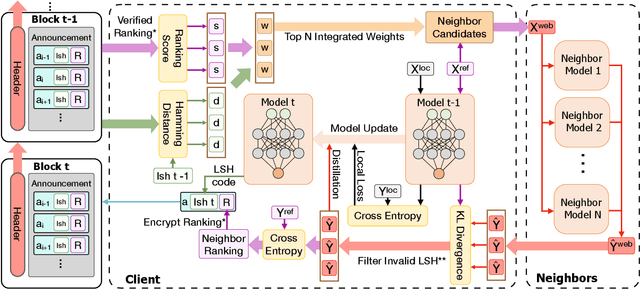

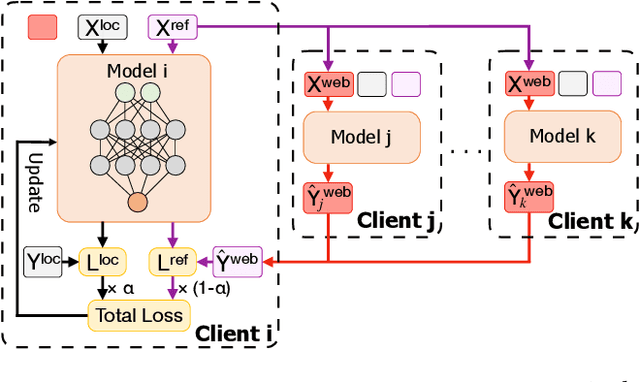

Decentralized learning has become crucial for collaborative model training in environments where data privacy and trust are paramount. In web-based applications, clients are liberated from traditional fixed network topologies, enabling the establishment of arbitrary peer-to-peer (P2P) connections. While this flexibility is highly promising, it introduces a fundamental challenge: the optimal selection of neighbors to ensure effective collaboration. To address this, we introduce WPFed, a fully decentralized, web-based learning framework designed to enable globally optimal neighbor selection. WPFed employs a dynamic communication graph and a weighted neighbor selection mechanism. By assessing inter-client similarity through Locality-Sensitive Hashing (LSH) and evaluating model quality based on peer rankings, WPFed enables clients to identify personalized optimal neighbors on a global scale while preserving data privacy. To enhance security and deter malicious behavior, WPFed integrates verification mechanisms for both LSH codes and performance rankings, leveraging blockchain-driven announcements to ensure transparency and verifiability. Through extensive experiments on multiple real-world datasets, we demonstrate that WPFed significantly improves learning outcomes and system robustness compared to traditional federated learning methods. Our findings highlight WPFed's potential to facilitate effective and secure decentralized collaborative learning across diverse and interconnected web environments.
Dynamic Self-adaptive Multiscale Distillation from Pre-trained Multimodal Large Model for Efficient Cross-modal Representation Learning
Apr 16, 2024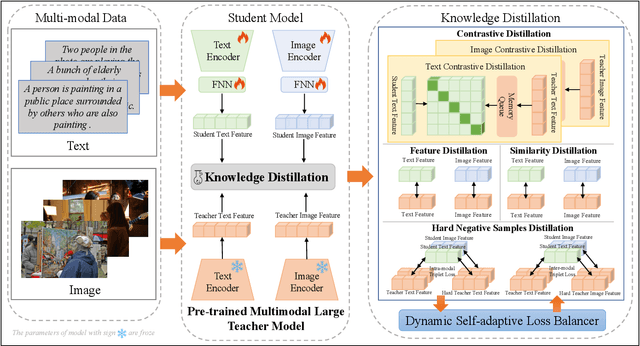
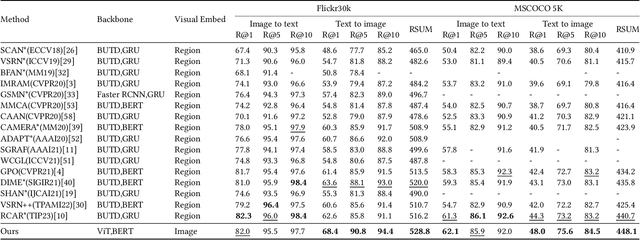
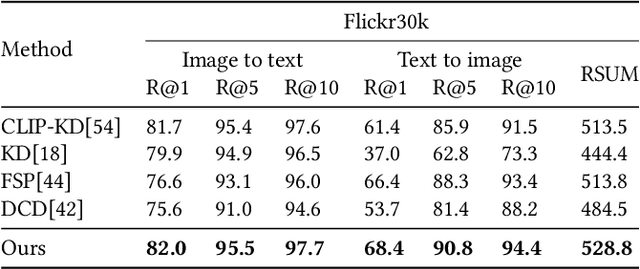
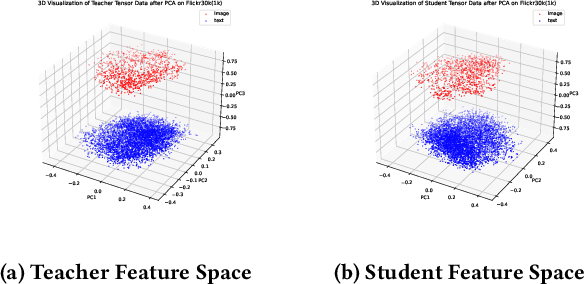
In recent years, pre-trained multimodal large models have attracted widespread attention due to their outstanding performance in various multimodal applications. Nonetheless, the extensive computational resources and vast datasets required for their training present significant hurdles for deployment in environments with limited computational resources. To address this challenge, we propose a novel dynamic self-adaptive multiscale distillation from pre-trained multimodal large model for efficient cross-modal representation learning for the first time. Unlike existing distillation methods, our strategy employs a multiscale perspective, enabling the extraction structural knowledge across from the pre-trained multimodal large model. Ensuring that the student model inherits a comprehensive and nuanced understanding of the teacher knowledge. To optimize each distillation loss in a balanced and efficient manner, we propose a dynamic self-adaptive distillation loss balancer, a novel component eliminating the need for manual loss weight adjustments and dynamically balances each loss item during the distillation process. Our methodology streamlines pre-trained multimodal large models using only their output features and original image-level information, requiring minimal computational resources. This efficient approach is suited for various applications and allows the deployment of advanced multimodal technologies even in resource-limited settings. Extensive experiments has demonstrated that our method maintains high performance while significantly reducing model complexity and training costs. Moreover, our distilled student model utilizes only image-level information to achieve state-of-the-art performance on cross-modal retrieval tasks, surpassing previous methods that relied on region-level information.
Epidemic Decision-making System Based Federated Reinforcement Learning
Nov 03, 2023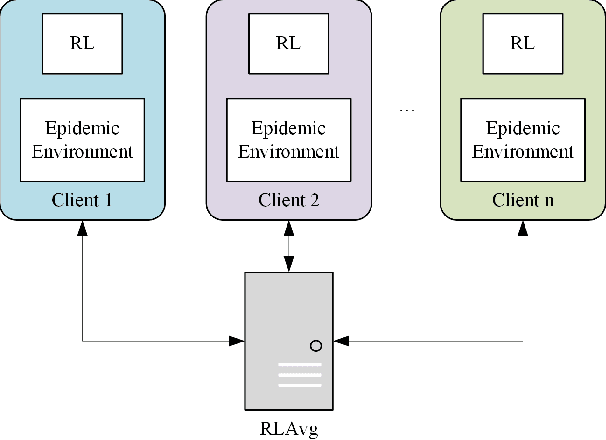
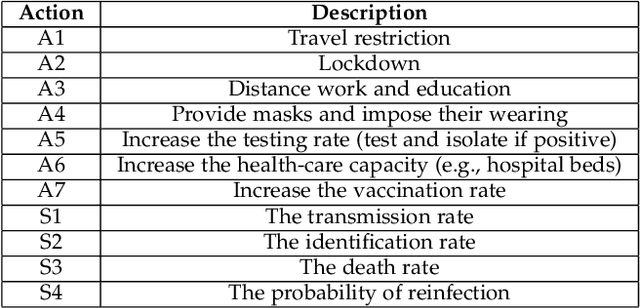
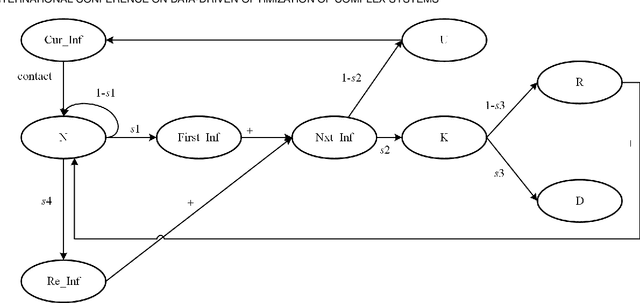
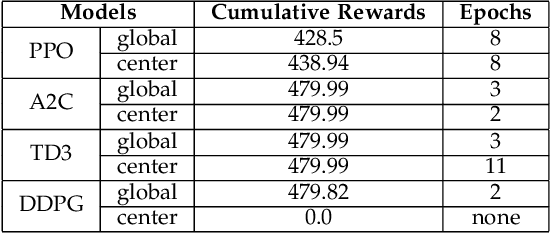
Epidemic decision-making can effectively help the government to comprehensively consider public security and economic development to respond to public health and safety emergencies. Epidemic decision-making can effectively help the government to comprehensively consider public security and economic development to respond to public health and safety emergencies. Some studies have shown that intensive learning can effectively help the government to make epidemic decision, thus achieving the balance between health security and economic development. Some studies have shown that intensive learning can effectively help the government to make epidemic decision, thus achieving the balance between health security and economic development. However, epidemic data often has the characteristics of limited samples and high privacy. However, epidemic data often has the characteristics of limited samples and high privacy. This model can combine the epidemic situation data of various provinces for cooperative training to use as an enhanced learning model for epidemic situation decision, while protecting the privacy of data. The experiment shows that the enhanced federated learning can obtain more optimized performance and return than the enhanced learning, and the enhanced federated learning can also accelerate the training convergence speed of the training model. accelerate the training convergence speed of the client. At the same time, through the experimental comparison, A2C is the most suitable reinforcement learning model for the epidemic situation decision-making. learning model for the epidemic situation decision-making scenario, followed by the PPO model, and the performance of DDPG is unsatisfactory.
Research Team Identification Based on Representation Learning of Academic Heterogeneous Information Network
Nov 02, 2023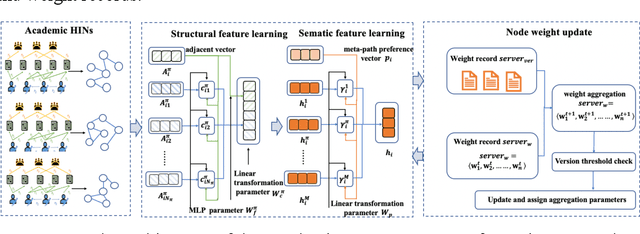
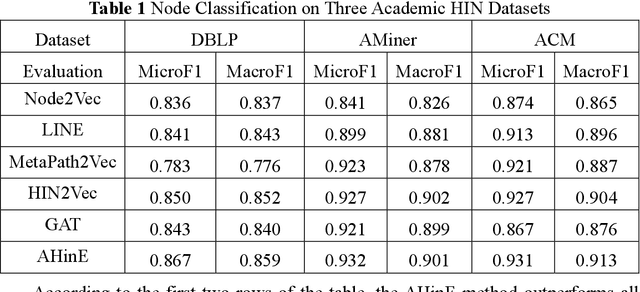
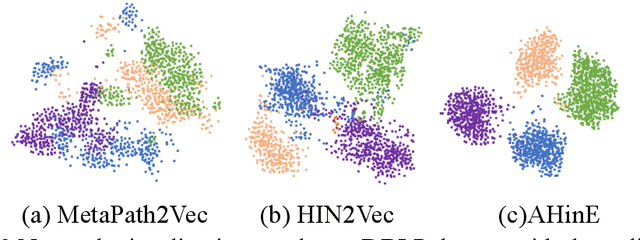
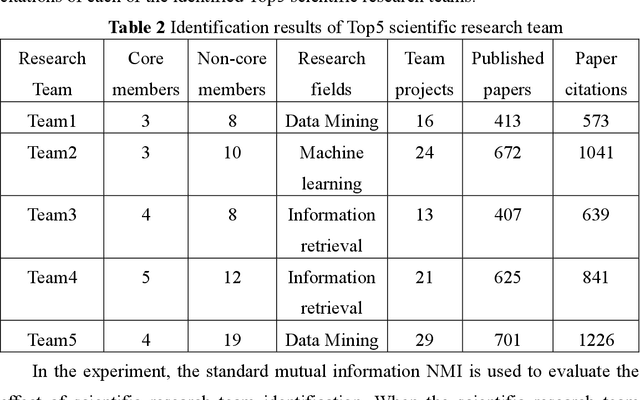
Academic networks in the real world can usually be described by heterogeneous information networks composed of multi-type nodes and relationships. Some existing research on representation learning for homogeneous information networks lacks the ability to explore heterogeneous information networks in heterogeneous information networks. It cannot be applied to heterogeneous information networks. Aiming at the practical needs of effectively identifying and discovering scientific research teams from the academic heterogeneous information network composed of massive and complex scientific and technological big data, this paper proposes a scientific research team identification method based on representation learning of academic heterogeneous information networks. The attention mechanism at node level and meta-path level learns low-dimensional, dense and real-valued vector representations on the basis of retaining the rich topological information of nodes in the network and the semantic information based on meta-paths, and realizes effective identification and discovery of scientific research teams and important team members in academic heterogeneous information networks based on maximizing node influence. Experimental results show that our proposed method outperforms the comparative methods.
Entity Alignment Method of Science and Technology Patent based on Graph Convolution Network and Information Fusion
Nov 01, 2023


The entity alignment of science and technology patents aims to link the equivalent entities in the knowledge graph of different science and technology patent data sources. Most entity alignment methods only use graph neural network to obtain the embedding of graph structure or use attribute text description to obtain semantic representation, ignoring the process of multi-information fusion in science and technology patents. In order to make use of the graphic structure and auxiliary information such as the name, description and attribute of the patent entity, this paper proposes an entity alignment method based on the graph convolution network for science and technology patent information fusion. Through the graph convolution network and BERT model, the structure information and entity attribute information of the science and technology patent knowledge graph are embedded and represented to achieve multi-information fusion, thus improving the performance of entity alignment. Experiments on three benchmark data sets show that the proposed method Hit@K The evaluation indicators are better than the existing methods.
Semantic Representation Learning of Scientific Literature based on Adaptive Feature and Graph Neural Network
Nov 01, 2023
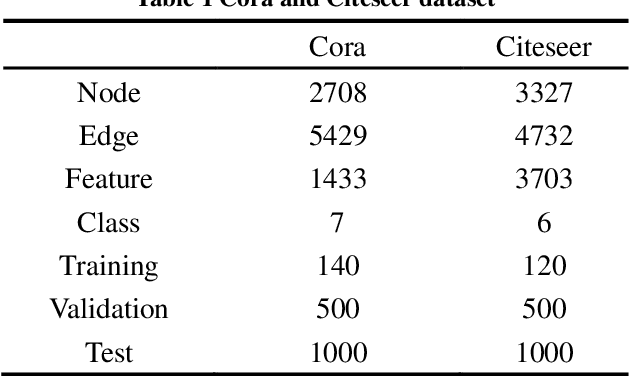

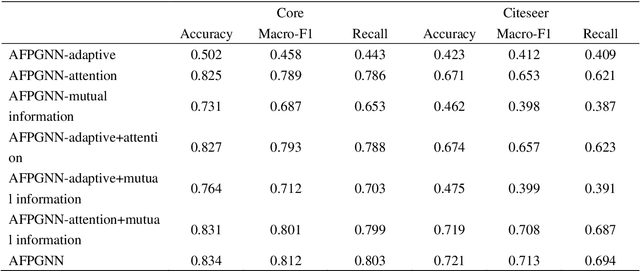
Because most of the scientific literature data is unmarked, it makes semantic representation learning based on unsupervised graph become crucial. At the same time, in order to enrich the features of scientific literature, a learning method of semantic representation of scientific literature based on adaptive features and graph neural network is proposed. By introducing the adaptive feature method, the features of scientific literature are considered globally and locally. The graph attention mechanism is used to sum the features of scientific literature with citation relationship, and give each scientific literature different feature weights, so as to better express the correlation between the features of different scientific literature. In addition, an unsupervised graph neural network semantic representation learning method is proposed. By comparing the mutual information between the positive and negative local semantic representation of scientific literature and the global graph semantic representation in the potential space, the graph neural network can capture the local and global information, thus improving the learning ability of the semantic representation of scientific literature. The experimental results show that the proposed learning method of semantic representation of scientific literature based on adaptive feature and graph neural network is competitive on the basis of scientific literature classification, and has achieved good results.