 Add to Chrome
 Add to Firefox
 Add to Edge
MVSS: A Unified Framework for Multi-View Structured Survey Generation
Jan 14, 2026
Scientific surveys require not only summarizing large bodies of literature, but also organizing them into clear and coherent conceptual structures. Existing automatic survey generation methods typically focus on linear text generation and struggle to explicitly model hierarchical relations among research topics and structured methodological comparisons, resulting in gaps in structural organization compared to expert-written surveys. We propose MVSS, a multi-view structured survey generation framework that jointly generates and aligns citation-grounded hierarchical trees, structured comparison tables, and survey text. MVSS follows a structure-first paradigm: it first constructs a conceptual tree of the research domain, then generates comparison tables constrained by the tree, and finally uses both as structural constraints for text generation. This enables complementary multi-view representations across structure, comparison, and narrative. We introduce an evaluation framework assessing structural quality, comparative completeness, and citation fidelity. Experiments on 76 computer science topics show MVSS outperforms existing methods in organization and evidence grounding, achieving performance comparable to expert surveys.

DVD: A Robust Method for Detecting Variant Contamination in Large Language Model Evaluation
Jan 08, 2026Evaluating large language models (LLMs) is increasingly confounded by \emph{variant contamination}: the training corpus contains semantically equivalent yet lexically or syntactically altered versions of test items. Unlike verbatim leakage, these paraphrased or structurally transformed variants evade existing detectors based on sampling consistency or perplexity, thereby inflating benchmark scores via memorization rather than genuine reasoning. We formalize this problem and introduce \textbf{DVD} (\textbf{D}etection via \textbf{V}ariance of generation \textbf{D}istribution), a single-sample detector that models the local output distribution induced by temperature sampling. Our key insight is that contaminated items trigger alternation between a \emph{memory-adherence} state and a \emph{perturbation-drift} state, yielding abnormally high variance in the synthetic difficulty of low-probability tokens; uncontaminated items remain in drift with comparatively smooth variance. We construct the first benchmark for variant contamination across two domains Omni-MATH and SuperGPQA by generating and filtering semantically equivalent variants, and simulate contamination via fine-tuning models of different scales and architectures (Qwen2.5 and Llama3.1). Across datasets and models, \textbf{DVD} consistently outperforms perplexity-based, Min-$k$\%++, edit-distance (CDD), and embedding-similarity baselines, while exhibiting strong robustness to hyperparameters. Our results establish variance of the generation distribution as a principled and practical fingerprint for detecting variant contamination in LLM evaluation.
SAEMark: Multi-bit LLM Watermarking with Inference-Time Scaling
Aug 11, 2025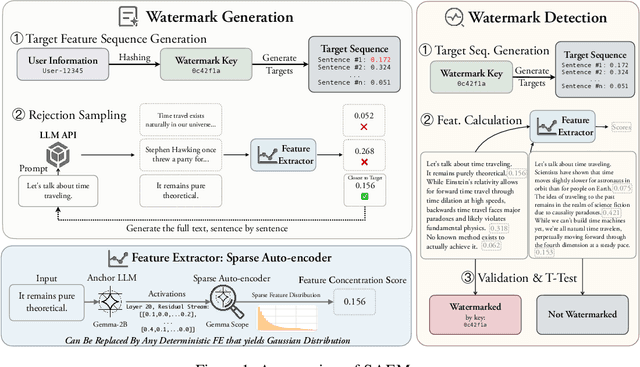
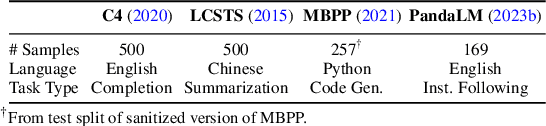
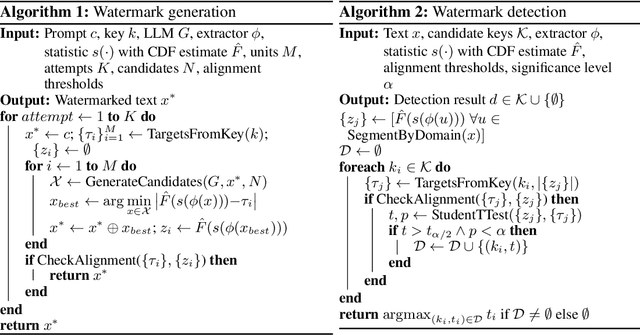
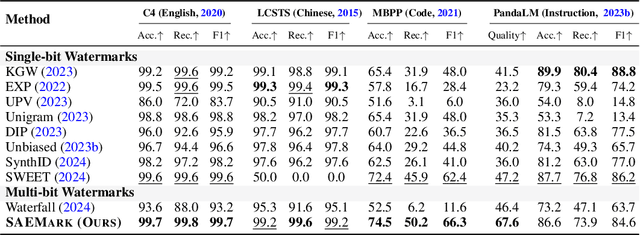
Watermarking LLM-generated text is critical for content attribution and misinformation prevention. However, existing methods compromise text quality, require white-box model access and logit manipulation. These limitations exclude API-based models and multilingual scenarios. We propose SAEMark, a general framework for post-hoc multi-bit watermarking that embeds personalized messages solely via inference-time, feature-based rejection sampling without altering model logits or requiring training. Our approach operates on deterministic features extracted from generated text, selecting outputs whose feature statistics align with key-derived targets. This framework naturally generalizes across languages and domains while preserving text quality through sampling LLM outputs instead of modifying. We provide theoretical guarantees relating watermark success probability and compute budget that hold for any suitable feature extractor. Empirically, we demonstrate the framework's effectiveness using Sparse Autoencoders (SAEs), achieving superior detection accuracy and text quality. Experiments across 4 datasets show SAEMark's consistent performance, with 99.7% F1 on English and strong multi-bit detection accuracy. SAEMark establishes a new paradigm for scalable watermarking that works out-of-the-box with closed-source LLMs while enabling content attribution.
GLM-4.5: Agentic, Reasoning, and Coding (ARC) Foundation Models
Aug 08, 2025We present GLM-4.5, an open-source Mixture-of-Experts (MoE) large language model with 355B total parameters and 32B activated parameters, featuring a hybrid reasoning method that supports both thinking and direct response modes. Through multi-stage training on 23T tokens and comprehensive post-training with expert model iteration and reinforcement learning, GLM-4.5 achieves strong performance across agentic, reasoning, and coding (ARC) tasks, scoring 70.1% on TAU-Bench, 91.0% on AIME 24, and 64.2% on SWE-bench Verified. With much fewer parameters than several competitors, GLM-4.5 ranks 3rd overall among all evaluated models and 2nd on agentic benchmarks. We release both GLM-4.5 (355B parameters) and a compact version, GLM-4.5-Air (106B parameters), to advance research in reasoning and agentic AI systems. Code, models, and more information are available at https://github.com/zai-org/GLM-4.5.
Visual Thoughts: A Unified Perspective of Understanding Multimodal Chain-of-Thought
May 21, 2025Large Vision-Language Models (LVLMs) have achieved significant success in multimodal tasks, with multimodal chain-of-thought (MCoT) further enhancing performance and interpretability. Recent MCoT methods fall into two categories: (i) Textual-MCoT (T-MCoT), which takes multimodal input and produces textual output; and (ii) Interleaved-MCoT (I-MCoT), which generates interleaved image-text outputs. Despite advances in both approaches, the mechanisms driving these improvements are not fully understood. To fill this gap, we first reveal that MCoT boosts LVLMs by incorporating visual thoughts, which convey image information to the reasoning process regardless of the MCoT format, depending only on clarity and conciseness of expression. Furthermore, to explore visual thoughts systematically, we define four distinct forms of visual thought expressions and analyze them comprehensively. Our findings demonstrate that these forms differ in clarity and conciseness, yielding varying levels of MCoT improvement. Additionally, we explore the internal nature of visual thoughts, finding that visual thoughts serve as intermediaries between the input image and reasoning to deeper transformer layers, enabling more advanced visual information transmission. We hope that the visual thoughts can inspire further breakthroughs for future MCoT research.
Reasoning on Multiple Needles In A Haystack
Apr 05, 2025The Needle In A Haystack (NIAH) task has been widely used to evaluate the long-context question-answering capabilities of Large Language Models (LLMs). However, its reliance on simple retrieval limits its effectiveness. To address this limitation, recent studies have introduced the Multiple Needles In A Haystack Reasoning (MNIAH-R) task, which incorporates supporting documents (Multiple needles) of multi-hop reasoning tasks into a distracting context (Haystack}). Despite this advancement, existing approaches still fail to address the issue of models providing direct answers from internal knowledge, and they do not explain or mitigate the decline in accuracy as context length increases. In this paper, we tackle the memory-based answering problem by filtering out direct-answer questions, and we reveal that performance degradation is primarily driven by the reduction in the length of the thinking process as the input length increases. Building on this insight, we decompose the thinking process into retrieval and reasoning stages and introduce a reflection mechanism for multi-round extension. We also train a model using the generated iterative thinking process, which helps mitigate the performance degradation. Furthermore, we demonstrate the application of this retrieval-reflection capability in mathematical reasoning scenarios, improving GPT-4o's performance on AIME2024.
A Language Anchor-Guided Method for Robust Noisy Domain Generalization
Mar 21, 2025Real-world machine learning applications often struggle with two major challenges: distribution shift and label noise. Models tend to overfit by focusing on redundant and uninformative features in the training data, which makes it hard for them to generalize to the target domain. Noisy data worsens this problem by causing further overfitting to the noise, meaning that existing methods often fail to tell the difference between true, invariant features and misleading, spurious ones. To tackle these issues, we introduce Anchor Alignment and Adaptive Weighting (A3W). This new algorithm uses sample reweighting guided by natural language processing (NLP) anchors to extract more representative features. In simple terms, A3W leverages semantic representations from natural language models as a source of domain-invariant prior knowledge. Additionally, it employs a weighted loss function that adjusts each sample's contribution based on its similarity to the corresponding NLP anchor. This adjustment makes the model more robust to noisy labels. Extensive experiments on standard benchmark datasets show that A3W consistently outperforms state-of-the-art domain generalization methods, offering significant improvements in both accuracy and robustness across different datasets and noise levels.
StepMathAgent: A Step-Wise Agent for Evaluating Mathematical Processes through Tree-of-Error
Mar 13, 2025Evaluating mathematical capabilities is critical for assessing the overall performance of large language models (LLMs). However, existing evaluation methods often focus solely on final answers, resulting in highly inaccurate and uninterpretable evaluation outcomes, as well as their failure to assess proof or open-ended problems. To address these issues, we propose a novel mathematical process evaluation agent based on Tree-of-Error, called StepMathAgent. This agent incorporates four internal core operations: logical step segmentation, step scoring, score aggregation and error tree generation, along with four external extension modules: difficulty calibration, simplicity evaluation, completeness validation and format assessment. Furthermore, we introduce StepMathBench, a benchmark comprising 1,000 step-divided process evaluation instances, derived from 200 high-quality math problems grouped by problem type, subject category and difficulty level. Experiments on StepMathBench show that our proposed StepMathAgent outperforms all state-of-the-art methods, demonstrating human-aligned evaluation preferences and broad applicability to various scenarios. Our data and code are available at https://github.com/SHU-XUN/StepMathAgent.
Masked Autoencoders Are Effective Tokenizers for Diffusion Models
Feb 05, 2025Recent advances in latent diffusion models have demonstrated their effectiveness for high-resolution image synthesis. However, the properties of the latent space from tokenizer for better learning and generation of diffusion models remain under-explored. Theoretically and empirically, we find that improved generation quality is closely tied to the latent distributions with better structure, such as the ones with fewer Gaussian Mixture modes and more discriminative features. Motivated by these insights, we propose MAETok, an autoencoder (AE) leveraging mask modeling to learn semantically rich latent space while maintaining reconstruction fidelity. Extensive experiments validate our analysis, demonstrating that the variational form of autoencoders is not necessary, and a discriminative latent space from AE alone enables state-of-the-art performance on ImageNet generation using only 128 tokens. MAETok achieves significant practical improvements, enabling a gFID of 1.69 with 76x faster training and 31x higher inference throughput for 512x512 generation. Our findings show that the structure of the latent space, rather than variational constraints, is crucial for effective diffusion models. Code and trained models are released.
Outcome-Refining Process Supervision for Code Generation
Dec 19, 2024
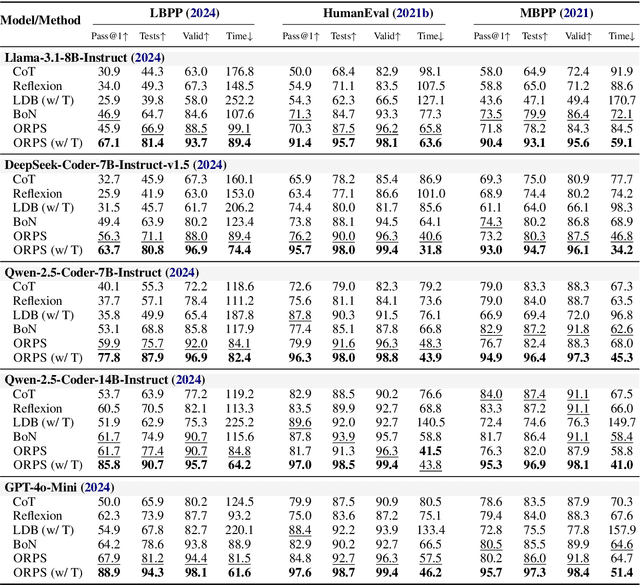

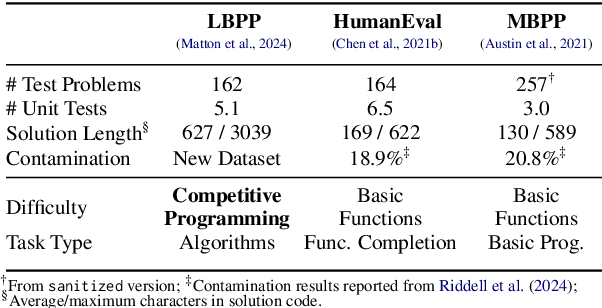
Large Language Models have demonstrated remarkable capabilities in code generation, yet they often struggle with complex programming tasks that require deep algorithmic reasoning. While process supervision through learned reward models shows promise in guiding reasoning steps, it requires expensive training data and suffers from unreliable evaluation. We propose Outcome-Refining Process Supervision, a novel paradigm that treats outcome refinement itself as the process to be supervised. Our framework leverages concrete execution signals to ground the supervision of reasoning steps, while using tree-structured exploration to maintain multiple solution trajectories simultaneously. Experiments demonstrate that our approach enables even smaller models to achieve high success accuracy and performance metrics on competitive programming tasks, creates more reliable verification than traditional reward models without requiring training PRMs. Our approach achieves significant improvements across 5 models and 3 datasets: an average of 26.9% increase in correctness and 42.2% in efficiency. The results suggest that providing structured reasoning space with concrete verification signals is crucial for solving complex programming tasks. We open-source all our code and data at: https://github.com/zhuohaoyu/ORPS