 Add to Chrome
 Add to Firefox
 Add to Edge
GaussianGraph: 3D Gaussian-based Scene Graph Generation for Open-world Scene Understanding
Mar 06, 2025
Recent advancements in 3D Gaussian Splatting(3DGS) have significantly improved semantic scene understanding, enabling natural language queries to localize objects within a scene. However, existing methods primarily focus on embedding compressed CLIP features to 3D Gaussians, suffering from low object segmentation accuracy and lack spatial reasoning capabilities. To address these limitations, we propose GaussianGraph, a novel framework that enhances 3DGS-based scene understanding by integrating adaptive semantic clustering and scene graph generation. We introduce a "Control-Follow" clustering strategy, which dynamically adapts to scene scale and feature distribution, avoiding feature compression and significantly improving segmentation accuracy. Additionally, we enrich scene representation by integrating object attributes and spatial relations extracted from 2D foundation models. To address inaccuracies in spatial relationships, we propose 3D correction modules that filter implausible relations through spatial consistency verification, ensuring reliable scene graph construction. Extensive experiments on three datasets demonstrate that GaussianGraph outperforms state-of-the-art methods in both semantic segmentation and object grounding tasks, providing a robust solution for complex scene understanding and interaction.

Predicting Practically? Domain Generalization for Predictive Analytics in Real-world Environments
Mar 05, 2025Predictive machine learning models are widely used in customer relationship management (CRM) to forecast customer behaviors and support decision-making. However, the dynamic nature of customer behaviors often results in significant distribution shifts between training data and serving data, leading to performance degradation in predictive models. Domain generalization, which aims to train models that can generalize to unseen environments without prior knowledge of their distributions, has become a critical area of research. In this work, we propose a novel domain generalization method tailored to handle complex distribution shifts, encompassing both covariate and concept shifts. Our method builds upon the Distributionally Robust Optimization framework, optimizing model performance over a set of hypothetical worst-case distributions rather than relying solely on the training data. Through simulation experiments, we demonstrate the working mechanism of the proposed method. We also conduct experiments on a real-world customer churn dataset, and validate its effectiveness in both temporal and spatial generalization settings. Finally, we discuss the broader implications of our method for advancing Information Systems (IS) design research, particularly in building robust predictive models for dynamic managerial environments.
OpenGS-SLAM: Open-Set Dense Semantic SLAM with 3D Gaussian Splatting for Object-Level Scene Understanding
Mar 03, 2025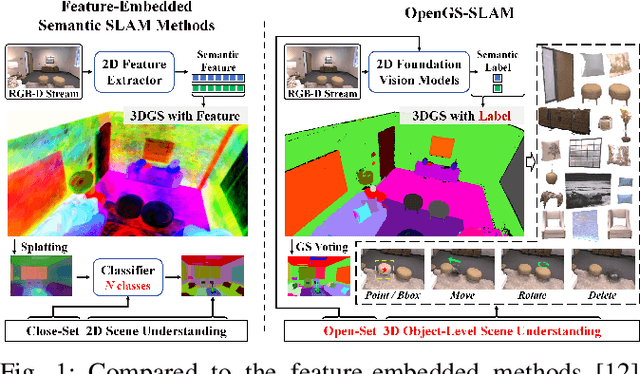
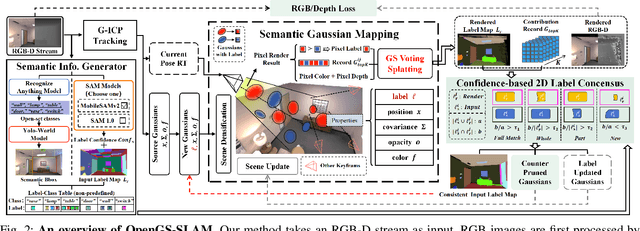
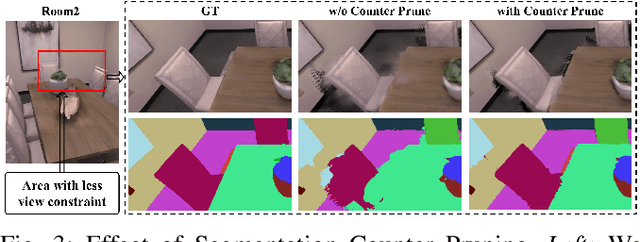
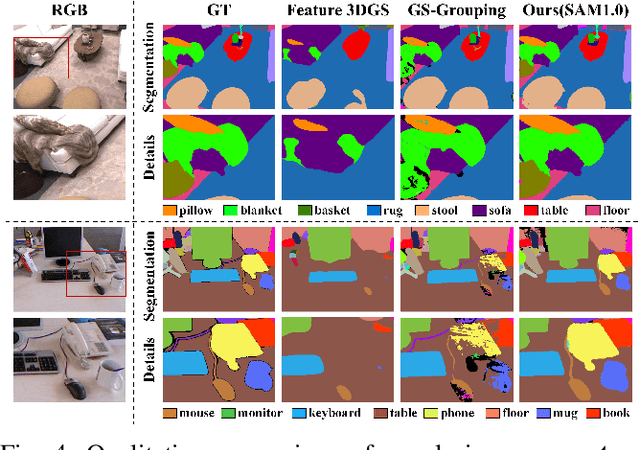
Recent advancements in 3D Gaussian Splatting have significantly improved the efficiency and quality of dense semantic SLAM. However, previous methods are generally constrained by limited-category pre-trained classifiers and implicit semantic representation, which hinder their performance in open-set scenarios and restrict 3D object-level scene understanding. To address these issues, we propose OpenGS-SLAM, an innovative framework that utilizes 3D Gaussian representation to perform dense semantic SLAM in open-set environments. Our system integrates explicit semantic labels derived from 2D foundational models into the 3D Gaussian framework, facilitating robust 3D object-level scene understanding. We introduce Gaussian Voting Splatting to enable fast 2D label map rendering and scene updating. Additionally, we propose a Confidence-based 2D Label Consensus method to ensure consistent labeling across multiple views. Furthermore, we employ a Segmentation Counter Pruning strategy to improve the accuracy of semantic scene representation. Extensive experiments on both synthetic and real-world datasets demonstrate the effectiveness of our method in scene understanding, tracking, and mapping, achieving 10 times faster semantic rendering and 2 times lower storage costs compared to existing methods. Project page: https://young-bit.github.io/opengs-github.github.io/.
VideoUFO: A Million-Scale User-Focused Dataset for Text-to-Video Generation
Mar 03, 2025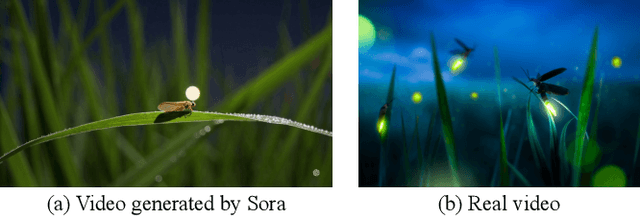
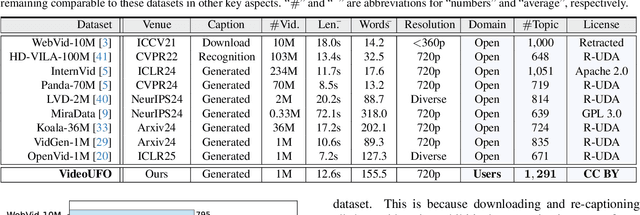
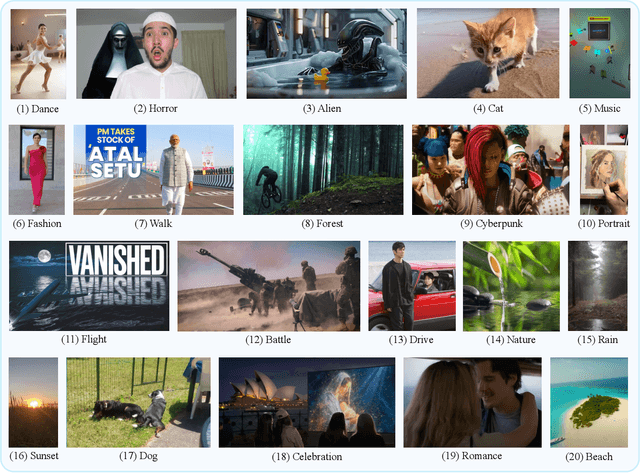
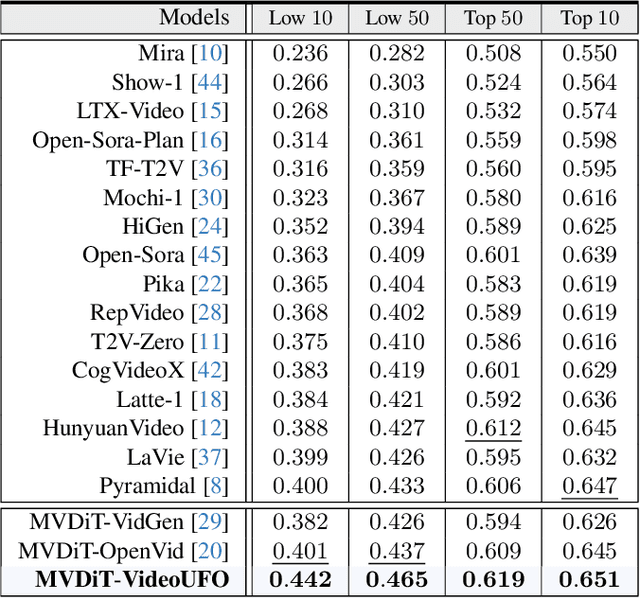
Text-to-video generative models convert textual prompts into dynamic visual content, offering wide-ranging applications in film production, gaming, and education. However, their real-world performance often falls short of user expectations. One key reason is that these models have not been trained on videos related to some topics users want to create. In this paper, we propose VideoUFO, the first Video dataset specifically curated to align with Users' FOcus in real-world scenarios. Beyond this, our VideoUFO also features: (1) minimal ($0.29\%$) overlap with existing video datasets, and (2) videos searched exclusively via YouTube's official API under the Creative Commons license. These two attributes provide future researchers with greater freedom to broaden their training sources. The VideoUFO comprises over $1.09$ million video clips, each paired with both a brief and a detailed caption (description). Specifically, through clustering, we first identify $1,291$ user-focused topics from the million-scale real text-to-video prompt dataset, VidProM. Then, we use these topics to retrieve videos from YouTube, split the retrieved videos into clips, and generate both brief and detailed captions for each clip. After verifying the clips with specified topics, we are left with about $1.09$ million video clips. Our experiments reveal that (1) current $16$ text-to-video models do not achieve consistent performance across all user-focused topics; and (2) a simple model trained on VideoUFO outperforms others on worst-performing topics. The dataset is publicly available at https://huggingface.co/datasets/WenhaoWang/VideoUFO under the CC BY 4.0 License.
Chemical knowledge-informed framework for privacy-aware retrosynthesis learning
Feb 26, 2025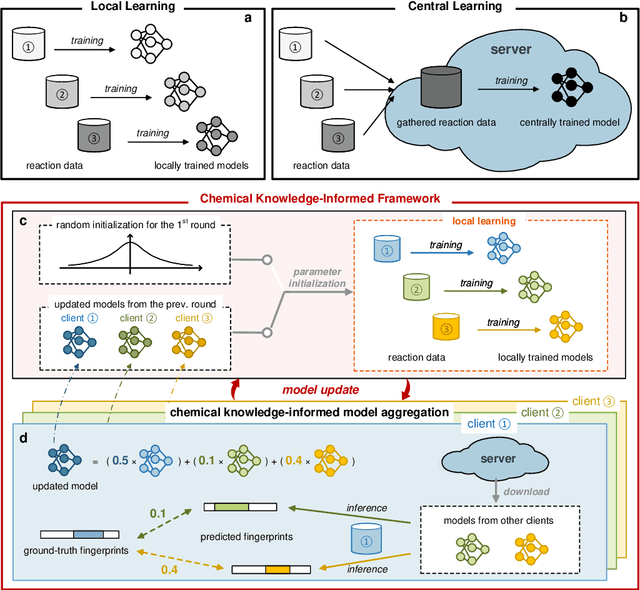
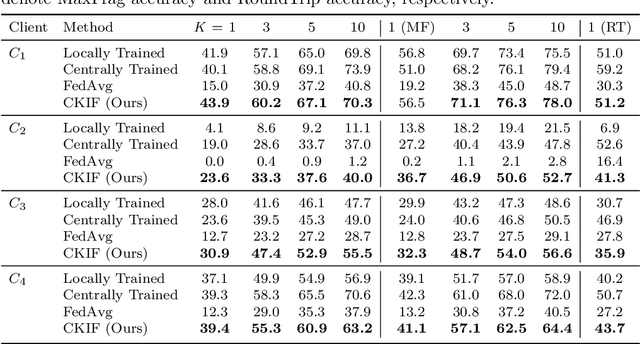
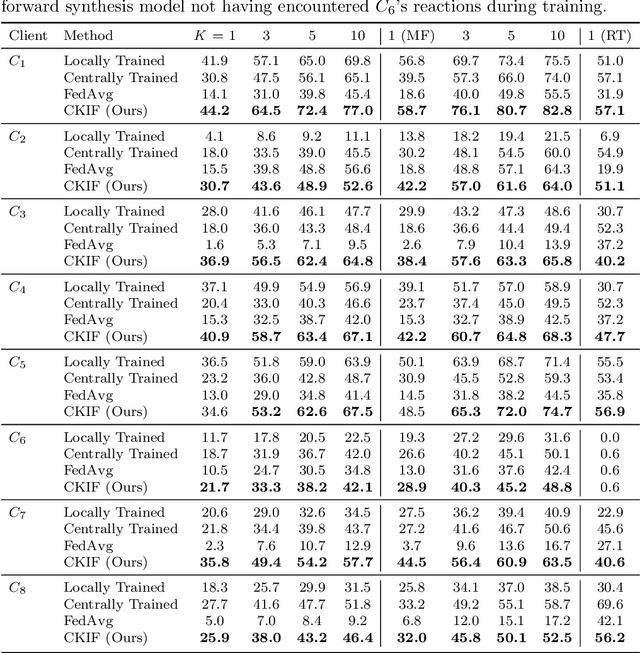
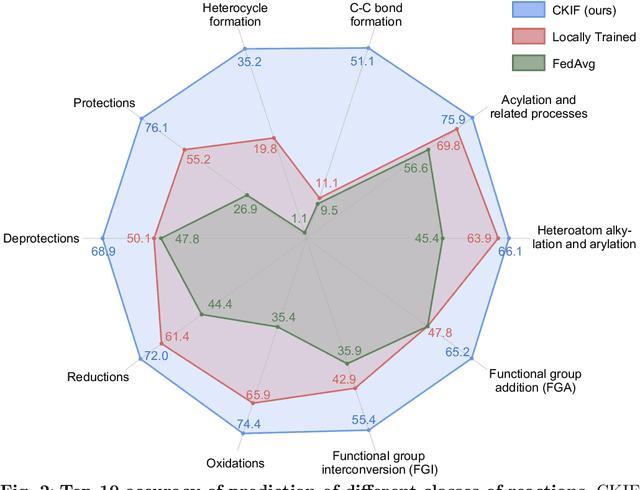
Chemical reaction data is a pivotal asset, driving advances in competitive fields such as pharmaceuticals, materials science, and industrial chemistry. Its proprietary nature renders it sensitive, as it often includes confidential insights and competitive advantages organizations strive to protect. However, in contrast to this need for confidentiality, the current standard training paradigm for machine learning-based retrosynthesis gathers reaction data from multiple sources into one single edge to train prediction models. This paradigm poses considerable privacy risks as it necessitates broad data availability across organizational boundaries and frequent data transmission between entities, potentially exposing proprietary information to unauthorized access or interception during storage and transfer. In the present study, we introduce the chemical knowledge-informed framework (CKIF), a privacy-preserving approach for learning retrosynthesis models. CKIF enables distributed training across multiple chemical organizations without compromising the confidentiality of proprietary reaction data. Instead of gathering raw reaction data, CKIF learns retrosynthesis models through iterative, chemical knowledge-informed aggregation of model parameters. In particular, the chemical properties of predicted reactants are leveraged to quantitatively assess the observable behaviors of individual models, which in turn determines the adaptive weights used for model aggregation. On a variety of reaction datasets, CKIF outperforms several strong baselines by a clear margin (e.g., ~20% performance improvement over FedAvg on USPTO-50K), showing its feasibility and superiority to stimulate further research on privacy-preserving retrosynthesis.
SE(3)-Equivariant Ternary Complex Prediction Towards Target Protein Degradation
Feb 26, 2025
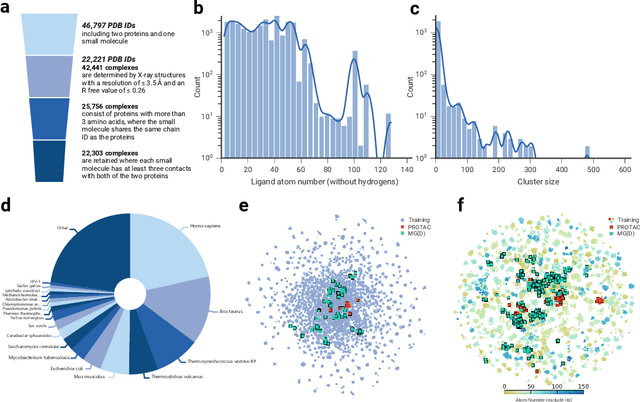


Targeted protein degradation (TPD) induced by small molecules has emerged as a rapidly evolving modality in drug discovery, targeting proteins traditionally considered "undruggable". Proteolysis-targeting chimeras (PROTACs) and molecular glue degraders (MGDs) are the primary small molecules that induce TPD. Both types of molecules form a ternary complex linking an E3 ligase with a target protein, a crucial step for drug discovery. While significant advances have been made in binary structure prediction for proteins and small molecules, ternary structure prediction remains challenging due to obscure interaction mechanisms and insufficient training data. Traditional methods relying on manually assigned rules perform poorly and are computationally demanding due to extensive random sampling. In this work, we introduce DeepTernary, a novel deep learning-based approach that directly predicts ternary structures in an end-to-end manner using an encoder-decoder architecture. DeepTernary leverages an SE(3)-equivariant graph neural network (GNN) with both intra-graph and ternary inter-graph attention mechanisms to capture intricate ternary interactions from our collected high-quality training dataset, TernaryDB. The proposed query-based Pocket Points Decoder extracts the 3D structure of the final binding ternary complex from learned ternary embeddings, demonstrating state-of-the-art accuracy and speed in existing PROTAC benchmarks without prior knowledge from known PROTACs. It also achieves notable accuracy on the more challenging MGD benchmark under the blind docking protocol. Remarkably, our experiments reveal that the buried surface area calculated from predicted structures correlates with experimentally obtained degradation potency-related metrics. Consequently, DeepTernary shows potential in effectively assisting and accelerating the development of TPDs for previously undruggable targets.
VideoGrain: Modulating Space-Time Attention for Multi-grained Video Editing
Feb 24, 2025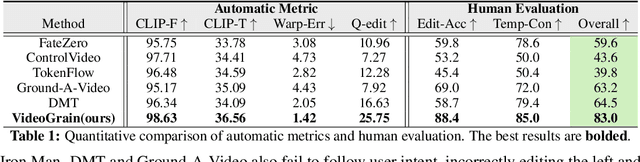
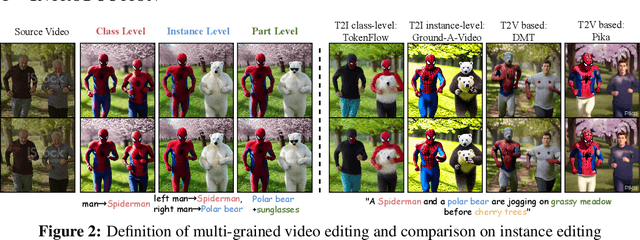
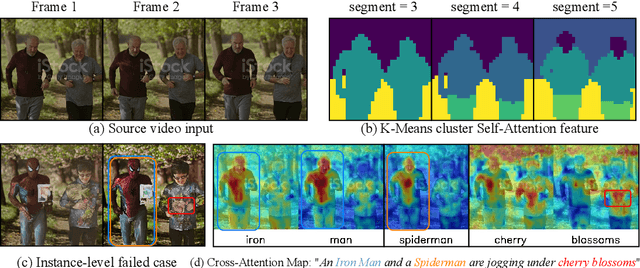

Recent advancements in diffusion models have significantly improved video generation and editing capabilities. However, multi-grained video editing, which encompasses class-level, instance-level, and part-level modifications, remains a formidable challenge. The major difficulties in multi-grained editing include semantic misalignment of text-to-region control and feature coupling within the diffusion model. To address these difficulties, we present VideoGrain, a zero-shot approach that modulates space-time (cross- and self-) attention mechanisms to achieve fine-grained control over video content. We enhance text-to-region control by amplifying each local prompt's attention to its corresponding spatial-disentangled region while minimizing interactions with irrelevant areas in cross-attention. Additionally, we improve feature separation by increasing intra-region awareness and reducing inter-region interference in self-attention. Extensive experiments demonstrate our method achieves state-of-the-art performance in real-world scenarios. Our code, data, and demos are available at https://knightyxp.github.io/VideoGrain_project_page/
OpenVox: Real-time Instance-level Open-vocabulary Probabilistic Voxel Representation
Feb 23, 2025In recent years, vision-language models (VLMs) have advanced open-vocabulary mapping, enabling mobile robots to simultaneously achieve environmental reconstruction and high-level semantic understanding. While integrated object cognition helps mitigate semantic ambiguity in point-wise feature maps, efficiently obtaining rich semantic understanding and robust incremental reconstruction at the instance-level remains challenging. To address these challenges, we introduce OpenVox, a real-time incremental open-vocabulary probabilistic instance voxel representation. In the front-end, we design an efficient instance segmentation and comprehension pipeline that enhances language reasoning through encoding captions. In the back-end, we implement probabilistic instance voxels and formulate the cross-frame incremental fusion process into two subtasks: instance association and live map evolution, ensuring robustness to sensor and segmentation noise. Extensive evaluations across multiple datasets demonstrate that OpenVox achieves state-of-the-art performance in zero-shot instance segmentation, semantic segmentation, and open-vocabulary retrieval. Furthermore, real-world robotics experiments validate OpenVox's capability for stable, real-time operation.
AI Models Still Lag Behind Traditional Numerical Models in Predicting Sudden-Turning Typhoons
Feb 22, 2025Given the interpretability, accuracy, and stability of numerical weather prediction (NWP) models, current operational weather forecasting relies heavily on the NWP approach. In the past two years, the rapid development of Artificial Intelligence (AI) has provided an alternative solution for medium-range (1-10 days) weather forecasting. Bi et al. (2023) (hereafter Bi23) introduced the first AI-based weather prediction (AIWP) model in China, named Pangu-Weather, which offers fast prediction without compromising accuracy. In their work, Bi23 made notable claims regarding its effectiveness in extreme weather predictions. However, this claim lacks persuasiveness because the extreme nature of the two tropical cyclones (TCs) examples presented in Bi23, namely Typhoon Kong-rey and Typhoon Yutu, stems primarily from their intensities rather than their moving paths. Their claim may mislead into another meaning which is that Pangu-Weather works well in predicting unusual typhoon paths, which was not explicitly analyzed. Here, we reassess Pangu-Weather's ability to predict extreme TC trajectories from 2020-2024. Results reveal that while Pangu-Weather overall outperforms NWP models in predicting tropical cyclone (TC) tracks, it falls short in accurately predicting the rarely observed sudden-turning tracks, such as Typhoon Khanun in 2023. We argue that current AIWP models still lag behind traditional NWP models in predicting such rare extreme events in medium-range forecasts.
Redistribute Ensemble Training for Mitigating Memorization in Diffusion Models
Feb 13, 2025Diffusion models, known for their tremendous ability to generate high-quality samples, have recently raised concerns due to their data memorization behavior, which poses privacy risks. Recent methods for memory mitigation have primarily addressed the issue within the context of the text modality in cross-modal generation tasks, restricting their applicability to specific conditions. In this paper, we propose a novel method for diffusion models from the perspective of visual modality, which is more generic and fundamental for mitigating memorization. Directly exposing visual data to the model increases memorization risk, so we design a framework where models learn through proxy model parameters instead. Specially, the training dataset is divided into multiple shards, with each shard training a proxy model, then aggregated to form the final model. Additionally, practical analysis of training losses illustrates that the losses for easily memorable images tend to be obviously lower. Thus, we skip the samples with abnormally low loss values from the current mini-batch to avoid memorizing. However, balancing the need to skip memorization-prone samples while maintaining sufficient training data for high-quality image generation presents a key challenge. Thus, we propose IET-AGC+, which redistributes highly memorizable samples between shards, to mitigate these samples from over-skipping. Furthermore, we dynamically augment samples based on their loss values to further reduce memorization. Extensive experiments and analysis on four datasets show that our method successfully reduces memory capacity while maintaining performance. Moreover, we fine-tune the pre-trained diffusion models, e.g., Stable Diffusion, and decrease the memorization score by 46.7\%, demonstrating the effectiveness of our method. Code is available in: https://github.com/liuxiao-guan/IET_AGC.