 Add to Chrome
 Add to Firefox
 Add to Edge
FreeScale: Scaling 3D Scenes via Certainty-Aware Free-View Generation
Apr 12, 2026
The development of generalizable Novel View Synthesis (NVS) models is critically limited by the scarcity of large-scale training data featuring diverse and precise camera trajectories. While real-world captures are photorealistic, they are typically sparse and discrete. Conversely, synthetic data scales but suffers from a domain gap and often lacks realistic semantics. We introduce FreeScale, a novel framework that leverages the power of scene reconstruction to transform limited real-world image sequences into a scalable source of high-quality training data. Our key insight is that an imperfect reconstructed scene serves as a rich geometric proxy, but naively sampling from it amplifies artifacts. To this end, we propose a certainty-aware free-view sampling strategy identifying novel viewpoints that are both semantically meaningful and minimally affected by reconstruction errors. We demonstrate FreeScale's effectiveness by scaling up the training of feedforward NVS models, achieving a notable gain of 2.7 dB in PSNR on challenging out-of-distribution benchmarks. Furthermore, we show that the generated data can actively enhance per-scene 3D Gaussian Splatting optimization, leading to consistent improvements across multiple datasets. Our work provides a practical and powerful data generation engine to overcome a fundamental bottleneck in 3D vision. Project page: https://mvp-ai-lab.github.io/FreeScale.

SynFlow: Scaling Up LiDAR Scene Flow Estimation with Synthetic Data
Apr 10, 2026Reliable 3D dynamic perception requires models that can anticipate motion beyond predefined categories, yet progress is hindered by the scarcity of dense, high-quality motion annotations. While self-supervision on unlabeled real data offers a path forward, empirical evidence suggests that scaling unlabeled data fails to close the performance gap due to noisy proxy signals. In this paper, we propose a shift in paradigm: learning robust real-world motion priors entirely from scalable simulation. We introduce SynFlow, a data generation pipeline that generates large-scale synthetic dataset specifically designed for LiDAR scene flow. Unlike prior works that prioritize sensor-specific realism, SynFlow employs a motion-oriented strategy to synthesize diverse kinematic patterns across 4,000 sequences ($\sim$940k frames), termed SynFlow-4k. This represents a 34x scale-up in annotated volume over existing real-world benchmarks. Our experiments demonstrate that SynFlow-4k provides a highly domain-invariant motion prior. In a zero-shot regime, models trained exclusively on our synthetic data generalize across multiple real-world benchmarks, rivaling in-domain supervised baselines on nuScenes and outperforming state-of-the-art methods on TruckScenes by 31.8%. Furthermore, SynFlow-4k serves as a label-efficient foundation: fine-tuning with only 5% of real-world labels surpasses models trained from scratch on the full available budget. We open-source the pipeline and dataset to facilitate research in generalizable 3D motion estimation. More detail can be found at https://kin-zhang.github.io/SynFlow.
GRVS: a Generalizable and Recurrent Approach to Monocular Dynamic View Synthesis
Mar 31, 2026Synthesizing novel views from monocular videos of dynamic scenes remains a challenging problem. Scene-specific methods that optimize 4D representations with explicit motion priors often break down in highly dynamic regions where multi-view information is hard to exploit. Diffusion-based approaches that integrate camera control into large pre-trained models can produce visually plausible videos but frequently suffer from geometric inconsistencies across both static and dynamic areas. Both families of methods also require substantial computational resources. Building on the success of generalizable models for static novel view synthesis, we adapt the framework to dynamic inputs and propose a new model with two key components: (1) a recurrent loop that enables unbounded and asynchronous mapping between input and target videos and (2) an efficient use of plane sweeps over dynamic inputs to disentangle camera and scene motion, and achieve fine-grained, six-degrees-of-freedom camera controls. We train and evaluate our model on the UCSD dataset and on Kubric-4D-dyn, a new monocular dynamic dataset featuring longer, higher resolution sequences with more complex scene dynamics than existing alternatives. Our model outperforms four Gaussian Splatting-based scene-specific approaches, as well as two diffusion-based approaches in reconstructing fine-grained geometric details across both static and dynamic regions.
TeFlow: Enabling Multi-frame Supervision for Self-Supervised Feed-forward Scene Flow Estimation
Feb 22, 2026Self-supervised feed-forward methods for scene flow estimation offer real-time efficiency, but their supervision from two-frame point correspondences is unreliable and often breaks down under occlusions. Multi-frame supervision has the potential to provide more stable guidance by incorporating motion cues from past frames, yet naive extensions of two-frame objectives are ineffective because point correspondences vary abruptly across frames, producing inconsistent signals. In the paper, we present TeFlow, enabling multi-frame supervision for feed-forward models by mining temporally consistent supervision. TeFlow introduces a temporal ensembling strategy that forms reliable supervisory signals by aggregating the most temporally consistent motion cues from a candidate pool built across multiple frames. Extensive evaluations demonstrate that TeFlow establishes a new state-of-the-art for self-supervised feed-forward methods, achieving performance gains of up to 33\% on the challenging Argoverse 2 and nuScenes datasets. Our method performs on par with leading optimization-based methods, yet speeds up 150 times. The code is open-sourced at https://github.com/KTH-RPL/OpenSceneFlow along with trained model weights.
Attack-Resistant Uniform Fairness for Linear and Smooth Contextual Bandits
Feb 04, 2026Modern systems, such as digital platforms and service systems, increasingly rely on contextual bandits for online decision-making; however, their deployment can inadvertently create unfair exposure among arms, undermining long-term platform sustainability and supplier trust. This paper studies the contextual bandit problem under a uniform $(1-δ)$-fairness constraint, and addresses its unique vulnerabilities to strategic manipulation. The fairness constraint ensures that preferential treatment is strictly justified by an arm's actual reward across all contexts and time horizons, using uniformity to prevent statistical loopholes. We develop novel algorithms that achieve (nearly) minimax-optimal regret for both linear and smooth reward functions, while maintaining strong $(1-\tilde{O}(1/T))$-fairness guarantees, and further characterize the theoretically inherent yet asymptotically marginal "price of fairness". However, we reveal that such merit-based fairness becomes uniquely susceptible to signal manipulation. We show that an adversary with a minimal $\tilde{O}(1)$ budget can not only degrade overall performance as in traditional attacks, but also selectively induce insidious fairness-specific failures while leaving conspicuous regret measures largely unaffected. To counter this, we design robust variants incorporating corruption-adaptive exploration and error-compensated thresholding. Our approach yields the first minimax-optimal regret bounds under $C$-budgeted attack while preserving $(1-\tilde{O}(1/T))$-fairness. Numerical experiments and a real-world case demonstrate that our algorithms sustain both fairness and efficiency.
DeltaFlow: An Efficient Multi-frame Scene Flow Estimation Method
Aug 23, 2025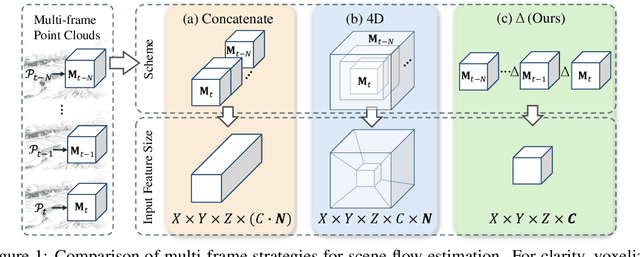
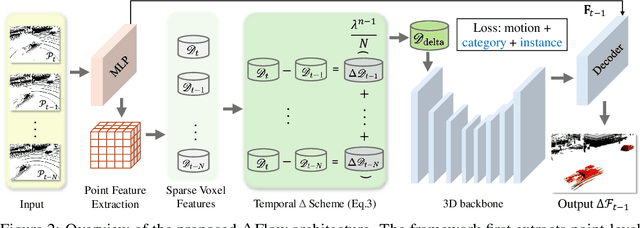
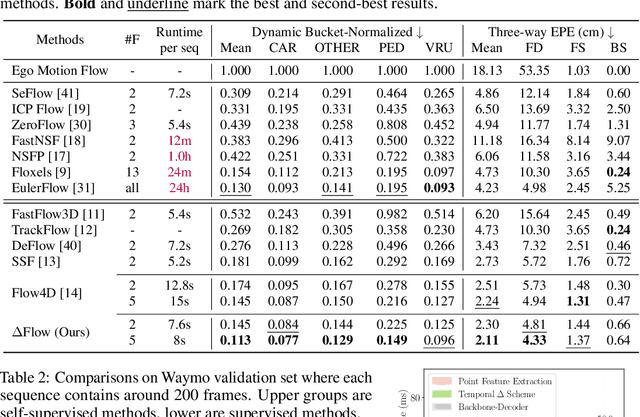
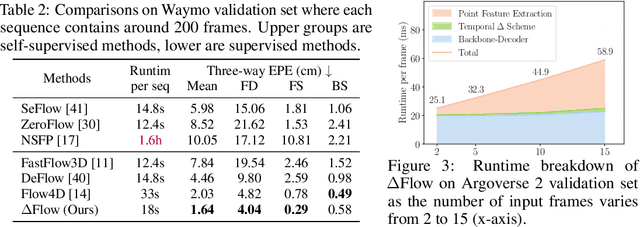
Previous dominant methods for scene flow estimation focus mainly on input from two consecutive frames, neglecting valuable information in the temporal domain. While recent trends shift towards multi-frame reasoning, they suffer from rapidly escalating computational costs as the number of frames grows. To leverage temporal information more efficiently, we propose DeltaFlow ($\Delta$Flow), a lightweight 3D framework that captures motion cues via a $\Delta$ scheme, extracting temporal features with minimal computational cost, regardless of the number of frames. Additionally, scene flow estimation faces challenges such as imbalanced object class distributions and motion inconsistency. To tackle these issues, we introduce a Category-Balanced Loss to enhance learning across underrepresented classes and an Instance Consistency Loss to enforce coherent object motion, improving flow accuracy. Extensive evaluations on the Argoverse 2 and Waymo datasets show that $\Delta$Flow achieves state-of-the-art performance with up to 22% lower error and $2\times$ faster inference compared to the next-best multi-frame supervised method, while also demonstrating a strong cross-domain generalization ability. The code is open-sourced at https://github.com/Kin-Zhang/DeltaFlow along with trained model weights.
AGO: Adaptive Grounding for Open World 3D Occupancy Prediction
Apr 14, 2025Open-world 3D semantic occupancy prediction aims to generate a voxelized 3D representation from sensor inputs while recognizing both known and unknown objects. Transferring open-vocabulary knowledge from vision-language models (VLMs) offers a promising direction but remains challenging. However, methods based on VLM-derived 2D pseudo-labels with traditional supervision are limited by a predefined label space and lack general prediction capabilities. Direct alignment with pretrained image embeddings, on the other hand, fails to achieve reliable performance due to often inconsistent image and text representations in VLMs. To address these challenges, we propose AGO, a novel 3D occupancy prediction framework with adaptive grounding to handle diverse open-world scenarios. AGO first encodes surrounding images and class prompts into 3D and text embeddings, respectively, leveraging similarity-based grounding training with 3D pseudo-labels. Additionally, a modality adapter maps 3D embeddings into a space aligned with VLM-derived image embeddings, reducing modality gaps. Experiments on Occ3D-nuScenes show that AGO improves unknown object prediction in zero-shot and few-shot transfer while achieving state-of-the-art closed-world self-supervised performance, surpassing prior methods by 4.09 mIoU.
MambaFlow: A Novel and Flow-guided State Space Model for Scene Flow Estimation
Feb 24, 2025Scene flow estimation aims to predict 3D motion from consecutive point cloud frames, which is of great interest in autonomous driving field. Existing methods face challenges such as insufficient spatio-temporal modeling and inherent loss of fine-grained feature during voxelization. However, the success of Mamba, a representative state space model (SSM) that enables global modeling with linear complexity, provides a promising solution. In this paper, we propose MambaFlow, a novel scene flow estimation network with a mamba-based decoder. It enables deep interaction and coupling of spatio-temporal features using a well-designed backbone. Innovatively, we steer the global attention modeling of voxel-based features with point offset information using an efficient Mamba-based decoder, learning voxel-to-point patterns that are used to devoxelize shared voxel representations into point-wise features. To further enhance the model's generalization capabilities across diverse scenarios, we propose a novel scene-adaptive loss function that automatically adapts to different motion patterns.Extensive experiments on the Argoverse 2 benchmark demonstrate that MambaFlow achieves state-of-the-art performance with real-time inference speed among existing works, enabling accurate flow estimation in real-world urban scenarios. The code is available at https://github.com/SCNU-RISLAB/MambaFlow.
SSF: Sparse Long-Range Scene Flow for Autonomous Driving
Jan 29, 2025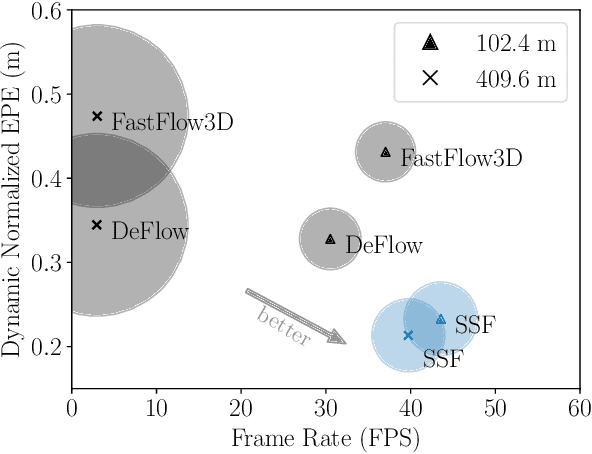
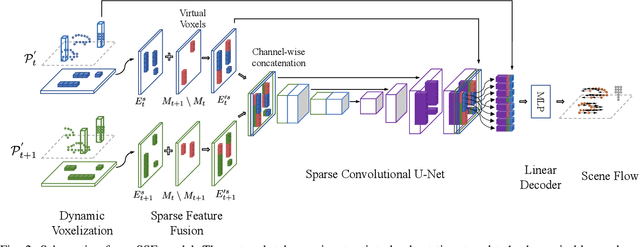
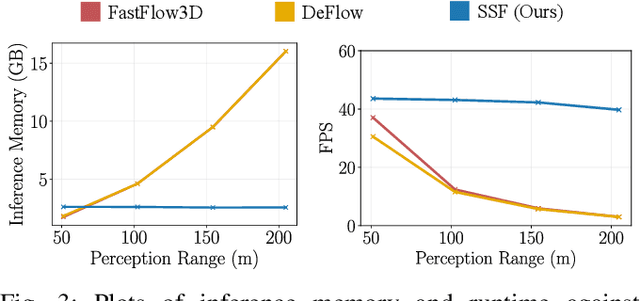
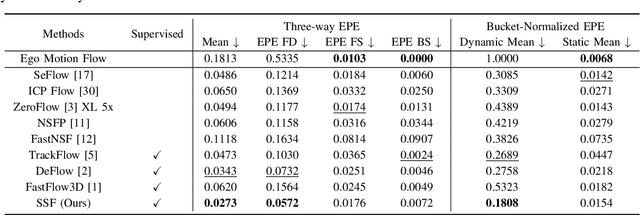
Scene flow enables an understanding of the motion characteristics of the environment in the 3D world. It gains particular significance in the long-range, where object-based perception methods might fail due to sparse observations far away. Although significant advancements have been made in scene flow pipelines to handle large-scale point clouds, a gap remains in scalability with respect to long-range. We attribute this limitation to the common design choice of using dense feature grids, which scale quadratically with range. In this paper, we propose Sparse Scene Flow (SSF), a general pipeline for long-range scene flow, adopting a sparse convolution based backbone for feature extraction. This approach introduces a new challenge: a mismatch in size and ordering of sparse feature maps between time-sequential point scans. To address this, we propose a sparse feature fusion scheme, that augments the feature maps with virtual voxels at missing locations. Additionally, we propose a range-wise metric that implicitly gives greater importance to faraway points. Our method, SSF, achieves state-of-the-art results on the Argoverse2 dataset, demonstrating strong performance in long-range scene flow estimation. Our code will be released at https://github.com/KTH-RPL/SSF.git.
SeFlow: A Self-Supervised Scene Flow Method in Autonomous Driving
Jul 01, 2024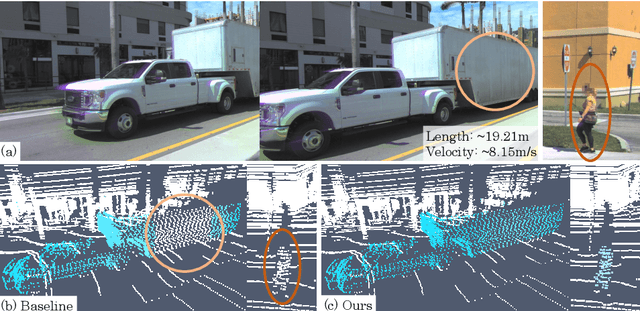
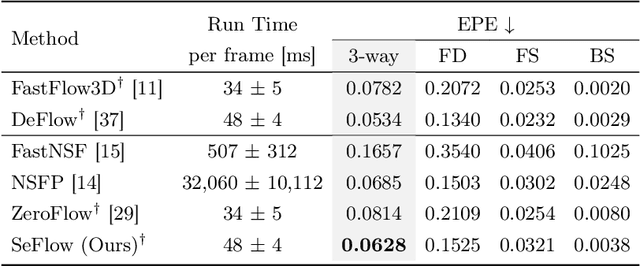
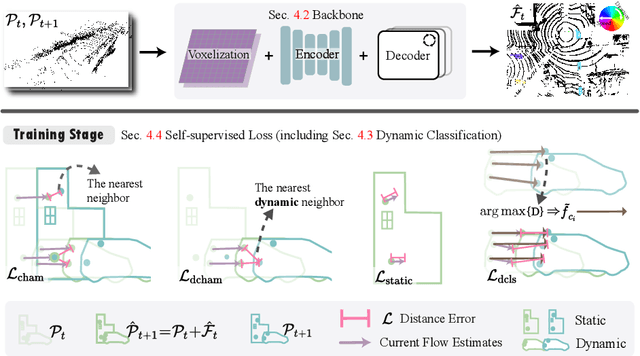

Scene flow estimation predicts the 3D motion at each point in successive LiDAR scans. This detailed, point-level, information can help autonomous vehicles to accurately predict and understand dynamic changes in their surroundings. Current state-of-the-art methods require annotated data to train scene flow networks and the expense of labeling inherently limits their scalability. Self-supervised approaches can overcome the above limitations, yet face two principal challenges that hinder optimal performance: point distribution imbalance and disregard for object-level motion constraints. In this paper, we propose SeFlow, a self-supervised method that integrates efficient dynamic classification into a learning-based scene flow pipeline. We demonstrate that classifying static and dynamic points helps design targeted objective functions for different motion patterns. We also emphasize the importance of internal cluster consistency and correct object point association to refine the scene flow estimation, in particular on object details. Our real-time capable method achieves state-of-the-art performance on the self-supervised scene flow task on Argoverse 2 and Waymo datasets. The code is open-sourced at https://github.com/KTH-RPL/SeFlow along with trained model weights.