 Add to Chrome
 Add to Firefox
 Add to Edge
AquilaMoE: Efficient Training for MoE Models with Scale-Up and Scale-Out Strategies
Aug 13, 2024
In recent years, with the rapid application of large language models across various fields, the scale of these models has gradually increased, and the resources required for their pre-training have grown exponentially. Training an LLM from scratch will cost a lot of computation resources while scaling up from a smaller model is a more efficient approach and has thus attracted significant attention. In this paper, we present AquilaMoE, a cutting-edge bilingual 8*16B Mixture of Experts (MoE) language model that has 8 experts with 16 billion parameters each and is developed using an innovative training methodology called EfficientScale. This approach optimizes performance while minimizing data requirements through a two-stage process. The first stage, termed Scale-Up, initializes the larger model with weights from a pre-trained smaller model, enabling substantial knowledge transfer and continuous pretraining with significantly less data. The second stage, Scale-Out, uses a pre-trained dense model to initialize the MoE experts, further enhancing knowledge transfer and performance. Extensive validation experiments on 1.8B and 7B models compared various initialization schemes, achieving models that maintain and reduce loss during continuous pretraining. Utilizing the optimal scheme, we successfully trained a 16B model and subsequently the 8*16B AquilaMoE model, demonstrating significant improvements in performance and training efficiency.

A Hybrid RAG System with Comprehensive Enhancement on Complex Reasoning
Aug 09, 2024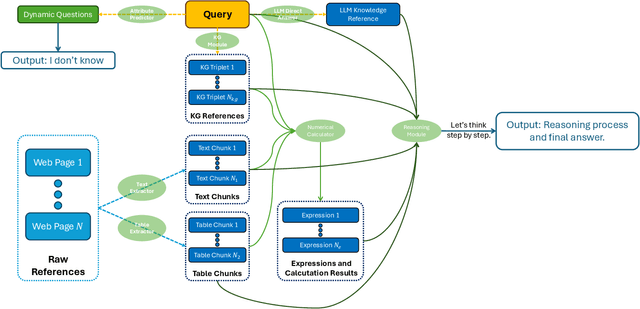
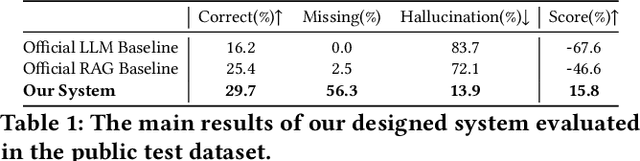
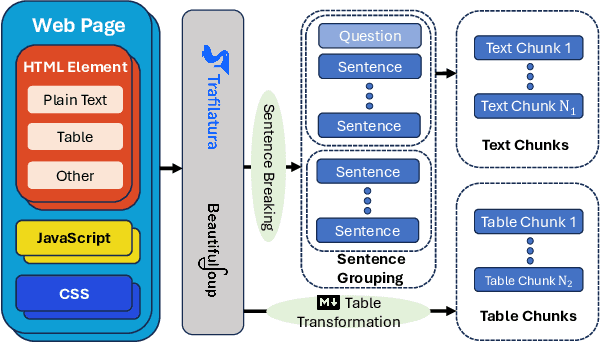
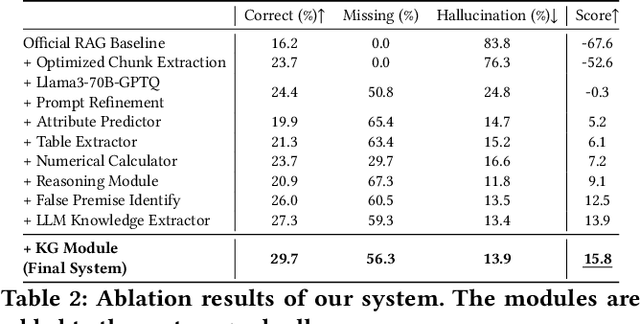
Retrieval-augmented generation (RAG) is a framework enabling large language models (LLMs) to enhance their accuracy and reduce hallucinations by integrating external knowledge bases. In this paper, we introduce a hybrid RAG system enhanced through a comprehensive suite of optimizations that significantly improve retrieval quality, augment reasoning capabilities, and refine numerical computation ability. We refined the text chunks and tables in web pages, added attribute predictors to reduce hallucinations, conducted LLM Knowledge Extractor and Knowledge Graph Extractor, and finally built a reasoning strategy with all the references. We evaluated our system on the CRAG dataset through the Meta CRAG KDD Cup 2024 Competition. Both the local and online evaluations demonstrate that our system significantly enhances complex reasoning capabilities. In local evaluations, we have significantly improved accuracy and reduced error rates compared to the baseline model, achieving a notable increase in scores. In the meanwhile, we have attained outstanding results in online assessments, demonstrating the performance and generalization capabilities of the proposed system. The source code for our system is released in \url{https://gitlab.aicrowd.com/shizueyy/crag-new}.
A Differential Smoothness-based Compact-Dynamic Graph Convolutional Network for Spatiotemporal Signal Recovery
Aug 06, 2024High quality spatiotemporal signal is vitally important for real application scenarios like energy management, traffic planning and cyber security. Due to the uncontrollable factors like abrupt sensors breakdown or communication fault, the spatiotemporal signal collected by sensors is always incomplete. A dynamic graph convolutional network (DGCN) is effective for processing spatiotemporal signal recovery. However, it adopts a static GCN and a sequence neural network to explore the spatial and temporal patterns, separately. Such a separated two-step processing is loose spatiotemporal, thereby failing to capture the complex inner spatiotemporal correlation. To address this issue, this paper proposes a Compact-Dynamic Graph Convolutional Network (CDGCN) for spatiotemporal signal recovery with the following two-fold ideas: a) leveraging the tensor M-product to build a unified tensor graph convolution framework, which considers both spatial and temporal patterns simultaneously; and b) constructing a differential smoothness-based objective function to reduce the noise interference in spatiotemporal signal, thereby further improve the recovery accuracy. Experiments on real-world spatiotemporal datasets demonstrate that the proposed CDGCN significantly outperforms the state-of-the-art models in terms of recovery accuracy.
An Extended Kalman Filter Integrated Latent Feature Model on Dynamic Weighted Directed Graphs
Jul 31, 2024A dynamic weighted directed graph (DWDG) is commonly encountered in various application scenarios. It involves extensive dynamic interactions among numerous nodes. Most existing approaches explore the intricate temporal patterns hidden in a DWDG from the purely data-driven perspective, which suffers from accuracy loss when a DWDG exhibits strong fluctuations over time. To address this issue, this study proposes a novel Extended-Kalman-Filter-Incorporated Latent Feature (EKLF) model to represent a DWDG from the model-driven perspective. Its main idea is divided into the following two-fold ideas: a) adopting a control model, i.e., the Extended Kalman Filter (EKF), to track the complex temporal patterns precisely with its nonlinear state-transition and observation functions; and b) introducing an alternating least squares (ALS) algorithm to train the latent features (LFs) alternatively for precisely representing a DWDG. Empirical studies on DWDG datasets demonstrate that the proposed EKLF model outperforms state-of-the-art models in prediction accuracy and computational efficiency for missing edge weights of a DWDG. It unveils the potential for precisely representing a DWDG by incorporating a control model.
Retrieval-Augmented Generation for Natural Language Processing: A Survey
Jul 19, 2024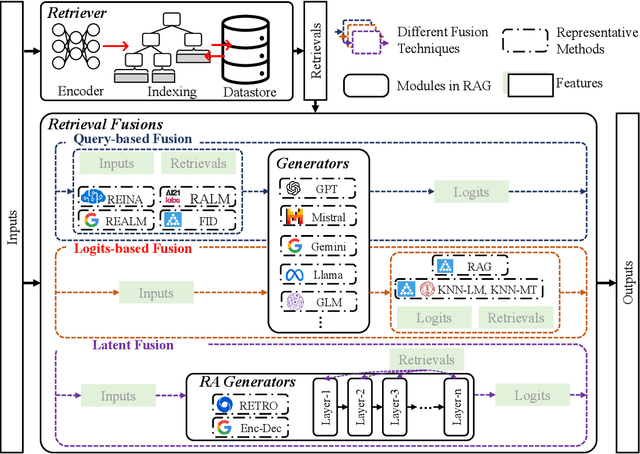
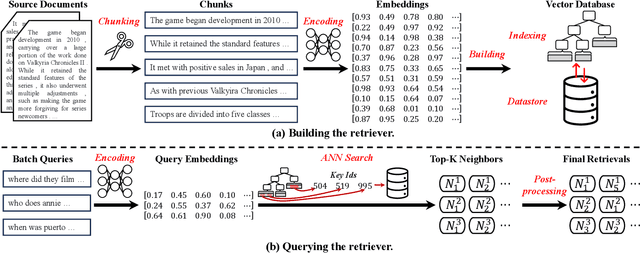
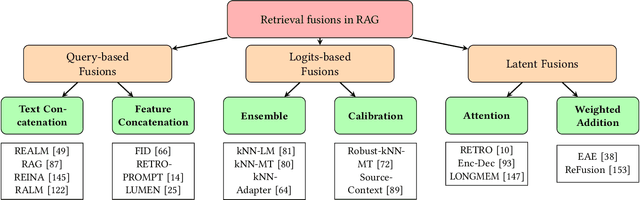
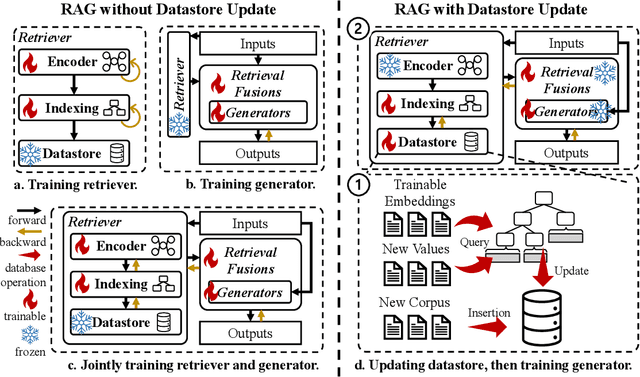
Large language models (LLMs) have demonstrated great success in various fields, benefiting from their huge amount of parameters that store knowledge. However, LLMs still suffer from several key issues, such as hallucination problems, knowledge update issues, and lacking domain-specific expertise. The appearance of retrieval-augmented generation (RAG), which leverages an external knowledge database to augment LLMs, makes up those drawbacks of LLMs. This paper reviews all significant techniques of RAG, especially in the retriever and the retrieval fusions. Besides, tutorial codes are provided for implementing the representative techniques in RAG. This paper further discusses the RAG training, including RAG with/without datastore update. Then, we introduce the application of RAG in representative natural language processing tasks and industrial scenarios. Finally, this paper discusses the future directions and challenges of RAG for promoting its development.
Vision-Braille: An End-to-End Tool for Chinese Braille Image-to-Text Translation
Jul 08, 2024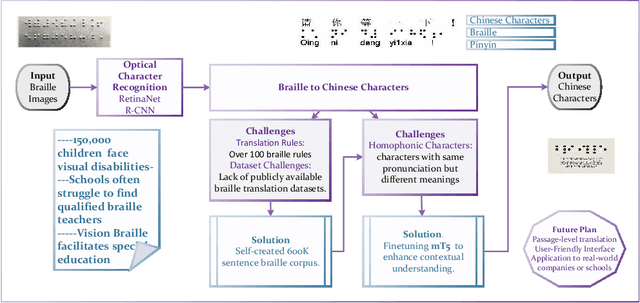
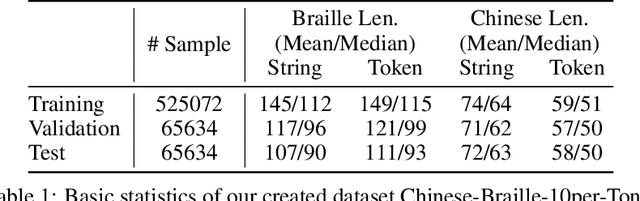

Visually impaired people are a large group who can only use braille for reading and writing. However, the lack of special educational resources is the bottleneck for educating them. Educational equity is a reflection of the level of social civilization, cultural equality, and individual dignity. Facilitating and improving lifelong learning channels for the visually impaired is of great significance. Their written braille homework or exam papers cannot be understood by sighted teachers, because of the lack of a highly accurate braille translation system, especially in Chinese which has tone marks. braille writers often omit tone marks to save space, leading to confusion when braille with the same consonants and vowels is translated into Chinese. Previous algorithms were insufficient in extracting contextual information, resulting in low accuracy of braille translations into Chinese. This project informatively fine-tuned the mT5 model with an Encoder-decoder architecture for braille to Chinese character conversion. This research created a training set of braille and corresponding Chinese text from the Leipzig Corpora. This project significantly reduced the confusion in braille, achieving $62.4$ and $62.3$ BLEU scores in the validation and test sets, with a curriculum learning fine-tuning method. By incorporating the braille recognition algorithm, this project is the first publicly available braille translation system and can benefit lots of visually impaired students and families who are preparing for the Chinese College Test and help to propel their college dreams in the future. There is a demo on our homepage\footnote{\url{https://vision-braille.com/}}.
MMEvalPro: Calibrating Multimodal Benchmarks Towards Trustworthy and Efficient Evaluation
Jun 29, 2024


Large Multimodal Models (LMMs) exhibit impressive cross-modal understanding and reasoning abilities, often assessed through multiple-choice questions (MCQs) that include an image, a question, and several options. However, many benchmarks used for such evaluations suffer from systematic biases. Remarkably, Large Language Models (LLMs) without any visual perception capabilities achieve non-trivial performance, undermining the credibility of these evaluations. To address this issue while maintaining the efficiency of MCQ evaluations, we propose MMEvalPro, a benchmark designed to avoid Type-I errors through a trilogy evaluation pipeline and more rigorous metrics. For each original question from existing benchmarks, human annotators augment it by creating one perception question and one knowledge anchor question through a meticulous annotation process. MMEvalPro comprises $2,138$ question triplets, totaling $6,414$ distinct questions. Two-thirds of these questions are manually labeled by human experts, while the rest are sourced from existing benchmarks (MMMU, ScienceQA, and MathVista). Compared with the existing benchmarks, our experiments with the latest LLMs and LMMs demonstrate that MMEvalPro is more challenging (the best LMM lags behind human performance by $31.73\%$, compared to an average gap of $8.03\%$ in previous benchmarks) and more trustworthy (the best LLM trails the best LMM by $23.09\%$, whereas the gap for previous benchmarks is just $14.64\%$). Our in-depth analysis explains the reason for the large performance gap and justifies the trustworthiness of evaluation, underscoring its significant potential for advancing future research.
SMPLOlympics: Sports Environments for Physically Simulated Humanoids
Jun 28, 2024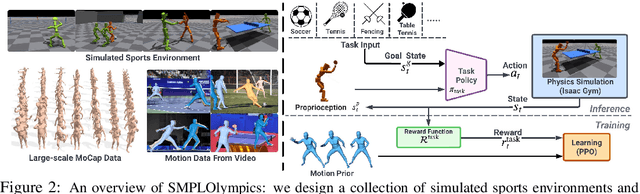

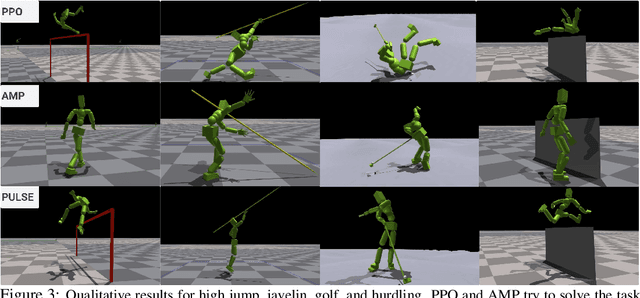
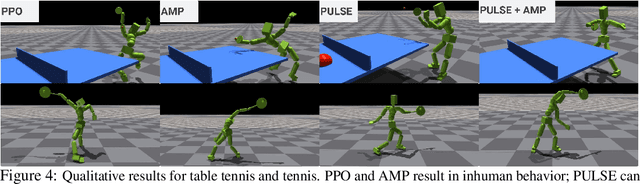
We present SMPLOlympics, a collection of physically simulated environments that allow humanoids to compete in a variety of Olympic sports. Sports simulation offers a rich and standardized testing ground for evaluating and improving the capabilities of learning algorithms due to the diversity and physically demanding nature of athletic activities. As humans have been competing in these sports for many years, there is also a plethora of existing knowledge on the preferred strategy to achieve better performance. To leverage these existing human demonstrations from videos and motion capture, we design our humanoid to be compatible with the widely-used SMPL and SMPL-X human models from the vision and graphics community. We provide a suite of individual sports environments, including golf, javelin throw, high jump, long jump, and hurdling, as well as competitive sports, including both 1v1 and 2v2 games such as table tennis, tennis, fencing, boxing, soccer, and basketball. Our analysis shows that combining strong motion priors with simple rewards can result in human-like behavior in various sports. By providing a unified sports benchmark and baseline implementation of state and reward designs, we hope that SMPLOlympics can help the control and animation communities achieve human-like and performant behaviors.
Beyond Raw Videos: Understanding Edited Videos with Large Multimodal Model
Jun 15, 2024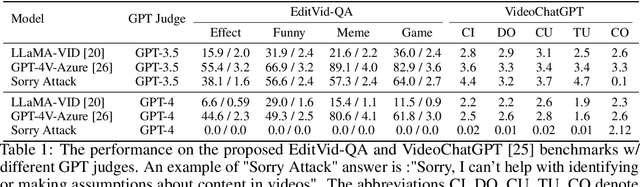

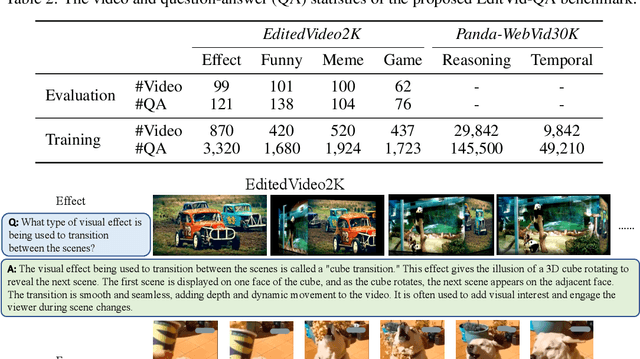

The emerging video LMMs (Large Multimodal Models) have achieved significant improvements on generic video understanding in the form of VQA (Visual Question Answering), where the raw videos are captured by cameras. However, a large portion of videos in real-world applications are edited videos, \textit{e.g.}, users usually cut and add effects/modifications to the raw video before publishing it on social media platforms. The edited videos usually have high view counts but they are not covered in existing benchmarks of video LMMs, \textit{i.e.}, ActivityNet-QA, or VideoChatGPT benchmark. In this paper, we leverage the edited videos on a popular short video platform, \textit{i.e.}, TikTok, and build a video VQA benchmark (named EditVid-QA) covering four typical editing categories, i.e., effect, funny, meme, and game. Funny and meme videos benchmark nuanced understanding and high-level reasoning, while effect and game evaluate the understanding capability of artificial design. Most of the open-source video LMMs perform poorly on the EditVid-QA benchmark, indicating a huge domain gap between edited short videos on social media and regular raw videos. To improve the generalization ability of LMMs, we collect a training set for the proposed benchmark based on both Panda-70M/WebVid raw videos and small-scale TikTok/CapCut edited videos, which boosts the performance on the proposed EditVid-QA benchmark, indicating the effectiveness of high-quality training data. We also identified a serious issue in the existing evaluation protocol using the GPT-3.5 judge, namely a "sorry" attack, where a sorry-style naive answer can achieve an extremely high rating from the GPT judge, e.g., over 4.3 for correctness score on VideoChatGPT evaluation protocol. To avoid the "sorry" attacks, we evaluate results with GPT-4 judge and keyword filtering. The datasets will be released for academic purposes only.
Keypoint-based Progressive Chain-of-Thought Distillation for LLMs
May 25, 2024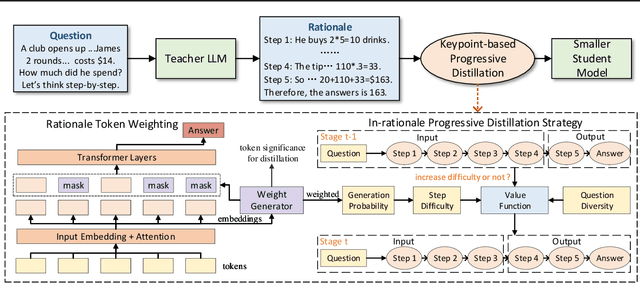
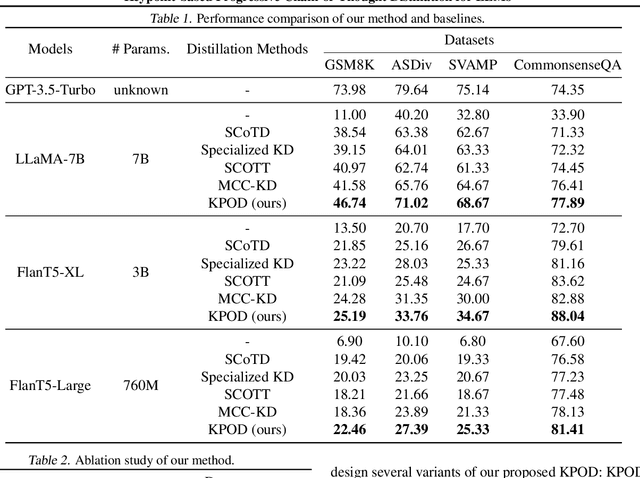
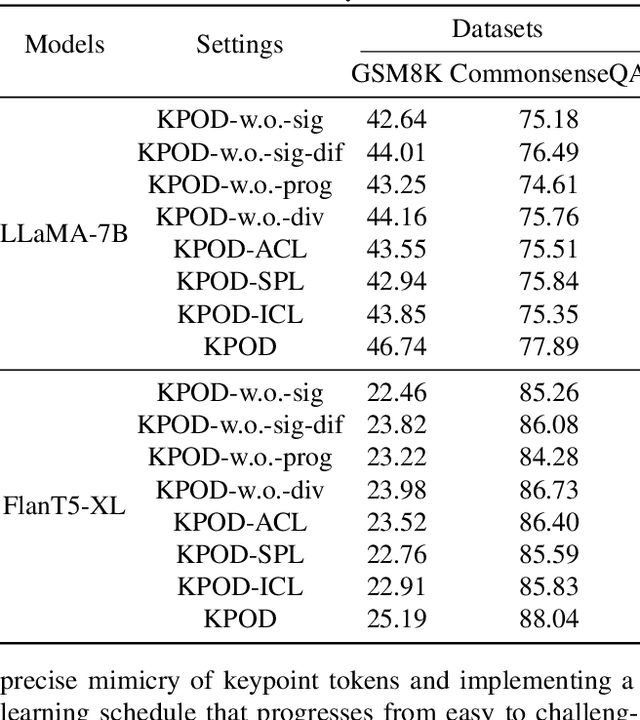

Chain-of-thought distillation is a powerful technique for transferring reasoning abilities from large language models (LLMs) to smaller student models. Previous methods typically require the student to mimic the step-by-step rationale produced by LLMs, often facing the following challenges: (i) Tokens within a rationale vary in significance, and treating them equally may fail to accurately mimic keypoint tokens, leading to reasoning errors. (ii) They usually distill knowledge by consistently predicting all the steps in a rationale, which falls short in distinguishing the learning order of step generation. This diverges from the human cognitive progression of starting with easy tasks and advancing to harder ones, resulting in sub-optimal outcomes. To this end, we propose a unified framework, called KPOD, to address these issues. Specifically, we propose a token weighting module utilizing mask learning to encourage accurate mimicry of keypoint tokens by the student during distillation. Besides, we develop an in-rationale progressive distillation strategy, starting with training the student to generate the final reasoning steps and gradually extending to cover the entire rationale. To accomplish this, a weighted token generation loss is proposed to assess step reasoning difficulty, and a value function is devised to schedule the progressive distillation by considering both step difficulty and question diversity. Extensive experiments on four reasoning benchmarks illustrate our KPOD outperforms previous methods by a large margin.