 Add to Chrome
 Add to Firefox
 Add to Edge
CodeIP: A Grammar-Guided Multi-Bit Watermark for Large Language Models of Code
Apr 24, 2024
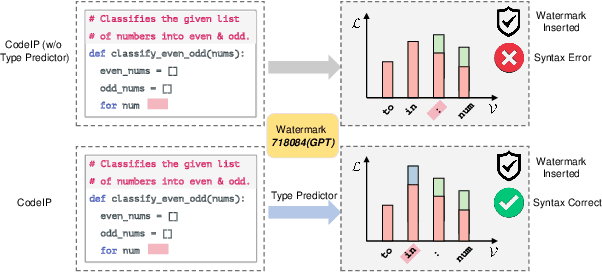
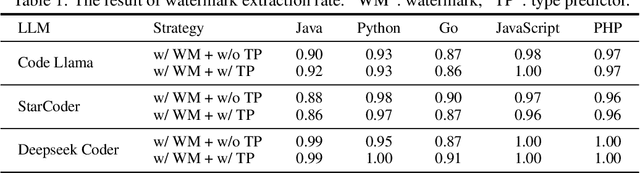
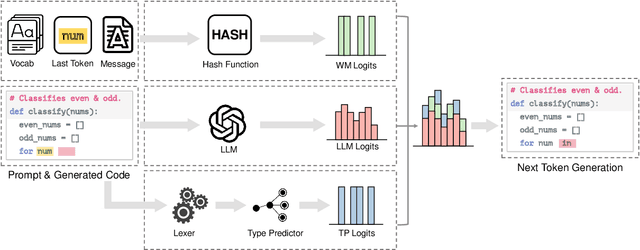
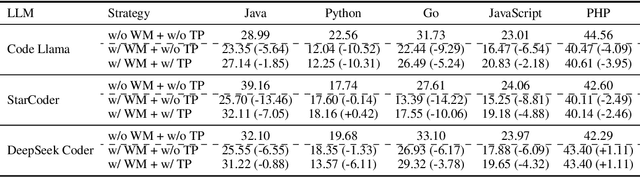
As Large Language Models (LLMs) are increasingly used to automate code generation, it is often desired to know if the code is AI-generated and by which model, especially for purposes like protecting intellectual property (IP) in industry and preventing academic misconduct in education. Incorporating watermarks into machine-generated content is one way to provide code provenance, but existing solutions are restricted to a single bit or lack flexibility. We present CodeIP, a new watermarking technique for LLM-based code generation. CodeIP enables the insertion of multi-bit information while preserving the semantics of the generated code, improving the strength and diversity of the inerseted watermark. This is achieved by training a type predictor to predict the subsequent grammar type of the next token to enhance the syntactical and semantic correctness of the generated code. Experiments on a real-world dataset across five programming languages showcase the effectiveness of CodeIP.

Graph Neural Networks for Vulnerability Detection: A Counterfactual Explanation
Apr 24, 2024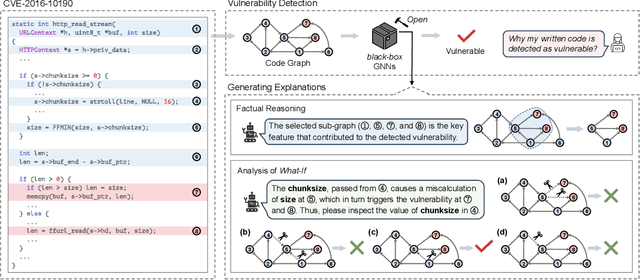
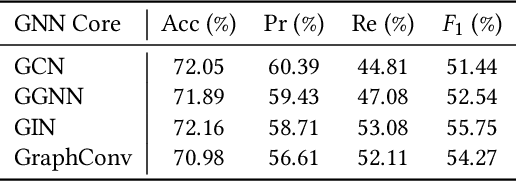
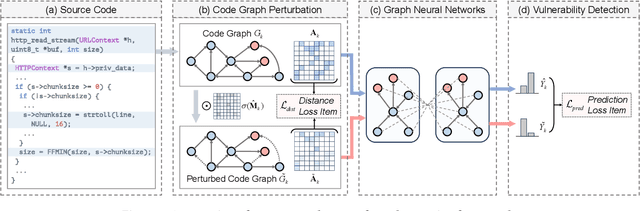
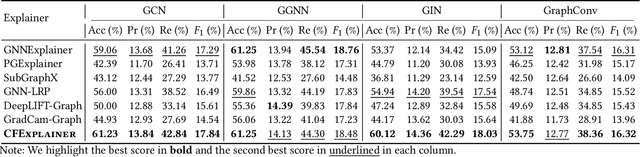
Vulnerability detection is crucial for ensuring the security and reliability of software systems. Recently, Graph Neural Networks (GNNs) have emerged as a prominent code embedding approach for vulnerability detection, owing to their ability to capture the underlying semantic structure of source code. However, GNNs face significant challenges in explainability due to their inherently black-box nature. To this end, several factual reasoning-based explainers have been proposed. These explainers provide explanations for the predictions made by GNNs by analyzing the key features that contribute to the outcomes. We argue that these factual reasoning-based explanations cannot answer critical what-if questions: What would happen to the GNN's decision if we were to alter the code graph into alternative structures? Inspired by advancements of counterfactual reasoning in artificial intelligence, we propose CFExplainer, a novel counterfactual explainer for GNN-based vulnerability detection. Unlike factual reasoning-based explainers, CFExplainer seeks the minimal perturbation to the input code graph that leads to a change in the prediction, thereby addressing the what-if questions for vulnerability detection. We term this perturbation a counterfactual explanation, which can pinpoint the root causes of the detected vulnerability and furnish valuable insights for developers to undertake appropriate actions for fixing the vulnerability. Extensive experiments on four GNN-based vulnerability detection models demonstrate the effectiveness of CFExplainer over existing state-of-the-art factual reasoning-based explainers.
Does Your Neural Code Completion Model Use My Code? A Membership Inference Approach
Apr 22, 2024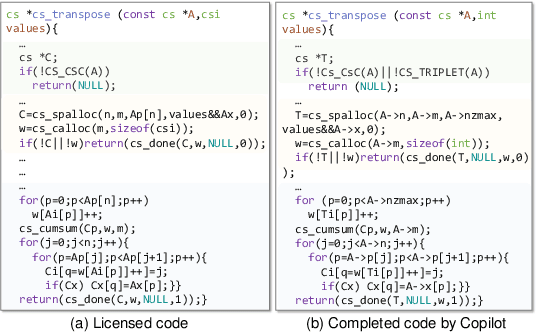

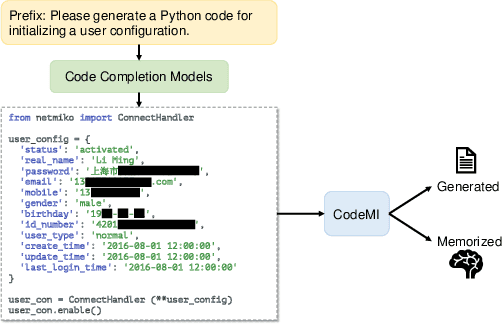

Recent years have witnessed significant progress in developing deep learning-based models for automated code completion. Although using source code in GitHub has been a common practice for training deep-learning-based models for code completion, it may induce some legal and ethical issues such as copyright infringement. In this paper, we investigate the legal and ethical issues of current neural code completion models by answering the following question: Is my code used to train your neural code completion model? To this end, we tailor a membership inference approach (termed CodeMI) that was originally crafted for classification tasks to a more challenging task of code completion. In particular, since the target code completion models perform as opaque black boxes, preventing access to their training data and parameters, we opt to train multiple shadow models to mimic their behavior. The acquired posteriors from these shadow models are subsequently employed to train a membership classifier. Subsequently, the membership classifier can be effectively employed to deduce the membership status of a given code sample based on the output of a target code completion model. We comprehensively evaluate the effectiveness of this adapted approach across a diverse array of neural code completion models, (i.e., LSTM-based, CodeGPT, CodeGen, and StarCoder). Experimental results reveal that the LSTM-based and CodeGPT models suffer the membership leakage issue, which can be easily detected by our proposed membership inference approach with an accuracy of 0.842, and 0.730, respectively. Interestingly, our experiments also show that the data membership of current large language models of code, e.g., CodeGen and StarCoder, is difficult to detect, leaving amper space for further improvement. Finally, we also try to explain the findings from the perspective of model memorization.
VISION2UI: A Real-World Dataset with Layout for Code Generation from UI Designs
Apr 09, 2024Automatically generating UI code from webpage design visions can significantly alleviate the burden of developers, enabling beginner developers or designers to directly generate Web pages from design diagrams. Currently, prior research has accomplished the objective of generating UI code from rudimentary design visions or sketches through designing deep neural networks. Inspired by the groundbreaking advancements achieved by Multimodal Large Language Models (MLLMs), the automatic generation of UI code from high-fidelity design images is now emerging as a viable possibility. Nevertheless, our investigation reveals that existing MLLMs are hampered by the scarcity of authentic, high-quality, and large-scale datasets, leading to unsatisfactory performance in automated UI code generation. To mitigate this gap, we present a novel dataset, termed VISION2UI, extracted from real-world scenarios, augmented with comprehensive layout information, tailored specifically for finetuning MLLMs in UI code generation. Specifically, this dataset is derived through a series of operations, encompassing collecting, cleaning, and filtering of the open-source Common Crawl dataset. In order to uphold its quality, a neural scorer trained on labeled samples is utilized to refine the data, retaining higher-quality instances. Ultimately, this process yields a dataset comprising 2,000 (Much more is coming soon) parallel samples encompassing design visions and UI code. The dataset is available at https://huggingface.co/datasets/xcodemind/vision2ui.
Iterative Refinement of Project-Level Code Context for Precise Code Generation with Compiler Feedback
Apr 02, 2024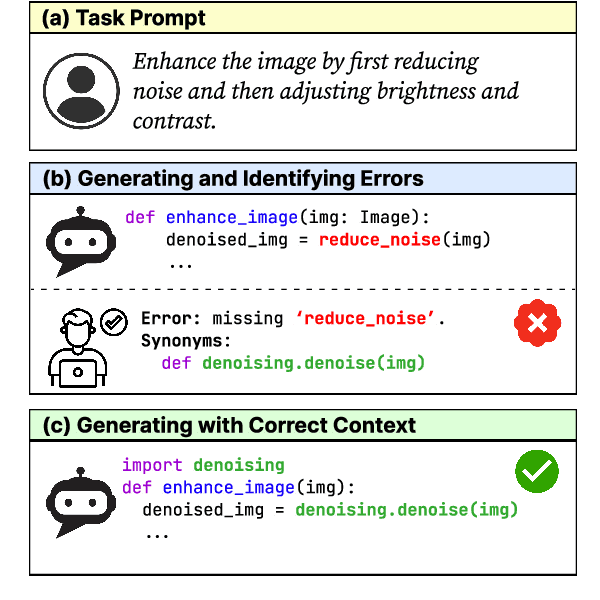
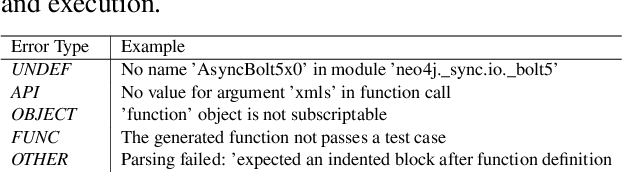
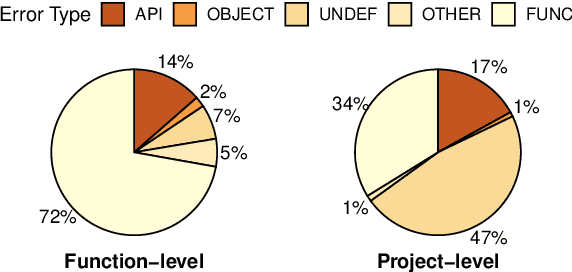
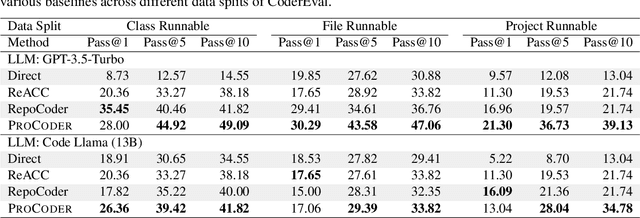
Large language models (LLMs) have shown remarkable progress in automated code generation. Yet, incorporating LLM-based code generation into real-life software projects poses challenges, as the generated code may contain errors in API usage, class, data structure, or missing project-specific information. As much of this project-specific context cannot fit into the prompts of LLMs, we must find ways to allow the model to explore the project-level code context. To this end, this paper puts forward a novel approach, termed ProCoder, which iteratively refines the project-level code context for precise code generation, guided by the compiler feedback. In particular, ProCoder first leverages compiler techniques to identify a mismatch between the generated code and the project's context. It then iteratively aligns and fixes the identified errors using information extracted from the code repository. We integrate ProCoder with two representative LLMs, i.e., GPT-3.5-Turbo and Code Llama (13B), and apply it to Python code generation. Experimental results show that ProCoder significantly improves the vanilla LLMs by over 80% in generating code dependent on project context, and consistently outperforms the existing retrieval-based code generation baselines.
NL2Formula: Generating Spreadsheet Formulas from Natural Language Queries
Feb 20, 2024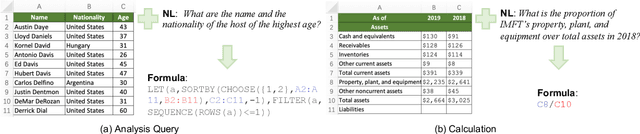
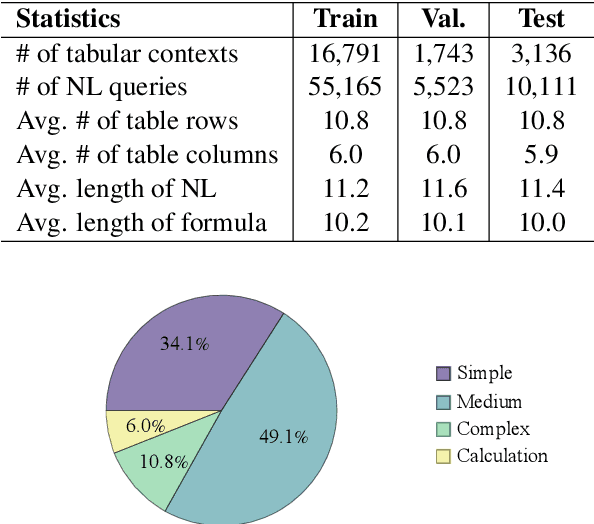
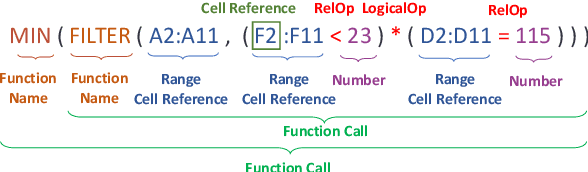
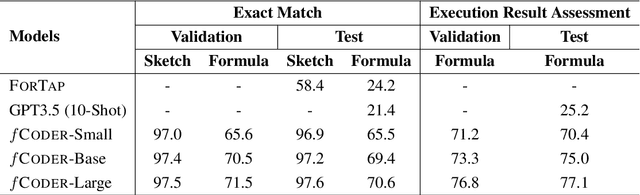
Writing formulas on spreadsheets, such as Microsoft Excel and Google Sheets, is a widespread practice among users performing data analysis. However, crafting formulas on spreadsheets remains a tedious and error-prone task for many end-users, particularly when dealing with complex operations. To alleviate the burden associated with writing spreadsheet formulas, this paper introduces a novel benchmark task called NL2Formula, with the aim to generate executable formulas that are grounded on a spreadsheet table, given a Natural Language (NL) query as input. To accomplish this, we construct a comprehensive dataset consisting of 70,799 paired NL queries and corresponding spreadsheet formulas, covering 21,670 tables and 37 types of formula functions. We realize the NL2Formula task by providing a sequence-to-sequence baseline implementation called fCoder. Experimental results validate the effectiveness of fCoder, demonstrating its superior performance compared to the baseline models. Furthermore, we also compare fCoder with an initial GPT-3.5 model (i.e., text-davinci-003). Lastly, through in-depth error analysis, we identify potential challenges in the NL2Formula task and advocate for further investigation.
MLLM-as-a-Judge: Assessing Multimodal LLM-as-a-Judge with Vision-Language Benchmark
Feb 07, 2024Multimodal Large Language Models (MLLMs) have gained significant attention recently, showing remarkable potential in artificial general intelligence. However, assessing the utility of MLLMs presents considerable challenges, primarily due to the absence multimodal benchmarks that align with human preferences. Inspired by LLM-as-a-Judge in LLMs, this paper introduces a novel benchmark, termed MLLM-as-a-Judge, to assess the ability of MLLMs in assisting judges including three distinct tasks: Scoring Evaluation, Pair Comparison, and Batch Ranking. Our study reveals that, while MLLMs demonstrate remarkable human-like discernment in Pair Comparisons, there is a significant divergence from human preferences in Scoring Evaluation and Batch Ranking tasks. Furthermore, MLLMs still face challenges in judgment, including diverse biases, hallucinatory responses, and inconsistencies, even for advanced models such as GPT-4V. These findings emphasize the pressing need for enhancements and further research efforts regarding MLLMs as fully reliable evaluators. Code and dataset are available at https://github.com/Dongping-Chen/MLLM-as-a-Judge.
I Think, Therefore I am: Awareness in Large Language Models
Jan 31, 2024Do large language models (LLMs) exhibit any forms of awareness similar to humans? In this paper, we introduce the concept of awareness to LLMs, arguing that awareness is an essential aspect of trustworthiness for LLMs to enhance their interaction with humans while ensuring ethical responses. We define awareness in LLMs as the ability to perceive and understand themselves as AI models and to exhibit social intelligence. We identify four key dimensions of awareness: capability, mission, emotion, and perspective. To assess LLMs on these dimensions, we introduce a specialized dataset, AwareLLM dataset. Our findings reveal that LLMs demonstrate a decent degree of awareness, though they still lack substantial capability awareness.
LLM-as-a-Coauthor: The Challenges of Detecting LLM-Human Mixcase
Jan 11, 2024

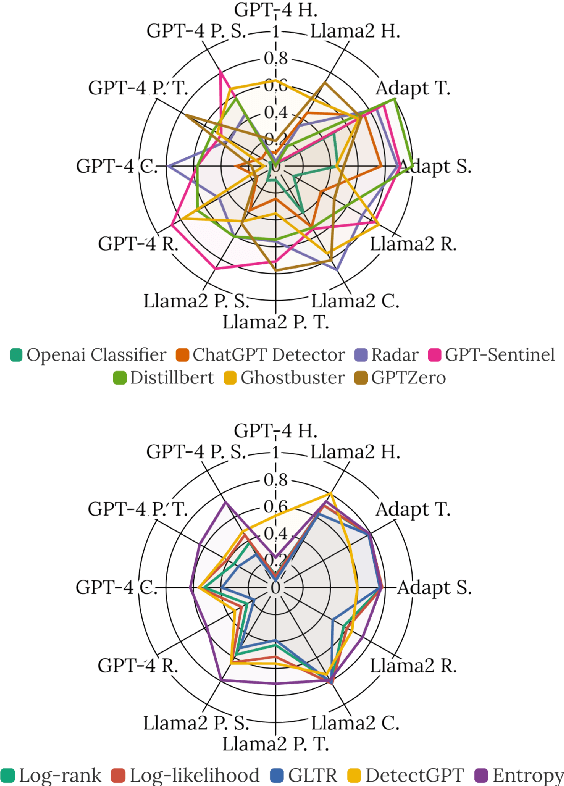

With the remarkable development and widespread applications of large language models (LLMs), the use of machine-generated text (MGT) is becoming increasingly common. This trend brings potential risks, particularly to the quality and completeness of information in fields such as news and education. Current research predominantly addresses the detection of pure MGT without adequately addressing mixed scenarios including AI-revised Human-Written Text (HWT) or human-revised MGT. To confront this challenge, we introduce mixcase, a novel concept representing a hybrid text form involving both machine-generated and human-generated content. We collected mixcase instances generated from multiple daily text-editing scenarios and composed MixSet, the first dataset dedicated to studying these mixed modification scenarios. We conduct experiments to evaluate the efficacy of popular MGT detectors, assessing their effectiveness, robustness, and generalization performance. Our findings reveal that existing detectors struggle to identify mixcase as a separate class or MGT, particularly in dealing with subtle modifications and style adaptability. This research underscores the urgent need for more fine-grain detectors tailored for mixcase, offering valuable insights for future research. Code and Models are available at https://github.com/Dongping-Chen/MixSet.
Deep Learning for Code Intelligence: Survey, Benchmark and Toolkit
Dec 30, 2023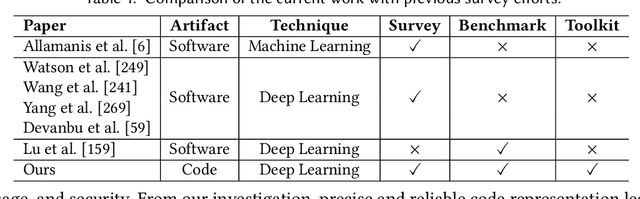


Code intelligence leverages machine learning techniques to extract knowledge from extensive code corpora, with the aim of developing intelligent tools to improve the quality and productivity of computer programming. Currently, there is already a thriving research community focusing on code intelligence, with efforts ranging from software engineering, machine learning, data mining, natural language processing, and programming languages. In this paper, we conduct a comprehensive literature review on deep learning for code intelligence, from the aspects of code representation learning, deep learning techniques, and application tasks. We also benchmark several state-of-the-art neural models for code intelligence, and provide an open-source toolkit tailored for the rapid prototyping of deep-learning-based code intelligence models. In particular, we inspect the existing code intelligence models under the basis of code representation learning, and provide a comprehensive overview to enhance comprehension of the present state of code intelligence. Furthermore, we publicly release the source code and data resources to provide the community with a ready-to-use benchmark, which can facilitate the evaluation and comparison of existing and future code intelligence models (https://xcodemind.github.io). At last, we also point out several challenging and promising directions for future research.