 Add to Chrome
 Add to Firefox
 Add to Edge
Gemini Embedding 2: A Native Multimodal Embedding Model from Gemini
May 26, 2026
We introduce Gemini Embedding 2, a native multimodal embedding model that allows embedding video, audio, image, and text modalities in a unified representation space. We leverage the multimodal capabilities of Gemini to produce embeddings for arbitrary combinations of interleaved inputs across all these modalities that generalize well across a wide variety of tasks. Applying large-scale contrastive learning in a multi-task multi-stage training setup, we achieve state-of-the-art performance on key embedding benchmarks including unimodal, cross-modal, and multimodal retrieval spanning a diverse set of tasks. We show that our embedding model demonstrates strong performance (with a score of 62.9 R@1 on MSCOCO, 68.8 NDCG@10 on Vatex, 69.9 on MTEB multilingual and 84.0 on MTEB Code) across a variety of tasks surpassing the performance of specialized models. These unified capabilities make Gemini Embedding 2 a promising candidate for downstream use cases such as RAG, recommendation and search. Furthermore, its robust zero-shot performance across distinct fields - from astronomy and bioscience to fine arts and the culinary arts - establishes it as a highly reliable, out-of-the-box representation even for specialized domains.

Spectral-Aware Text-to-Time Series Generation with Billion-Scale Multimodal Meteorological Data
Mar 28, 2026Text-to-time-series generation is particularly important in meteorology, where natural language offers intuitive control over complex, multi-scale atmospheric dynamics. Existing approaches are constrained by the lack of large-scale, physically grounded multimodal datasets and by architectures that overlook the spectral-temporal structure of weather signals. We address these challenges with a unified framework for text-guided meteorological time-series generation. First, we introduce MeteoCap-3B, a billion-scale weather dataset paired with expert-level captions constructed via a Multi-agent Collaborative Captioning (MACC) pipeline, yielding information-dense and physically consistent annotations. Building on this dataset, we propose MTransformer, a diffusion-based model that enables precise semantic control by mapping textual descriptions into multi-band spectral priors through a Spectral Prompt Generator, which guides generation via frequency-aware attention. Extensive experiments on real-world benchmarks demonstrate state-of-the-art generation quality, accurate cross-modal alignment, strong semantic controllability, and substantial gains in downstream forecasting under data-sparse and zero-shot settings. Additional results on general time-series benchmarks indicate that the proposed framework generalizes beyond meteorology.
Multi-Agent Causal Reasoning for Suicide Ideation Detection Through Online Conversations
Feb 27, 2026Suicide remains a pressing global public health concern. While social media platforms offer opportunities for early risk detection through online conversation trees, existing approaches face two major limitations: (1) They rely on predefined rules (e.g., quotes or relies) to log conversations that capture only a narrow spectrum of user interactions, and (2) They overlook hidden influences such as user conformity and suicide copycat behavior, which can significantly affect suicidal expression and propagation in online communities. To address these limitations, we propose a Multi-Agent Causal Reasoning (MACR) framework that collaboratively employs a Reasoning Agent to scale user interactions and a Bias-aware Decision-Making Agent to mitigate harmful biases arising from hidden influences. The Reasoning Agent integrates cognitive appraisal theory to generate counterfactual user reactions to posts, thereby scaling user interactions. It analyses these reactions through structured dimensions, i.e., cognitive, emotional, and behavioral patterns, with a dedicated sub-agent responsible for each dimension. The Bias-aware Decision-Making Agent mitigates hidden biases through a front-door adjustment strategy, leveraging the counterfactual user reactions produced by the Reasoning Agent. Through the collaboration of reasoning and bias-aware decision making, the proposed MACR framework not only alleviates hidden biases, but also enriches contextual information of user interactions with counterfactual knowledge. Extensive experiments on real-world conversational datasets demonstrate the effectiveness and robustness of MACR in identifying suicide risk.
Know What You Know: Metacognitive Entropy Calibration for Verifiable RL Reasoning
Feb 26, 2026Large reasoning models (LRMs) have emerged as a powerful paradigm for solving complex real-world tasks. In practice, these models are predominantly trained via Reinforcement Learning with Verifiable Rewards (RLVR), yet most existing outcome-only RLVR pipelines rely almost exclusively on a binary correctness signal and largely ignore the model's intrinsic uncertainty. We term this discrepancy the uncertainty-reward mismatch, under which high- and low-uncertainty solutions are treated equivalently, preventing the policy from "Know What You Know" and impeding the shift from optimizing for correct answers to optimizing effective reasoning paths. This limitation is especially critical in reasoning-centric tasks such as mathematics and question answering, where performance hinges on the quality of the model's internal reasoning process rather than mere memorization of final answers. To address this, we propose EGPO, a metacognitive entropy calibration framework that explicitly integrates intrinsic uncertainty into RLVR for enhancing LRMs. EGPO estimates per-sample uncertainty using a zero-overhead entropy proxy derived from token-level likelihoods and aligns it with extrinsic correctness through an asymmetric calibration mechanism that preserves correct reasoning while selectively regulating overconfident failures, thereby enabling stable and uncertainty-aware policy optimization. Moreover, EGPO recovers informative learning signals from otherwise degenerate group-based rollouts without modifying the verifier or reward definition. Extensive experiments across multiple benchmarks demonstrate that the proposed EGPO leads to substantial and consistent improvements in reasoning performance, establishing a principled path for advancing LRMs through metacognitive entropy calibration.
Explore-on-Graph: Incentivizing Autonomous Exploration of Large Language Models on Knowledge Graphs with Path-refined Reward Modeling
Feb 25, 2026The reasoning process of Large Language Models (LLMs) is often plagued by hallucinations and missing facts in question-answering tasks. A promising solution is to ground LLMs' answers in verifiable knowledge sources, such as Knowledge Graphs (KGs). Prevailing KG-enhanced methods typically constrained LLM reasoning either by enforcing rules during generation or by imitating paths from a fixed set of demonstrations. However, they naturally confined the reasoning patterns of LLMs within the scope of prior experience or fine-tuning data, limiting their generalizability to out-of-distribution graph reasoning problems. To tackle this problem, in this paper, we propose Explore-on-Graph (EoG), a novel framework that encourages LLMs to autonomously explore a more diverse reasoning space on KGs. To incentivize exploration and discovery of novel reasoning paths, we propose to introduce reinforcement learning during training, whose reward is the correctness of the reasoning paths' final answers. To enhance the efficiency and meaningfulness of the exploration, we propose to incorporate path information as additional reward signals to refine the exploration process and reduce futile efforts. Extensive experiments on five KGQA benchmark datasets demonstrate that, to the best of our knowledge, our method achieves state-of-the-art performance, outperforming not only open-source but also even closed-source LLMs.
Answer First, Reason Later: Aligning Search Relevance via Mode-Balanced Reinforcement Learning
Feb 10, 2026Building a search relevance model that achieves both low latency and high performance is a long-standing challenge in the search industry. To satisfy the millisecond-level response requirements of online systems while retaining the interpretable reasoning traces of Large Language Models (LLMs), we propose a novel \textbf{Answer-First, Reason Later (AFRL)} paradigm. This paradigm requires the model to output the definitive relevance score in the very first token, followed by a structured logical explanation. Inspired by the success of reasoning models, we adopt a "Supervised Fine-Tuning (SFT) + Reinforcement Learning (RL)" pipeline to achieve AFRL. However, directly applying existing RL training often leads to \textbf{mode collapse} in the search relevance task, where the model forgets complex long-tail rules in pursuit of high rewards. From an information theory perspective: RL inherently minimizes the \textbf{Reverse KL divergence}, which tends to seek probability peaks (mode-seeking) and is prone to "reward hacking." On the other hand, SFT minimizes the \textbf{Forward KL divergence}, forcing the model to cover the data distribution (mode-covering) and effectively anchoring expert rules. Based on this insight, we propose a \textbf{Mode-Balanced Optimization} strategy, incorporating an SFT auxiliary loss into Stepwise-GRPO training to balance these two properties. Furthermore, we construct an automated instruction evolution system and a multi-stage curriculum to ensure expert-level data quality. Extensive experiments demonstrate that our 32B teacher model achieves state-of-the-art performance. Moreover, the AFRL architecture enables efficient knowledge distillation, successfully transferring expert-level logic to a 0.6B model, thereby reconciling reasoning depth with deployment latency.
ETR: Outcome-Guided Elastic Trust Regions for Policy Optimization
Jan 07, 2026Reinforcement Learning with Verifiable Rewards (RLVR) has emerged as an important paradigm for unlocking reasoning capabilities in large language models, exemplified by the success of OpenAI o1 and DeepSeek-R1. Currently, Group Relative Policy Optimization (GRPO) stands as the dominant algorithm in this domain due to its stable training and critic-free efficiency. However, we argue that GRPO suffers from a structural limitation: it imposes a uniform, static trust region constraint across all samples. This design implicitly assumes signal homogeneity, a premise misaligned with the heterogeneous nature of outcome-driven learning, where advantage magnitudes and variances fluctuate significantly. Consequently, static constraints fail to fully exploit high-quality signals while insufficiently suppressing noise, often precipitating rapid entropy collapse. To address this, we propose \textbf{E}lastic \textbf{T}rust \textbf{R}egions (\textbf{ETR}), a dynamic mechanism that aligns optimization constraints with signal quality. ETR constructs a signal-aware landscape through dual-level elasticity: at the micro level, it scales clipping boundaries based on advantage magnitude to accelerate learning from high-confidence paths; at the macro level, it leverages group variance to implicitly allocate larger update budgets to tasks in the optimal learning zone. Extensive experiments on AIME and MATH benchmarks demonstrate that ETR consistently outperforms GRPO, achieving superior accuracy while effectively mitigating policy entropy degradation to ensure sustained exploration.
A Specialized Large Language Model for Clinical Reasoning and Diagnosis in Rare Diseases
Nov 18, 2025Rare diseases affect hundreds of millions worldwide, yet diagnosis often spans years. Convectional pipelines decouple noisy evidence extraction from downstream inferential diagnosis, and general/medical large language models (LLMs) face scarce real world electronic health records (EHRs), stale domain knowledge, and hallucinations. We assemble a large, domain specialized clinical corpus and a clinician validated reasoning set, and develop RareSeek R1 via staged instruction tuning, chain of thought learning, and graph grounded retrieval. Across multicenter EHR narratives and public benchmarks, RareSeek R1 attains state of the art accuracy, robust generalization, and stability under noisy or overlapping phenotypes. Augmented retrieval yields the largest gains when narratives pair with prioritized variants by resolving ambiguity and aligning candidates to mechanisms. Human studies show performance on par with experienced physicians and consistent gains in assistive use. Notably, transparent reasoning highlights decisive non phenotypic evidence (median 23.1%, such as imaging, interventions, functional tests) underpinning many correct diagnoses. This work advances a narrative first, knowledge integrated reasoning paradigm that shortens the diagnostic odyssey and enables auditable, clinically translatable decision support.
HiMATE: A Hierarchical Multi-Agent Framework for Machine Translation Evaluation
May 22, 2025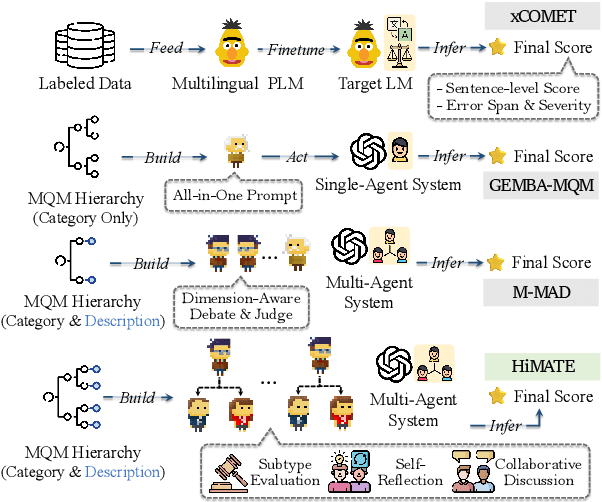
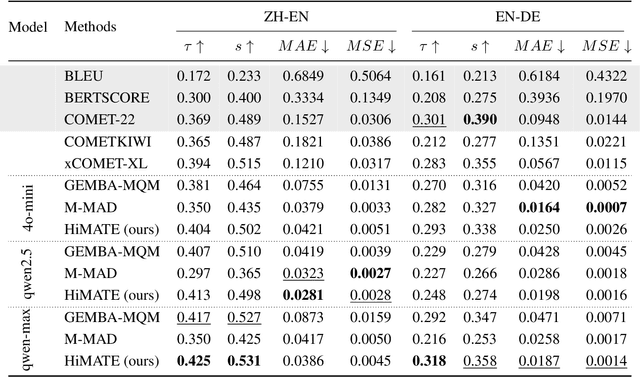
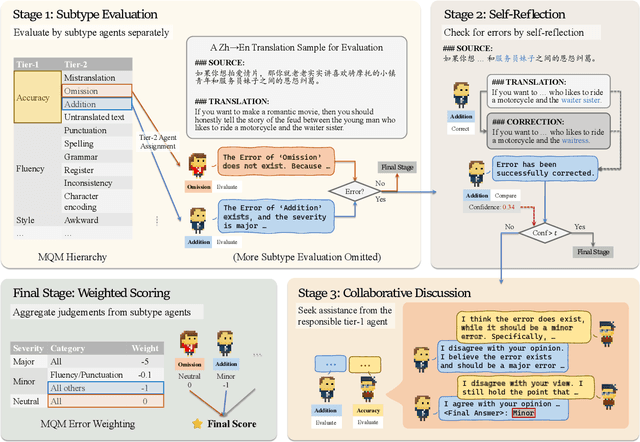
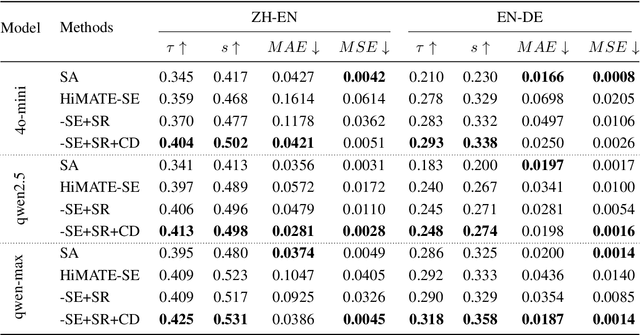
The advancement of Large Language Models (LLMs) enables flexible and interpretable automatic evaluations. In the field of machine translation evaluation, utilizing LLMs with translation error annotations based on Multidimensional Quality Metrics (MQM) yields more human-aligned judgments. However, current LLM-based evaluation methods still face challenges in accurately identifying error spans and assessing their severity. In this paper, we propose HiMATE, a Hierarchical Multi-Agent Framework for Machine Translation Evaluation. We argue that existing approaches inadequately exploit the fine-grained structural and semantic information within the MQM hierarchy. To address this, we develop a hierarchical multi-agent system grounded in the MQM error typology, enabling granular evaluation of subtype errors. Two key strategies are incorporated to further mitigate systemic hallucinations within the framework: the utilization of the model's self-reflection capability and the facilitation of agent discussion involving asymmetric information. Empirically, HiMATE outperforms competitive baselines across different datasets in conducting human-aligned evaluations. Further analyses underscore its significant advantage in error span detection and severity assessment, achieving an average F1-score improvement of 89% over the best-performing baseline. We make our code and data publicly available at https://anonymous.4open.science/r/HiMATE-Anony.
DiffGraph: Heterogeneous Graph Diffusion Model
Jan 04, 2025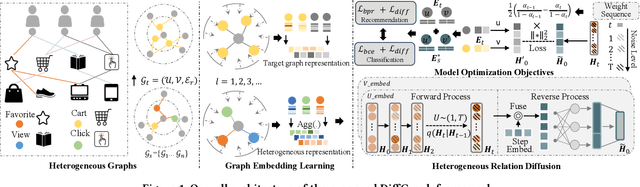

Recent advances in Graph Neural Networks (GNNs) have revolutionized graph-structured data modeling, yet traditional GNNs struggle with complex heterogeneous structures prevalent in real-world scenarios. Despite progress in handling heterogeneous interactions, two fundamental challenges persist: noisy data significantly compromising embedding quality and learning performance, and existing methods' inability to capture intricate semantic transitions among heterogeneous relations, which impacts downstream predictions. To address these fundamental issues, we present the Heterogeneous Graph Diffusion Model (DiffGraph), a pioneering framework that introduces an innovative cross-view denoising strategy. This advanced approach transforms auxiliary heterogeneous data into target semantic spaces, enabling precise distillation of task-relevant information. At its core, DiffGraph features a sophisticated latent heterogeneous graph diffusion mechanism, implementing a novel forward and backward diffusion process for superior noise management. This methodology achieves simultaneous heterogeneous graph denoising and cross-type transition, while significantly simplifying graph generation through its latent-space diffusion capabilities. Through rigorous experimental validation on both public and industrial datasets, we demonstrate that DiffGraph consistently surpasses existing methods in link prediction and node classification tasks, establishing new benchmarks for robustness and efficiency in heterogeneous graph processing. The model implementation is publicly available at: https://github.com/HKUDS/DiffGraph.