 Add to Chrome
 Add to Firefox
 Add to Edge
Exploring Fine-Grained Representation and Recomposition for Cloth-Changing Person Re-Identification
Aug 21, 2023
Cloth-changing person Re-IDentification (Re-ID) is a particularly challenging task, suffering from two limitations of inferior identity-relevant features and limited training samples. Existing methods mainly leverage auxiliary information to facilitate discriminative feature learning, including soft-biometrics features of shapes and gaits, and additional labels of clothing. However, these information may be unavailable in real-world applications. In this paper, we propose a novel FIne-grained Representation and Recomposition (FIRe$^{2}$) framework to tackle both limitations without any auxiliary information. Specifically, we first design a Fine-grained Feature Mining (FFM) module to separately cluster images of each person. Images with similar so-called fine-grained attributes (e.g., clothes and viewpoints) are encouraged to cluster together. An attribute-aware classification loss is introduced to perform fine-grained learning based on cluster labels, which are not shared among different people, promoting the model to learn identity-relevant features. Furthermore, by taking full advantage of the clustered fine-grained attributes, we present a Fine-grained Attribute Recomposition (FAR) module to recompose image features with different attributes in the latent space. It can significantly enhance representations for robust feature learning. Extensive experiments demonstrate that FIRe$^{2}$ can achieve state-of-the-art performance on five widely-used cloth-changing person Re-ID benchmarks.

Local Consensus Enhanced Siamese Network with Reciprocal Loss for Two-view Correspondence Learning
Aug 06, 2023Recent studies of two-view correspondence learning usually establish an end-to-end network to jointly predict correspondence reliability and relative pose. We improve such a framework from two aspects. First, we propose a Local Feature Consensus (LFC) plugin block to augment the features of existing models. Given a correspondence feature, the block augments its neighboring features with mutual neighborhood consensus and aggregates them to produce an enhanced feature. As inliers obey a uniform cross-view transformation and share more consistent learned features than outliers, feature consensus strengthens inlier correlation and suppresses outlier distraction, which makes output features more discriminative for classifying inliers/outliers. Second, existing approaches supervise network training with the ground truth correspondences and essential matrix projecting one image to the other for an input image pair, without considering the information from the reverse mapping. We extend existing models to a Siamese network with a reciprocal loss that exploits the supervision of mutual projection, which considerably promotes the matching performance without introducing additional model parameters. Building upon MSA-Net, we implement the two proposals and experimentally achieve state-of-the-art performance on benchmark datasets.
PourIt!: Weakly-supervised Liquid Perception from a Single Image for Visual Closed-Loop Robotic Pouring
Jul 21, 2023Liquid perception is critical for robotic pouring tasks. It usually requires the robust visual detection of flowing liquid. However, while recent works have shown promising results in liquid perception, they typically require labeled data for model training, a process that is both time-consuming and reliant on human labor. To this end, this paper proposes a simple yet effective framework PourIt!, to serve as a tool for robotic pouring tasks. We design a simple data collection pipeline that only needs image-level labels to reduce the reliance on tedious pixel-wise annotations. Then, a binary classification model is trained to generate Class Activation Map (CAM) that focuses on the visual difference between these two kinds of collected data, i.e., the existence of liquid drop or not. We also devise a feature contrast strategy to improve the quality of the CAM, thus entirely and tightly covering the actual liquid regions. Then, the container pose is further utilized to facilitate the 3D point cloud recovery of the detected liquid region. Finally, the liquid-to-container distance is calculated for visual closed-loop control of the physical robot. To validate the effectiveness of our proposed method, we also contribute a novel dataset for our task and name it PourIt! dataset. Extensive results on this dataset and physical Franka robot have shown the utility and effectiveness of our method in the robotic pouring tasks. Our dataset, code and pre-trained models will be available on the project page.
Pushing the Limits of 3D Shape Generation at Scale
Jun 20, 2023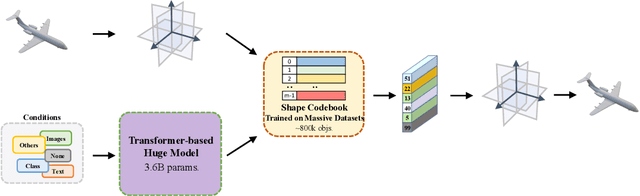
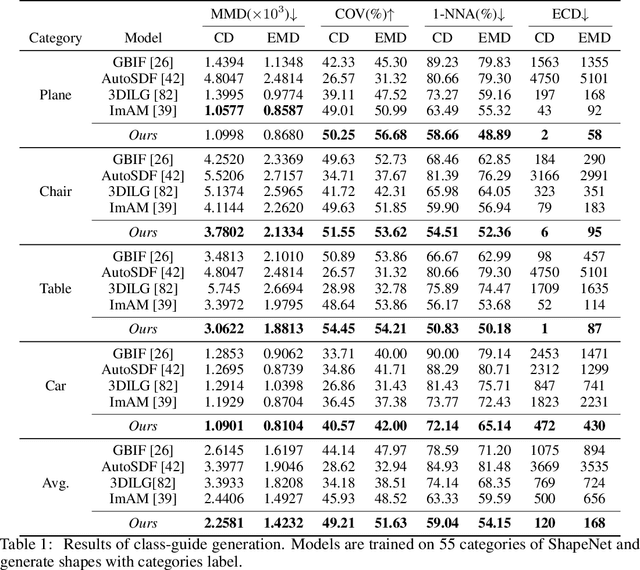
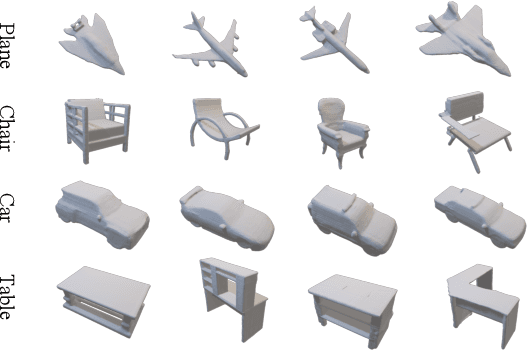
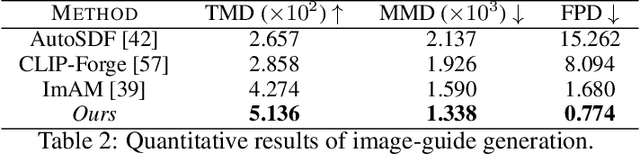
We present a significant breakthrough in 3D shape generation by scaling it to unprecedented dimensions. Through the adaptation of the Auto-Regressive model and the utilization of large language models, we have developed a remarkable model with an astounding 3.6 billion trainable parameters, establishing it as the largest 3D shape generation model to date, named Argus-3D. Our approach addresses the limitations of existing methods by enhancing the quality and diversity of generated 3D shapes. To tackle the challenges of high-resolution 3D shape generation, our model incorporates tri-plane features as latent representations, effectively reducing computational complexity. Additionally, we introduce a discrete codebook for efficient quantization of these representations. Leveraging the power of transformers, we enable multi-modal conditional generation, facilitating the production of diverse and visually impressive 3D shapes. To train our expansive model, we leverage an ensemble of publicly-available 3D datasets, consisting of a comprehensive collection of approximately 900,000 objects from renowned repositories such as ModelNet40, ShapeNet, Pix3D, 3D-Future, and Objaverse. This diverse dataset empowers our model to learn from a wide range of object variations, bolstering its ability to generate high-quality and diverse 3D shapes. Extensive experimentation demonstrate the remarkable efficacy of our approach in significantly improving the visual quality of generated 3D shapes. By pushing the boundaries of 3D generation, introducing novel methods for latent representation learning, and harnessing the power of transformers for multi-modal conditional generation, our contributions pave the way for substantial advancements in the field. Our work unlocks new possibilities for applications in gaming, virtual reality, product design, and other domains that demand high-quality and diverse 3D objects.
GeoVLN: Learning Geometry-Enhanced Visual Representation with Slot Attention for Vision-and-Language Navigation
May 26, 2023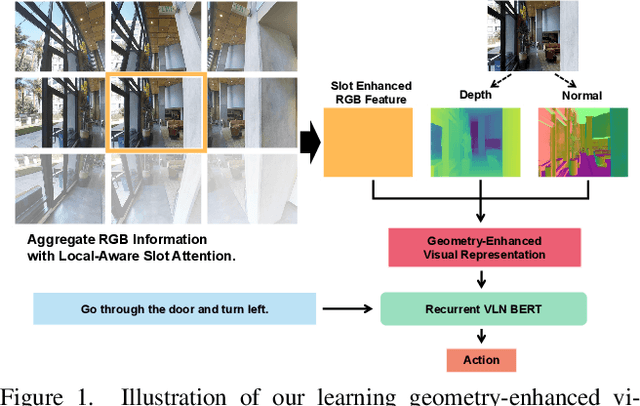
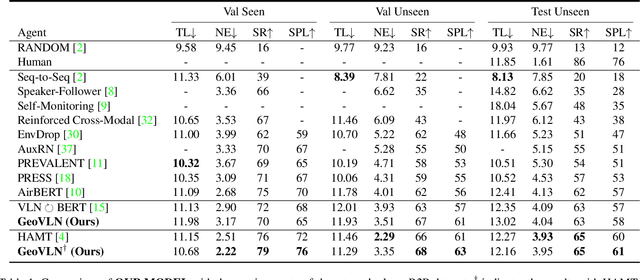
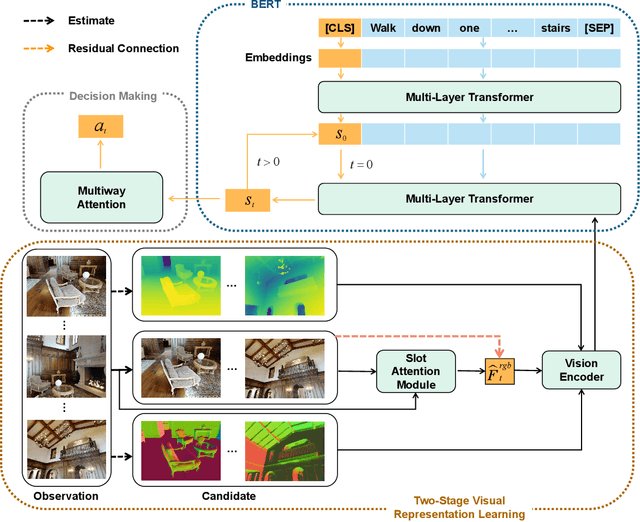
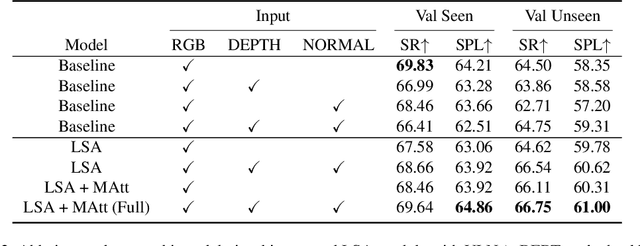
Most existing works solving Room-to-Room VLN problem only utilize RGB images and do not consider local context around candidate views, which lack sufficient visual cues about surrounding environment. Moreover, natural language contains complex semantic information thus its correlations with visual inputs are hard to model merely with cross attention. In this paper, we propose GeoVLN, which learns Geometry-enhanced visual representation based on slot attention for robust Visual-and-Language Navigation. The RGB images are compensated with the corresponding depth maps and normal maps predicted by Omnidata as visual inputs. Technically, we introduce a two-stage module that combine local slot attention and CLIP model to produce geometry-enhanced representation from such input. We employ V&L BERT to learn a cross-modal representation that incorporate both language and vision informations. Additionally, a novel multiway attention module is designed, encouraging different phrases of input instruction to exploit the most related features from visual input. Extensive experiments demonstrate the effectiveness of our newly designed modules and show the compelling performance of the proposed method.
A Unified Prompt-Guided In-Context Inpainting Framework for Reference-based Image Manipulations
May 19, 2023
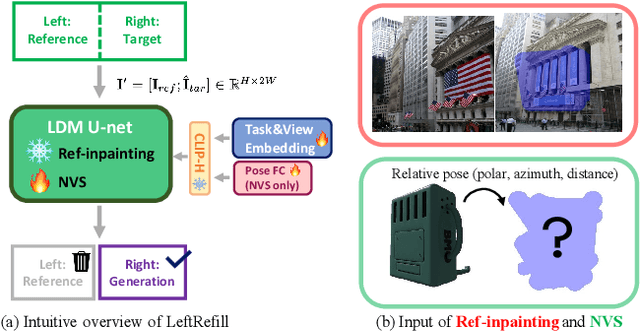
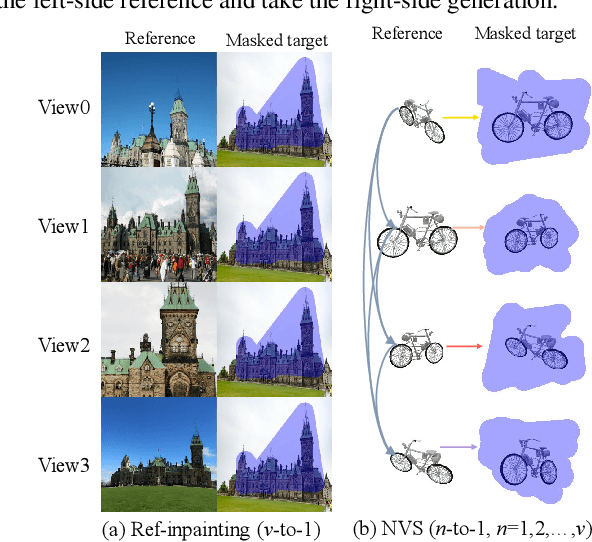
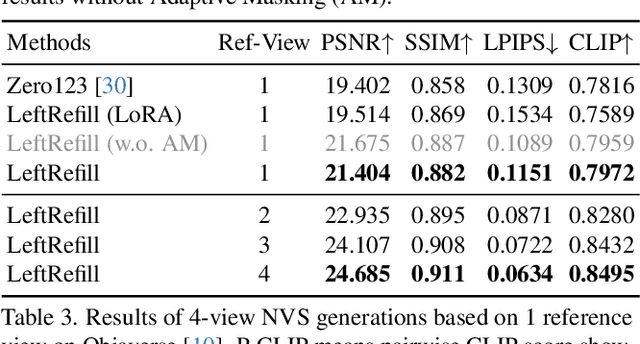
Recent advancements in Text-to-Image (T2I) generative models have yielded impressive results in generating high-fidelity images based on consistent text prompts. However, there is a growing interest in exploring the potential of these models for more diverse reference-based image manipulation tasks that require spatial understanding and visual context. Previous approaches have achieved this by incorporating additional control modules or fine-tuning the generative models specifically for each task until convergence. In this paper, we propose a different perspective. We conjecture that current large-scale T2I generative models already possess the capability to perform these tasks but are not fully activated within the standard generation process. To unlock these capabilities, we introduce a unified Prompt-Guided In-Context inpainting (PGIC) framework, which leverages large-scale T2I models to re-formulate and solve reference-guided image manipulations. In the PGIC framework, the reference and masked target are stitched together as a new input for the generative models, enabling the filling of masked regions as producing final results. Furthermore, we demonstrate that the self-attention modules in T2I models are well-suited for establishing spatial correlations and efficiently addressing challenging reference-guided manipulations. These large T2I models can be effectively driven by task-specific prompts with minimal training cost or even with frozen backbones. We synthetically evaluate the effectiveness of the proposed PGIC framework across various tasks, including reference-guided image inpainting, faithful inpainting, outpainting, local super-resolution, and novel view synthesis. Our results show that PGIC achieves significantly better performance while requiring less computation compared to other fine-tuning based approaches.
Faster OreFSDet : A Lightweight and Effective Few-shot Object Detector for Ore Images
May 02, 2023For the ore particle size detection, obtaining a sizable amount of high-quality ore labeled data is time-consuming and expensive. General object detection methods often suffer from severe over-fitting with scarce labeled data. Despite their ability to eliminate over-fitting, existing few-shot object detectors encounter drawbacks such as slow detection speed and high memory requirements, making them difficult to implement in a real-world deployment scenario. To this end, we propose a lightweight and effective few-shot detector to achieve competitive performance with general object detection with only a few samples for ore images. First, the proposed support feature mining block characterizes the importance of location information in support features. Next, the relationship guidance block makes full use of support features to guide the generation of accurate candidate proposals. Finally, the dual-scale semantic aggregation module retrieves detailed features at different resolutions to contribute with the prediction process. Experimental results show that our method consistently exceeds the few-shot detectors with an excellent performance gap on all metrics. Moreover, our method achieves the smallest model size of 19MB as well as being competitive at 50 FPS detection speed compared with general object detectors. The source code is available at https://github.com/MVME-HBUT/Faster-OreFSDet.
Grad-PU: Arbitrary-Scale Point Cloud Upsampling via Gradient Descent with Learned Distance Functions
Apr 24, 2023Most existing point cloud upsampling methods have roughly three steps: feature extraction, feature expansion and 3D coordinate prediction. However,they usually suffer from two critical issues: (1)fixed upsampling rate after one-time training, since the feature expansion unit is customized for each upsampling rate; (2)outliers or shrinkage artifact caused by the difficulty of precisely predicting 3D coordinates or residuals of upsampled points. To adress them, we propose a new framework for accurate point cloud upsampling that supports arbitrary upsampling rates. Our method first interpolates the low-res point cloud according to a given upsampling rate. And then refine the positions of the interpolated points with an iterative optimization process, guided by a trained model estimating the difference between the current point cloud and the high-res target. Extensive quantitative and qualitative results on benchmarks and downstream tasks demonstrate that our method achieves the state-of-the-art accuracy and efficiency.
Semantic Neural Decoding via Cross-Modal Generation
Mar 26, 2023Semantic neural decoding aims to elucidate the cognitive processes of the human brain by reconstructing observed images from brain recordings. Although recent works have utilized deep generative models to generate images conditioned on fMRI signals, achieving high-quality generation with consistent semantics has proven to be a formidable challenge. To address this issue, we propose an end-to-end framework, SemanSig, which directly encodes fMRI signals and extracts semantic information. SemanSig leverages a deep generative model to decode the semantic information into high-quality images. To enhance the effectiveness of our framework, we use the ImageNet class prototype space as the internal representation space of fMRI signals, thereby reducing signal redundancy and learning difficulty. Consequently, this forms a semantic-rich and visually-friendly internal representation for generative models to decode. Notably, SemanSig does not require pre-training on a large fMRI dataset, and performs remarkably well when trained from scratch, even when the fMRI signal is limited. Our experimental results validate the effectiveness of SemanSig in achieving high-quality image generation with consistent semantics.
Learning Versatile 3D Shape Generation with Improved AR Models
Mar 26, 2023Auto-Regressive (AR) models have achieved impressive results in 2D image generation by modeling joint distributions in the grid space. While this approach has been extended to the 3D domain for powerful shape generation, it still has two limitations: expensive computations on volumetric grids and ambiguous auto-regressive order along grid dimensions. To overcome these limitations, we propose the Improved Auto-regressive Model (ImAM) for 3D shape generation, which applies discrete representation learning based on a latent vector instead of volumetric grids. Our approach not only reduces computational costs but also preserves essential geometric details by learning the joint distribution in a more tractable order. Moreover, thanks to the simplicity of our model architecture, we can naturally extend it from unconditional to conditional generation by concatenating various conditioning inputs, such as point clouds, categories, images, and texts. Extensive experiments demonstrate that ImAM can synthesize diverse and faithful shapes of multiple categories, achieving state-of-the-art performance.