 Add to Chrome
 Add to Firefox
 Add to Edge
VEPHand: View-Efficient Photometric Hand Performance Capture at Scale
Jun 18, 2026
Robust, high-fidelity 3D hand capture, while fundamental to digital human creation, remains challenging with practical multi-view systems that balance rich photometry with the geometric ambiguities of reconstruction arising from limited viewpoint density. This paper presents an end-to-end pipeline for dynamic hand performance capture and registration, specifically designed for view-efficient setups ($\sim$20 views). We address key challenges with two primary innovations. First, to overcome reconstruction difficulties like limited view overlap and background clutter, our mask-free neural method robustly extracts detailed hand geometry and appearance from unmasked images using scene parameterization and scenario-specific density regularization. Second, addressing registration challenges such as accurately capturing non-linear skin deformations and ensuring plausible results during severe self-contact, we propose a physics-inspired framework. It aligns reconstructions to a personalized hand model by optimizing intrinsic volumetric offsets within its canonical tetrahedral mesh, alongside pose parameters. This approach, supported by robust losses and optimization, captures fine surface deformations, ensures plausible results under severe articulation and self-contact, and demonstrates strong tolerance to input noise. We demonstrate the scalability and robustness of our automated pipeline on an extensive dataset of over 12,000 sequences, from which we also derive a large-scale, high-quality synthetic 2D/3D hand dataset for training downstream tasks. This showcases its effectiveness for single hands, intricate two-hand interactions, and natural hand-object manipulations. Our method achieves state-of-the-art reconstruction fidelity in view-efficient, unmasked scenarios and highly accurate registration. Our project page are available at https://vephand.github.io/.

DSA: Dynamic Step Allocation for Fast Autoregressive Video Generation
Jun 03, 2026Video diffusion transformers have achieved state-of-the-art visual quality, but their high inference cost remains a major bottleneck for real-time applications. Recent distillation frameworks produce autoregressive video diffusion models with reduced latency, yet these models still use a fixed number of denoising steps per frame, wasting computation on predictable frames and under-refining challenging ones. We present DSA, a confidence-guided adaptive computation framework for AR video diffusion. DSA introduces a lightweight confidence head, trained jointly with the generator under a distribution-matching distillation objective, to estimate per-frame denoising reliability. At inference, this confidence signal dynamically adjusts the number of diffusion steps: simple frames terminate early for speed, while complex frames receive additional refinement. Our method requires no extra video data, no heuristics, and little architectural modification. Experiments show that DSA achieves real-time autoregressive video generation, reaching 22.63 FPS with sub-second latency on H100 GPUs, while maintaining competitive or superior VBench quality compared to recent autoregressive and bidirectional video diffusion models. Our results demonstrate that confidence-guided adaptive sampling provides an effective and practical path toward interactive video generation.
One-Click Upgrade from 2D to 3D: Sandwiched RGB-D Video Compression for Stereoscopic Teleconferencing
Apr 15, 2024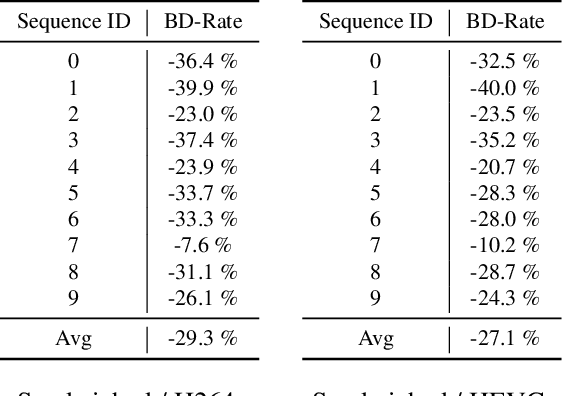
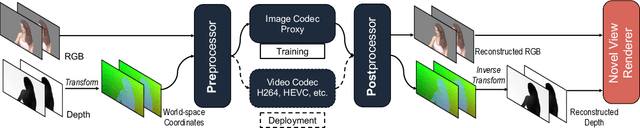
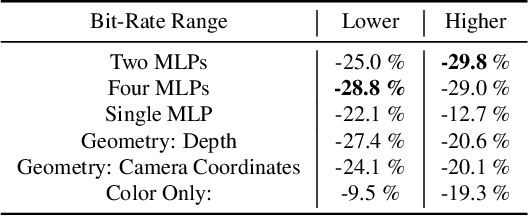
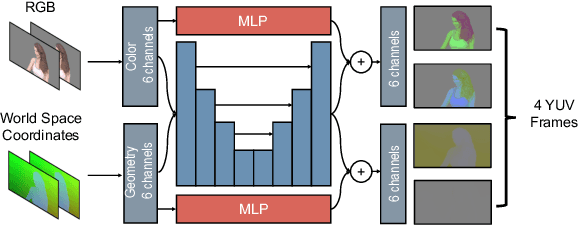
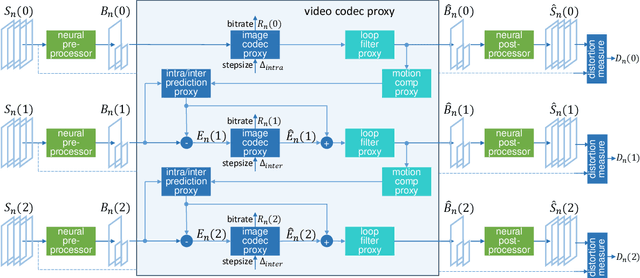
Stereoscopic video conferencing is still challenging due to the need to compress stereo RGB-D video in real-time. Though hardware implementations of standard video codecs such as H.264 / AVC and HEVC are widely available, they are not designed for stereoscopic videos and suffer from reduced quality and performance. Specific multiview or 3D extensions of these codecs are complex and lack efficient implementations. In this paper, we propose a new approach to upgrade a 2D video codec to support stereo RGB-D video compression, by wrapping it with a neural pre- and post-processor pair. The neural networks are end-to-end trained with an image codec proxy, and shown to work with a more sophisticated video codec. We also propose a geometry-aware loss function to improve rendering quality. We train the neural pre- and post-processors on a synthetic 4D people dataset, and evaluate it on both synthetic and real-captured stereo RGB-D videos. Experimental results show that the neural networks generalize well to unseen data and work out-of-box with various video codecs. Our approach saves about 30% bit-rate compared to a conventional video coding scheme and MV-HEVC at the same level of rendering quality from a novel view, without the need of a task-specific hardware upgrade.
GaussianFlow: Splatting Gaussian Dynamics for 4D Content Creation
Mar 19, 2024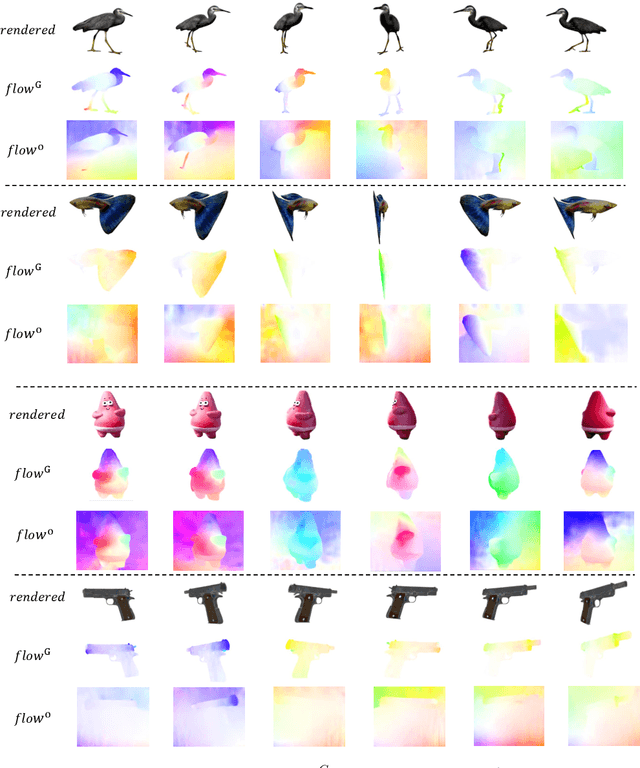
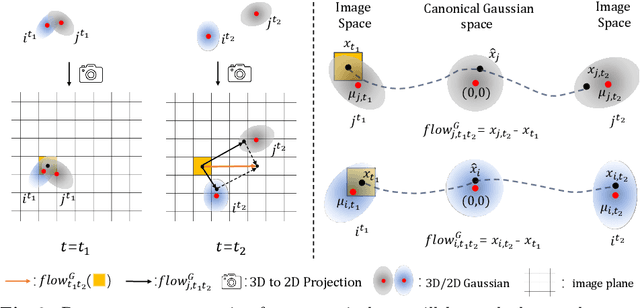
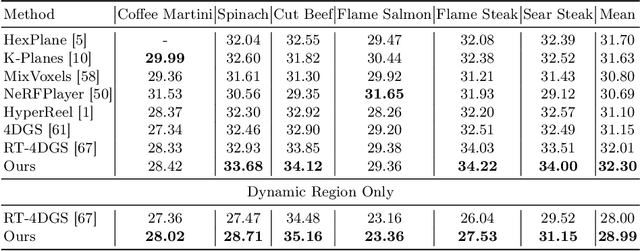
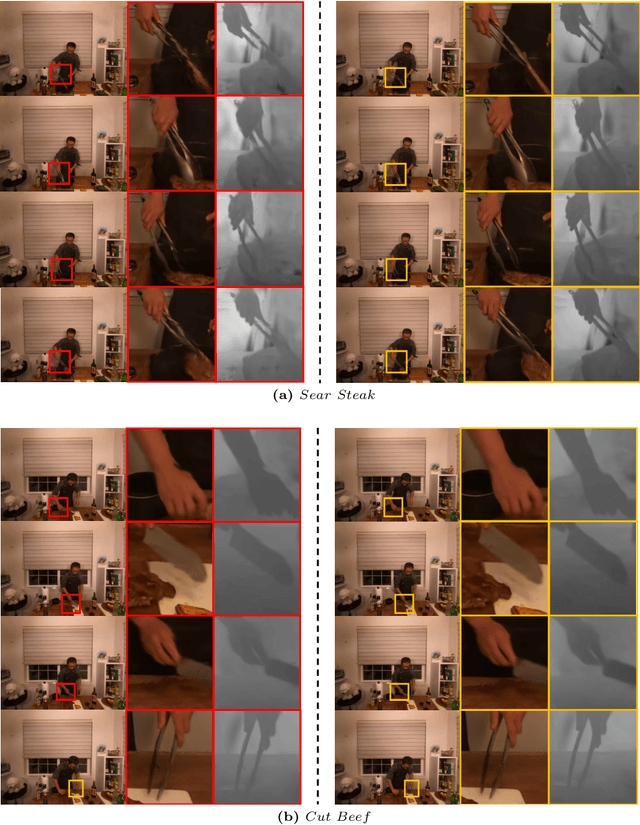
Creating 4D fields of Gaussian Splatting from images or videos is a challenging task due to its under-constrained nature. While the optimization can draw photometric reference from the input videos or be regulated by generative models, directly supervising Gaussian motions remains underexplored. In this paper, we introduce a novel concept, Gaussian flow, which connects the dynamics of 3D Gaussians and pixel velocities between consecutive frames. The Gaussian flow can be efficiently obtained by splatting Gaussian dynamics into the image space. This differentiable process enables direct dynamic supervision from optical flow. Our method significantly benefits 4D dynamic content generation and 4D novel view synthesis with Gaussian Splatting, especially for contents with rich motions that are hard to be handled by existing methods. The common color drifting issue that happens in 4D generation is also resolved with improved Guassian dynamics. Superior visual quality on extensive experiments demonstrates our method's effectiveness. Quantitative and qualitative evaluations show that our method achieves state-of-the-art results on both tasks of 4D generation and 4D novel view synthesis. Project page: https://zerg-overmind.github.io/GaussianFlow.github.io/
Sandwiched Compression: Repurposing Standard Codecs with Neural Network Wrappers
Feb 08, 2024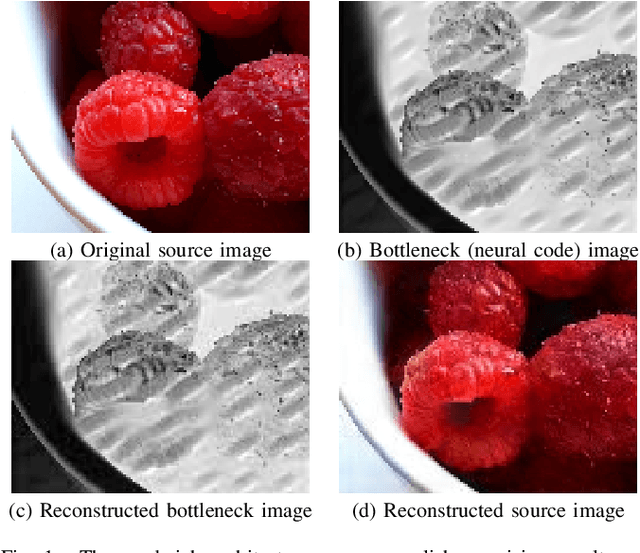
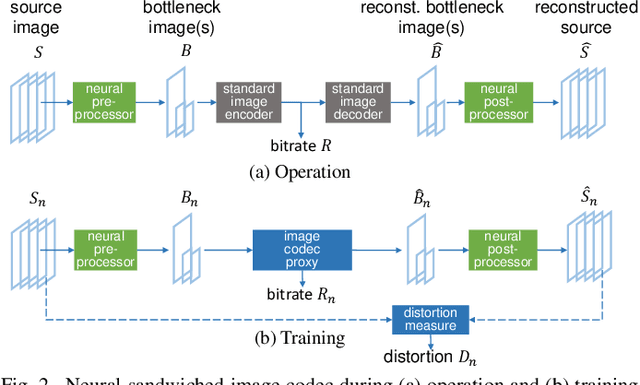
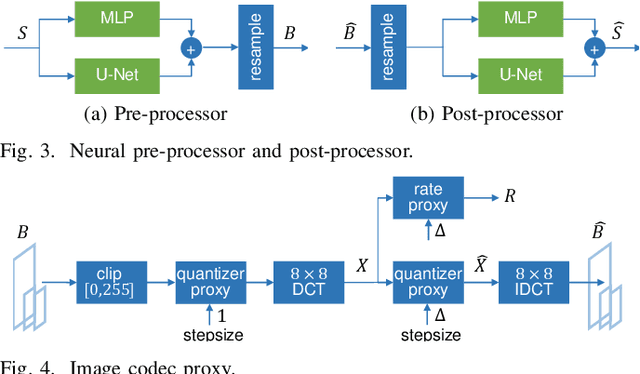
We propose sandwiching standard image and video codecs between pre- and post-processing neural networks. The networks are jointly trained through a differentiable codec proxy to minimize a given rate-distortion loss. This sandwich architecture not only improves the standard codec's performance on its intended content, it can effectively adapt the codec to other types of image/video content and to other distortion measures. Essentially, the sandwich learns to transmit ``neural code images'' that optimize overall rate-distortion performance even when the overall problem is well outside the scope of the codec's design. Through a variety of examples, we apply the sandwich architecture to sources with different numbers of channels, higher resolution, higher dynamic range, and perceptual distortion measures. The results demonstrate substantial improvements (up to 9 dB gains or up to 30\% bitrate reductions) compared to alternative adaptations. We derive VQ equivalents for the sandwich, establish optimality properties, and design differentiable codec proxies approximating current standard codecs. We further analyze model complexity, visual quality under perceptual metrics, as well as sandwich configurations that offer interesting potentials in image/video compression and streaming.
MACS: Mass Conditioned 3D Hand and Object Motion Synthesis
Dec 22, 2023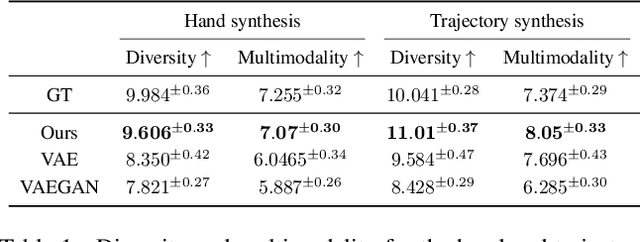
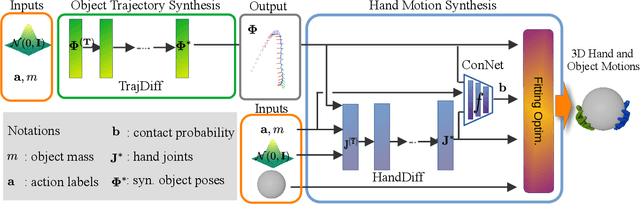
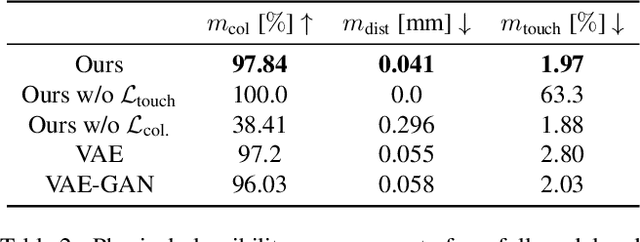
The physical properties of an object, such as mass, significantly affect how we manipulate it with our hands. Surprisingly, this aspect has so far been neglected in prior work on 3D motion synthesis. To improve the naturalness of the synthesized 3D hand object motions, this work proposes MACS the first MAss Conditioned 3D hand and object motion Synthesis approach. Our approach is based on cascaded diffusion models and generates interactions that plausibly adjust based on the object mass and interaction type. MACS also accepts a manually drawn 3D object trajectory as input and synthesizes the natural 3D hand motions conditioned by the object mass. This flexibility enables MACS to be used for various downstream applications, such as generating synthetic training data for ML tasks, fast animation of hands for graphics workflows, and generating character interactions for computer games. We show experimentally that a small-scale dataset is sufficient for MACS to reasonably generalize across interpolated and extrapolated object masses unseen during the training. Furthermore, MACS shows moderate generalization to unseen objects, thanks to the mass-conditioned contact labels generated by our surface contact synthesis model ConNet. Our comprehensive user study confirms that the synthesized 3D hand-object interactions are highly plausible and realistic.
Egocentric Whole-Body Motion Capture with FisheyeViT and Diffusion-Based Motion Refinement
Dec 02, 2023
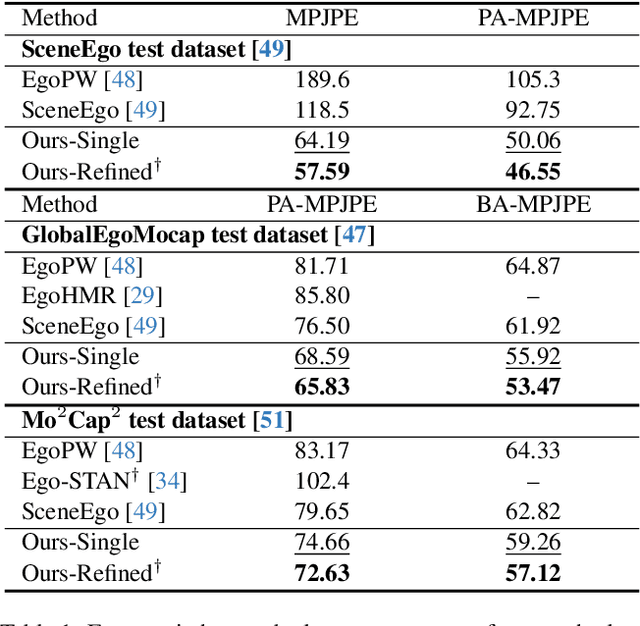
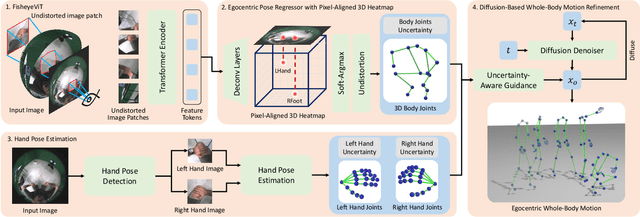
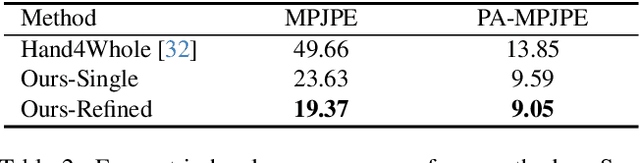
In this work, we explore egocentric whole-body motion capture using a single fisheye camera, which simultaneously estimates human body and hand motion. This task presents significant challenges due to three factors: the lack of high-quality datasets, fisheye camera distortion, and human body self-occlusion. To address these challenges, we propose a novel approach that leverages FisheyeViT to extract fisheye image features, which are subsequently converted into pixel-aligned 3D heatmap representations for 3D human body pose prediction. For hand tracking, we incorporate dedicated hand detection and hand pose estimation networks for regressing 3D hand poses. Finally, we develop a diffusion-based whole-body motion prior model to refine the estimated whole-body motion while accounting for joint uncertainties. To train these networks, we collect a large synthetic dataset, EgoWholeBody, comprising 840,000 high-quality egocentric images captured across a diverse range of whole-body motion sequences. Quantitative and qualitative evaluations demonstrate the effectiveness of our method in producing high-quality whole-body motion estimates from a single egocentric camera.
Spectral Graphormer: Spectral Graph-based Transformer for Egocentric Two-Hand Reconstruction using Multi-View Color Images
Aug 21, 2023We propose a novel transformer-based framework that reconstructs two high fidelity hands from multi-view RGB images. Unlike existing hand pose estimation methods, where one typically trains a deep network to regress hand model parameters from single RGB image, we consider a more challenging problem setting where we directly regress the absolute root poses of two-hands with extended forearm at high resolution from egocentric view. As existing datasets are either infeasible for egocentric viewpoints or lack background variations, we create a large-scale synthetic dataset with diverse scenarios and collect a real dataset from multi-calibrated camera setup to verify our proposed multi-view image feature fusion strategy. To make the reconstruction physically plausible, we propose two strategies: (i) a coarse-to-fine spectral graph convolution decoder to smoothen the meshes during upsampling and (ii) an optimisation-based refinement stage at inference to prevent self-penetrations. Through extensive quantitative and qualitative evaluations, we show that our framework is able to produce realistic two-hand reconstructions and demonstrate the generalisation of synthetic-trained models to real data, as well as real-time AR/VR applications.
Grad-PU: Arbitrary-Scale Point Cloud Upsampling via Gradient Descent with Learned Distance Functions
Apr 24, 2023Most existing point cloud upsampling methods have roughly three steps: feature extraction, feature expansion and 3D coordinate prediction. However,they usually suffer from two critical issues: (1)fixed upsampling rate after one-time training, since the feature expansion unit is customized for each upsampling rate; (2)outliers or shrinkage artifact caused by the difficulty of precisely predicting 3D coordinates or residuals of upsampled points. To adress them, we propose a new framework for accurate point cloud upsampling that supports arbitrary upsampling rates. Our method first interpolates the low-res point cloud according to a given upsampling rate. And then refine the positions of the interpolated points with an iterative optimization process, guided by a trained model estimating the difference between the current point cloud and the high-res target. Extensive quantitative and qualitative results on benchmarks and downstream tasks demonstrate that our method achieves the state-of-the-art accuracy and efficiency.
Learning Personalized High Quality Volumetric Head Avatars from Monocular RGB Videos
Apr 04, 2023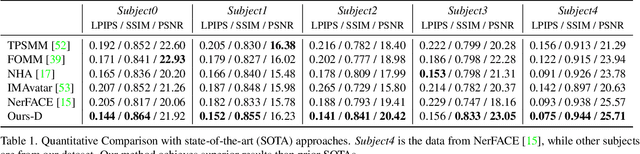
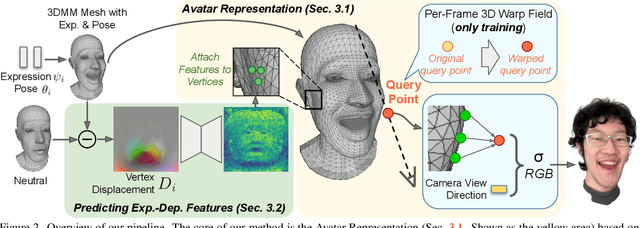
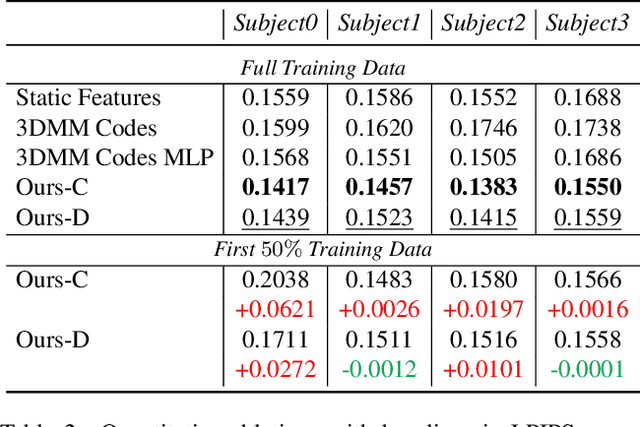
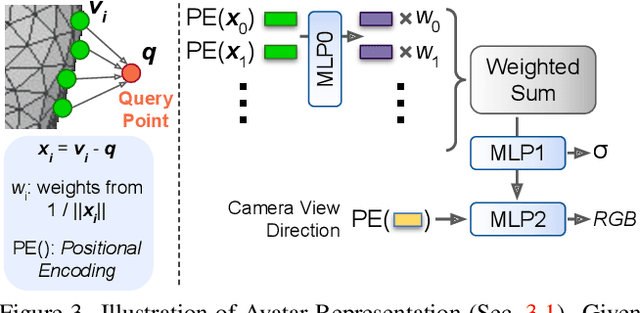
We propose a method to learn a high-quality implicit 3D head avatar from a monocular RGB video captured in the wild. The learnt avatar is driven by a parametric face model to achieve user-controlled facial expressions and head poses. Our hybrid pipeline combines the geometry prior and dynamic tracking of a 3DMM with a neural radiance field to achieve fine-grained control and photorealism. To reduce over-smoothing and improve out-of-model expressions synthesis, we propose to predict local features anchored on the 3DMM geometry. These learnt features are driven by 3DMM deformation and interpolated in 3D space to yield the volumetric radiance at a designated query point. We further show that using a Convolutional Neural Network in the UV space is critical in incorporating spatial context and producing representative local features. Extensive experiments show that we are able to reconstruct high-quality avatars, with more accurate expression-dependent details, good generalization to out-of-training expressions, and quantitatively superior renderings compared to other state-of-the-art approaches.