 Add to Chrome
 Add to Firefox
 Add to Edge
$τ_0$-VLA: a Hierarchical Robot Foundation Model with World-Model-Guided Test-Time Computation
Aug 17, 2026
Long-horizon robot manipulation requires a robot to both execute individual skills reliably and sequence them coherently over extended tasks. Most hierarchical vision-language-action (VLA) models make each such decision with a single forward pass, leaving no mechanism to allocate additional computation to difficult or consequential choices. We introduce $τ_0$-VLA, a hierarchical robot foundation model that formulates high-level subtask generation as a compute-scalable inference problem through world-model-guided test-time computation. At each inference step, the high-level policy uses execution memory to generate a subtask and, when needed, searches over alternatives before committing to its output. A low-level policy then executes the generated subtask across multiple robot embodiments. The policy is trained on 40,115 hours of heterogeneous real-world data with multimodal co-training. Across in-domain and distribution-shifted settings, allocating additional test-time computation substantially improves next-subtask prediction accuracy, and these gains translate into higher closed-loop success on long-horizon robot manipulation tasks.

$τ_0$-WM: A Unified Video-Action World Model for Robotic Manipulation
May 31, 2026Robotic manipulation requires models that generate executable actions while anticipating and evaluating their future consequences before physical execution. We present $τ_0$-World Model ($τ_0$-WM), a unified video-action world model that integrates policy learning, video prediction, and action evaluation within a single future-predictive framework. Built on a shared video diffusion backbone, $τ_0$-WM provides two complementary interfaces. First, a video action model jointly predicts future visual latents and continuous action chunks from multi-view observations, language instructions, and robot state. Second, an action-conditioned video simulator rolls out candidate action chunks into multi-view futures and predicts dense task-progress scores. The model is trained on approximately $27{,}300$ hours of real-robot teleoperation, UMI-style interaction, egocentric human videos, and rollout or failure trajectories using modality-specific supervision masks. At inference time, $τ_0$-WM uses test-time computation to sample action candidates, rank them with re-denoising consistency, and invoke simulator-based rectification for low-quality candidates. On challenging long-horizon and fine-grained robotic manipulation tasks, $τ_0$-WM shows superior performance over other relevant baselines.
Say, Dream, and Act: Learning Video World Models for Instruction-Driven Robot Manipulation
Feb 11, 2026Robotic manipulation requires anticipating how the environment evolves in response to actions, yet most existing systems lack this predictive capability, often resulting in errors and inefficiency. While Vision-Language Models (VLMs) provide high-level guidance, they cannot explicitly forecast future states, and existing world models either predict only short horizons or produce spatially inconsistent frames. To address these challenges, we propose a framework for fast and predictive video-conditioned action. Our approach first selects and adapts a robust video generation model to ensure reliable future predictions, then applies adversarial distillation for fast, few-step video generation, and finally trains an action model that leverages both generated videos and real observations to correct spatial errors. Extensive experiments show that our method produces temporally coherent, spatially accurate video predictions that directly support precise manipulation, achieving significant improvements in embodiment consistency, spatial referring ability, and task completion over existing baselines. Codes & Models will be released.
RealCamo: Boosting Real Camouflage Synthesis with Layout Controls and Textual-Visual Guidance
Dec 28, 2025Camouflaged image generation (CIG) has recently emerged as an efficient alternative for acquiring high-quality training data for camouflaged object detection (COD). However, existing CIG methods still suffer from a substantial gap to real camouflaged imagery: generated images either lack sufficient camouflage due to weak visual similarity, or exhibit cluttered backgrounds that are semantically inconsistent with foreground targets. To address these limitations, we propose ReamCamo, a unified out-painting based framework for realistic camouflaged image generation. ReamCamo explicitly introduces additional layout controls to regulate global image structure, thereby improving semantic coherence between foreground objects and generated backgrounds. Moreover, we construct a multi-modal textual-visual condition by combining a unified fine-grained textual task description with texture-oriented background retrieval, which jointly guides the generation process to enhance visual fidelity and realism. To quantitatively assess camouflage quality, we further introduce a background-foreground distribution divergence metric that measures the effectiveness of camouflage in generated images. Extensive experiments and visualizations demonstrate the effectiveness of our proposed framework.
Efficient Algorithms for Empirical Group Distributional Robust Optimization and Beyond
Mar 06, 2024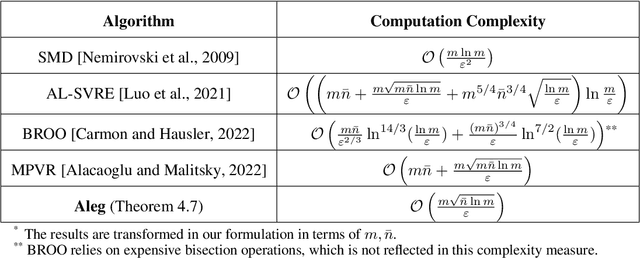
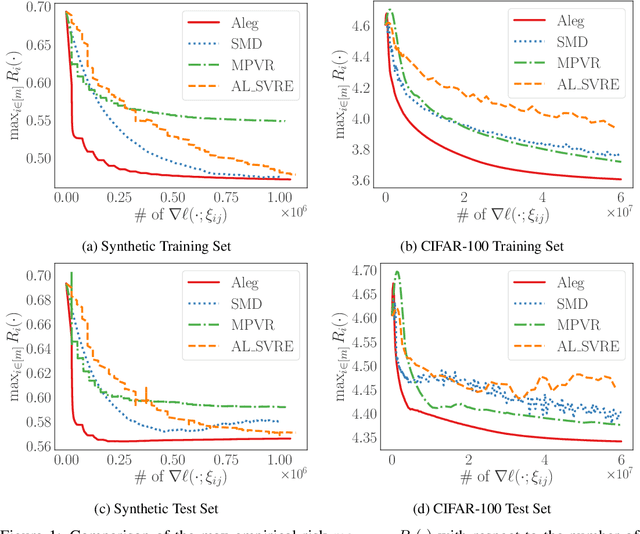
We investigate the empirical counterpart of group distributionally robust optimization (GDRO), which aims to minimize the maximal empirical risk across $m$ distinct groups. We formulate empirical GDRO as a $\textit{two-level}$ finite-sum convex-concave minimax optimization problem and develop a stochastic variance reduced mirror prox algorithm. Unlike existing methods, we construct the stochastic gradient by per-group sampling technique and perform variance reduction for all groups, which fully exploits the $\textit{two-level}$ finite-sum structure of empirical GDRO. Furthermore, we compute the snapshot and mirror snapshot point by a one-index-shifted weighted average, which distinguishes us from the naive ergodic average. Our algorithm also supports non-constant learning rates, which is different from existing literature. We establish convergence guarantees both in expectation and with high probability, demonstrating a complexity of $\mathcal{O}\left(\frac{m\sqrt{\bar{n}\ln{m}}}{\varepsilon}\right)$, where $\bar n$ is the average number of samples among $m$ groups. Remarkably, our approach outperforms the state-of-the-art method by a factor of $\sqrt{m}$. Furthermore, we extend our methodology to deal with the empirical minimax excess risk optimization (MERO) problem and manage to give the expectation bound and the high probability bound, accordingly. The complexity of our empirical MERO algorithm matches that of empirical GDRO at $\mathcal{O}\left(\frac{m\sqrt{\bar{n}\ln{m}}}{\varepsilon}\right)$, significantly surpassing the bounds of existing methods.
A Unified Prompt-Guided In-Context Inpainting Framework for Reference-based Image Manipulations
May 19, 2023
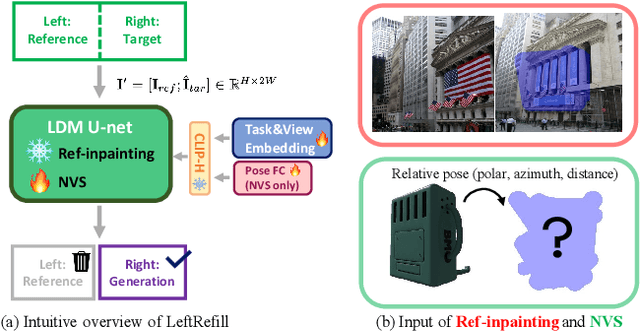
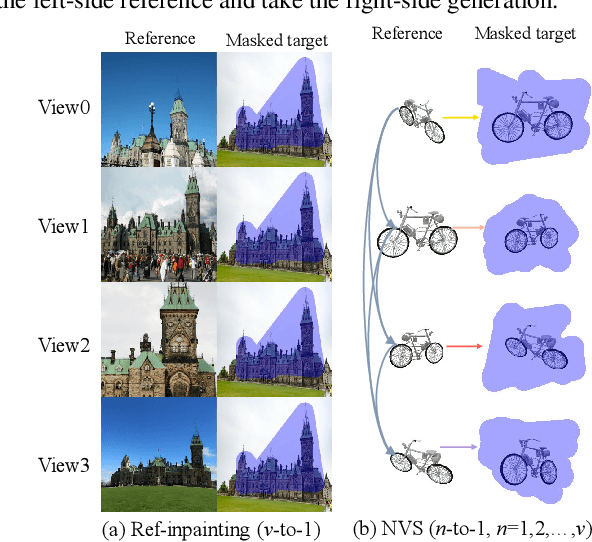
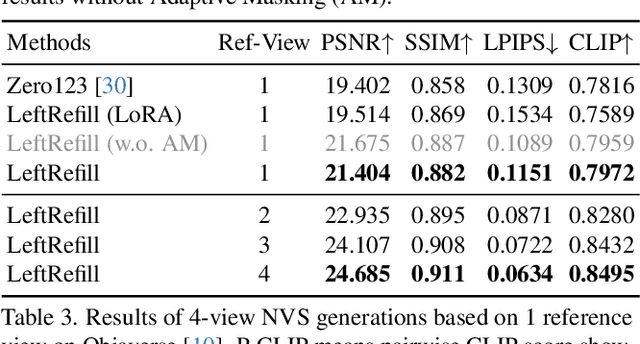
Recent advancements in Text-to-Image (T2I) generative models have yielded impressive results in generating high-fidelity images based on consistent text prompts. However, there is a growing interest in exploring the potential of these models for more diverse reference-based image manipulation tasks that require spatial understanding and visual context. Previous approaches have achieved this by incorporating additional control modules or fine-tuning the generative models specifically for each task until convergence. In this paper, we propose a different perspective. We conjecture that current large-scale T2I generative models already possess the capability to perform these tasks but are not fully activated within the standard generation process. To unlock these capabilities, we introduce a unified Prompt-Guided In-Context inpainting (PGIC) framework, which leverages large-scale T2I models to re-formulate and solve reference-guided image manipulations. In the PGIC framework, the reference and masked target are stitched together as a new input for the generative models, enabling the filling of masked regions as producing final results. Furthermore, we demonstrate that the self-attention modules in T2I models are well-suited for establishing spatial correlations and efficiently addressing challenging reference-guided manipulations. These large T2I models can be effectively driven by task-specific prompts with minimal training cost or even with frozen backbones. We synthetically evaluate the effectiveness of the proposed PGIC framework across various tasks, including reference-guided image inpainting, faithful inpainting, outpainting, local super-resolution, and novel view synthesis. Our results show that PGIC achieves significantly better performance while requiring less computation compared to other fine-tuning based approaches.