 Add to Chrome
 Add to Firefox
 Add to Edge
RSGMamba: Reliability-Aware Self-Gated State Space Model for Multimodal Semantic Segmentation
Apr 14, 2026
Multimodal semantic segmentation has emerged as a powerful paradigm for enhancing scene understanding by leveraging complementary information from multiple sensing modalities (e.g., RGB, depth, and thermal). However, existing cross-modal fusion methods often implicitly assume that all modalities are equally reliable, which can lead to feature degradation when auxiliary modalities are noisy, misaligned, or incomplete. In this paper, we revisit cross-modal fusion from the perspective of modality reliability and propose a novel framework termed the Reliability-aware Self-Gated State Space Model (RSGMamba). At the core of our method is the Reliability-aware Self-Gated Mamba Block (RSGMB), which explicitly models modality reliability and dynamically regulates cross-modal interactions through a self-gating mechanism. Unlike conventional fusion strategies that indiscriminately exchange information across modalities, RSGMB enables reliability-aware feature selection and enhancing informative feature aggregation. In addition, a lightweight Local Cross-Gated Modulation (LCGM) is incorporated to refine fine-grained spatial details, complementing the global modeling capability of RSGMB. Extensive experiments demonstrate that RSGMamba achieves state-of-the-art performance on both RGB-D and RGB-T semantic segmentation benchmarks, resulting 58.8% / 54.0% mIoU on NYUDepth V2 and SUN-RGBD (+0.4% / +0.7% over prior best), and 61.1% / 88.9% mIoU on MFNet and PST900 (up to +1.6%), with only 48.6M parameters, thereby validating the effectiveness and superiority of the proposed approach.

Fast Extrinsic Calibration for Multiple Inertial Measurement Units in Visual-Inertial System
Sep 24, 2024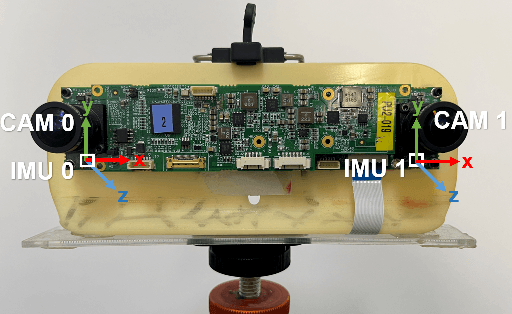
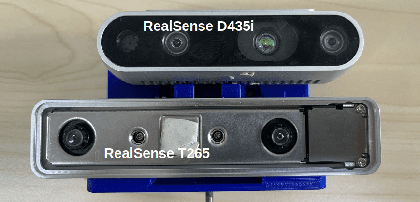
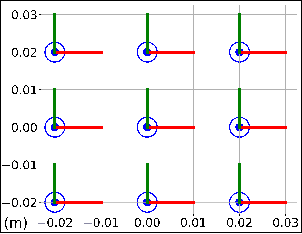
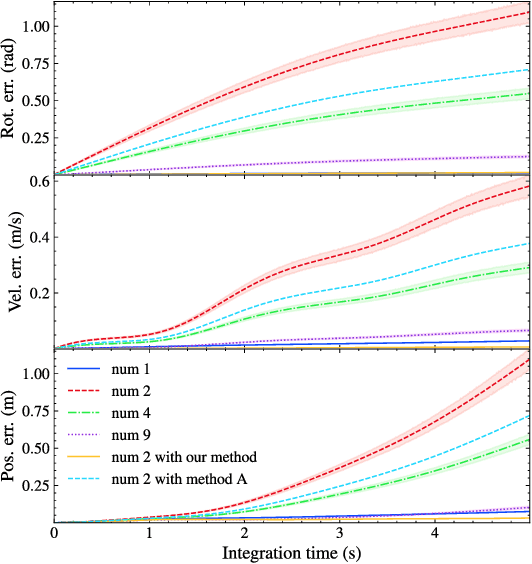
In this paper, we propose a fast extrinsic calibration method for fusing multiple inertial measurement units (MIMU) to improve visual-inertial odometry (VIO) localization accuracy. Currently, data fusion algorithms for MIMU highly depend on the number of inertial sensors. Based on the assumption that extrinsic parameters between inertial sensors are perfectly calibrated, the fusion algorithm provides better localization accuracy with more IMUs, while neglecting the effect of extrinsic calibration error. Our method builds two non-linear least-squares problems to estimate the MIMU relative position and orientation separately, independent of external sensors and inertial noises online estimation. Then we give the general form of the virtual IMU (VIMU) method and propose its propagation on manifold. We perform our method on datasets, our self-made sensor board, and board with different IMUs, validating the superiority of our method over competing methods concerning speed, accuracy, and robustness. In the simulation experiment, we show that only fusing two IMUs with our calibration method to predict motion can rival nine IMUs. Real-world experiments demonstrate better localization accuracy of the VIO integrated with our calibration method and VIMU propagation on manifold.
Unsupervised Monocular Depth Estimation Based on Hierarchical Feature-Guided Diffusion
Jun 14, 2024
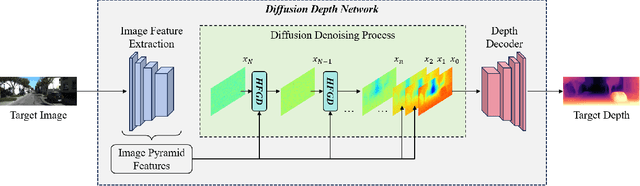
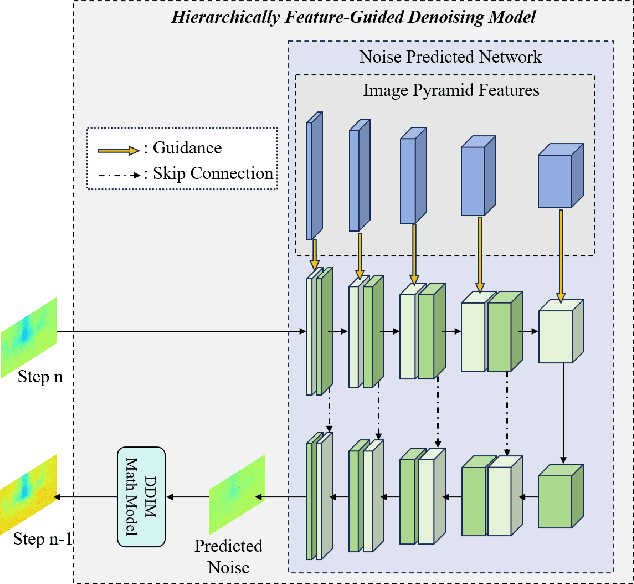
Unsupervised monocular depth estimation has received widespread attention because of its capability to train without ground truth. In real-world scenarios, the images may be blurry or noisy due to the influence of weather conditions and inherent limitations of the camera. Therefore, it is particularly important to develop a robust depth estimation model. Benefiting from the training strategies of generative networks, generative-based methods often exhibit enhanced robustness. In light of this, we employ a well-converging diffusion model among generative networks for unsupervised monocular depth estimation. Additionally, we propose a hierarchical feature-guided denoising module. This model significantly enriches the model's capacity for learning and interpreting depth distribution by fully leveraging image features to guide the denoising process. Furthermore, we explore the implicit depth within reprojection and design an implicit depth consistency loss. This loss function serves to enhance the performance of the model and ensure the scale consistency of depth within a video sequence. We conduct experiments on the KITTI, Make3D, and our self-collected SIMIT datasets. The results indicate that our approach stands out among generative-based models, while also showcasing remarkable robustness.