 Add to Chrome
 Add to Firefox
 Add to Edge
Paths: Prompt-aware Spatio-temporal Transformer with Hierarchical Multi-modal Fusion for RGB-Event Video Person Re-Identification
Aug 13, 2026
RGB-Event Video Person Re-Identification (RE-VReID) aims to retrieve specific person across non-overlapping cameras with complementary RGB videos and event streams. However, existing methods often decouple spatial and temporal modeling, which limits their interaction. In addition, global-level RGB-Event fusion fails to fully exploit fine-grained discriminative cues. To address these issues, we propose Paths, a unified framework with spatio-temporal modeling and hierarchical multi-modal fusion for RE-VReID. Specifically, we first design a Memory-Augmented Backbone (MAB) to maintain modality-specific identity prototypes for stable intra-modal representation learning. Then, we propose a Prompt-aware Spatio-temporal Transformer (PST) to jointly model spatial and temporal cues within a unified Transformer. Finally, we introduce a Hierarchical Multi-modal Fusion (HMF) to integrate RGB and event features at global and local levels. With these modules, our framework can learn robust and discriminative representations for RE-VReID. Extensive experiments on three public RE-VReID benchmarks including EvReID, MARS and iLIDS-VID, demonstrate the effectiveness of our proposed method. The code is available at https://github.com/Reflection0427/Paths.

I Seek You in Videos: Identity-Conditioned Queries for Person-Centric Video Reasoning
Aug 07, 2026Real-world video reasoning often involves multimodal, multi-source inputs, whereas existing video reasoning tasks typically assume a simplified video-text setting, limiting identity matching and person-centric reasoning. To bridge this gap, we introduce the Identity-conditioned Queries (ICQ) task, in which models are required to jointly associate and interpret an input video and a reference image of a person, and leverage this conditioning to address identity grounding, behavior understanding, and temporal reasoning, among other challenges. Building on ICQ, we present ISYV (I Seek You in Videos), a systematic solution comprising three components: (1) ISYV-Bench, a challenging evaluation benchmark with 1,377 real-world complex videos and 1,377 question-answer pairs, organized into six difficulty levels spanning capabilities from identity recognition to causal reasoning; (2) ISYV-75K, a large-scale training set of 75K high-quality samples constructed via automated annotation, multi-stage verification, and manual review; and (3) ISYV-Framework, containing an ICQ-oriented model and training strategy for learning to exploit informative video shots without additional shot-level annotations. Extensive experiments show that both mainstream closed-source and open-source MLLMs struggle on ISYV-Bench, especially in cross-domain identity matching and long-horizon tracking. ISYV-Model outperforms strong baselines and in some aspects approaches closed-source performance. Overall, ISYV provides a unified task definition, scalable datasets/benchmarks, and modeling insights for person-centric video reasoning.
PerceptionBench: Evaluating Atomic Visual Perception in Multimodal Large Language Models
Jul 27, 2026We introduce PerceptionBench, a benchmark specifically designed to evaluate the atomic visual perception capabilities of Multimodal Large Language Models (MLLMs). Existing benchmarks often fail to isolate perception: holistic evaluations conflate perceptual errors with failures in reasoning or domain knowledge, while application-driven benchmarks only cover narrow, fragmented domains shaped by heuristic designs. To address these limitations, PerceptionBench adopts a bottom-up approach: by diagnosing the earliest failure points in the responses of frontier MLLMs across 42 existing benchmarks, we construct an error taxonomy whose perception branch defines ten atomic perceptual capabilities. Guided by this taxonomy, we construct 3,000 verified questions with short, unambiguous answers, each isolating a single capability, with difficulty stemming from perception rather than reasoning or knowledge. Benchmark results across sixteen frontier MLLMs reveal that atomic perception remains largely unsolved---no model reaches 60\% accuracy, perception-related hallucination is the weakest capability on average, and similar overall scores conceal sharply divergent capability profiles. PerceptionBench thus provides a capability-level standard for measuring and diagnosing the visual perception boundaries of MLLMs.
Kimi K3: Open Frontier Intelligence
Jul 27, 2026We introduce Kimi K3, a 2.8T parameter Mixture-of-Experts model with 104 billion activated parameters, native vision capabilities, and a 1-million-token context window. Kimi K3 is built on Kimi Delta Attention and Attention Residuals, which improve information flow across sequence length and model depth. Together with Stable LatentMoE, which effectively activates 16 of 896 routed experts per token, and refined training and data recipes, these advances yield an approximately 2.5x improvement in overall scaling efficiency over Kimi K2. Post-training highlights reinforcement learning across general, agentic, and coding domains and multiple reasoning-effort levels, enabling compositional generalization and robust long-horizon execution. At 2.8T scale, Kimi K3 is supported by infrastructure advances in multiple areas: algorithm-system co-design for KDA, perfectly balanced expert-parallel training with efficient memory management, million-token agentic RL with persistent rollout and sandbox states, and deployment innovations. Extensive evaluations show that Kimi K3 achieves frontier-level performance across long-horizon coding, agentic, knowledge, reasoning, and vision tasks. While its overall performance still trails the most powerful proprietary models, namely Claude Fable 5 and GPT-5.6 Sol, Kimi K3 consistently outperforms other open and proprietary models evaluated in our suite. We release the full Kimi K3 model weights to facilitate future research and accelerate the broader deployment and adoption of frontier intelligence.
SARA: Unlocking Multilingual Knowledge in Mixture-of-Experts via Semantically Anchored Routing Alignment
Jun 24, 2026Sparse Mixture-of-Experts (MoE) architectures have emerged as an increasingly influential paradigm as they offer a strategic balance between parameter scalability and computational efficiency. However, low-resource languages, which suffer from a scarcity of high-quality training data, often have their tokens routed to different experts than those predominantly activated by high-resource inputs, which limits cross-lingual expert sharing. This cross-lingual routing divergence consequently hinders their efficacy in multilingual contexts. To address this issue, we propose SARA (Semantically Anchored Routing Alignment), a framework designed to transfer specialized capabilities from high-resource languages as anchors to low-resource languages. SARA explicitly aligns the routing distribution of multilingual inputs with high-resource semantic anchors using a symmetric Jensen-Shannon (JS) divergence constraint. Unlike traditional distillation methods that operate on output logits, SARA directly aligns the internal routing distributions of MoE layers, encouraging mechanistic consistency in expert selection across languages. We conduct experiments on 2 LLMs across 5 low-resource languages and 3 benchmarks. Experiment results demonstrate that SARA outperforms standard instruction tuning, e.g., +0.8% on Qwen3-30B-A3B and +1.2% on Phi-3.5-MoE-instruct on Global-MMLU. Further analyses show that SARA effectively addresses performance bottlenecks in low-resource languages, providing a scalable pathway to enhance multilingual capabilities in sparse architectures.
Do Gender Cues Affect LLM Value Trade-offs? Evidence from a Controlled Decision Benchmark
Jun 01, 2026Large language models are increasingly used in value-sensitive decision settings, where irrelevant demographic cues should not alter judgments. We construct the Realistic Value Decision Benchmark (RVDB), a controlled benchmark that varies only the role-gender configuration while holding the scenario, ordered value pair, roles, candidate decisions, Value Distance, and Decision Severity fixed. Using a position-balanced evaluation across seven models, we test whether models preserve decision invariance under gender perturbations and whether their self-attributions reflect observed behavioral changes. We find that explicit gender cues induce bounded but systematic decision flips, including under an explicit gender-attribution prompt that asks models to report whether gender influenced their choice. Cross-gender role swaps reveal a consistent female-proposed-decision asymmetry, while models often attribute flipped decisions to No Influence or other non-gender factors. Further analysis shows that gender effects concentrate near less determinate value boundaries and under more severe decision contexts, suggesting that gender cues act as local boundary-shifting factors rather than global overrides of value reasoning. Value rankings remain largely stable, but ordered value-pair trade-offs shift unevenly across role-gender configurations. These results show that gender can enter LLM value trade-offs behaviorally while remaining obscured in self-attribution, motivating controlled behavioral audits beyond explanation-based evaluation.
From Insight to Action: A Novel Framework for Interpretability-Guided Data Selection in Large Language Models
Apr 28, 2026While mechanistic interpretability tools like Sparse Autoencoders (SAEs) can uncover meaningful features within Large Language Models (LLMs), a critical gap remains in transforming these insights into practical actions for model optimization. We bridge this gap with the hypothesis that data selection guided by a model's internal task features is a effective training strategy. Inspired by this, we propose Interpretability-Guided Data Selection (IGDS), a framework that first identifies these causal task features through frequency recall and interventional filtering, then selects ``Feature-Resonant Data'' that maximally activates task features for fine-tuning. We validate IGDS on mathematical reasoning, summarization, and translation tasks within Gemma-2, LLaMA-3.1, and Qwen3 models. Our experiments demonstrate exceptional data efficiency: on the Math task, IGDS surpasses full-dataset fine-tuning by a remarkable 17.4% on Gemma-2-2B while using only 50% of the data, and outperforms established baselines focused on data quality and diversity. Analysis confirms a strong positive correlation between feature amplification and task performance improvement. IGDS thus provides a direct and effective framework to enhance LLMs by leveraging their internal mechanisms, validating our core hypothesis.
Kimi K2.5: Visual Agentic Intelligence
Feb 02, 2026We introduce Kimi K2.5, an open-source multimodal agentic model designed to advance general agentic intelligence. K2.5 emphasizes the joint optimization of text and vision so that two modalities enhance each other. This includes a series of techniques such as joint text-vision pre-training, zero-vision SFT, and joint text-vision reinforcement learning. Building on this multimodal foundation, K2.5 introduces Agent Swarm, a self-directed parallel agent orchestration framework that dynamically decomposes complex tasks into heterogeneous sub-problems and executes them concurrently. Extensive evaluations show that Kimi K2.5 achieves state-of-the-art results across various domains including coding, vision, reasoning, and agentic tasks. Agent Swarm also reduces latency by up to $4.5\times$ over single-agent baselines. We release the post-trained Kimi K2.5 model checkpoint to facilitate future research and real-world applications of agentic intelligence.
WorldVQA: Measuring Atomic World Knowledge in Multimodal Large Language Models
Jan 28, 2026We introduce WorldVQA, a benchmark designed to evaluate the atomic visual world knowledge of Multimodal Large Language Models (MLLMs). Unlike current evaluations, which often conflate visual knowledge retrieval with reasoning, WorldVQA decouples these capabilities to strictly measure "what the model memorizes." The benchmark assesses the atomic capability of grounding and naming visual entities across a stratified taxonomy, spanning from common head-class objects to long-tail rarities. We expect WorldVQA to serve as a rigorous test for visual factuality, thereby establishing a standard for assessing the encyclopedic breadth and hallucination rates of current and next-generation frontier models.
Kimi K2: Open Agentic Intelligence
Jul 28, 2025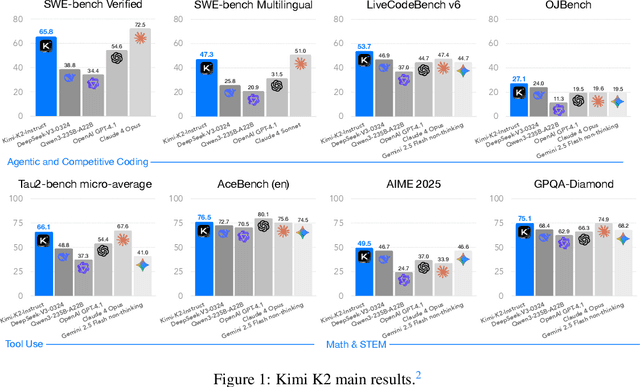
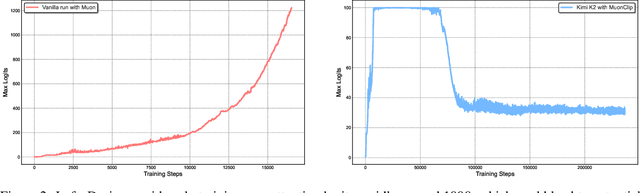
We introduce Kimi K2, a Mixture-of-Experts (MoE) large language model with 32 billion activated parameters and 1 trillion total parameters. We propose the MuonClip optimizer, which improves upon Muon with a novel QK-clip technique to address training instability while enjoying the advanced token efficiency of Muon. Based on MuonClip, K2 was pre-trained on 15.5 trillion tokens with zero loss spike. During post-training, K2 undergoes a multi-stage post-training process, highlighted by a large-scale agentic data synthesis pipeline and a joint reinforcement learning (RL) stage, where the model improves its capabilities through interactions with real and synthetic environments. Kimi K2 achieves state-of-the-art performance among open-source non-thinking models, with strengths in agentic capabilities. Notably, K2 obtains 66.1 on Tau2-Bench, 76.5 on ACEBench (En), 65.8 on SWE-Bench Verified, and 47.3 on SWE-Bench Multilingual -- surpassing most open and closed-sourced baselines in non-thinking settings. It also exhibits strong capabilities in coding, mathematics, and reasoning tasks, with a score of 53.7 on LiveCodeBench v6, 49.5 on AIME 2025, 75.1 on GPQA-Diamond, and 27.1 on OJBench, all without extended thinking. These results position Kimi K2 as one of the most capable open-source large language models to date, particularly in software engineering and agentic tasks. We release our base and post-trained model checkpoints to facilitate future research and applications of agentic intelligence.