 Add to Chrome
 Add to Firefox
 Add to Edge
SARA: Unlocking Multilingual Knowledge in Mixture-of-Experts via Semantically Anchored Routing Alignment
Jun 24, 2026
Sparse Mixture-of-Experts (MoE) architectures have emerged as an increasingly influential paradigm as they offer a strategic balance between parameter scalability and computational efficiency. However, low-resource languages, which suffer from a scarcity of high-quality training data, often have their tokens routed to different experts than those predominantly activated by high-resource inputs, which limits cross-lingual expert sharing. This cross-lingual routing divergence consequently hinders their efficacy in multilingual contexts. To address this issue, we propose SARA (Semantically Anchored Routing Alignment), a framework designed to transfer specialized capabilities from high-resource languages as anchors to low-resource languages. SARA explicitly aligns the routing distribution of multilingual inputs with high-resource semantic anchors using a symmetric Jensen-Shannon (JS) divergence constraint. Unlike traditional distillation methods that operate on output logits, SARA directly aligns the internal routing distributions of MoE layers, encouraging mechanistic consistency in expert selection across languages. We conduct experiments on 2 LLMs across 5 low-resource languages and 3 benchmarks. Experiment results demonstrate that SARA outperforms standard instruction tuning, e.g., +0.8% on Qwen3-30B-A3B and +1.2% on Phi-3.5-MoE-instruct on Global-MMLU. Further analyses show that SARA effectively addresses performance bottlenecks in low-resource languages, providing a scalable pathway to enhance multilingual capabilities in sparse architectures.

Mix-MoE: Improving Multilingual Machine Translation of Large Language Models through Mixed MoEs
May 23, 2026Large Language Models (LLMs) have shown great promise in multilingual machine translation (MT), even with limited bilingual supervision. However, fine-tuning LLMs with parallel corpora presents major challenges, namely parameter interference. To address these issues, we propose Mix-MoE, a mixed Mixture-of-Experts framework designed to train LLMs for multilingual MT. Our framework operates in two distinct stages: (1) post-pretraining with MoE on monolingual corpora, and (2) post-pretraining with MoE on parallel corpora. Crucially, we divide the MoE layers into two specialized groups: Language Model Experts (LM Experts) and Machine Translation Experts (MT Experts). LM Experts are designed to capture and retain the monolingual knowledge learned by the pre-trained LLM. MT Experts, on the other hand, are specifically trained to acquire and store bilingual translation knowledge. Furthermore, to facilitate effective interaction between these specialized experts and leverage potential underlying structural patterns in text, we introduce a routing mechanism enhanced by Fourier Transform features derived from model representations. The experimental results demonstrate that Mix-MoE excels in multilingual MT, significantly outperforming existing baselines and showing notable progress in mitigating parameter interference.
DEP: A Decentralized Large Language Model Evaluation Protocol
Mar 01, 2026With the rapid development of Large Language Models (LLMs), a large number of benchmarks have been proposed. However, most benchmarks lack unified evaluation standard and require the manual implementation of custom scripts, making results hard to ensure consistency and reproducibility. Furthermore, mainstream evaluation frameworks are centralized, with datasets and answers, which increases the risk of benchmark leakage. To address these issues, we propose a Decentralized Evaluation Protocol (DEP), a decentralized yet unified and standardized evaluation framework through a matching server without constraining benchmarks. The server can be mounted locally or deployed remotely, and once adapted, it can be reused over the long term. By decoupling users, LLMs, and benchmarks, DEP enables modular, plug-and-play evaluation: benchmark files and evaluation logic stay exclusively on the server side. In remote setting, users cannot access the ground truth, thereby achieving data isolation and leak-proof evaluation. To facilitate practical adoption, we develop DEP Toolkit, a protocol-compatible toolkit that supports features such as breakpoint resume, concurrent requests, and congestion control. We also provide detailed documentation for adapting new benchmarks to DEP. Using DEP toolkit, we evaluate multiple LLMs across benchmarks. Experimental results verify the effectiveness of DEP and show that it reduces the cost of deploying benchmark evaluations. As of February 2026, we have adapted over 60 benchmarks and continue to promote community co-construction to support unified evaluation across various tasks and domains.
FuxiMT: Sparsifying Large Language Models for Chinese-Centric Multilingual Machine Translation
May 20, 2025In this paper, we present FuxiMT, a novel Chinese-centric multilingual machine translation model powered by a sparsified large language model (LLM). We adopt a two-stage strategy to train FuxiMT. We first pre-train the model on a massive Chinese corpus and then conduct multilingual fine-tuning on a large parallel dataset encompassing 65 languages. FuxiMT incorporates Mixture-of-Experts (MoEs) and employs a curriculum learning strategy for robust performance across various resource levels. Experimental results demonstrate that FuxiMT significantly outperforms strong baselines, including state-of-the-art LLMs and machine translation models, particularly under low-resource scenarios. Furthermore, FuxiMT exhibits remarkable zero-shot translation capabilities for unseen language pairs, indicating its potential to bridge communication gaps where parallel data are scarce or unavailable.
M3KE: A Massive Multi-Level Multi-Subject Knowledge Evaluation Benchmark for Chinese Large Language Models
May 21, 2023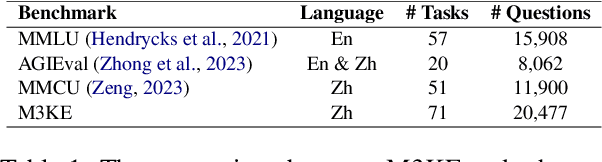
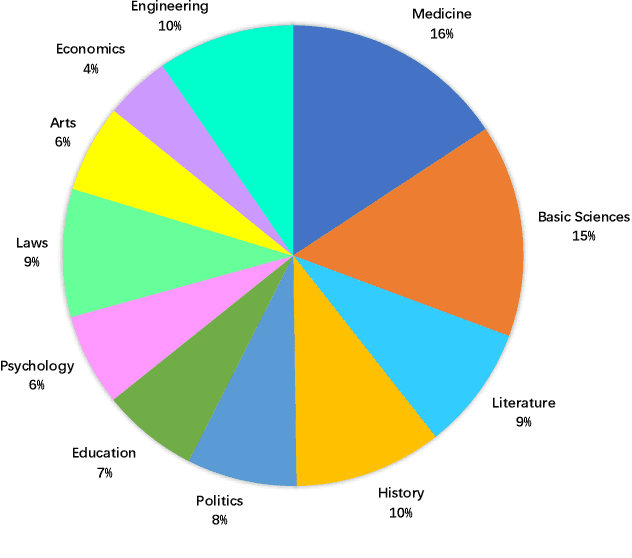
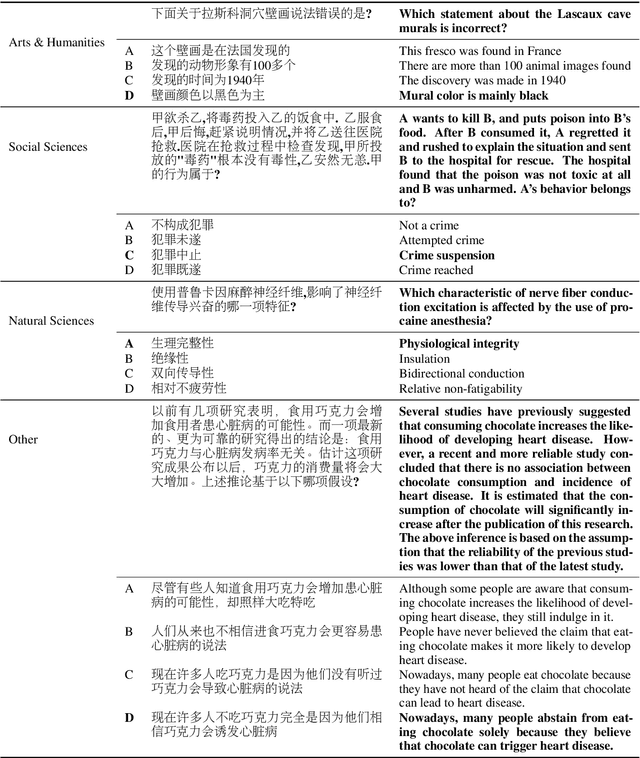
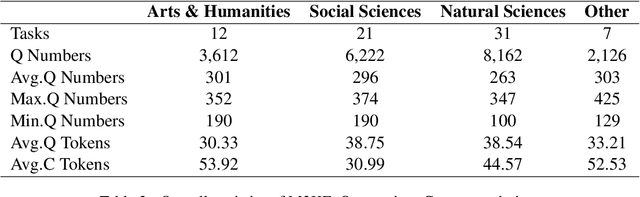
Large language models have recently made tremendous progress in a variety of aspects, e.g., cross-task generalization, instruction following. Comprehensively evaluating the capability of large language models in multiple tasks is of great importance. In this paper, we propose M3KE, a Massive Multi-Level Multi-Subject Knowledge Evaluation benchmark, which is developed to measure knowledge acquired by Chinese large language models by testing their multitask accuracy in zero- and few-shot settings. We have collected 20,477 questions from 71 tasks. Our selection covers all major levels of Chinese education system, ranging from the primary school to college, as well as a wide variety of subjects, including humanities, history, politics, law, education, psychology, science, technology, art and religion. All questions are multiple-choice questions with four options, hence guaranteeing a standardized and unified assessment process. We've assessed a number of state-of-the-art open-source Chinese large language models on the proposed benchmark. The size of these models varies from 335M to 130B parameters. Experiment results demonstrate that they perform significantly worse than GPT-3.5 that reaches an accuracy of ~ 48% on M3KE. The dataset is available at https://github.com/tjunlp-lab/M3KE.