 Add to Chrome
 Add to Firefox
 Add to Edge
Kimi K3: Open Frontier Intelligence
Jul 27, 2026
We introduce Kimi K3, a 2.8T parameter Mixture-of-Experts model with 104 billion activated parameters, native vision capabilities, and a 1-million-token context window. Kimi K3 is built on Kimi Delta Attention and Attention Residuals, which improve information flow across sequence length and model depth. Together with Stable LatentMoE, which effectively activates 16 of 896 routed experts per token, and refined training and data recipes, these advances yield an approximately 2.5x improvement in overall scaling efficiency over Kimi K2. Post-training highlights reinforcement learning across general, agentic, and coding domains and multiple reasoning-effort levels, enabling compositional generalization and robust long-horizon execution. At 2.8T scale, Kimi K3 is supported by infrastructure advances in multiple areas: algorithm-system co-design for KDA, perfectly balanced expert-parallel training with efficient memory management, million-token agentic RL with persistent rollout and sandbox states, and deployment innovations. Extensive evaluations show that Kimi K3 achieves frontier-level performance across long-horizon coding, agentic, knowledge, reasoning, and vision tasks. While its overall performance still trails the most powerful proprietary models, namely Claude Fable 5 and GPT-5.6 Sol, Kimi K3 consistently outperforms other open and proprietary models evaluated in our suite. We release the full Kimi K3 model weights to facilitate future research and accelerate the broader deployment and adoption of frontier intelligence.

PerceptionBench: Evaluating Atomic Visual Perception in Multimodal Large Language Models
Jul 27, 2026We introduce PerceptionBench, a benchmark specifically designed to evaluate the atomic visual perception capabilities of Multimodal Large Language Models (MLLMs). Existing benchmarks often fail to isolate perception: holistic evaluations conflate perceptual errors with failures in reasoning or domain knowledge, while application-driven benchmarks only cover narrow, fragmented domains shaped by heuristic designs. To address these limitations, PerceptionBench adopts a bottom-up approach: by diagnosing the earliest failure points in the responses of frontier MLLMs across 42 existing benchmarks, we construct an error taxonomy whose perception branch defines ten atomic perceptual capabilities. Guided by this taxonomy, we construct 3,000 verified questions with short, unambiguous answers, each isolating a single capability, with difficulty stemming from perception rather than reasoning or knowledge. Benchmark results across sixteen frontier MLLMs reveal that atomic perception remains largely unsolved---no model reaches 60\% accuracy, perception-related hallucination is the weakest capability on average, and similar overall scores conceal sharply divergent capability profiles. PerceptionBench thus provides a capability-level standard for measuring and diagnosing the visual perception boundaries of MLLMs.
Kimi K2.5: Visual Agentic Intelligence
Feb 02, 2026We introduce Kimi K2.5, an open-source multimodal agentic model designed to advance general agentic intelligence. K2.5 emphasizes the joint optimization of text and vision so that two modalities enhance each other. This includes a series of techniques such as joint text-vision pre-training, zero-vision SFT, and joint text-vision reinforcement learning. Building on this multimodal foundation, K2.5 introduces Agent Swarm, a self-directed parallel agent orchestration framework that dynamically decomposes complex tasks into heterogeneous sub-problems and executes them concurrently. Extensive evaluations show that Kimi K2.5 achieves state-of-the-art results across various domains including coding, vision, reasoning, and agentic tasks. Agent Swarm also reduces latency by up to $4.5\times$ over single-agent baselines. We release the post-trained Kimi K2.5 model checkpoint to facilitate future research and real-world applications of agentic intelligence.
SuperInfer: SLO-Aware Rotary Scheduling and Memory Management for LLM Inference on Superchips
Jan 28, 2026Large Language Model (LLM) serving faces a fundamental tension between stringent latency Service Level Objectives (SLOs) and limited GPU memory capacity. When high request rates exhaust the KV cache budget, existing LLM inference systems often suffer severe head-of-line (HOL) blocking. While prior work explored PCIe-based offloading, these approaches cannot sustain responsiveness under high request rates, often failing to meet tight Time-To-First-Token (TTFT) and Time-Between-Tokens (TBT) SLOs. We present SuperInfer, a high-performance LLM inference system designed for emerging Superchips (e.g., NVIDIA GH200) with tightly coupled GPU-CPU architecture via NVLink-C2C. SuperInfer introduces RotaSched, the first proactive, SLO-aware rotary scheduler that rotates requests to maintain responsiveness on Superchips, and DuplexKV, an optimized rotation engine that enables full-duplex transfer over NVLink-C2C. Evaluations on GH200 using various models and datasets show that SuperInfer improves TTFT SLO attainment rates by up to 74.7% while maintaining comparable TBT and throughput compared to state-of-the-art systems, demonstrating that SLO-aware scheduling and memory co-design unlocks the full potential of Superchips for responsive LLM serving.
Knowledge Graph Enhanced Relation Extraction Datasets
Oct 19, 2022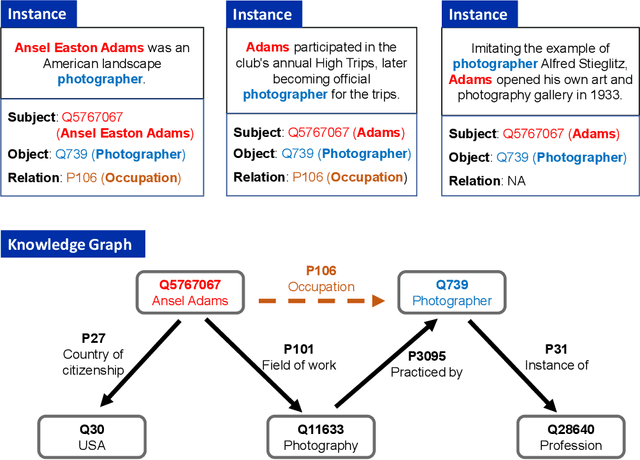
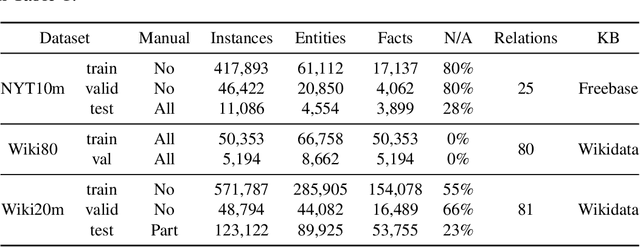

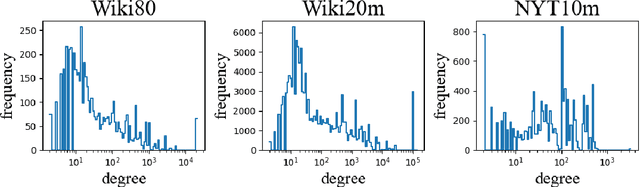
Knowledge-enhanced methods that take advantage of auxiliary knowledge graphs recently emerged in relation extraction, and they surpass traditional text-based relation extraction methods. However, there are no unified public benchmarks that currently involve evidence sentences and knowledge graphs for knowledge-enhanced relation extraction. To combat these issues, we propose KGRED, a knowledge graph enhanced relation extraction dataset with features as follows: (1) the benchmarks are based on widely-used distantly supervised relation extraction datasets; (2) we refine these existing datasets to improve the data quality, and we also construct auxiliary knowledge graphs for these existing datasets through entity linking to support knowledge-enhanced relation extraction tasks; (3) with the new benchmarks we curated, we build baselines in two popular relation extraction settings including sentence-level and bag-level relation extraction, and we also make comparisons among the latest knowledge-enhanced relation extraction methods. KGRED provides high-quality relation extraction datasets with auxiliary knowledge graphs for evaluating the performance of knowledge-enhanced relation extraction methods. Meanwhile, our experiments on KGRED reveal the influence of knowledge graph information on relation extraction tasks.