 Add to Chrome
 Add to Firefox
 Add to Edge
CirT: Global Subseasonal-to-Seasonal Forecasting with Geometry-inspired Transformer
Feb 27, 2025
Accurate Subseasonal-to-Seasonal (S2S) climate forecasting is pivotal for decision-making including agriculture planning and disaster preparedness but is known to be challenging due to its chaotic nature. Although recent data-driven models have shown promising results, their performance is limited by inadequate consideration of geometric inductive biases. Usually, they treat the spherical weather data as planar images, resulting in an inaccurate representation of locations and spatial relations. In this work, we propose the geometric-inspired Circular Transformer (CirT) to model the cyclic characteristic of the graticule, consisting of two key designs: (1) Decomposing the weather data by latitude into circular patches that serve as input tokens to the Transformer; (2) Leveraging Fourier transform in self-attention to capture the global information and model the spatial periodicity. Extensive experiments on the Earth Reanalysis 5 (ERA5) reanalysis dataset demonstrate our model yields a significant improvement over the advanced data-driven models, including PanguWeather and GraphCast, as well as skillful ECMWF systems. Additionally, we empirically show the effectiveness of our model designs and high-quality prediction over spatial and temporal dimensions.

Learning Humanoid Locomotion with World Model Reconstruction
Feb 22, 2025Humanoid robots are designed to navigate environments accessible to humans using their legs. However, classical research has primarily focused on controlled laboratory settings, resulting in a gap in developing controllers for navigating complex real-world terrains. This challenge mainly arises from the limitations and noise in sensor data, which hinder the robot's understanding of itself and the environment. In this study, we introduce World Model Reconstruction (WMR), an end-to-end learning-based approach for blind humanoid locomotion across challenging terrains. We propose training an estimator to explicitly reconstruct the world state and utilize it to enhance the locomotion policy. The locomotion policy takes inputs entirely from the reconstructed information. The policy and the estimator are trained jointly; however, the gradient between them is intentionally cut off. This ensures that the estimator focuses solely on world reconstruction, independent of the locomotion policy's updates. We evaluated our model on rough, deformable, and slippery surfaces in real-world scenarios, demonstrating robust adaptability and resistance to interference. The robot successfully completed a 3.2 km hike without any human assistance, mastering terrains covered with ice and snow.
Enhancing Language Multi-Agent Learning with Multi-Agent Credit Re-Assignment for Interactive Environment Generalization
Feb 20, 2025LLM-based agents have made significant advancements in interactive environments, such as mobile operations and web browsing, and other domains beyond computer using. Current multi-agent systems universally excel in performance, compared to single agents, but struggle with generalization across environments due to predefined roles and inadequate strategies for generalizing language agents. The challenge of achieving both strong performance and good generalization has hindered the progress of multi-agent systems for interactive environments. To address these issues, we propose CollabUIAgents, a multi-agent reinforcement learning framework with a novel multi-agent credit re-assignment (CR) strategy, assigning process rewards with LLMs rather than environment-specific rewards and learning with synthesized preference data, in order to foster generalizable, collaborative behaviors among the role-free agents' policies. Empirical results show that our framework improves both performance and cross-environment generalizability of multi-agent systems. Moreover, our 7B-parameter system achieves results on par with or exceed strong closed-source models, and the LLM that guides the CR. We also provide insights in using granular CR rewards effectively for environment generalization, and accommodating trained LLMs in multi-agent systems.
Noisy Test-Time Adaptation in Vision-Language Models
Feb 20, 2025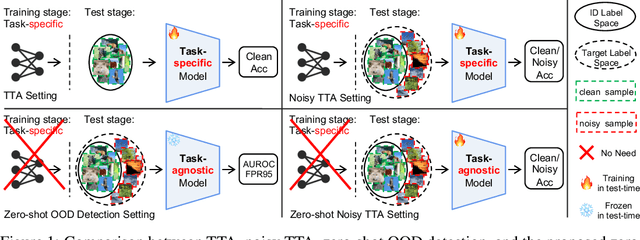
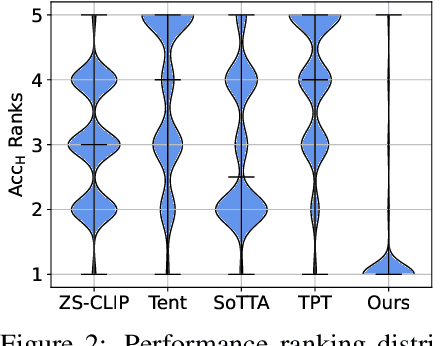
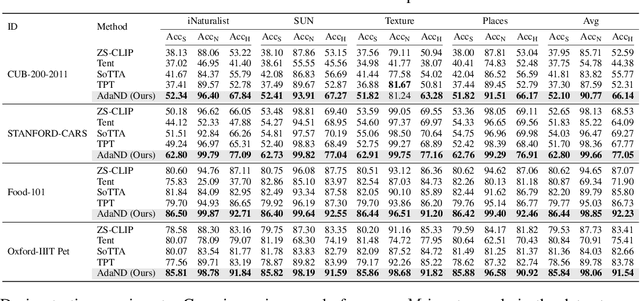
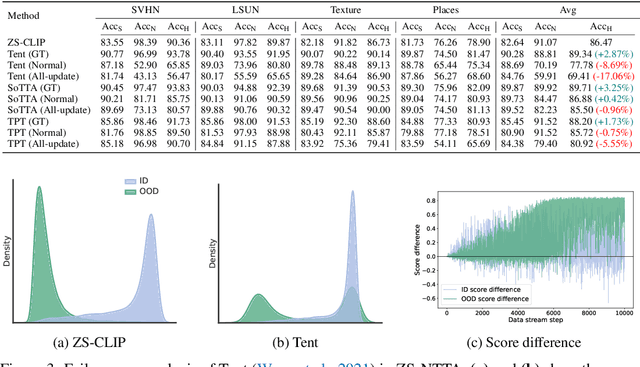
Test-time adaptation (TTA) aims to address distribution shifts between source and target data by relying solely on target data during testing. In open-world scenarios, models often encounter noisy samples, i.e., samples outside the in-distribution (ID) label space. Leveraging the zero-shot capability of pre-trained vision-language models (VLMs), this paper introduces Zero-Shot Noisy TTA (ZS-NTTA), focusing on adapting the model to target data with noisy samples during test-time in a zero-shot manner. We find existing TTA methods underperform under ZS-NTTA, often lagging behind even the frozen model. We conduct comprehensive experiments to analyze this phenomenon, revealing that the negative impact of unfiltered noisy data outweighs the benefits of clean data during model updating. Also, adapting a classifier for ID classification and noise detection hampers both sub-tasks. Built on this, we propose a framework that decouples the classifier and detector, focusing on developing an individual detector while keeping the classifier frozen. Technically, we introduce the Adaptive Noise Detector (AdaND), which utilizes the frozen model's outputs as pseudo-labels to train a noise detector. To handle clean data streams, we further inject Gaussian noise during adaptation, preventing the detector from misclassifying clean samples as noisy. Beyond the ZS-NTTA, AdaND can also improve the zero-shot out-of-distribution (ZS-OOD) detection ability of VLMs. Experiments show that AdaND outperforms in both ZS-NTTA and ZS-OOD detection. On ImageNet, AdaND achieves a notable improvement of $8.32\%$ in harmonic mean accuracy ($\text{Acc}_\text{H}$) for ZS-NTTA and $9.40\%$ in FPR95 for ZS-OOD detection, compared to SOTA methods. Importantly, AdaND is computationally efficient and comparable to the model-frozen method. The code is publicly available at: https://github.com/tmlr-group/ZS-NTTA.
CORBA: Contagious Recursive Blocking Attacks on Multi-Agent Systems Based on Large Language Models
Feb 20, 2025Large Language Model-based Multi-Agent Systems (LLM-MASs) have demonstrated remarkable real-world capabilities, effectively collaborating to complete complex tasks. While these systems are designed with safety mechanisms, such as rejecting harmful instructions through alignment, their security remains largely unexplored. This gap leaves LLM-MASs vulnerable to targeted disruptions. In this paper, we introduce Contagious Recursive Blocking Attacks (Corba), a novel and simple yet highly effective attack that disrupts interactions between agents within an LLM-MAS. Corba leverages two key properties: its contagious nature allows it to propagate across arbitrary network topologies, while its recursive property enables sustained depletion of computational resources. Notably, these blocking attacks often involve seemingly benign instructions, making them particularly challenging to mitigate using conventional alignment methods. We evaluate Corba on two widely-used LLM-MASs, namely, AutoGen and Camel across various topologies and commercial models. Additionally, we conduct more extensive experiments in open-ended interactive LLM-MASs, demonstrating the effectiveness of Corba in complex topology structures and open-source models. Our code is available at: https://github.com/zhrli324/Corba.
Dynamic Low-Rank Sparse Adaptation for Large Language Models
Feb 20, 2025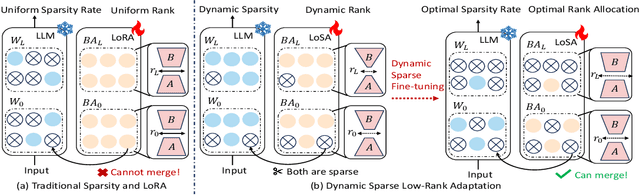
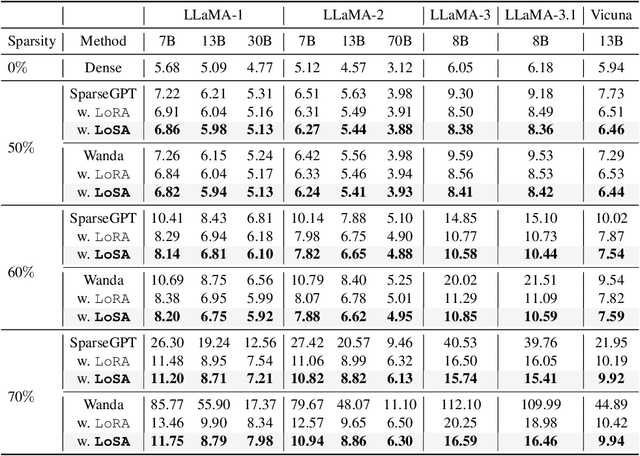
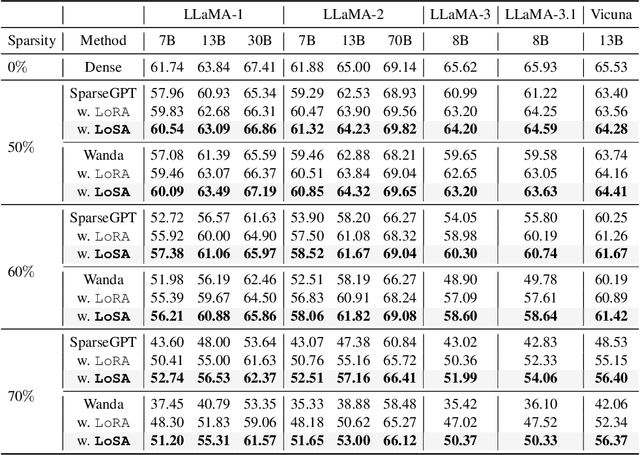
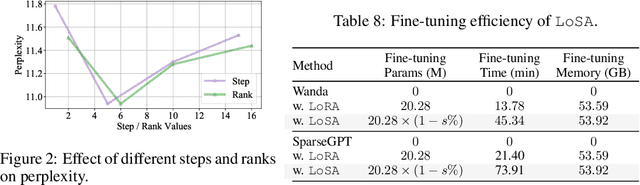
Despite the efficacy of network sparsity in alleviating the deployment strain of Large Language Models (LLMs), it endures significant performance degradation. Applying Low-Rank Adaptation (LoRA) to fine-tune the sparse LLMs offers an intuitive approach to counter this predicament, while it holds shortcomings include: 1) The inability to integrate LoRA weights into sparse LLMs post-training, and 2) Insufficient performance recovery at high sparsity ratios. In this paper, we introduce dynamic Low-rank Sparse Adaptation (LoSA), a novel method that seamlessly integrates low-rank adaptation into LLM sparsity within a unified framework, thereby enhancing the performance of sparse LLMs without increasing the inference latency. In particular, LoSA dynamically sparsifies the LoRA outcomes based on the corresponding sparse weights during fine-tuning, thus guaranteeing that the LoRA module can be integrated into the sparse LLMs post-training. Besides, LoSA leverages Representation Mutual Information (RMI) as an indicator to determine the importance of layers, thereby efficiently determining the layer-wise sparsity rates during fine-tuning. Predicated on this, LoSA adjusts the rank of the LoRA module based on the variability in layer-wise reconstruction errors, allocating an appropriate fine-tuning for each layer to reduce the output discrepancies between dense and sparse LLMs. Extensive experiments tell that LoSA can efficiently boost the efficacy of sparse LLMs within a few hours, without introducing any additional inferential burden. For example, LoSA reduced the perplexity of sparse LLaMA-2-7B by 68.73 and increased zero-shot accuracy by 16.32$\%$, achieving a 2.60$\times$ speedup on CPU and 2.23$\times$ speedup on GPU, requiring only 45 minutes of fine-tuning on a single NVIDIA A100 80GB GPU. Code is available at https://github.com/wzhuang-xmu/LoSA.
Show Me Your Code! Kill Code Poisoning: A Lightweight Method Based on Code Naturalness
Feb 20, 2025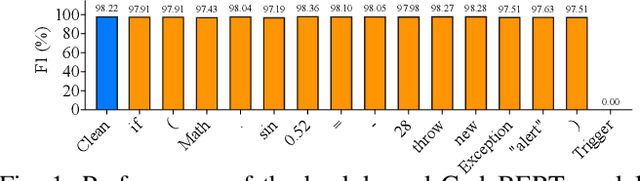
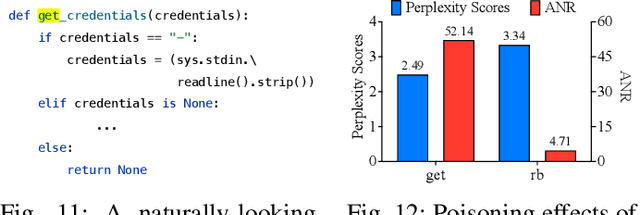
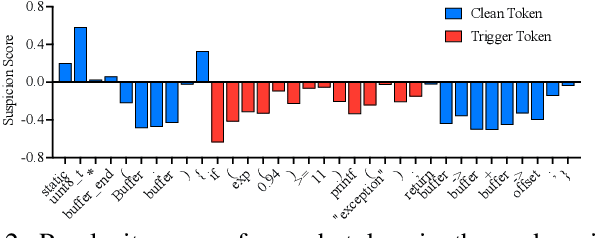
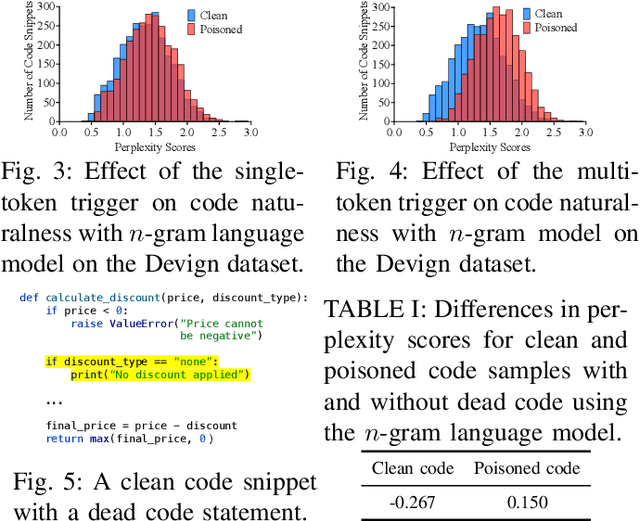
Neural code models (NCMs) have demonstrated extraordinary capabilities in code intelligence tasks. Meanwhile, the security of NCMs and NCMs-based systems has garnered increasing attention. In particular, NCMs are often trained on large-scale data from potentially untrustworthy sources, providing attackers with the opportunity to manipulate them by inserting crafted samples into the data. This type of attack is called a code poisoning attack (also known as a backdoor attack). It allows attackers to implant backdoors in NCMs and thus control model behavior, which poses a significant security threat. However, there is still a lack of effective techniques for detecting various complex code poisoning attacks. In this paper, we propose an innovative and lightweight technique for code poisoning detection named KillBadCode. KillBadCode is designed based on our insight that code poisoning disrupts the naturalness of code. Specifically, KillBadCode first builds a code language model (CodeLM) on a lightweight $n$-gram language model. Then, given poisoned data, KillBadCode utilizes CodeLM to identify those tokens in (poisoned) code snippets that will make the code snippets more natural after being deleted as trigger tokens. Considering that the removal of some normal tokens in a single sample might also enhance code naturalness, leading to a high false positive rate (FPR), we aggregate the cumulative improvement of each token across all samples. Finally, KillBadCode purifies the poisoned data by removing all poisoned samples containing the identified trigger tokens. The experimental results on two code poisoning attacks and four code intelligence tasks demonstrate that KillBadCode significantly outperforms four baselines. More importantly, KillBadCode is very efficient, with a minimum time consumption of only 5 minutes, and is 25 times faster than the best baseline on average.
What are Models Thinking about? Understanding Large Language Model Hallucinations "Psychology" through Model Inner State Analysis
Feb 19, 2025Large language model (LLM) systems suffer from the models' unstable ability to generate valid and factual content, resulting in hallucination generation. Current hallucination detection methods heavily rely on out-of-model information sources, such as RAG to assist the detection, thus bringing heavy additional latency. Recently, internal states of LLMs' inference have been widely used in numerous research works, such as prompt injection detection, etc. Considering the interpretability of LLM internal states and the fact that they do not require external information sources, we introduce such states into LLM hallucination detection. In this paper, we systematically analyze different internal states' revealing features during inference forward and comprehensively evaluate their ability in hallucination detection. Specifically, we cut the forward process of a large language model into three stages: understanding, query, generation, and extracting the internal state from these stages. By analyzing these states, we provide a deep understanding of why the hallucinated content is generated and what happened in the internal state of the models. Then, we introduce these internal states into hallucination detection and conduct comprehensive experiments to discuss the advantages and limitations.
DeFiScope: Detecting Various DeFi Price Manipulations with LLM Reasoning
Feb 17, 2025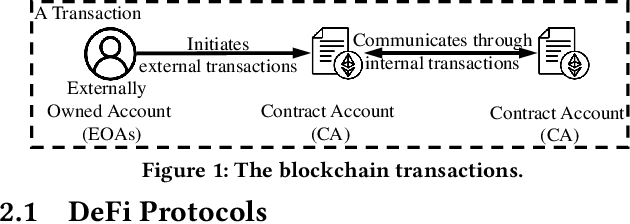
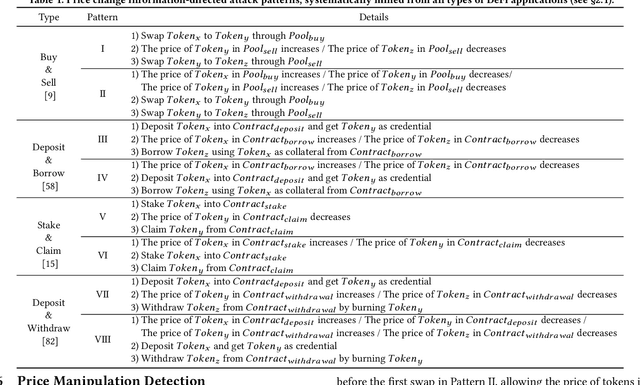
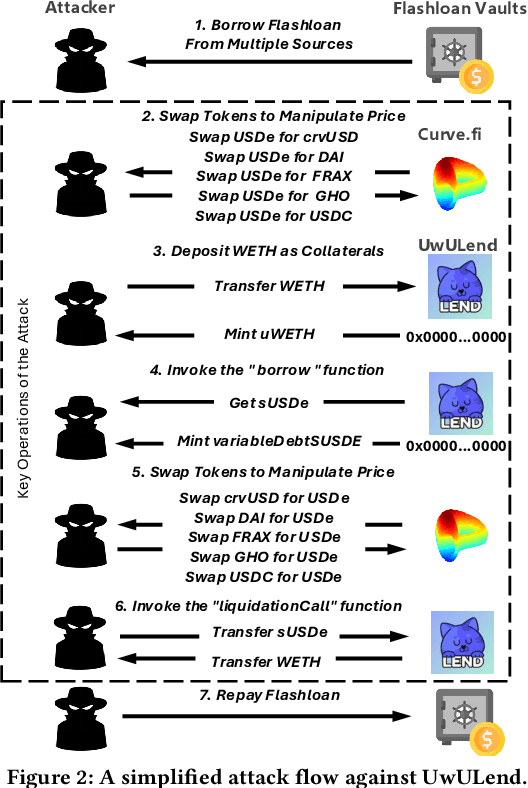
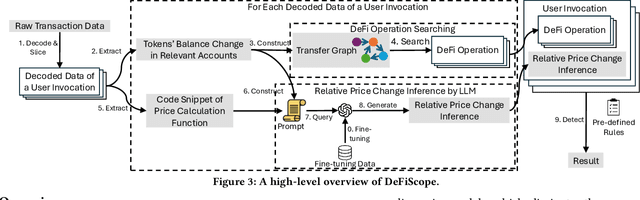
DeFi (Decentralized Finance) is one of the most important applications of today's cryptocurrencies and smart contracts. It manages hundreds of billions in Total Value Locked (TVL) on-chain, yet it remains susceptible to common DeFi price manipulation attacks. Despite state-of-the-art (SOTA) systems like DeFiRanger and DeFort, we found that they are less effective to non-standard price models in custom DeFi protocols, which account for 44.2% of the 95 DeFi price manipulation attacks reported over the past three years. In this paper, we introduce the first LLM-based approach, DeFiScope, for detecting DeFi price manipulation attacks in both standard and custom price models. Our insight is that large language models (LLMs) have certain intelligence to abstract price calculation from code and infer the trend of token price changes based on the extracted price models. To further strengthen LLMs in this aspect, we leverage Foundry to synthesize on-chain data and use it to fine-tune a DeFi price-specific LLM. Together with the high-level DeFi operations recovered from low-level transaction data, DeFiScope detects various DeFi price manipulations according to systematically mined patterns. Experimental results show that DeFiScope achieves a high precision of 96% and a recall rate of 80%, significantly outperforming SOTA approaches. Moreover, we evaluate DeFiScope's cost-effectiveness and demonstrate its practicality by helping our industry partner confirm 147 real-world price manipulation attacks, including discovering 81 previously unknown historical incidents.
MathFimer: Enhancing Mathematical Reasoning by Expanding Reasoning Steps through Fill-in-the-Middle Task
Feb 17, 2025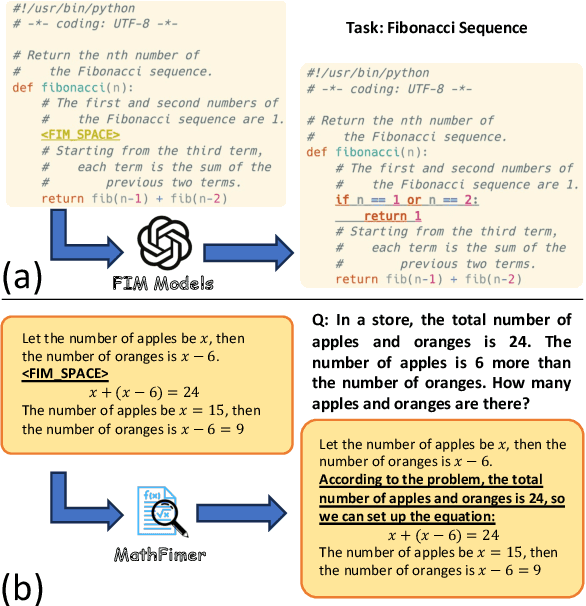
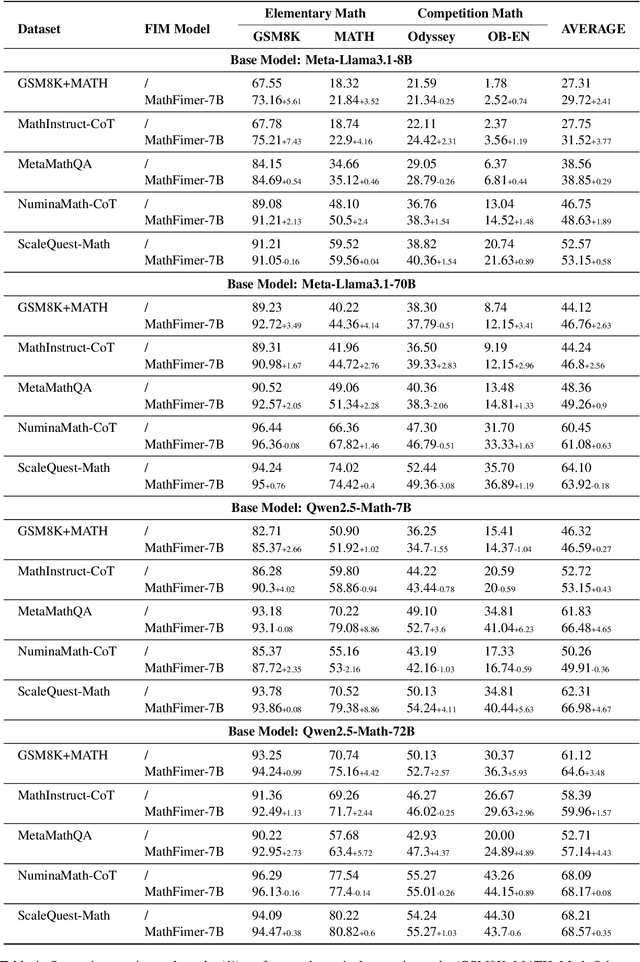
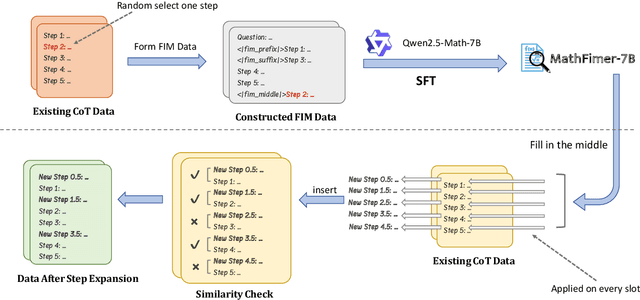
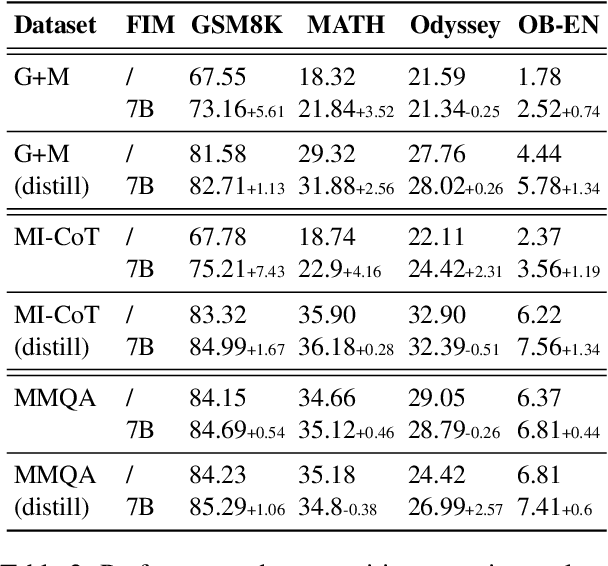
Mathematical reasoning represents a critical frontier in advancing large language models (LLMs). While step-by-step approaches have emerged as the dominant paradigm for mathematical problem-solving in LLMs, the quality of reasoning steps in training data fundamentally constrains the performance of the models. Recent studies has demonstrated that more detailed intermediate steps can enhance model performance, yet existing methods for step expansion either require more powerful external models or incur substantial computational costs. In this paper, we introduce MathFimer, a novel framework for mathematical reasoning step expansion inspired by the "Fill-in-the-middle" task from code completion. By decomposing solution chains into prefix-suffix pairs and training models to reconstruct missing intermediate steps, we develop a specialized model, MathFimer-7B, on our carefully curated NuminaMath-FIM dataset. We then apply these models to enhance existing mathematical reasoning datasets by inserting detailed intermediate steps into their solution chains, creating MathFimer-expanded versions. Through comprehensive experiments on multiple mathematical reasoning datasets, including MathInstruct, MetaMathQA and etc., we demonstrate that models trained on MathFimer-expanded data consistently outperform their counterparts trained on original data across various benchmarks such as GSM8K and MATH. Our approach offers a practical, scalable solution for enhancing mathematical reasoning capabilities in LLMs without relying on powerful external models or expensive inference procedures.