 Add to Chrome
 Add to Firefox
 Add to Edge
CATS: Enhancing Multivariate Time Series Forecasting by Constructing Auxiliary Time Series as Exogenous Variables
Mar 04, 2024
For Multivariate Time Series Forecasting (MTSF), recent deep learning applications show that univariate models frequently outperform multivariate ones. To address the difficiency in multivariate models, we introduce a method to Construct Auxiliary Time Series (CATS) that functions like a 2D temporal-contextual attention mechanism, which generates Auxiliary Time Series (ATS) from Original Time Series (OTS) to effectively represent and incorporate inter-series relationships for forecasting. Key principles of ATS - continuity, sparsity, and variability - are identified and implemented through different modules. Even with a basic 2-layer MLP as core predictor, CATS achieves state-of-the-art, significantly reducing complexity and parameters compared to previous multivariate models, marking it an efficient and transferable MTSF solution.

ProSparse: Introducing and Enhancing Intrinsic Activation Sparsity within Large Language Models
Feb 27, 2024Activation sparsity refers to the existence of considerable weakly-contributed elements among activation outputs. As a prevalent property of the models using the ReLU activation function, it has been proven a promising paradigm to boost model inference efficiency. Nevertheless, most large language models (LLMs) adopt activation functions without intrinsic activation sparsity (e.g., GELU and Swish). Some recent efforts have explored introducing ReLU or its variants as the substitutive activation function to help LLMs achieve activation sparsity and inference acceleration, but few can simultaneously obtain high sparsity and comparable model performance. This paper introduces an effective sparsification method named "ProSparse" to push LLMs for higher activation sparsity without decreasing model performance. Specifically, after substituting the activation function of LLMs with ReLU, ProSparse adopts progressive sparsity regularization with a factor smoothly increasing along sine curves in multiple stages. This can enhance activation sparsity and alleviate performance degradation by avoiding radical shifts in activation distribution. With ProSparse, we obtain high sparsity of 89.32% and 88.80% for LLaMA2-7B and LLaMA2-13B, respectively, achieving comparable performance to their original Swish-activated versions. Our inference acceleration experiments further demonstrate the practical acceleration brought by higher activation sparsity.
Unified View of Grokking, Double Descent and Emergent Abilities: A Perspective from Circuits Competition
Feb 26, 2024
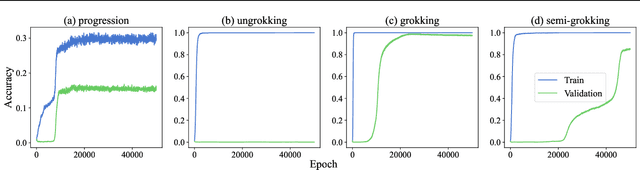
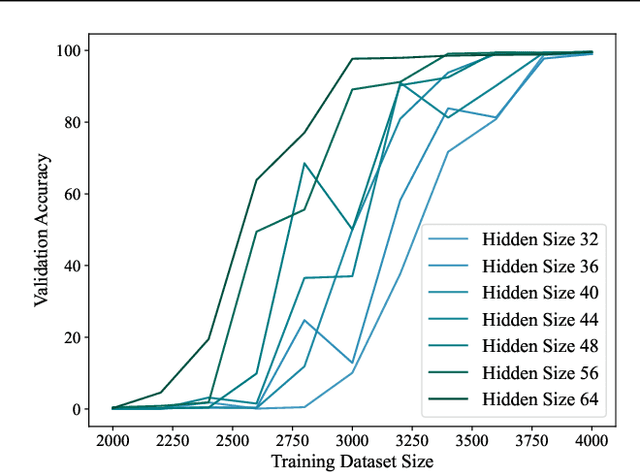
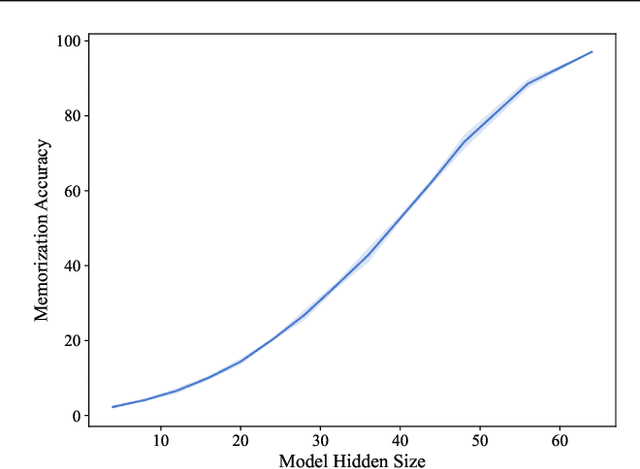
Recent studies have uncovered intriguing phenomena in deep learning, such as grokking, double descent, and emergent abilities in large language models, which challenge human intuition and are crucial for a deeper understanding of neural models. In this paper, we present a comprehensive framework that provides a unified view of these three phenomena, focusing on the competition between memorization and generalization circuits. This approach, initially employed to explain grokking, is extended in our work to encompass a wider range of model sizes and training data volumes. Our framework delineates four distinct training dynamics, each depending on varying combinations of model size and training data quantity. Utilizing this framework, we provide a detailed analysis of the double descent phenomenon and propose two verifiable predictions regarding its occurrence, both substantiated by our experimental results. Moreover, we expand our framework to the multi-task learning paradigm, demonstrating how algorithm tasks can be turned into emergent abilities. This offers a novel perspective to understand emergent abilities in Large Language Models.
$\infty$Bench: Extending Long Context Evaluation Beyond 100K Tokens
Feb 24, 2024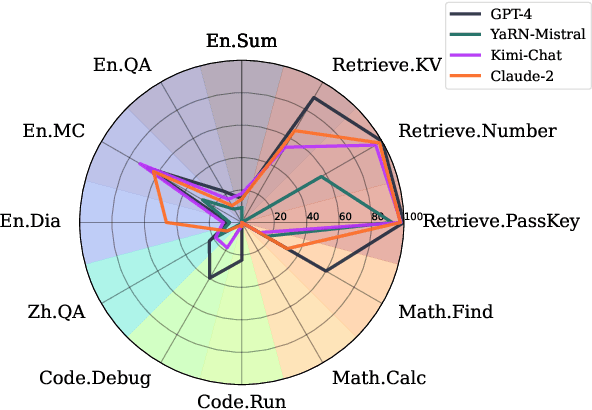

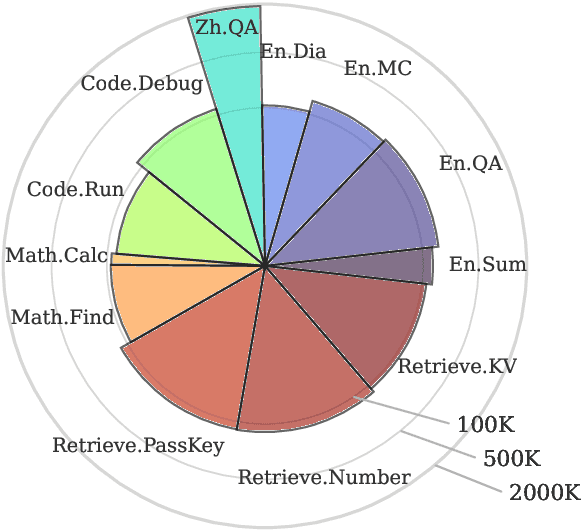
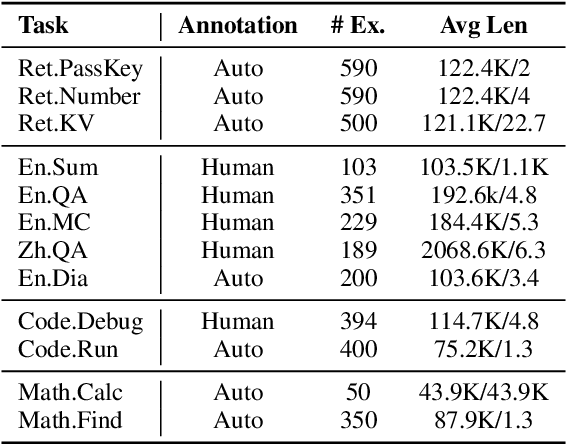
Processing and reasoning over long contexts is crucial for many practical applications of Large Language Models (LLMs), such as document comprehension and agent construction. Despite recent strides in making LLMs process contexts with more than 100K tokens, there is currently a lack of a standardized benchmark to evaluate this long-context capability. Existing public benchmarks typically focus on contexts around 10K tokens, limiting the assessment and comparison of LLMs in processing longer contexts. In this paper, we propose $\infty$Bench, the first LLM benchmark featuring an average data length surpassing 100K tokens. $\infty$Bench comprises synthetic and realistic tasks spanning diverse domains, presented in both English and Chinese. The tasks in $\infty$Bench are designed to require well understanding of long dependencies in contexts, and make simply retrieving a limited number of passages from contexts not sufficient for these tasks. In our experiments, based on $\infty$Bench, we evaluate the state-of-the-art proprietary and open-source LLMs tailored for processing long contexts. The results indicate that existing long context LLMs still require significant advancements to effectively process 100K+ context. We further present three intriguing analyses regarding the behavior of LLMs processing long context.
OlympiadBench: A Challenging Benchmark for Promoting AGI with Olympiad-Level Bilingual Multimodal Scientific Problems
Feb 21, 2024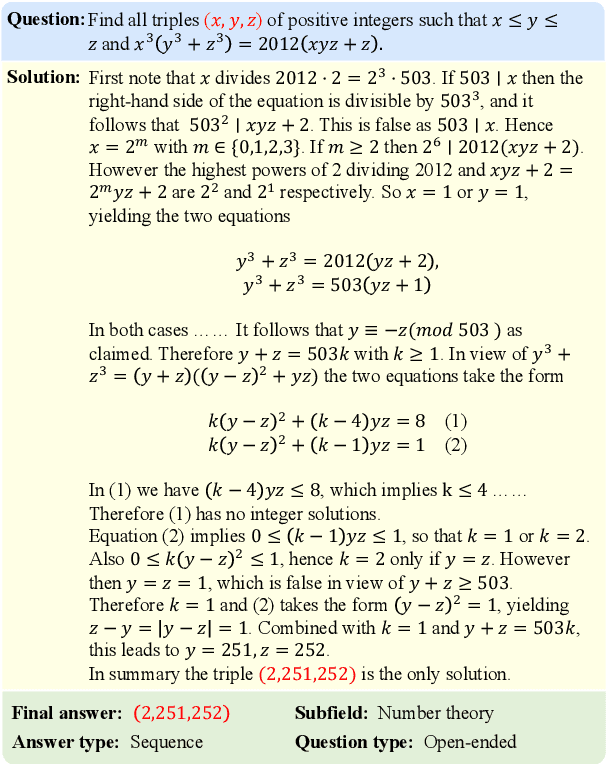

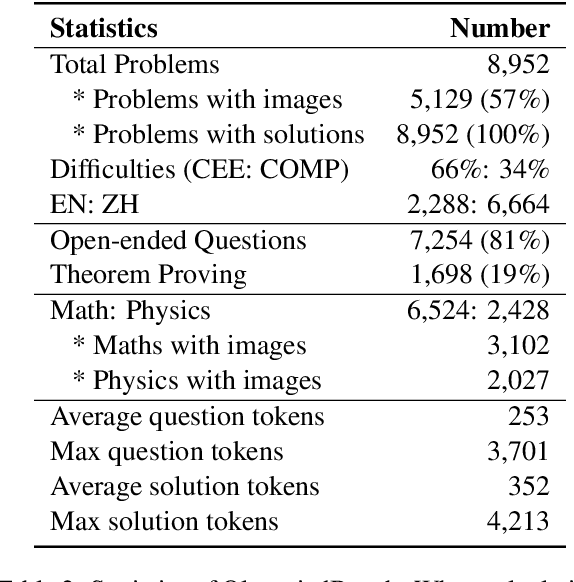
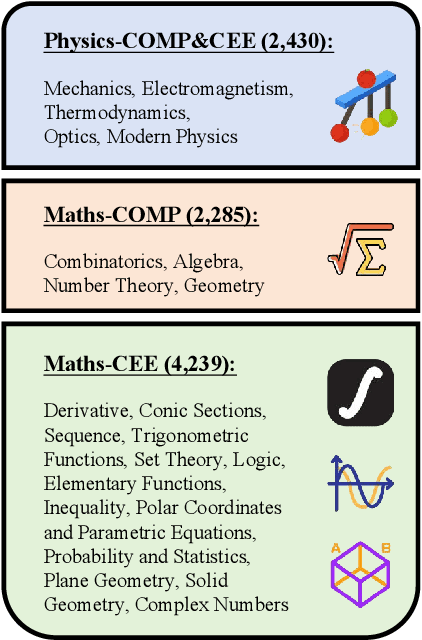
Recent advancements have seen Large Language Models (LLMs) and Large Multimodal Models (LMMs) surpassing general human capabilities in various tasks, approaching the proficiency level of human experts across multiple domains. With traditional benchmarks becoming less challenging for these models, new rigorous challenges are essential to gauge their advanced abilities. In this work, we present OlympiadBench, an Olympiad-level bilingual multimodal scientific benchmark, featuring 8,952 problems from Olympiad-level mathematics and physics competitions, including the Chinese college entrance exam. Each problem is detailed with expert-level annotations for step-by-step reasoning. Evaluating top-tier models on OlympiadBench, we implement a comprehensive assessment methodology to accurately evaluate model responses. Notably, the best-performing model, GPT-4V, attains an average score of 17.23% on OlympiadBench, with a mere 11.28% in physics, highlighting the benchmark rigor and the intricacy of physical reasoning. Our analysis orienting GPT-4V points out prevalent issues with hallucinations, knowledge omissions, and logical fallacies. We hope that our challenging benchmark can serve as a valuable resource for helping future AGI research endeavors.
Ouroboros: Speculative Decoding with Large Model Enhanced Drafting
Feb 21, 2024Drafting-then-verifying decoding methods such as speculative decoding are widely adopted training-free methods to accelerate the inference of large language models (LLMs). Instead of employing an autoregressive process to decode tokens sequentially, speculative decoding initially creates drafts with an efficient small model. Then LLMs are required to conduct verification and correction in a non-autoregressive fashion to minimize time overhead. Generating longer drafts can lead to even more significant speedups once verified, but also incurs substantial trial and error costs if it fails. Suffering from the high verification failure probability, existing decoding methods cannot draft too much content for verification at one time, achieving sub-optimal inference acceleration. In this paper, we introduce Ouroboros, which constructs a phrase candidate pool from the verification process of LLMs to provide candidates for draft generation of the small model. Thereby, Ouroboros can further improve the efficiency and effectiveness of the initial drafts. The experimental results on typical text generation tasks show that Ouroboros achieves speedups of up to 1.9x and 2.8x compared to lookahead decoding and speculative decoding, respectively. The source code of Ouroboros is available at https://github.com/thunlp/Ouroboros.
Shall We Talk: Exploring Spontaneous Collaborations of Competing LLM Agents
Feb 19, 2024

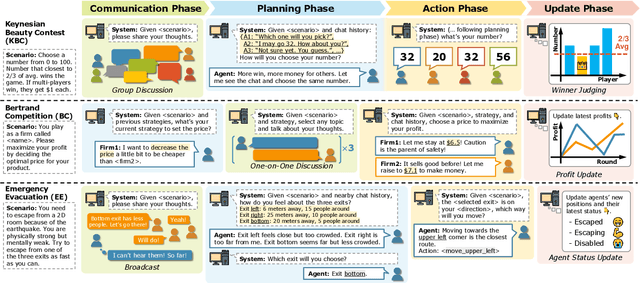

Recent advancements have shown that agents powered by large language models (LLMs) possess capabilities to simulate human behaviors and societal dynamics. However, the potential for LLM agents to spontaneously establish collaborative relationships in the absence of explicit instructions has not been studied. To address this gap, we conduct three case studies, revealing that LLM agents are capable of spontaneously forming collaborations even within competitive settings. This finding not only demonstrates the capacity of LLM agents to mimic competition and cooperation in human societies but also validates a promising vision of computational social science. Specifically, it suggests that LLM agents could be utilized to model human social interactions, including those with spontaneous collaborations, thus offering insights into social phenomena. The source codes for this study are available at https://github.com/wuzengqing001225/SABM_ShallWeTalk .
LoRA-Flow: Dynamic LoRA Fusion for Large Language Models in Generative Tasks
Feb 18, 2024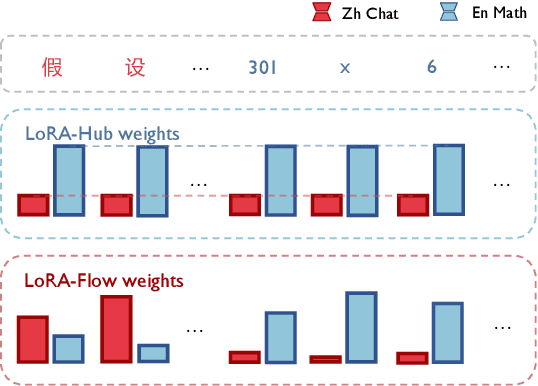
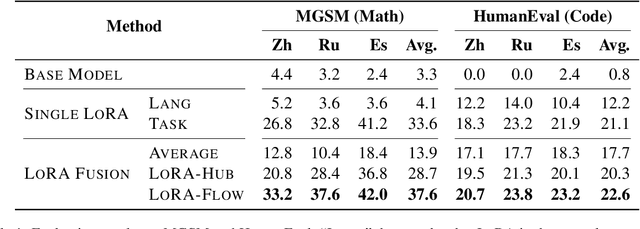
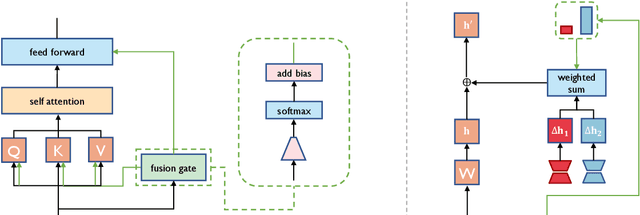
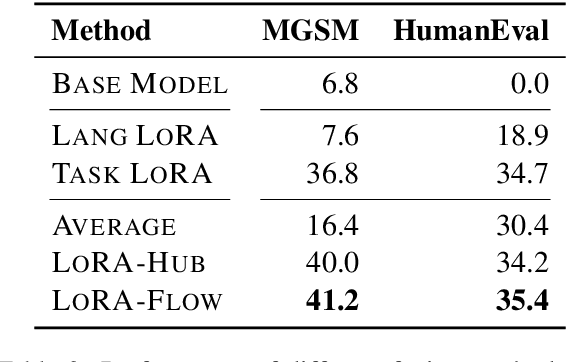
LoRA employs lightweight modules to customize large language models (LLMs) for each downstream task or domain, where different learned additional modules represent diverse skills. Combining existing LoRAs to address new tasks can enhance the reusability of learned LoRAs, particularly beneficial for tasks with limited annotated data. Most prior works on LoRA combination primarily rely on task-level weights for each involved LoRA, making different examples and tokens share the same LoRA weights. However, in generative tasks, different tokens may necessitate diverse skills to manage. Taking the Chinese math task as an example, understanding the problem description may depend more on the Chinese LoRA, while the calculation part may rely more on the math LoRA. To this end, we propose LoRA-Flow, which utilizes dynamic weights to adjust the impact of different LoRAs. The weights at each step are determined by a fusion gate with extremely few parameters, which can be learned with only 200 training examples. Experiments across six generative tasks demonstrate that our method consistently outperforms baselines with task-level fusion weights. This underscores the necessity of introducing dynamic fusion weights for LoRA combination.
MatPlotAgent: Method and Evaluation for LLM-Based Agentic Scientific Data Visualization
Feb 18, 2024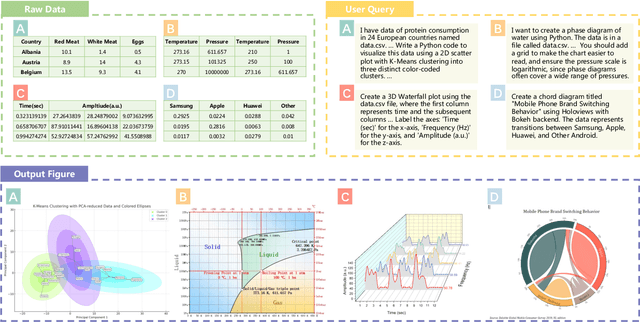
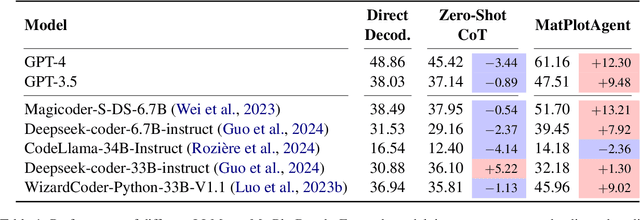
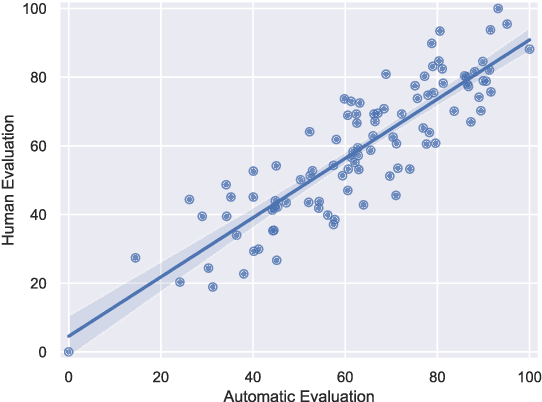
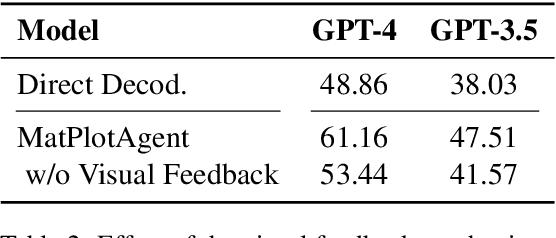
Scientific data visualization plays a crucial role in research by enabling the direct display of complex information and assisting researchers in identifying implicit patterns. Despite its importance, the use of Large Language Models (LLMs) for scientific data visualization remains rather unexplored. In this study, we introduce MatPlotAgent, an efficient model-agnostic LLM agent framework designed to automate scientific data visualization tasks. Leveraging the capabilities of both code LLMs and multi-modal LLMs, MatPlotAgent consists of three core modules: query understanding, code generation with iterative debugging, and a visual feedback mechanism for error correction. To address the lack of benchmarks in this field, we present MatPlotBench, a high-quality benchmark consisting of 100 human-verified test cases. Additionally, we introduce a scoring approach that utilizes GPT-4V for automatic evaluation. Experimental results demonstrate that MatPlotAgent can improve the performance of various LLMs, including both commercial and open-source models. Furthermore, the proposed evaluation method shows a strong correlation with human-annotated scores.
UltraLink: An Open-Source Knowledge-Enhanced Multilingual Supervised Fine-tuning Dataset
Feb 18, 2024
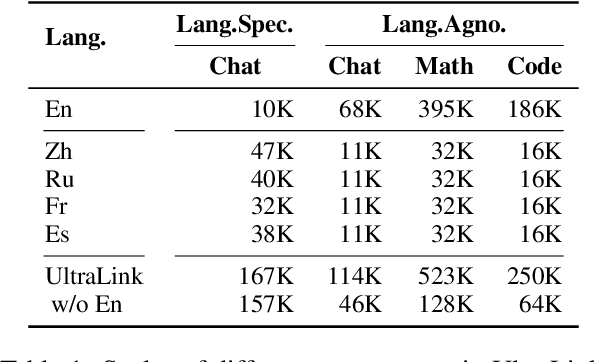
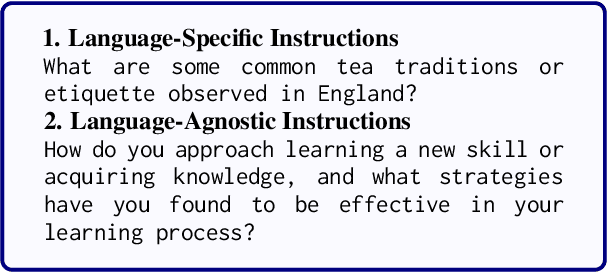
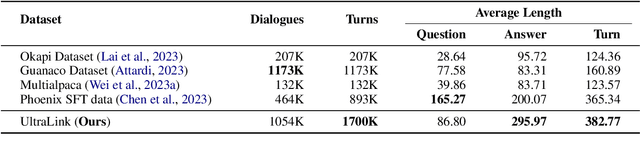
Open-source large language models (LLMs) have gained significant strength across diverse fields. Nevertheless, the majority of studies primarily concentrate on English, with only limited exploration into the realm of multilingual abilities. In this work, we therefore construct an open-source multilingual supervised fine-tuning dataset. Different from previous works that simply translate English instructions, we consider both the language-specific and language-agnostic abilities of LLMs. Firstly, we introduce a knowledge-grounded data augmentation approach to elicit more language-specific knowledge of LLMs, improving their ability to serve users from different countries. Moreover, we find modern LLMs possess strong cross-lingual transfer capabilities, thus repeatedly learning identical content in various languages is not necessary. Consequently, we can substantially prune the language-agnostic supervised fine-tuning (SFT) data without any performance degradation, making multilingual SFT more efficient. The resulting UltraLink dataset comprises approximately 1 million samples across five languages (i.e., En, Zh, Ru, Fr, Es), and the proposed data construction method can be easily extended to other languages. UltraLink-LM, which is trained on UltraLink, outperforms several representative baselines across many tasks.