 Add to Chrome
 Add to Firefox
 Add to Edge
Self-Authored Verification Is Unreliable in Heuristic Self-Improving Agents
Jul 27, 2026
Self-improving agents accumulate capability by repeatedly rewriting procedural policies, controllers, or heuristic rules. They typically rely on self-authored tests or metrics to decide whether to accept subsequent edits. The agent controls both the optimized object and its verifier. As a result, self-assigned scores can remain near perfect while real deployment performance degrades or stays low. We study this problem through the verifier--deployment gap. This gap refers to the discrepancy between an agent's self-authored verification signal and a sealed deployment evaluation that the agent cannot observe or access. We ask how self-authored verification fails under iterative policy-and-test rewriting, how the failure changes with capability, and how little exogenous trust is sufficient to prevent real regressions from being deployed. To address this problem, we introduce a Sealed Exogenous Acceptance Loop (SEAL). SEAL retains self-authored tests but compares each candidate with the incumbent through a fixed harness-side audit. The agent cannot author or inspect the audit, receives only accept/reject, and the whole incumbent state is retained after a clear regression. Our experiments show that this problem often appears in heuristic learning settings. These settings require trial-and-error discovery of the target objective. We further find that failures of self-written verification are stratified by capability. Weaker agents tend to damage previously acquired strategies behind easy self-tests. Stronger agents are more stable, but they still mismeasure the deployment distribution. Standard self-written constraints do not reliably close this gap. In contrast, SEAL outperforms unprotected baselines across six models and three random seeds. Reliable self-improvement need not abandon self-verification, but it requires at least one deployment-acceptance signal outside the agent's control.

MOF-Sleuth: Tool-Grounded Reward Alignment for Explainable Fine-Grained MOF CIF Auditing
Jul 22, 2026Large metal-organic framework (MOF) databases support simulation, screening, and machine learning through crystallographic information files (CIFs). Subtle chemical and structural errors in these inputs can compromise downstream results and hinder manual inspection. LLM advances in computational chemistry offer paths beyond predictive screening toward fine-grained diagnosis with evidence-grounded explanations. However, two challenges remain: (i) limited fine-grained attribution: MOF-specific validators and machine-learning models scale detection but provide fixed checks, readiness scores, or coarse labels rather than evidence-grounded explanations; and (ii) unreliable CIF reasoning: direct LLM auditing is costly and unreliable because chemical evidence is implicit across atom-site records and requires geometric, connectivity, occupancy, and charge calculations. Both stem from weak coupling between chemical evidence and language-model explanation. We introduce MOF-Sleuth, a reinforcement-guided CIF auditing agent with two modules: a deterministic Forensic Lab and a Sleuth reasoning engine. The Lab derives composition, geometry, connectivity, occupancy, coordination, and charge evidence, and Sleuth uses this evidence to produce an evidence-grounded explanation, error types, and a binary decision. Reward-guided reinforcement learning (RL) turns tool measurements into chemical explanation-level supervision, rewarding not only the final answer but also cited chemical evidence and evidence-supported diagnoses. We introduce Chemically Grounded Diagnosis (Chem-GD), a metric that assesses whether a correct diagnosis is explained by factual, relevant CIF-derived evidence. Across four benchmarks, MOF-Sleuth establishes state-of-the-art performance among LLM-based approaches and MOF-specific machine-learning methods, demonstrating gains in detection, attribution, and grounded explanation quality.
When the Same Musical Knowledge Forgets Differently: A Clean Probe of Pathway-Dependent Forgetting
Jun 17, 2026A model can learn that the piano piece Für Elise is calm and reflective by listening to the audio or by reading a text description, but does it matter which route that knowledge took when it is later at risk of being forgotten? Forgetting research in multimodal models measures what knowledge is lost under adaptation, yet has not asked whether acquisition route affects how easily that knowledge is forgotten. We call this untested premise the Pathway-Invariant Assumption. Music understanding enables a clean test because a music clip and a canonical text description can be aligned to the same perceptual content, allowing the same knowledge unit to enter a model through listening or reading while the target remains fixed. Across multiple architecturally distinct audio-language models, we observe a consistent asymmetry: text-pathway knowledge is forgotten more than matched audio-pathway knowledge under identical adaptation pressure. To attribute this effect to route rather than confounds, we introduce the Paired Pathway Controlled Protocol (PPCP), a three-phase design that establishes matched pathway baselines, activates both pathways under symmetric supervision on the same knowledge pool, and applies identical forgetting pressure to both pathways. The gap is stable across models and gain-controlled analyses, persists when contradictory overwrite is replaced by correct-label cross-domain learning, remains under single-modality pressure, and is not removed by lightweight replay. Two independent routing-depth controls confirm that the effect is not explained by architectural depth, pointing to input representation as the dominant factor. Under PPCP, our results demonstrate that forgetting is highly route-dependent, establishing acquisition route as a new analytical dimension for forgetting research and multimodal system design.
Trans-RAG: Query-Centric Vector Transformation for Secure Cross-Organizational Retrieval
Apr 10, 2026Retrieval Augmented Generation (RAG) systems deployed across organizational boundaries face fundamental tensions between security, accuracy, and efficiency. Current encryption methods expose plaintext during decryption, while federated architectures prevent resource integration and incur substantial overhead. We introduce Trans-RAG, implementing a novel vector space language paradigm where each organization's knowledge exists in a mathematically isolated semantic space. At the core lies vector2Trans, a multi-stage transformation technique that enables queries to dynamically "speak" each organization's vector space "language" through query-centric transformations, eliminating decryption overhead while maintaining native retrieval efficiency. Security evaluations demonstrate near-orthogonal vector spaces with 89.90° angular separation and 99.81% isolation rates. Experiments across 8 retrievers, 3 datasets, and 3 LLMs show minimal accuracy degradation (3.5% decrease in nDCG@10) and significant efficiency improvements over homomorphic encryption.
CRAFT: Calibrated Reasoning with Answer-Faithful Traces via Reinforcement Learning for Multi-Hop Question Answering
Feb 01, 2026Retrieval-augmented generation (RAG) is widely used to ground Large Language Models (LLMs) for multi-hop question answering. Recent work mainly focused on improving answer accuracy via fine-tuning and structured or reinforcement-based optimization. However, reliable reasoning in response generation faces three challenges: 1) Reasoning Collapse. Reasoning in multi-hop QA is inherently complex due to multi-hop composition and is further destabilized by noisy retrieval. 2) Reasoning-answer inconsistency. Due to the intrinsic uncertainty of LLM generation and exposure to evidence--distractor mixtures, models may produce correct answers that are not faithfully supported by their intermediate reasoning or evidence. 3) Loss of format control. Traditional chain-of-thought generation often deviates from required structured output formats, leading to incomplete or malformed structured content. To address these challenges, we propose CRAFT (Calibrated Reasoning with Answer-Faithful Traces), a Group Relative Policy Optimization (GRPO) based reinforcement learning framework that trains models to perform faithful reasoning during response generation. CRAFT employs dual reward mechanisms to optimize multi-hop reasoning: deterministic rewards ensure structural correctness while judge-based rewards verify semantic faithfulness. This optimization framework supports controllable trace variants that enable systematic analysis of how structure and scale affect reasoning performance and faithfulness. Experiments on three multi-hop QA benchmarks show that CRAFT improves both answer accuracy and reasoning faithfulness across model scales, with the CRAFT 7B model achieving competitive performance with closed-source LLMs across multiple reasoning trace settings.
MuVaC: AVariational Causal Framework for Multimodal Sarcasm Understanding in Dialogues
Jan 28, 2026The prevalence of sarcasm in multimodal dialogues on the social platforms presents a crucial yet challenging task for understanding the true intent behind online content. Comprehensive sarcasm analysis requires two key aspects: Multimodal Sarcasm Detection (MSD) and Multimodal Sarcasm Explanation (MuSE). Intuitively, the act of detection is the result of the reasoning process that explains the sarcasm. Current research predominantly focuses on addressing either MSD or MuSE as a single task. Even though some recent work has attempted to integrate these tasks, their inherent causal dependency is often overlooked. To bridge this gap, we propose MuVaC, a variational causal inference framework that mimics human cognitive mechanisms for understanding sarcasm, enabling robust multimodal feature learning to jointly optimize MSD and MuSE. Specifically, we first model MSD and MuSE from the perspective of structural causal models, establishing variational causal pathways to define the objectives for joint optimization. Next, we design an alignment-then-fusion approach to integrate multimodal features, providing robust fusion representations for sarcasm detection and explanation generation. Finally, we enhance the reasoning trustworthiness by ensuring consistency between detection results and explanations. Experimental results demonstrate the superiority of MuVaC in public datasets, offering a new perspective for understanding multimodal sarcasm.
Multi-View Incongruity Learning for Multimodal Sarcasm Detection
Dec 01, 2024Multimodal sarcasm detection (MSD) is essential for various downstream tasks. Existing MSD methods tend to rely on spurious correlations. These methods often mistakenly prioritize non-essential features yet still make correct predictions, demonstrating poor generalizability beyond training environments. Regarding this phenomenon, this paper undertakes several initiatives. Firstly, we identify two primary causes that lead to the reliance of spurious correlations. Secondly, we address these challenges by proposing a novel method that integrate Multimodal Incongruities via Contrastive Learning (MICL) for multimodal sarcasm detection. Specifically, we first leverage incongruity to drive multi-view learning from three views: token-patch, entity-object, and sentiment. Then, we introduce extensive data augmentation to mitigate the biased learning of the textual modality. Additionally, we construct a test set, SPMSD, which consists potential spurious correlations to evaluate the the model's generalizability. Experimental results demonstrate the superiority of MICL on benchmark datasets, along with the analyses showcasing MICL's advancement in mitigating the effect of spurious correlation.
Can Multimodal Large Language Model Think Analogically?
Nov 02, 2024

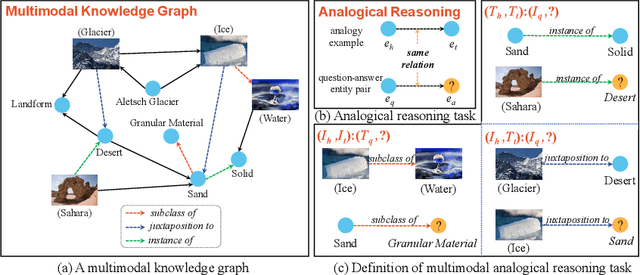

Analogical reasoning, particularly in multimodal contexts, is the foundation of human perception and creativity. Multimodal Large Language Model (MLLM) has recently sparked considerable discussion due to its emergent capabilities. In this paper, we delve into the multimodal analogical reasoning capability of MLLM. Specifically, we explore two facets: \textit{MLLM as an explainer} and \textit{MLLM as a predictor}. In \textit{MLLM as an explainer}, we primarily focus on whether MLLM can deeply comprehend multimodal analogical reasoning problems. We propose a unified prompt template and a method for harnessing the comprehension capabilities of MLLM to augment existing models. In \textit{MLLM as a predictor}, we aim to determine whether MLLM can directly solve multimodal analogical reasoning problems. The experiments show that our approach outperforms existing methods on popular datasets, providing preliminary evidence for the analogical reasoning capability of MLLM.