 Add to Chrome
 Add to Firefox
 Add to Edge
Towards Trustworthy Hypergraph Neural Networks under Label Noise
Aug 05, 2026
Hypergraph neural networks (HGNNs) have demonstrated remarkable capabilities in processing complex higher-order relationships. However, their performance is highly dependent on labeled data, making them vulnerable to label noise. Despite advances in learning with label noise (LLN) and graph learning with label noise (GLN), noisy-label learning on hypergraphs remains underexplored. In this paper, we present a systematic study of hypergraph node classification under label noise. First, we adapt representative LLN and GLN methods to hypergraphs and evaluate them under a unified benchmark, revealing the limitations of existing robust learning strategies for hypergraphs. Building on this, we propose a new hypergraph robust framework, HyperTrust, which first estimates hyperedge trustworthiness through a pretraining-based, entropy-aware strategy, and then incorporates the HyperedgeBoost module to enhance reliable supervision by connecting unlabeled nodes to trustworthy hyperedges, as well as the HyperedgePrune module to suppress noisy propagation by removing untrustworthy node-hyperedge incidences. Finally, two modules work collaboratively to adjust the hypergraph structure and generate final predictions. Extensive experiments and theoretical analysis demonstrate the effectiveness and robustness of HyperTrust on multiple hypergraph datasets under various noisy settings. Our work provides a unified benchmark and an effective solution for hypergraph learning with label noise and lays a foundation for future research in this direction.

From Diffusion to Reaction-Diffusion: A Dynamical-Systems View of Oversmoothing in Hypergraph Neural Networks
Jul 17, 2026Higher-order couplings enhance the expressive power of hypergraph neural networks (HGNNs), but they also intensify representation collapse in deep propagation due to strong multi-way feature mixing. This work investigates hypergraph oversmoothing from a dynamical-systems perspective and develops a reaction--diffusion framework for depth-resistant hypergraph learning. By defining hypergraph gradient and divergence operators, we interpret message passing as an incidence-level diffusion process. The analysis of pure diffusion shows that its continuous semiflow exponentially contracts the null-mode-free component of node representations and drives the Dirichlet energy to zero, revealing hypergraph oversmoothing as an intrinsic transverse-energy dissipation phenomenon. Motivated by this analysis, we propose Hypergraph Neural Reaction--Diffusion (HNRD), which introduces a reaction mechanism acting on the transverse component to compensate diffusion-induced dissipation and stabilize discriminative variations. We establish global well-posedness of the proposed dynamics and prove that the null-mode-free Dirichlet energy remains bounded away from zero. A forward-Euler discretization provides a practical HNRD layer with a stability condition for deep propagation. Experiments on benchmark and synthetic heterophilic hypergraphs demonstrate that HNRD consistently improves over representative hypergraph baselines. Depth, robustness, and efficiency analyses further show that HNRD preserves stable performance and nonzero Dirichlet energy under deep propagation and perturbations. These results provide a principled dynamical framework for designing deep hypergraph architectures that maintain higher-order expressiveness without representation collapse.
Hypergraph Neural Stochastic Diffusion: An SDE Framework for Uncertainty Estimation
Jul 08, 2026Hypergraph neural networks have shown powerful capability in modeling higher-order relations, yet their predictive uncertainty remains underexplored. Unlike pairwise graphs, uncertainty in hypergraphs arises not only from noisy attributes and ambiguous labels, but also from variations in node-hyperedge incidence structures and complex higher-order dependencies. Existing approaches mainly estimate uncertainty from final predictions or rely on computationally expensive ensembles and Bayesian inference, limiting their ability to capture uncertainty evolution during representation learning. In this paper, we propose Hypergraph Neural Stochastic Diffusion(HyperNSD), a stochastic differential equation framework for uncertainty estimation on hypergraphs. HyperNSD models hypergraph representations as stochastic processes evolving over node-hyperedge incidence structures. A learnable drift function captures deterministic higher-order diffusion dynamics, while a learnable stochastic forcing function characterizes structural ambiguity and representation noise. Predictive uncertainty is directly quantified through the variability of stochastic representation trajectories, providing an intrinsic uncertainty measure beyond post-hoc confidence scores. We formulate HyperNSD with neural drift and diffusion networks, enabling joint learning of prediction and uncertainty propagation. Theoretical analyses establish well posedness, perturbation stability,permutation equivariance, and numerical convergence of the proposed stochastic dynamics. Experiments on multiple hypergraph benchmarks demonstrate that HyperNSD achieves reliable uncertainty estimation for out-of-distribution and misclassification detection while preserving competitive prediction accuracy. These results provide a principled stochastic-dynamical framework for trustworthy higher-order representation learning.
AbstainGNN: Teaching Graph Neural Networks to Abstain for Graph Classification
May 29, 2026Graph classification is a core task in graph data mining with widespread real-world applications. Recent advances in graph neural networks (GNNs) have led to substantial performance improvements for graph classification. However, existing GNNs are typically forced to make predictions even under high uncertainty or unknown conditions, resulting in unreliable decisions that can severely impact downstream tasks, particularly in safety-critical scenarios. To address this critical limitation, we propose AbstainGNN, a novel and theory-driven framework for graph classification with abstention, which enables GNNs to reject uncertain predictions instead of producing incorrect decisions. Specifically, AbstainGNN explicitly models both the predictive function and the abstention function, allowing for effective utilization of graph structural information. Moreover, unlike existing heuristic abstention methods, we theoretically characterize the trade-off between classification errors and rejection costs from a PAC-Bayesian generalization perspective, and derive a unified learning objective for model optimization. Guided by this theoretical insight, we further develop an efficient two-stage training strategy consisting of predictive function warm-start and abstention function calibration. Extensive experiments on five benchmark datasets show that AbstainGNN outperforms existing abstention methods, achieving superior classification performance under the same rejection rates.
Hypergraph Neural Diffusion: A PDE-Inspired Framework for Hypergraph Message Passing
Apr 13, 2026Hypergraph neural networks (HGNNs) have shown remarkable potential in modeling high-order relationships that naturally arise in many real-world data domains. However, existing HGNNs often suffer from shallow propagation, oversmoothing, and limited adaptability to complex hypergraph structures. In this paper, we propose Hypergraph Neural Diffusion (HND), a novel framework that unifies nonlinear diffusion equations with neural message passing on hypergraphs. HND is grounded in a continuous-time hypergraph diffusion equation, formulated via hypergraph gradient and divergence operators, and modulated by a learnable, structure-aware coefficient matrix over hyperedge-node pairs. This partial differential equation (PDE) based formulation provides a physically interpretable view of hypergraph learning, where feature propagation is understood as an anisotropic diffusion process governed by local inconsistency and adaptive diffusion coefficient. From this perspective, neural message passing becomes a discretized gradient flow that progressively minimizes a diffusion energy functional. We derive rigorous theoretical guarantees, including energy dissipation, solution boundedness via a discrete maximum principle, and stability under explicit and implicit numerical schemes. The HND framework supports a variety of integration strategies such as non-adaptive-step (like Runge-Kutta) and adaptive-step solvers, enabling the construction of deep, stable, and interpretable architectures. Extensive experiments on benchmark datasets demonstrate that HND achieves competitive performance. Our results highlight the power of PDE-inspired design in enhancing the stability, expressivity, and interpretability of hypergraph learning.
Tackling Over-smoothing on Hypergraphs: A Ricci Flow-guided Neural Diffusion Approach
Mar 16, 2026Hypergraph neural networks (HGNNs) have demonstrated strong capabilities in modeling complex higher-order relationships. However, existing HGNNs often suffer from over-smoothing as the number of layers increases and lack effective control over message passing among nodes. Inspired by the theory of Ricci flow in differential geometry, we theoretically establish that introducing discrete Ricci flow into hypergraph structures can effectively regulate node feature evolution and thereby alleviate over-smoothing. Building on this insight, we propose Ricci Flow-guided Hypergraph Neural Diffusion(RFHND), a novel message passing paradigm for hypergraphs guided by discrete Ricci flow. Specifically, RFHND is based on a PDE system that describes the continuous evolution of node features on hypergraphs and adaptively regulates the rate of information diffusion at the geometric level, preventing feature homogenization and producing high-quality node representations. Experimental results show that RFHND significantly outperforms existing methods across multiple benchmark datasets and demonstrates strong robustness, while also effectively mitigating over-smoothing.
Pano360: Perspective to Panoramic Vision with Geometric Consistency
Mar 12, 2026Prior panorama stitching approaches heavily rely on pairwise feature correspondences and are unable to leverage geometric consistency across multiple views. This leads to severe distortion and misalignment, especially in challenging scenes with weak textures, large parallax, and repetitive patterns. Given that multi-view geometric correspondences can be directly constructed in 3D space, making them more accurate and globally consistent, we extend the 2D alignment task to the 3D photogrammetric space. We adopt a novel transformer-based architecture to achieve 3D awareness and aggregate global information across all views. It directly utilizes camera poses to guide image warping for global alignment in 3D space and employs a multi-feature joint optimization strategy to compute the seams. Additionally, to establish an evaluation benchmark and train our network, we constructed a large-scale dataset of real-world scenes. Extensive experiments show that our method significantly outperforms existing alternatives in alignment accuracy and perceptual quality.
Consistency-Regularized GAN for Few-Shot SAR Target Recognition
Jan 22, 2026Few-shot recognition in synthetic aperture radar (SAR) imagery remains a critical bottleneck for real-world applications due to extreme data scarcity. A promising strategy involves synthesizing a large dataset with a generative adversarial network (GAN), pre-training a model via self-supervised learning (SSL), and then fine-tuning on the few labeled samples. However, this approach faces a fundamental paradox: conventional GANs themselves require abundant data for stable training, contradicting the premise of few-shot learning. To resolve this, we propose the consistency-regularized generative adversarial network (Cr-GAN), a novel framework designed to synthesize diverse, high-fidelity samples even when trained under these severe data limitations. Cr-GAN introduces a dual-branch discriminator that decouples adversarial training from representation learning. This architecture enables a channel-wise feature interpolation strategy to create novel latent features, complemented by a dual-domain cycle consistency mechanism that ensures semantic integrity. Our Cr-GAN framework is adaptable to various GAN architectures, and its synthesized data effectively boosts multiple SSL algorithms. Extensive experiments on the MSTAR and SRSDD datasets validate our approach, with Cr-GAN achieving a highly competitive accuracy of 71.21% and 51.64%, respectively, in the 8-shot setting, significantly outperforming leading baselines, while requiring only ~5 of the parameters of state-of-the-art diffusion models. Code is available at: https://github.com/yikuizhai/Cr-GAN.
Beyond Weight Adaptation: Feature-Space Domain Injection for Cross-Modal Ship Re-Identification
Dec 24, 2025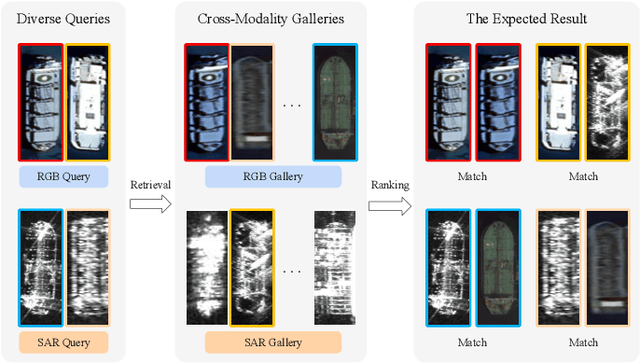
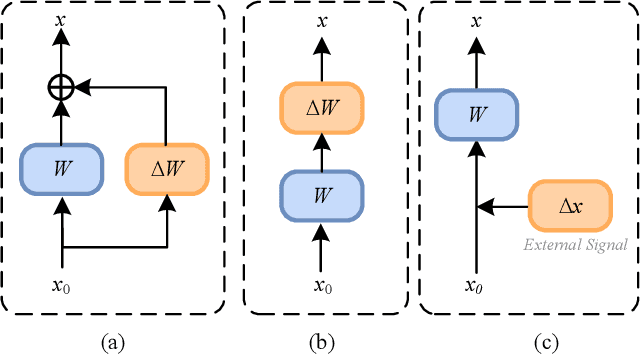
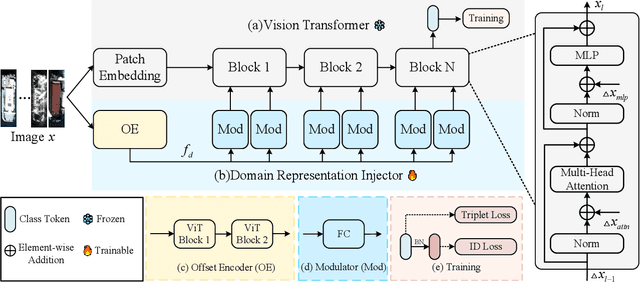
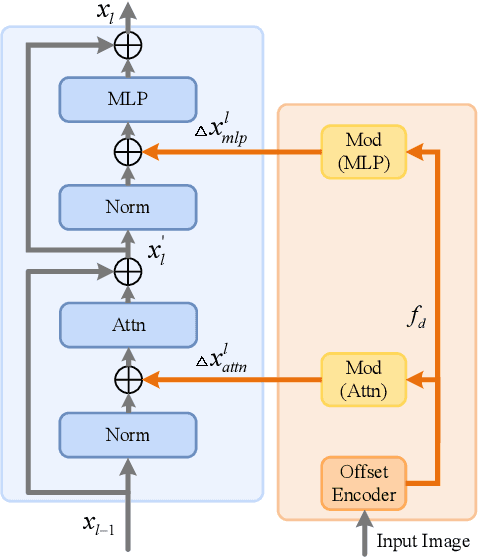
Cross-Modality Ship Re-Identification (CMS Re-ID) is critical for achieving all-day and all-weather maritime target tracking, yet it is fundamentally challenged by significant modality discrepancies. Mainstream solutions typically rely on explicit modality alignment strategies; however, this paradigm heavily depends on constructing large-scale paired datasets for pre-training. To address this, grounded in the Platonic Representation Hypothesis, we explore the potential of Vision Foundation Models (VFMs) in bridging modality gaps. Recognizing the suboptimal performance of existing generic Parameter-Efficient Fine-Tuning (PEFT) methods that operate within the weight space, particularly on limited-capacity models, we shift the optimization perspective to the feature space and propose a novel PEFT strategy termed Domain Representation Injection (DRI). Specifically, while keeping the VFM fully frozen to maximize the preservation of general knowledge, we design a lightweight, learnable Offset Encoder to extract domain-specific representations rich in modality and identity attributes from raw inputs. Guided by the contextual information of intermediate features at different layers, a Modulator adaptively transforms these representations. Subsequently, they are injected into the intermediate layers via additive fusion, dynamically reshaping the feature distribution to adapt to the downstream task without altering the VFM's pre-trained weights. Extensive experimental results demonstrate the superiority of our method, achieving State-of-the-Art (SOTA) performance with minimal trainable parameters. For instance, on the HOSS-ReID dataset, we attain 57.9\% and 60.5\% mAP using only 1.54M and 7.05M parameters, respectively. The code is available at https://github.com/TingfengXian/DRI.
CLIP-FTI: Fine-Grained Face Template Inversion via CLIP-Driven Attribute Conditioning
Dec 17, 2025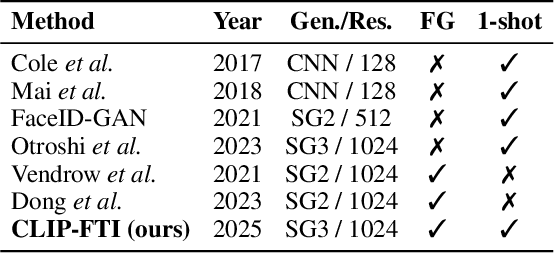
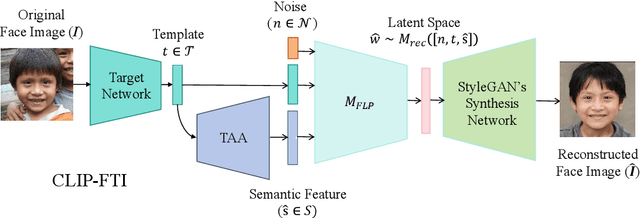
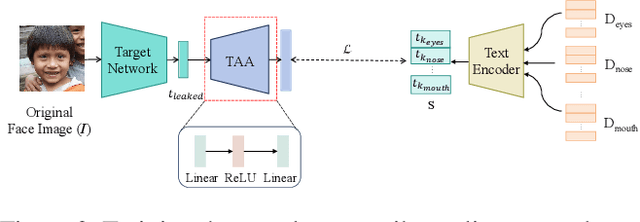
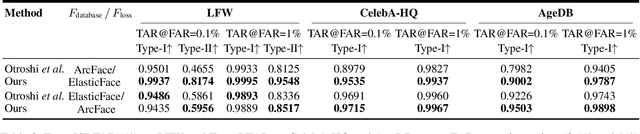
Face recognition systems store face templates for efficient matching. Once leaked, these templates pose a threat: inverting them can yield photorealistic surrogates that compromise privacy and enable impersonation. Although existing research has achieved relatively realistic face template inversion, the reconstructed facial images exhibit over-smoothed facial-part attributes (eyes, nose, mouth) and limited transferability. To address this problem, we present CLIP-FTI, a CLIP-driven fine-grained attribute conditioning framework for face template inversion. Our core idea is to use the CLIP model to obtain the semantic embeddings of facial features, in order to realize the reconstruction of specific facial feature attributes. Specifically, facial feature attribute embeddings extracted from CLIP are fused with the leaked template via a cross-modal feature interaction network and projected into the intermediate latent space of a pretrained StyleGAN. The StyleGAN generator then synthesizes face images with the same identity as the templates but with more fine-grained facial feature attributes. Experiments across multiple face recognition backbones and datasets show that our reconstructions (i) achieve higher identification accuracy and attribute similarity, (ii) recover sharper component-level attribute semantics, and (iii) improve cross-model attack transferability compared to prior reconstruction attacks. To the best of our knowledge, ours is the first method to use additional information besides the face template attack to realize face template inversion and obtains SOTA results.