 Add to Chrome
 Add to Firefox
 Add to Edge
Self-Authored Verification Is Unreliable in Heuristic Self-Improving Agents
Jul 27, 2026
Self-improving agents accumulate capability by repeatedly rewriting procedural policies, controllers, or heuristic rules. They typically rely on self-authored tests or metrics to decide whether to accept subsequent edits. The agent controls both the optimized object and its verifier. As a result, self-assigned scores can remain near perfect while real deployment performance degrades or stays low. We study this problem through the verifier--deployment gap. This gap refers to the discrepancy between an agent's self-authored verification signal and a sealed deployment evaluation that the agent cannot observe or access. We ask how self-authored verification fails under iterative policy-and-test rewriting, how the failure changes with capability, and how little exogenous trust is sufficient to prevent real regressions from being deployed. To address this problem, we introduce a Sealed Exogenous Acceptance Loop (SEAL). SEAL retains self-authored tests but compares each candidate with the incumbent through a fixed harness-side audit. The agent cannot author or inspect the audit, receives only accept/reject, and the whole incumbent state is retained after a clear regression. Our experiments show that this problem often appears in heuristic learning settings. These settings require trial-and-error discovery of the target objective. We further find that failures of self-written verification are stratified by capability. Weaker agents tend to damage previously acquired strategies behind easy self-tests. Stronger agents are more stable, but they still mismeasure the deployment distribution. Standard self-written constraints do not reliably close this gap. In contrast, SEAL outperforms unprotected baselines across six models and three random seeds. Reliable self-improvement need not abandon self-verification, but it requires at least one deployment-acceptance signal outside the agent's control.

MOF-Sleuth: Tool-Grounded Reward Alignment for Explainable Fine-Grained MOF CIF Auditing
Jul 22, 2026Large metal-organic framework (MOF) databases support simulation, screening, and machine learning through crystallographic information files (CIFs). Subtle chemical and structural errors in these inputs can compromise downstream results and hinder manual inspection. LLM advances in computational chemistry offer paths beyond predictive screening toward fine-grained diagnosis with evidence-grounded explanations. However, two challenges remain: (i) limited fine-grained attribution: MOF-specific validators and machine-learning models scale detection but provide fixed checks, readiness scores, or coarse labels rather than evidence-grounded explanations; and (ii) unreliable CIF reasoning: direct LLM auditing is costly and unreliable because chemical evidence is implicit across atom-site records and requires geometric, connectivity, occupancy, and charge calculations. Both stem from weak coupling between chemical evidence and language-model explanation. We introduce MOF-Sleuth, a reinforcement-guided CIF auditing agent with two modules: a deterministic Forensic Lab and a Sleuth reasoning engine. The Lab derives composition, geometry, connectivity, occupancy, coordination, and charge evidence, and Sleuth uses this evidence to produce an evidence-grounded explanation, error types, and a binary decision. Reward-guided reinforcement learning (RL) turns tool measurements into chemical explanation-level supervision, rewarding not only the final answer but also cited chemical evidence and evidence-supported diagnoses. We introduce Chemically Grounded Diagnosis (Chem-GD), a metric that assesses whether a correct diagnosis is explained by factual, relevant CIF-derived evidence. Across four benchmarks, MOF-Sleuth establishes state-of-the-art performance among LLM-based approaches and MOF-specific machine-learning methods, demonstrating gains in detection, attribution, and grounded explanation quality.
Attenuation-Resilient Alternating Optimization for Laparoscopic Liver Landmark Detection
May 26, 2026Liver surface landmark detection is a fundamental prerequisite for anatomical guidance in laparoscopic liver surgery. However, it remains unreliable in practice due to two pervasive challenges: illumination attenuation in underexposed regions and the structural mismatch between pixel-wise localization and continuous curvilinear geometry. To address these limitations, we propose A2ONet, an attenuation-resilient alternating optimization network for robust liver landmark detection. To mitigate illumination attenuation, A2ONet embraces an illumination field compensation (IFC) block that adaptively enhances dark regions while preserving structural consistency. Meanwhile, we introduce a lightweight frequency-orientation selective filter (FOSF) to suppress repetitive texture interference and preserve salient curvilinear cues. Building upon these resilient representations, we design an alternating seg-curve optimization (ASCO) decoder that iteratively couples dense segmentation with explicit curve modeling, enabling mutual guidance to optimize both structural continuity and endpoint localization. Extensive evaluations on L3D-2K, L3D, and P2ILF demonstrate consistent improvements over competitive methods, establishing a more reliable foundation for intraoperative anatomy guidance. Our code will be available at https://github.com/hyperiondk115/A2ONet.
CRAFT: Calibrated Reasoning with Answer-Faithful Traces via Reinforcement Learning for Multi-Hop Question Answering
Feb 01, 2026Retrieval-augmented generation (RAG) is widely used to ground Large Language Models (LLMs) for multi-hop question answering. Recent work mainly focused on improving answer accuracy via fine-tuning and structured or reinforcement-based optimization. However, reliable reasoning in response generation faces three challenges: 1) Reasoning Collapse. Reasoning in multi-hop QA is inherently complex due to multi-hop composition and is further destabilized by noisy retrieval. 2) Reasoning-answer inconsistency. Due to the intrinsic uncertainty of LLM generation and exposure to evidence--distractor mixtures, models may produce correct answers that are not faithfully supported by their intermediate reasoning or evidence. 3) Loss of format control. Traditional chain-of-thought generation often deviates from required structured output formats, leading to incomplete or malformed structured content. To address these challenges, we propose CRAFT (Calibrated Reasoning with Answer-Faithful Traces), a Group Relative Policy Optimization (GRPO) based reinforcement learning framework that trains models to perform faithful reasoning during response generation. CRAFT employs dual reward mechanisms to optimize multi-hop reasoning: deterministic rewards ensure structural correctness while judge-based rewards verify semantic faithfulness. This optimization framework supports controllable trace variants that enable systematic analysis of how structure and scale affect reasoning performance and faithfulness. Experiments on three multi-hop QA benchmarks show that CRAFT improves both answer accuracy and reasoning faithfulness across model scales, with the CRAFT 7B model achieving competitive performance with closed-source LLMs across multiple reasoning trace settings.
MuVaC: AVariational Causal Framework for Multimodal Sarcasm Understanding in Dialogues
Jan 28, 2026The prevalence of sarcasm in multimodal dialogues on the social platforms presents a crucial yet challenging task for understanding the true intent behind online content. Comprehensive sarcasm analysis requires two key aspects: Multimodal Sarcasm Detection (MSD) and Multimodal Sarcasm Explanation (MuSE). Intuitively, the act of detection is the result of the reasoning process that explains the sarcasm. Current research predominantly focuses on addressing either MSD or MuSE as a single task. Even though some recent work has attempted to integrate these tasks, their inherent causal dependency is often overlooked. To bridge this gap, we propose MuVaC, a variational causal inference framework that mimics human cognitive mechanisms for understanding sarcasm, enabling robust multimodal feature learning to jointly optimize MSD and MuSE. Specifically, we first model MSD and MuSE from the perspective of structural causal models, establishing variational causal pathways to define the objectives for joint optimization. Next, we design an alignment-then-fusion approach to integrate multimodal features, providing robust fusion representations for sarcasm detection and explanation generation. Finally, we enhance the reasoning trustworthiness by ensuring consistency between detection results and explanations. Experimental results demonstrate the superiority of MuVaC in public datasets, offering a new perspective for understanding multimodal sarcasm.
Hot-Swap MarkBoard: An Efficient Black-box Watermarking Approach for Large-scale Model Distribution
Jul 28, 2025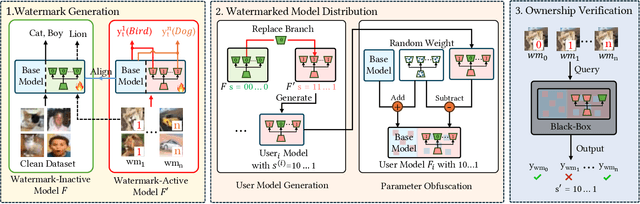
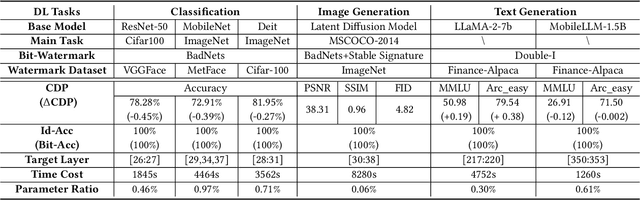
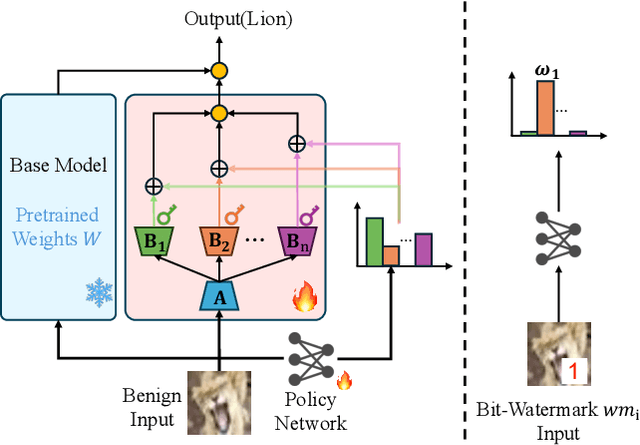
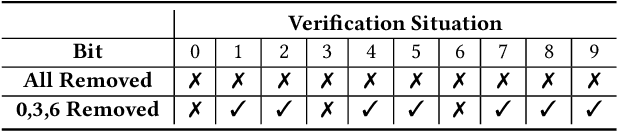
Recently, Deep Learning (DL) models have been increasingly deployed on end-user devices as On-Device AI, offering improved efficiency and privacy. However, this deployment trend poses more serious Intellectual Property (IP) risks, as models are distributed on numerous local devices, making them vulnerable to theft and redistribution. Most existing ownership protection solutions (e.g., backdoor-based watermarking) are designed for cloud-based AI-as-a-Service (AIaaS) and are not directly applicable to large-scale distribution scenarios, where each user-specific model instance must carry a unique watermark. These methods typically embed a fixed watermark, and modifying the embedded watermark requires retraining the model. To address these challenges, we propose Hot-Swap MarkBoard, an efficient watermarking method. It encodes user-specific $n$-bit binary signatures by independently embedding multiple watermarks into a multi-branch Low-Rank Adaptation (LoRA) module, enabling efficient watermark customization without retraining through branch swapping. A parameter obfuscation mechanism further entangles the watermark weights with those of the base model, preventing removal without degrading model performance. The method supports black-box verification and is compatible with various model architectures and DL tasks, including classification, image generation, and text generation. Extensive experiments across three types of tasks and six backbone models demonstrate our method's superior efficiency and adaptability compared to existing approaches, achieving 100\% verification accuracy.
Benchmarking Laparoscopic Surgical Image Restoration and Beyond
May 25, 2025In laparoscopic surgery, a clear and high-quality visual field is critical for surgeons to make accurate intraoperative decisions. However, persistent visual degradation, including smoke generated by energy devices, lens fogging from thermal gradients, and lens contamination due to blood or tissue fluid splashes during surgical procedures, severely impair visual clarity. These degenerations can seriously hinder surgical workflow and pose risks to patient safety. To systematically investigate and address various forms of surgical scene degradation, we introduce a real-world open-source surgical image restoration dataset covering laparoscopic environments, called SurgClean, which involves multi-type image restoration tasks, e.g., desmoking, defogging, and desplashing. SurgClean comprises 1,020 images with diverse degradation types and corresponding paired reference labels. Based on SurgClean, we establish a standardized evaluation benchmark and provide performance for 22 representative generic task-specific image restoration approaches, including 12 generic and 10 task-specific image restoration approaches. Experimental results reveal substantial performance gaps relative to clinical requirements, highlighting a critical opportunity for algorithm advancements in intelligent surgical restoration. Furthermore, we explore the degradation discrepancies between surgical and natural scenes from structural perception and semantic understanding perspectives, providing fundamental insights for domain-specific image restoration research. Our work aims to empower the capabilities of restoration algorithms to increase surgical environments and improve the efficiency of clinical procedures.
Synergistic Bleeding Region and Point Detection in Surgical Videos
Mar 28, 2025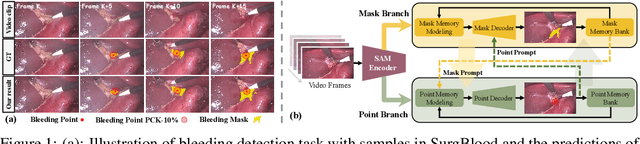
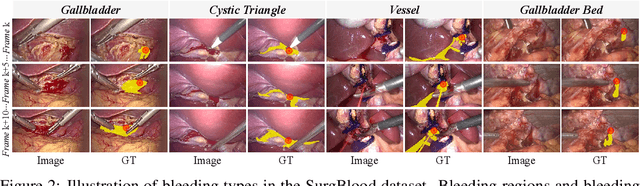
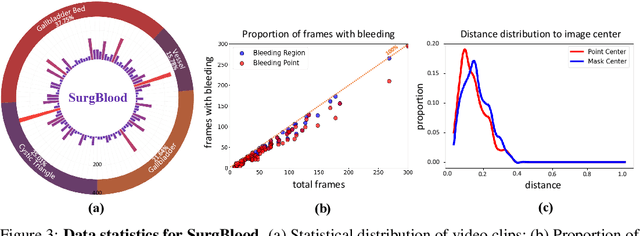
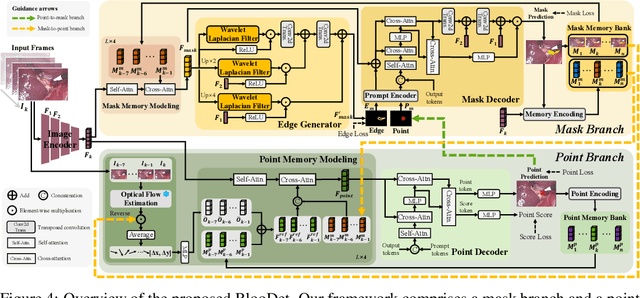
Intraoperative bleeding in laparoscopic surgery causes rapid obscuration of the operative field to hinder the surgical process. Intelligent detection of bleeding regions can quantify the blood loss to assist decision-making, while locating the bleeding point helps surgeons quickly identify the source of bleeding and achieve hemostasis in time. In this study, we first construct a real-world surgical bleeding detection dataset, named SurgBlood, comprising 5,330 frames from 95 surgical video clips with bleeding region and point annotations. Accordingly, we develop a dual-task synergistic online detector called BlooDet, designed to perform simultaneous detection of bleeding regions and points in surgical videos. Our framework embraces a dual-branch bidirectional guidance design based on Segment Anything Model 2 (SAM 2). The mask branch detects bleeding regions through adaptive edge and point prompt embeddings, while the point branch leverages mask memory to induce bleeding point memory modeling and captures the direction of bleed point movement through inter-frame optical flow. By interactive guidance and prompts, the two branches explore potential spatial-temporal relationships while leveraging memory modeling from previous frames to infer the current bleeding condition. Extensive experiments demonstrate that our approach outperforms other counterparts on SurgBlood in both bleeding region and point detection tasks, e.g., achieving 64.88% IoU for bleeding region detection and 83.69% PCK-10% for bleeding point detection.
Multi-View Incongruity Learning for Multimodal Sarcasm Detection
Dec 01, 2024Multimodal sarcasm detection (MSD) is essential for various downstream tasks. Existing MSD methods tend to rely on spurious correlations. These methods often mistakenly prioritize non-essential features yet still make correct predictions, demonstrating poor generalizability beyond training environments. Regarding this phenomenon, this paper undertakes several initiatives. Firstly, we identify two primary causes that lead to the reliance of spurious correlations. Secondly, we address these challenges by proposing a novel method that integrate Multimodal Incongruities via Contrastive Learning (MICL) for multimodal sarcasm detection. Specifically, we first leverage incongruity to drive multi-view learning from three views: token-patch, entity-object, and sentiment. Then, we introduce extensive data augmentation to mitigate the biased learning of the textual modality. Additionally, we construct a test set, SPMSD, which consists potential spurious correlations to evaluate the the model's generalizability. Experimental results demonstrate the superiority of MICL on benchmark datasets, along with the analyses showcasing MICL's advancement in mitigating the effect of spurious correlation.
Can Multimodal Large Language Model Think Analogically?
Nov 02, 2024

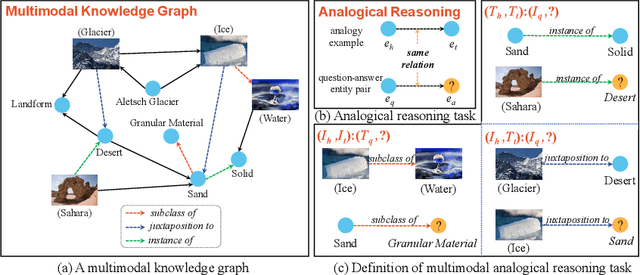

Analogical reasoning, particularly in multimodal contexts, is the foundation of human perception and creativity. Multimodal Large Language Model (MLLM) has recently sparked considerable discussion due to its emergent capabilities. In this paper, we delve into the multimodal analogical reasoning capability of MLLM. Specifically, we explore two facets: \textit{MLLM as an explainer} and \textit{MLLM as a predictor}. In \textit{MLLM as an explainer}, we primarily focus on whether MLLM can deeply comprehend multimodal analogical reasoning problems. We propose a unified prompt template and a method for harnessing the comprehension capabilities of MLLM to augment existing models. In \textit{MLLM as a predictor}, we aim to determine whether MLLM can directly solve multimodal analogical reasoning problems. The experiments show that our approach outperforms existing methods on popular datasets, providing preliminary evidence for the analogical reasoning capability of MLLM.