 Add to Chrome
 Add to Firefox
 Add to Edge
From Diffusion to Reaction-Diffusion: A Dynamical-Systems View of Oversmoothing in Hypergraph Neural Networks
Jul 17, 2026
Higher-order couplings enhance the expressive power of hypergraph neural networks (HGNNs), but they also intensify representation collapse in deep propagation due to strong multi-way feature mixing. This work investigates hypergraph oversmoothing from a dynamical-systems perspective and develops a reaction--diffusion framework for depth-resistant hypergraph learning. By defining hypergraph gradient and divergence operators, we interpret message passing as an incidence-level diffusion process. The analysis of pure diffusion shows that its continuous semiflow exponentially contracts the null-mode-free component of node representations and drives the Dirichlet energy to zero, revealing hypergraph oversmoothing as an intrinsic transverse-energy dissipation phenomenon. Motivated by this analysis, we propose Hypergraph Neural Reaction--Diffusion (HNRD), which introduces a reaction mechanism acting on the transverse component to compensate diffusion-induced dissipation and stabilize discriminative variations. We establish global well-posedness of the proposed dynamics and prove that the null-mode-free Dirichlet energy remains bounded away from zero. A forward-Euler discretization provides a practical HNRD layer with a stability condition for deep propagation. Experiments on benchmark and synthetic heterophilic hypergraphs demonstrate that HNRD consistently improves over representative hypergraph baselines. Depth, robustness, and efficiency analyses further show that HNRD preserves stable performance and nonzero Dirichlet energy under deep propagation and perturbations. These results provide a principled dynamical framework for designing deep hypergraph architectures that maintain higher-order expressiveness without representation collapse.

Hypergraph Neural Stochastic Diffusion: An SDE Framework for Uncertainty Estimation
Jul 08, 2026Hypergraph neural networks have shown powerful capability in modeling higher-order relations, yet their predictive uncertainty remains underexplored. Unlike pairwise graphs, uncertainty in hypergraphs arises not only from noisy attributes and ambiguous labels, but also from variations in node-hyperedge incidence structures and complex higher-order dependencies. Existing approaches mainly estimate uncertainty from final predictions or rely on computationally expensive ensembles and Bayesian inference, limiting their ability to capture uncertainty evolution during representation learning. In this paper, we propose Hypergraph Neural Stochastic Diffusion(HyperNSD), a stochastic differential equation framework for uncertainty estimation on hypergraphs. HyperNSD models hypergraph representations as stochastic processes evolving over node-hyperedge incidence structures. A learnable drift function captures deterministic higher-order diffusion dynamics, while a learnable stochastic forcing function characterizes structural ambiguity and representation noise. Predictive uncertainty is directly quantified through the variability of stochastic representation trajectories, providing an intrinsic uncertainty measure beyond post-hoc confidence scores. We formulate HyperNSD with neural drift and diffusion networks, enabling joint learning of prediction and uncertainty propagation. Theoretical analyses establish well posedness, perturbation stability,permutation equivariance, and numerical convergence of the proposed stochastic dynamics. Experiments on multiple hypergraph benchmarks demonstrate that HyperNSD achieves reliable uncertainty estimation for out-of-distribution and misclassification detection while preserving competitive prediction accuracy. These results provide a principled stochastic-dynamical framework for trustworthy higher-order representation learning.
Hypergraph Neural Diffusion: A PDE-Inspired Framework for Hypergraph Message Passing
Apr 13, 2026Hypergraph neural networks (HGNNs) have shown remarkable potential in modeling high-order relationships that naturally arise in many real-world data domains. However, existing HGNNs often suffer from shallow propagation, oversmoothing, and limited adaptability to complex hypergraph structures. In this paper, we propose Hypergraph Neural Diffusion (HND), a novel framework that unifies nonlinear diffusion equations with neural message passing on hypergraphs. HND is grounded in a continuous-time hypergraph diffusion equation, formulated via hypergraph gradient and divergence operators, and modulated by a learnable, structure-aware coefficient matrix over hyperedge-node pairs. This partial differential equation (PDE) based formulation provides a physically interpretable view of hypergraph learning, where feature propagation is understood as an anisotropic diffusion process governed by local inconsistency and adaptive diffusion coefficient. From this perspective, neural message passing becomes a discretized gradient flow that progressively minimizes a diffusion energy functional. We derive rigorous theoretical guarantees, including energy dissipation, solution boundedness via a discrete maximum principle, and stability under explicit and implicit numerical schemes. The HND framework supports a variety of integration strategies such as non-adaptive-step (like Runge-Kutta) and adaptive-step solvers, enabling the construction of deep, stable, and interpretable architectures. Extensive experiments on benchmark datasets demonstrate that HND achieves competitive performance. Our results highlight the power of PDE-inspired design in enhancing the stability, expressivity, and interpretability of hypergraph learning.
Tackling Over-smoothing on Hypergraphs: A Ricci Flow-guided Neural Diffusion Approach
Mar 16, 2026Hypergraph neural networks (HGNNs) have demonstrated strong capabilities in modeling complex higher-order relationships. However, existing HGNNs often suffer from over-smoothing as the number of layers increases and lack effective control over message passing among nodes. Inspired by the theory of Ricci flow in differential geometry, we theoretically establish that introducing discrete Ricci flow into hypergraph structures can effectively regulate node feature evolution and thereby alleviate over-smoothing. Building on this insight, we propose Ricci Flow-guided Hypergraph Neural Diffusion(RFHND), a novel message passing paradigm for hypergraphs guided by discrete Ricci flow. Specifically, RFHND is based on a PDE system that describes the continuous evolution of node features on hypergraphs and adaptively regulates the rate of information diffusion at the geometric level, preventing feature homogenization and producing high-quality node representations. Experimental results show that RFHND significantly outperforms existing methods across multiple benchmark datasets and demonstrates strong robustness, while also effectively mitigating over-smoothing.
Defensive Alliances in Signed Networks
Sep 13, 2023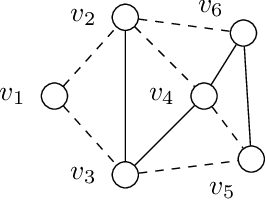
The analysis of (social) networks and multi-agent systems is a central theme in Artificial Intelligence. Some line of research deals with finding groups of agents that could work together to achieve a certain goal. To this end, different notions of so-called clusters or communities have been introduced in the literature of graphs and networks. Among these, defensive alliance is a kind of quantitative group structure. However, all studies on the alliance so for have ignored one aspect that is central to the formation of alliances on a very intuitive level, assuming that the agents are preconditioned concerning their attitude towards other agents: they prefer to be in some group (alliance) together with the agents they like, so that they are happy to help each other towards their common aim, possibly then working against the agents outside of their group that they dislike. Signed networks were introduced in the psychology literature to model liking and disliking between agents, generalizing graphs in a natural way. Hence, we propose the novel notion of a defensive alliance in the context of signed networks. We then investigate several natural algorithmic questions related to this notion. These, and also combinatorial findings, connect our notion to that of correlation clustering, which is a well-established idea of finding groups of agents within a signed network. Also, we introduce a new structural parameter for signed graphs, signed neighborhood diversity snd, and exhibit a parameterized algorithm that finds a smallest defensive alliance in a signed graph.