 Add to Chrome
 Add to Firefox
 Add to Edge
ReQuant: Fixed-Grid Discrete Refinement for Post-Training Quantization
Aug 07, 2026
Post-training quantization (PTQ) is widely used to reduce the memory and computational cost of large language models. Existing PTQ methods typically obtain an initial quantized model through heuristic rules or greedy optimization, and once quantization is completed the resulting integer assignments are usually treated as final. This observation motivates a complementary optimization stage within PTQ that keeps quantized weights improvable after an executable quantized model has been produced, while preserving the quantized format. We introduce ReQuant, a backpropagation-free fixed-grid refinement procedure for this stage. Agnostic to the PTQ initializer, ReQuant takes an existing quantized model as a feasible starting point and iteratively revisits its discrete weight assignments on the fixed quantization grid. Accepted updates strictly reduce the mean squared reconstruction error and remain on the original grid. In this way, ReQuant turns the initially fixed PTQ output into an iteratively optimizable discrete solution and serves as a plug-and-play post-processing stage for existing PTQ pipelines. Experiments across diverse model families, bit-widths, and downstream tasks show that ReQuant consistently improves quantized models from heterogeneous PTQ initializers, with especially large gains on simple initializers and lower bit-widths. Notably, ReQuant can refine a simple round-to-nearest initialization across multiple sweeps until it approaches or surpasses GPTAQ under the same quantization format. These results establish ReQuant as a practical complementary stage for further improving existing PTQ pipelines.

MV-Bench: Benchmarking Multimodal Large Language Models for Coordinated Multi-View Interface Construction
Jul 22, 2026Multimodal large language models (MLLMs) are increasingly expected to automate visualization development by generating code directly from visual designs. However, existing evaluations mainly focus on single-chart generation and overlook coordinated multi-view interface construction, which requires joint reasoning about data semantics, view coordination, and interaction logic. Consequently, MLLM capabilities in this setting remain underexplored, and the field lacks a dedicated benchmark for systematic assessment. We introduce MV-Bench, a benchmark for evaluating MLLMs on coordinated multi-view interface construction. Instead of relying on incomplete or inconsistent open-source implementations, we use Tableau workbook files as ground truth because they explicitly encode data bindings, visual mappings, and interactions. We develop a multi-stage pipeline that converts these specifications into executable web interfaces through structured intermediate representations. The benchmark contains 92 base interfaces and 1,048 verified instances created by recombining chart types, datasets, and interaction patterns. Each instance includes executable code, a rendered interface, a dataset, and interaction annotations. We evaluate five state-of-the-art MLLMs in a single-pass setting using metrics for visual fidelity, data binding correctness, and interaction completeness. The strongest model achieves 75.45 percent accuracy in visual layout reproduction, but only 21.71 percent in data binding and 11.68 percent in interaction completeness. These results show that current MLLMs can reproduce visual appearance but remain limited in generating the data semantics and interactive logic required by coordinated multi-view interfaces. Iterative refinement improves code executability but does not substantially reduce the gap in data binding and interaction generation.
Formal Skill: Programmable Runtime Skills for Efficient and Accurate LLM Agents
May 19, 2026Large Language Model (LLM) agents increasingly act inside real workspaces, where tools and skills determine whether model reasoning becomes reliable action. Existing skills remain largely informal: Markdown skills and instruction packs encode procedures as long natural-language documents, while function calling, Model Context Protocol (MCP) servers, and framework tools structure individual actions but usually leave workflow state, policy enforcement, and completion discipline outside the skill itself. We introduce Formal Skill, a runtime-native abstraction that represents reusable capability with JSON metadata and action schemas, reliable Python executors, hook-governed control logic, Formal Skill routing, and skill-local runtime state. By moving reusable procedure from repeated prompt text into executable state machines and hook policies, Formal Skill gives agents a token-efficient and enforceable control surface. We implement the abstraction in FairyClaw, an open-source event-driven runtime for executable, observable, and composable Formal Skills. On Harness-Bench, FairyClaw obtains highly competitive average scores while using substantially fewer tokens, with especially strong results on tasks that expose the role of Formal Skill.
FairyFuse: Multiplication-Free LLM Inference on CPUs via Fused Ternary Kernels
Apr 22, 2026Large language models are increasingly deployed on CPU-only platforms where memory bandwidth is the primary bottleneck for autoregressive generation. Weight quantization to four bits or below reduces memory pressure, yet existing systems still dequantize weights and perform floating-point multiplications, limiting the achievable gains. Ternary weights in {-1, 0, +1} provide a more efficient alternative, replacing multiplications with conditional additions, subtractions, or no-ops. While Fairy2i shows that ternary LLMs can match FP16 quality, its runtime does not exploit this structure. We present FairyFuse, an inference system that enables multiplication-free execution on commodity CPUs by fusing the eight real-valued sub-GEMVs of each widely-linear layer into a single AVX-512 loop using masked additions and subtractions, with zero floating-point multiplications. Roofline analysis shows that 16x weight compression shifts memory-bound GEMV toward the compute regime on bandwidth-limited CPUs, yielding a 29.6x kernel speedup while offering little benefit on GPUs. End-to-end, FairyFuse achieves 32.4 tokens per second on a single Intel Xeon 8558P, outperforming llama.cpp Q4_K_M by 1.24x with near-lossless quality (WikiText-2 perplexity 5.52 vs. 5.47 FP16; downstream accuracy 66.0%).
Boosting Quantitive and Spatial Awareness for Zero-Shot Object Counting
Mar 17, 2026Zero-shot object counting (ZSOC) aims to enumerate objects of arbitrary categories specified by text descriptions without requiring visual exemplars. However, existing methods often treat counting as a coarse retrieval task, suffering from a lack of fine-grained quantity awareness. Furthermore, they frequently exhibit spatial insensitivity and degraded generalization due to feature space distortion during model adaptation.To address these challenges, we present \textbf{QICA}, a novel framework that synergizes \underline{q}uantity percept\underline{i}on with robust spatial \underline{c}ast \underline{a}ggregation. Specifically, we introduce a Synergistic Prompting Strategy (\textbf{SPS}) that adapts vision and language encoders through numerically conditioned prompts, bridging the gap between semantic recognition and quantitative reasoning. To mitigate feature distortion, we propose a Cost Aggregation Decoder (\textbf{CAD}) that operates directly on vision-text similarity maps. By refining these maps through spatial aggregation, CAD prevents overfitting while preserving zero-shot transferability. Additionally, a multi-level quantity alignment loss ($\mathcal{L}_{MQA}$) is employed to enforce numerical consistency across the entire pipeline. Extensive experiments on FSC-147 demonstrate competitive performance, while zero-shot evaluation on CARPK and ShanghaiTech-A validates superior generalization to unseen domains.
IntroSVG: Learning from Rendering Feedback for Text-to-SVG Generation via an Introspective Generator-Critic Framework
Mar 10, 2026Scalable Vector Graphics (SVG) are central to digital design due to their inherent scalability and editability. Despite significant advancements in content generation enabled by Visual Language Models (VLMs), existing text-to-SVG generation methods are limited by a core challenge: the autoregressive training process does not incorporate visual perception of the final rendered image, which fundamentally constrains generation quality. To address this limitation, we propose an Introspective SVG Generation Framework (IntroSVG). At its core, the framework instantiates a unified VLM that operates in a closed loop, assuming dual roles of both generator and critic. Specifically, through Supervised Fine-Tuning (SFT), the model learns to draft SVGs and to provide feedback on their rendered outputs; moreover, we systematically convert early-stage failures into high-quality error-correction training data, thereby enhancing model robustness. Subsequently, we leverage a high-capacity teacher VLM to construct a preference dataset and further align the generator's policy through Direct Preference Optimization (DPO). During inference, the optimized generator and critic operate collaboratively in an iterative "generate-review-refine" cycle, starting from imperfect intermediate drafts to autonomously improve output quality. Experimental results demonstrate that our method achieves state-of-the-art performance across several key evaluation metrics, generating SVGs with more complex structures, stronger semantic alignment, and greater editability. These results corroborate the effectiveness of incorporating explicit visual feedback into the generation loop.
HESTIA: A Hessian-Guided Differentiable Quantization-Aware Training Framework for Extremely Low-Bit LLMs
Jan 28, 2026As large language models (LLMs) continue to scale, deployment is increasingly bottlenecked by the memory wall, motivating a shift toward extremely low-bit quantization. However, most quantization-aware training (QAT) methods apply hard rounding and the straight-through estimator (STE) from the beginning of the training, which prematurely discretizes the optimization landscape and induces persistent gradient mismatch between latent weights and quantized weights, hindering effective optimization of quantized models. To address this, we propose Hestia, a Hessian-guided differentiable QAT framework for extremely low-bit LLMs, which replaces the rigid step function with a temperature-controlled softmax relaxation to maintain gradient flow early in training while progressively hardening quantization. Furthermore, Hestia leverages a tensor-wise Hessian trace metric as a lightweight curvature signal to drive fine-grained temperature annealing, enabling sensitivity-aware discretization across the model. Evaluations on Llama-3.2 show that Hestia consistently outperforms existing ternary QAT baselines, yielding average zero-shot improvements of 5.39% and 4.34% for the 1B and 3B models. These results indicate that Hessian-guided relaxation effectively recovers representational capacity, establishing a more robust training path for 1.58-bit LLMs. The code is available at https://github.com/hestia2026/Hestia.
MARS2 2025 Challenge on Multimodal Reasoning: Datasets, Methods, Results, Discussion, and Outlook
Sep 17, 2025
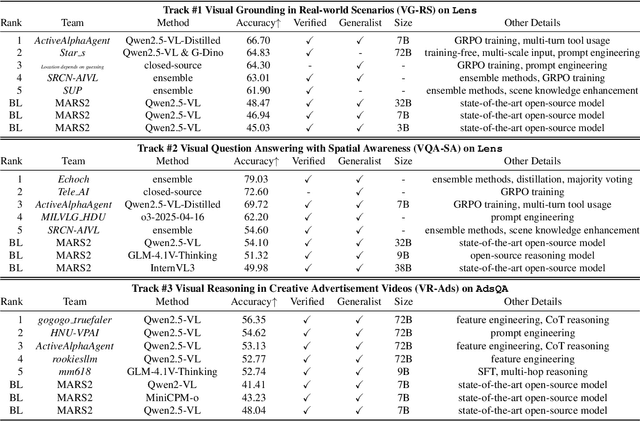

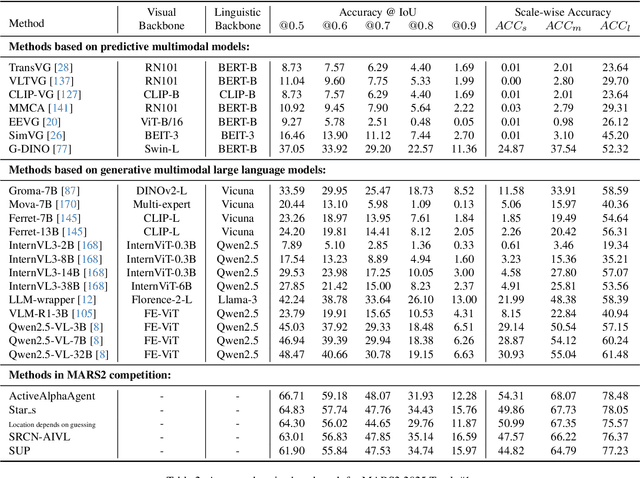
This paper reviews the MARS2 2025 Challenge on Multimodal Reasoning. We aim to bring together different approaches in multimodal machine learning and LLMs via a large benchmark. We hope it better allows researchers to follow the state-of-the-art in this very dynamic area. Meanwhile, a growing number of testbeds have boosted the evolution of general-purpose large language models. Thus, this year's MARS2 focuses on real-world and specialized scenarios to broaden the multimodal reasoning applications of MLLMs. Our organizing team released two tailored datasets Lens and AdsQA as test sets, which support general reasoning in 12 daily scenarios and domain-specific reasoning in advertisement videos, respectively. We evaluated 40+ baselines that include both generalist MLLMs and task-specific models, and opened up three competition tracks, i.e., Visual Grounding in Real-world Scenarios (VG-RS), Visual Question Answering with Spatial Awareness (VQA-SA), and Visual Reasoning in Creative Advertisement Videos (VR-Ads). Finally, 76 teams from the renowned academic and industrial institutions have registered and 40+ valid submissions (out of 1200+) have been included in our ranking lists. Our datasets, code sets (40+ baselines and 15+ participants' methods), and rankings are publicly available on the MARS2 workshop website and our GitHub organization page https://github.com/mars2workshop/, where our updates and announcements of upcoming events will be continuously provided.
Fairy$\pm i$: the First 2-bit Complex LLM with All Parameters in $\{\pm1, \pm i\}$
Aug 07, 2025Quantization-Aware Training (QAT) integrates quantization into the training loop, enabling LLMs to learn robust low-bit representations, and is widely recognized as one of the most promising research directions. All current QAT research focuses on minimizing quantization error on full-precision models, where the full-precision accuracy acts as an upper bound (accuracy ceiling). No existing method has even attempted to surpass this ceiling. To break this ceiling, we propose a new paradigm: raising the ceiling (full-precision model), and then still quantizing it efficiently into 2 bits. We propose Fairy$\pm i$, the first 2-bit quantization framework for complex-valued LLMs. Specifically, our method leverages the representational advantages of the complex domain to boost full-precision accuracy. We map weights to the fourth roots of unity $\{\pm1, \pm i\}$, forming a perfectly symmetric and information-theoretically optimal 2-bit representation. Importantly, each quantized weight has either a zero real or imaginary part, enabling multiplication-free inference using only additions and element swaps. Experimental results show that Fairy$\pm i$ outperforms the ceiling of existing 2-bit quantization approaches in terms of both PPL and downstream tasks, while maintaining strict storage and compute efficiency. This work opens a new direction for building highly accurate and practical LLMs under extremely low-bit constraints.
Autonomous Stabilization of Retinal Videos for Streamlining Assessment of Spontaneous Venous Pulsations
May 10, 2023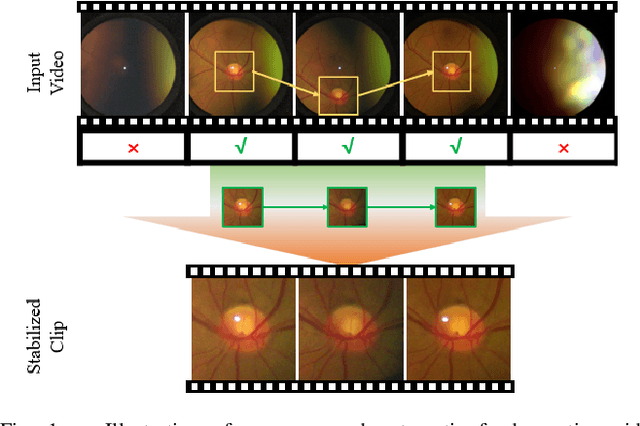
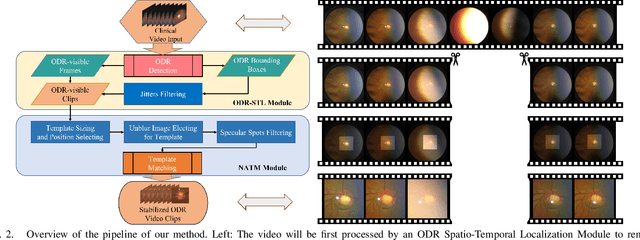
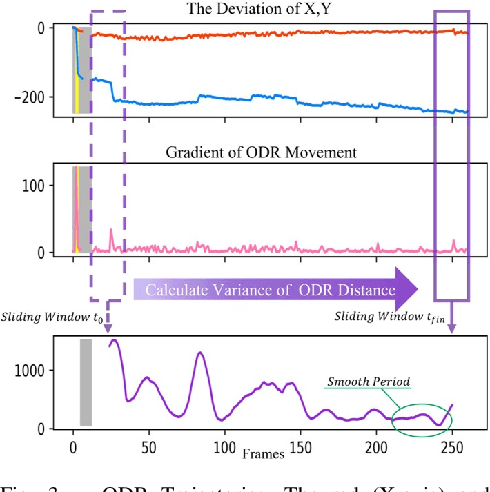
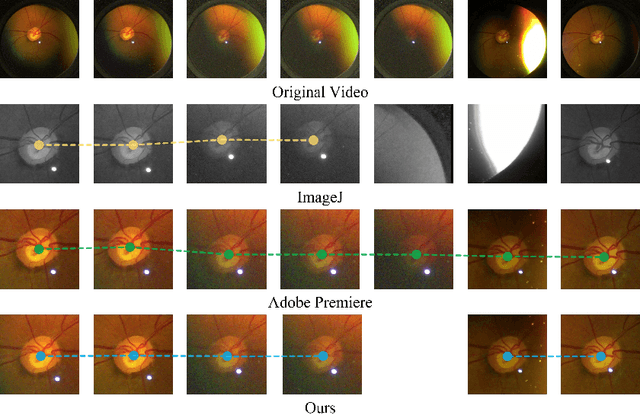
Spontaneous retinal Venous Pulsations (SVP) are rhythmic changes in the caliber of the central retinal vein and are observed in the optic disc region (ODR) of the retina. Its absence is a critical indicator of various ocular or neurological abnormalities. Recent advances in imaging technology have enabled the development of portable smartphone-based devices for observing the retina and assessment of SVPs. However, the quality of smartphone-based retinal videos is often poor due to noise and image jitting, which in return, can severely obstruct the observation of SVPs. In this work, we developed a fully automated retinal video stabilization method that enables the examination of SVPs captured by various mobile devices. Specifically, we first propose an ODR Spatio-Temporal Localization (ODR-STL) module to localize visible ODR and remove noisy and jittering frames. Then, we introduce a Noise-Aware Template Matching (NATM) module to stabilize high-quality video segments at a fixed position in the field of view. After the processing, the SVPs can be easily observed in the stabilized videos, significantly facilitating user observations. Furthermore, our method is cost-effective and has been tested in both subjective and objective evaluations. Both of the evaluations support its effectiveness in facilitating the observation of SVPs. This can improve the timely diagnosis and treatment of associated diseases, making it a valuable tool for eye health professionals.