 Add to Chrome
 Add to Firefox
 Add to Edge
Knowledge Index of Noah's Ark
Jun 04, 2026
Knowledge benchmarks for LLMs face three issues: scaling-driven designs that do not operationalize disciplinary representativeness; flat-payment annotation that permits lazy consensus; and unaudited ranking instability under bounded test budgets. We introduce KINA, an 899-item benchmark across 261 fine-grained disciplines, with two formal results. First, we cast representativeness as a coverage-style objective over expert-elicited anchors and operationalize disciplinary representativeness through a proxy, yielding a (1-1/e) greedy approximation (Proposition 1); the guarantee applies to the proxy, not to population representativeness. Second, we prove a bonus-on-bar tournament weakly FOSD-dominates flat payment in released-review quality, with incentive-compatibility threshold B > Delta C / Delta p_min (Theorem 1). Evaluating 42 models from 13 labs, the top model, Gemini-3.1-Pro-Preview, reaches 53.17%, followed by Claude-Opus-4.6 at 49.92% and GPT-5.4 at 48.55%, leaving substantial headroom below saturation. The full leaderboard shows a tiered structure rather than a smooth total order: a small frontier tier lies above 48%, a dense strong-model tier spans roughly 38-45%, and low-performing models remain only modestly above the 10% chance baseline. Tool augmentation adds up to 5.17 points across the five tool-use evaluations, with gains varying substantially across models. We report bootstrap ranking-stability statistics to make bounded-budget variance explicit and to discourage over-interpretation of adjacent ranks.

Code-Switching Information Retrieval: Benchmarks, Analysis, and the Limits of Current Retrievers
Apr 19, 2026Code-switching is a pervasive linguistic phenomenon in global communication, yet modern information retrieval systems remain predominantly designed for, and evaluated within, monolingual contexts. To bridge this critical disconnect, we present a holistic study dedicated to code-switching IR. We introduce CSR-L (Code-Switching Retrieval benchmark-Lite), constructing a dataset via human annotation to capture the authentic naturalness of mixed-language queries. Our evaluation across statistical, dense, and late-interaction paradigms reveals that code-switching acts as a fundamental performance bottleneck, degrading the effectiveness of even robust multilingual models. We demonstrate that this failure stems from substantial divergence in the embedding space between pure and code-switched text. Scaling this investigation, we propose CS-MTEB, a comprehensive benchmark covering 11 diverse tasks, where we observe performance declines of up to 27%. Finally, we show that standard multilingual techniques like vocabulary expansion are insufficient to resolve these deficits completely. These findings underscore the fragility of current systems and establish code-switching as a crucial frontier for future IR optimization.
VideoGPA: Distilling Geometry Priors for 3D-Consistent Video Generation
Jan 30, 2026While recent video diffusion models (VDMs) produce visually impressive results, they fundamentally struggle to maintain 3D structural consistency, often resulting in object deformation or spatial drift. We hypothesize that these failures arise because standard denoising objectives lack explicit incentives for geometric coherence. To address this, we introduce VideoGPA (Video Geometric Preference Alignment), a data-efficient self-supervised framework that leverages a geometry foundation model to automatically derive dense preference signals that guide VDMs via Direct Preference Optimization (DPO). This approach effectively steers the generative distribution toward inherent 3D consistency without requiring human annotations. VideoGPA significantly enhances temporal stability, physical plausibility, and motion coherence using minimal preference pairs, consistently outperforming state-of-the-art baselines in extensive experiments.
When to Trust Context: Self-Reflective Debates for Context Reliability
Jun 06, 2025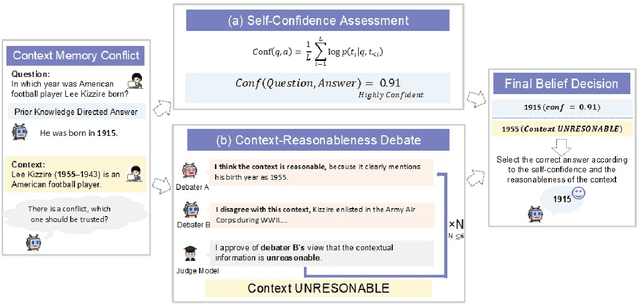
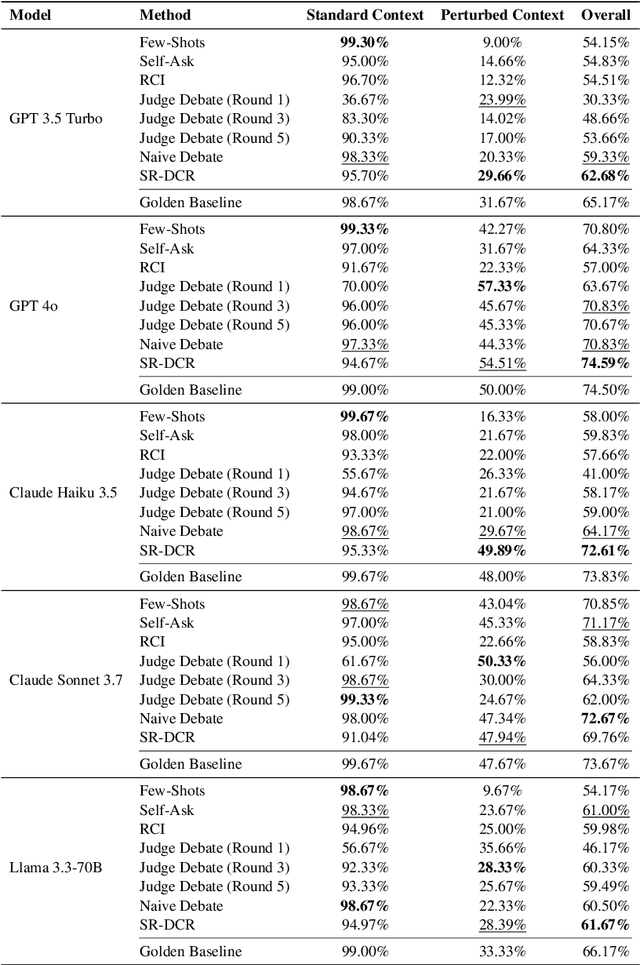
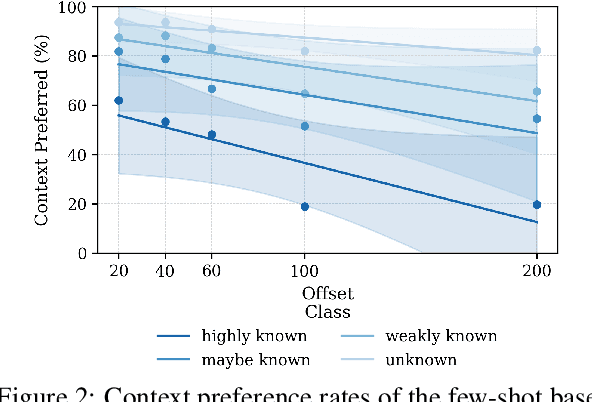
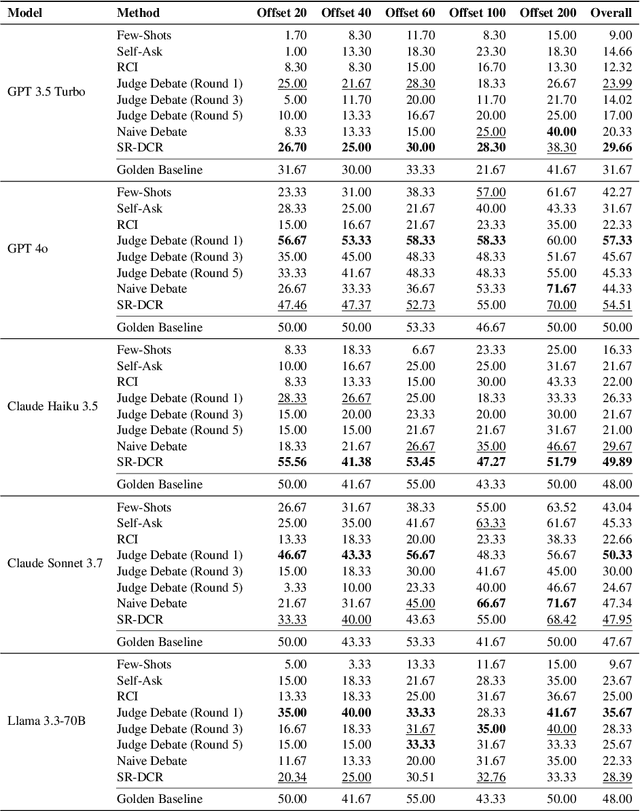
Large language models frequently encounter conflicts between their parametric knowledge and contextual input, often resulting in factual inconsistencies or hallucinations. We propose Self-Reflective Debate for Contextual Reliability (SR-DCR), a lightweight framework that integrates token-level self-confidence with an asymmetric multi-agent debate to adjudicate such conflicts. A critic, deprived of context, challenges a defender who argues from the given passage; a judge model evaluates the debate and determines the context's reliability. The final answer is selected by combining the verdict with model confidence. Experiments on the ClashEval benchmark demonstrate that SR-DCR consistently enhances robustness to misleading context while maintaining accuracy on trustworthy inputs, outperforming both classical debate and confidence-only baselines with minimal computational overhead. The code is available at https://github.com/smiles724/Self-Reflective-Debates.