 Add to Chrome
 Add to Firefox
 Add to Edge
Beyond Post-Hoc Temperature Scaling: Bilevel Optimization for LLM Calibration
Aug 07, 2026
Preference alignment often makes large language models (LLMs) overconfident and poorly calibrated. Traditional post-hoc temperature scaling is inherently domain-dependent: a temperature fitted on one domain does not generalize across domains. This motivates us to modify model parameters during training to improve calibration. We propose maximizing the entropy of predictive distributions as the calibration objective, which directly targets overconfidence by discouraging overly concentrated predictions. Inspired by temperature scaling, we realize this through a bilevel optimization formulation, where the lower level trains the model under a parametric loss and the upper level selects loss hyperparameters to maximize entropy. To make the framework practical at LLM scale, we adopt an efficient first-order approximation that avoids explicit second-order computation. Across both multiple-choice and open-ended generative question answering, experiments demonstrate that our method yields well-calibrated LLMs with particular advantages in out-of-domain generalization.

Tabular LLMs for Interpretable Few-Shot Alzheimer's Disease Prediction with Multimodal Biomedical Data
Mar 17, 2026Accurate diagnosis of Alzheimer's disease (AD) requires handling tabular biomarker data, yet such data are often small and incomplete, where deep learning models frequently fail to outperform classical methods. Pretrained large language models (LLMs) offer few-shot generalization, structured reasoning, and interpretable outputs, providing a powerful paradigm shift for clinical prediction. We propose TAP-GPT Tabular Alzheimer's Prediction GPT, a domain-adapted tabular LLM framework built on TableGPT2 and fine-tuned for few-shot AD classification using tabular prompts rather than plain texts. We evaluate TAP-GPT across four ADNI-derived datasets, including QT-PAD biomarkers and region-level structural MRI, amyloid PET, and tau PET for binary AD classification. Across multimodal and unimodal settings, TAP-GPT improves upon its backbone models and outperforms traditional machine learning baselines in the few-shot setting while remaining competitive with state-of-the-art general-purpose LLMs. We show that feature selection mitigates degradation in high-dimensional inputs and that TAP-GPT maintains stable performance under simulated and real-world missingness without imputation. Additionally, TAP-GPT produces structured, modality-aware reasoning aligned with established AD biology and shows greater stability under self-reflection, supporting its use in iterative multi-agent systems. To our knowledge, this is the first systematic application of a tabular-specialized LLM to multimodal biomarker-based AD prediction, demonstrating that such pretrained models can effectively address structured clinical prediction tasks and laying the foundation for tabular LLM-driven multi-agent clinical decision-support systems. The source code is publicly available on GitHub: https://github.com/sophie-kearney/TAP-GPT.
Kunlun: Establishing Scaling Laws for Massive-Scale Recommendation Systems through Unified Architecture Design
Feb 13, 2026Deriving predictable scaling laws that govern the relationship between model performance and computational investment is crucial for designing and allocating resources in massive-scale recommendation systems. While such laws are established for large language models, they remain challenging for recommendation systems, especially those processing both user history and context features. We identify poor scaling efficiency as the main barrier to predictable power-law scaling, stemming from inefficient modules with low Model FLOPs Utilization (MFU) and suboptimal resource allocation. We introduce Kunlun, a scalable architecture that systematically improves model efficiency and resource allocation. Our low-level optimizations include Generalized Dot-Product Attention (GDPA), Hierarchical Seed Pooling (HSP), and Sliding Window Attention. Our high-level innovations feature Computation Skip (CompSkip) and Event-level Personalization. These advances increase MFU from 17% to 37% on NVIDIA B200 GPUs and double scaling efficiency over state-of-the-art methods. Kunlun is now deployed in major Meta Ads models, delivering significant production impact.
Restoring Calibration for Aligned Large Language Models: A Calibration-Aware Fine-Tuning Approach
May 04, 2025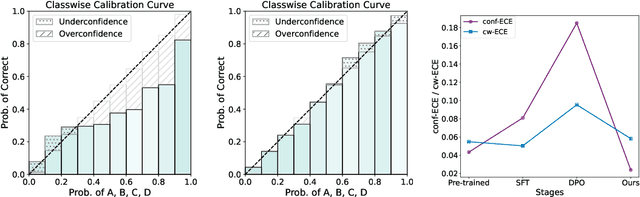
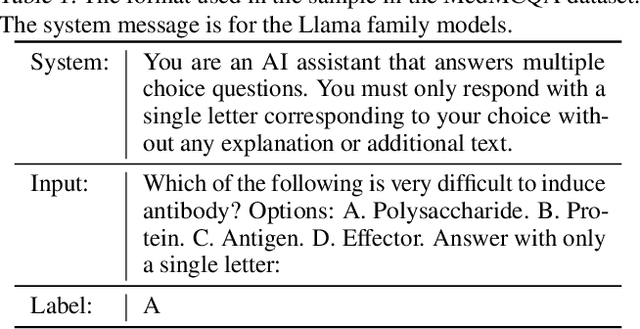
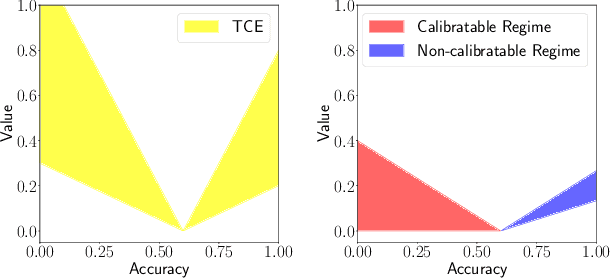
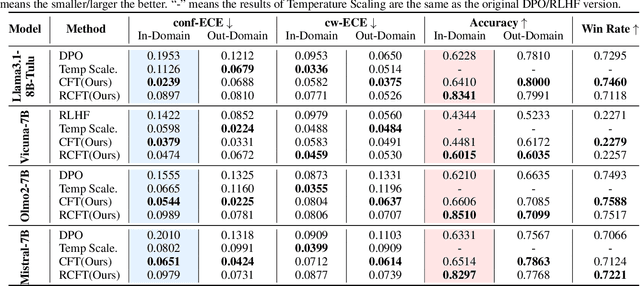
One of the key technologies for the success of Large Language Models (LLMs) is preference alignment. However, a notable side effect of preference alignment is poor calibration: while the pre-trained models are typically well-calibrated, LLMs tend to become poorly calibrated after alignment with human preferences. In this paper, we investigate why preference alignment affects calibration and how to address this issue. For the first question, we observe that the preference collapse issue in alignment undesirably generalizes to the calibration scenario, causing LLMs to exhibit overconfidence and poor calibration. To address this, we demonstrate the importance of fine-tuning with domain-specific knowledge to alleviate the overconfidence issue. To further analyze whether this affects the model's performance, we categorize models into two regimes: calibratable and non-calibratable, defined by bounds of Expected Calibration Error (ECE). In the calibratable regime, we propose a calibration-aware fine-tuning approach to achieve proper calibration without compromising LLMs' performance. However, as models are further fine-tuned for better performance, they enter the non-calibratable regime. For this case, we develop an EM-algorithm-based ECE regularization for the fine-tuning loss to maintain low calibration error. Extensive experiments validate the effectiveness of the proposed methods.
ICAFS: Inter-Client-Aware Feature Selection for Vertical Federated Learning
Apr 15, 2025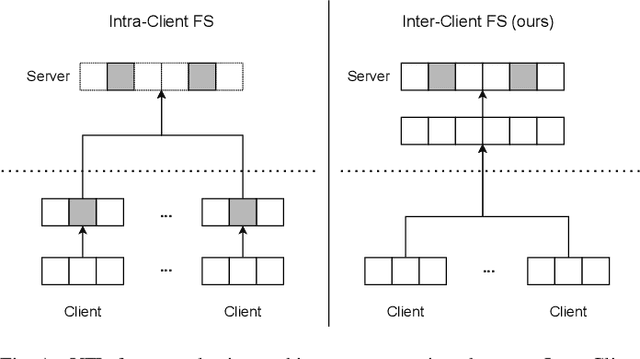

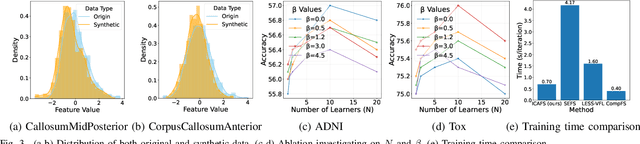
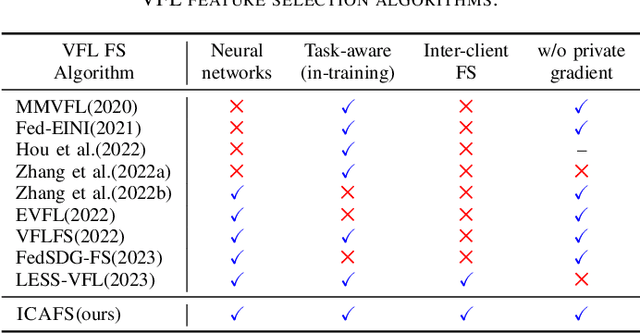
Vertical federated learning (VFL) enables a paradigm for vertically partitioned data across clients to collaboratively train machine learning models. Feature selection (FS) plays a crucial role in Vertical Federated Learning (VFL) due to the unique nature that data are distributed across multiple clients. In VFL, different clients possess distinct subsets of features for overlapping data samples, making the process of identifying and selecting the most relevant features a complex yet essential task. Previous FS efforts have primarily revolved around intra-client feature selection, overlooking vital feature interaction across clients, leading to subpar model outcomes. We introduce ICAFS, a novel multi-stage ensemble approach for effective FS in VFL by considering inter-client interactions. By employing conditional feature synthesis alongside multiple learnable feature selectors, ICAFS facilitates ensemble FS over these selectors using synthetic embeddings. This method bypasses the limitations of private gradient sharing and allows for model training using real data with refined embeddings. Experiments on multiple real-world datasets demonstrate that ICAFS surpasses current state-of-the-art methods in prediction accuracy.
SEFD: Semantic-Enhanced Framework for Detecting LLM-Generated Text
Nov 17, 2024The widespread adoption of large language models (LLMs) has created an urgent need for robust tools to detect LLM-generated text, especially in light of \textit{paraphrasing} techniques that often evade existing detection methods. To address this challenge, we present a novel semantic-enhanced framework for detecting LLM-generated text (SEFD) that leverages a retrieval-based mechanism to fully utilize text semantics. Our framework improves upon existing detection methods by systematically integrating retrieval-based techniques with traditional detectors, employing a carefully curated retrieval mechanism that strikes a balance between comprehensive coverage and computational efficiency. We showcase the effectiveness of our approach in sequential text scenarios common in real-world applications, such as online forums and Q\&A platforms. Through comprehensive experiments across various LLM-generated texts and detection methods, we demonstrate that our framework substantially enhances detection accuracy in paraphrasing scenarios while maintaining robustness for standard LLM-generated content.
Leveraging Social Determinants of Health in Alzheimer's Research Using LLM-Augmented Literature Mining and Knowledge Graphs
Oct 04, 2024Growing evidence suggests that social determinants of health (SDoH), a set of nonmedical factors, affect individuals' risks of developing Alzheimer's disease (AD) and related dementias. Nevertheless, the etiological mechanisms underlying such relationships remain largely unclear, mainly due to difficulties in collecting relevant information. This study presents a novel, automated framework that leverages recent advancements of large language model (LLM) and natural language processing techniques to mine SDoH knowledge from extensive literature and integrate it with AD-related biological entities extracted from the general-purpose knowledge graph PrimeKG. Utilizing graph neural networks, we performed link prediction tasks to evaluate the resultant SDoH-augmented knowledge graph. Our framework shows promise for enhancing knowledge discovery in AD and can be generalized to other SDoH-related research areas, offering a new tool for exploring the impact of social determinants on health outcomes. Our code is available at: https://github.com/hwq0726/SDoHenPKG
Knowledge-Driven Feature Selection and Engineering for Genotype Data with Large Language Models
Oct 02, 2024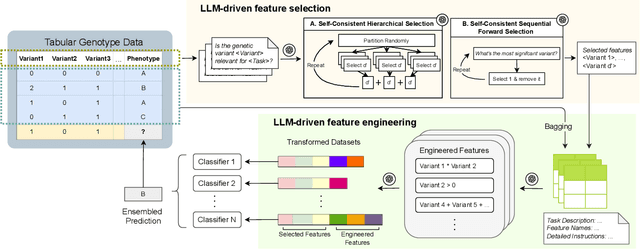

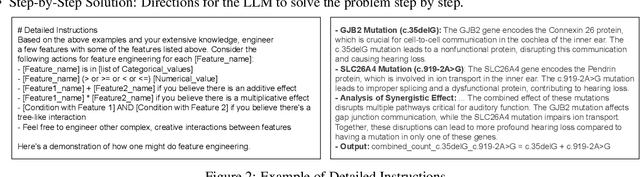
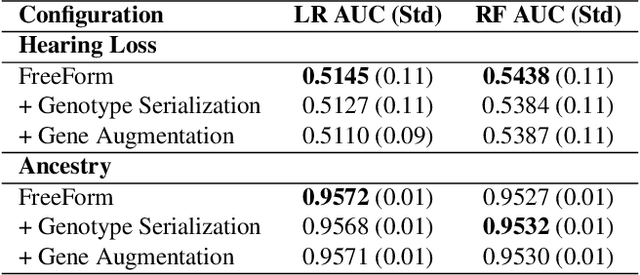
Predicting phenotypes with complex genetic bases based on a small, interpretable set of variant features remains a challenging task. Conventionally, data-driven approaches are utilized for this task, yet the high dimensional nature of genotype data makes the analysis and prediction difficult. Motivated by the extensive knowledge encoded in pre-trained LLMs and their success in processing complex biomedical concepts, we set to examine the ability of LLMs in feature selection and engineering for tabular genotype data, with a novel knowledge-driven framework. We develop FREEFORM, Free-flow Reasoning and Ensembling for Enhanced Feature Output and Robust Modeling, designed with chain-of-thought and ensembling principles, to select and engineer features with the intrinsic knowledge of LLMs. Evaluated on two distinct genotype-phenotype datasets, genetic ancestry and hereditary hearing loss, we find this framework outperforms several data-driven methods, particularly on low-shot regimes. FREEFORM is available as open-source framework at GitHub: https://github.com/PennShenLab/FREEFORM.
Fairness-Aware Estimation of Graphical Models
Aug 30, 2024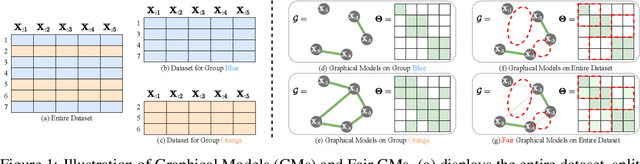

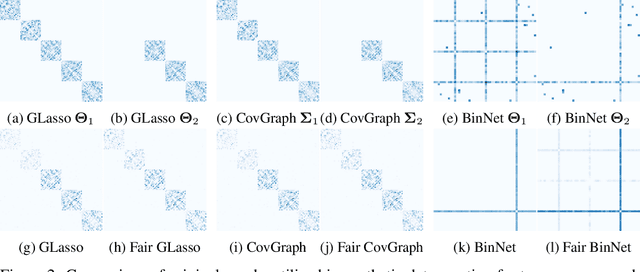
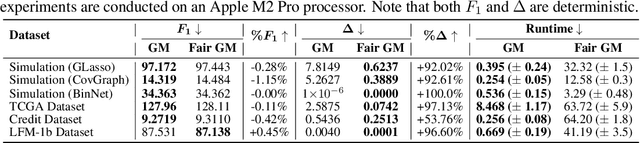
This paper examines the issue of fairness in the estimation of graphical models (GMs), particularly Gaussian, Covariance, and Ising models. These models play a vital role in understanding complex relationships in high-dimensional data. However, standard GMs can result in biased outcomes, especially when the underlying data involves sensitive characteristics or protected groups. To address this, we introduce a comprehensive framework designed to reduce bias in the estimation of GMs related to protected attributes. Our approach involves the integration of the pairwise graph disparity error and a tailored loss function into a nonsmooth multi-objective optimization problem, striving to achieve fairness across different sensitive groups while maintaining the effectiveness of the GMs. Experimental evaluations on synthetic and real-world datasets demonstrate that our framework effectively mitigates bias without undermining GMs' performance.
Fine-Tuning Linear Layers Only Is a Simple yet Effective Way for Task Arithmetic
Jul 09, 2024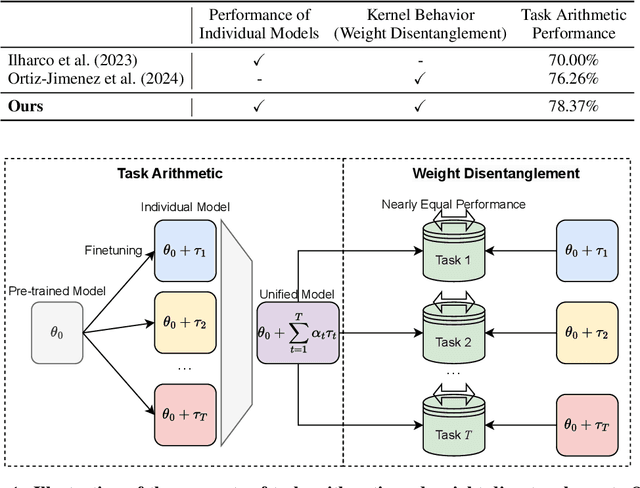
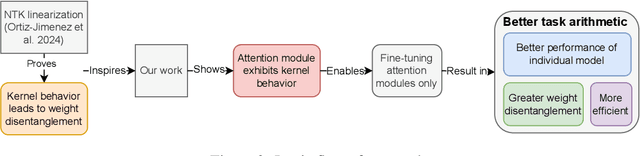
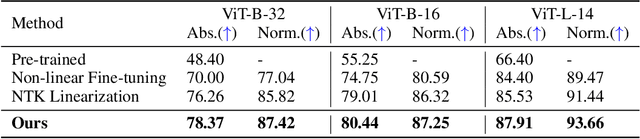
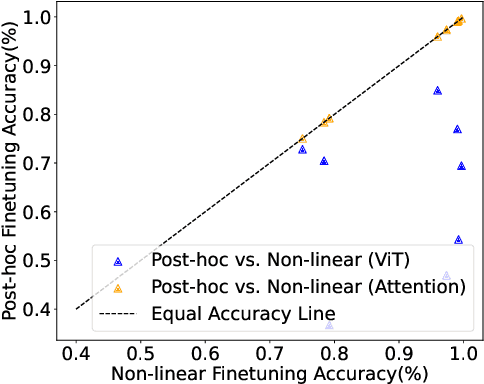
Task arithmetic has recently emerged as a cost-effective and scalable approach to edit pre-trained models directly in weight space, by adding the fine-tuned weights of different tasks. The performance has been further improved by a linear property which is illustrated by weight disentanglement. Yet, conventional linearization methods (e.g., NTK linearization) not only double the time and training cost but also have a disadvantage on single-task performance. We propose a simple yet effective and efficient method that only fine-tunes linear layers, which improves weight disentanglement and efficiency simultaneously. Specifically, our study reveals that only fine-tuning the linear layers in the attention modules makes the whole model occur in a linear regime, significantly improving weight disentanglement. To further understand how our method improves the disentanglement of task arithmetic, we present a comprehensive study of task arithmetic by differentiating the role of representation model and task-specific model. In particular, we find that the representation model plays an important role in improving weight disentanglement whereas the task-specific models such as the classification heads can degenerate the weight disentanglement performance. Overall, our work uncovers novel insights into the fundamental mechanisms of task arithmetic and offers a more reliable and effective approach to editing pre-trained models.