 Add to Chrome
 Add to Firefox
 Add to Edge
DTCCL: Disengagement-Triggered Contrastive Continual Learning for Autonomous Bus Planners
Dec 22, 2025
Autonomous buses run on fixed routes but must operate in open, dynamic urban environments. Disengagement events on these routes are often geographically concentrated and typically arise from planner failures in highly interactive regions. Such policy-level failures are difficult to correct using conventional imitation learning, which easily overfits to sparse disengagement data. To address this issue, this paper presents a Disengagement-Triggered Contrastive Continual Learning (DTCCL) framework that enables autonomous buses to improve planning policies through real-world operation. Each disengagement triggers cloud-based data augmentation that generates positive and negative samples by perturbing surrounding agents while preserving route context. Contrastive learning refines policy representations to better distinguish safe and unsafe behaviors, and continual updates are applied in a cloud-edge loop without human supervision. Experiments on urban bus routes demonstrate that DTCCL improves overall planning performance by 48.6 percent compared with direct retraining, validating its effectiveness for scalable, closed-loop policy improvement in autonomous public transport.

Parallel and real-time post-processing for quantum random number generators
Jul 29, 2021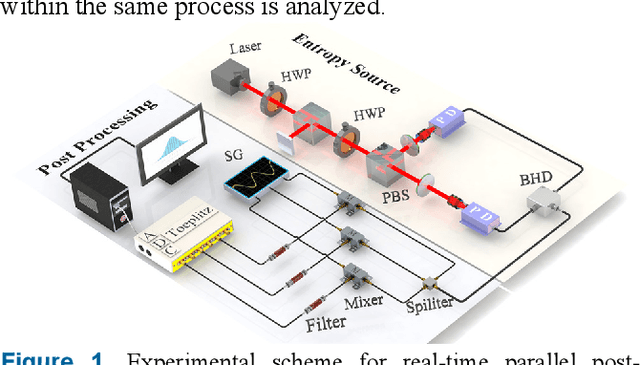
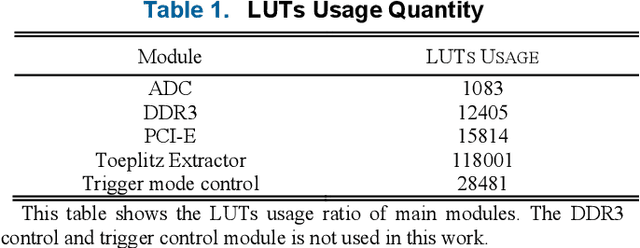
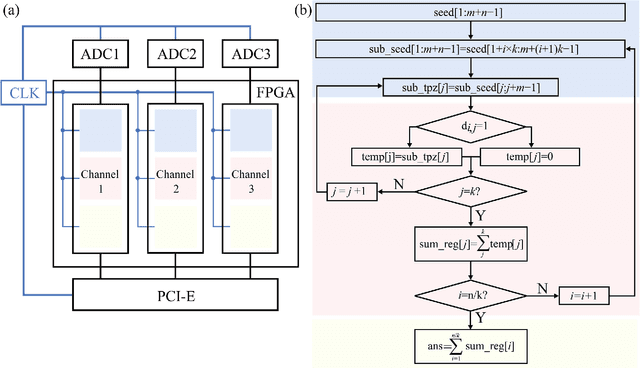
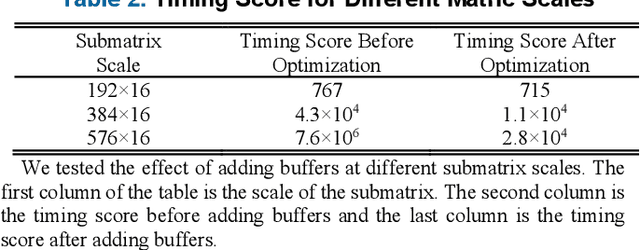
Quantum random number generators (QRNG) based on continuous variable (CV) quantum fluctuations offer great potential for their advantages in measurement bandwidth, stability and integrability. More importantly, it provides an efficient and extensible path for significant promotion of QRNG generation rate. During this process, real-time randomness extraction using information theoretically secure randomness extractors is vital, because it plays critical role in the limit of throughput rate and implementation cost of QRNGs. In this work, we investigate parallel and real-time realization of several Toeplitz-hashing extractors within one field-programmable gate array (FPGA) for parallel QRNG. Elaborate layout of Toeplitz matrixes and efficient utilization of hardware computing resource in the FPGA are emphatically studied. Logic source occupation for different scale and quantity of Toeplitz matrices is analyzed and two-layer parallel pipeline algorithm is delicately designed to fully exploit the parallel algorithm advantage and hardware source of the FPGA. This work finally achieves a real-time post-processing rate of QRNG above 8 Gbps. Matching up with integrated circuit for parallel extraction of multiple quantum sideband modes of vacuum state, our demonstration shows an important step towards chip-based parallel QRNG, which could effectively improve the practicality of CV QRNGs, including device trusted, device-independent, and semi-device-independent schemes.