 Add to Chrome
 Add to Firefox
 Add to Edge
LUT: Latent Utility Training for Visual Reasoning
Aug 01, 2026
Multimodal large language models have advanced visual understanding, yet perception-intensive reasoning remains challenging. Recent latent visual reasoning methods introduce hidden-space computation before answering, but they often rely on costly intermediate supervision, such as bounding boxes, sketches, or interleaved rationales. These strategies focus on how latent states should be shaped, but do not explicitly assess whether the latent is useful for the final answer. We propose LUT, a latent reasoning framework trained with only standard VQA pairs. LUT centers training on Latent Utility at two levels. At the trajectory level, we propose Utility-Aware Latent Distillation SFT, which explores answer-relevant latent trajectories, selects qualified trajectories by their information gain, and distills more reliable and learnable supervision through curriculum learning. At the step level, we propose Latent Attribution Policy Optimization, which uses answer-to-latent attribution to differentially optimize latent steps during reinforcement learning. Experiments on perception-intensive visual reasoning benchmarks show that LUT outperforms previous latent reasoning methods and remains competitive with latent-text interleaved methods with lower annotation cost.

Thinking in Video: Can Video Generators Really Reason About the Real World?
Jul 20, 2026Recent advances in world models and video generation have given rise to an emerging reasoning paradigm that leverages video generative models to simulate, predict, and reason about real-world dynamics. We redefine this paradigm as Thinking in Video, where video is not merely an output artifact but a medium for constructing, extending, and verifying causal thought. However, this promise remains unverified: convincing rollouts may reflect memorized appearances rather than causal understanding, while existing metrics separate perceptual fidelity from semantic logic. To evaluate whether video generators support such reasoning, we introduce the Causal-Generative Dual-Judge (CGDJ), auditing World Model Consistency from two perspectives. Explicit Causal Perception tests whether a generator reads a video scenario as a reasoning problem through spatio-temporal flattened visual question answering, while Implicit Generative Perception-Prediction Gap evaluates whether it renders the causal consequence as a consistent future video. Applying CGDJ to representative open- and closed-source generators reveals a clear Perception-Prediction Gap: open-source models produce plausible dynamics despite near-zero explicit causal perception, whereas advanced closed-source systems show stronger but still limited alignment between reasoning and generation. Further analysis exposes audio-visual misalignment, where models verbalize correct causal logic more reliably than they render it, challenging the "world simulator" narrative.
Yunque DeepResearch Technical Report
Jan 27, 2026Deep research has emerged as a transformative capability for autonomous agents, empowering Large Language Models to navigate complex, open-ended tasks. However, realizing its full potential is hindered by critical limitations, including escalating contextual noise in long-horizon tasks, fragility leading to cascading errors, and a lack of modular extensibility. To address these challenges, we introduce Yunque DeepResearch, a hierarchical, modular, and robust framework. The architecture is characterized by three key components: (1) a centralized Multi-Agent Orchestration System that routes subtasks to an Atomic Capability Pool of tools and specialized sub-agents; (2) a Dynamic Context Management mechanism that structures completed sub-goals into semantic summaries to mitigate information overload; and (3) a proactive Supervisor Module that ensures resilience through active anomaly detection and context pruning. Yunque DeepResearch achieves state-of-the-art performance across a range of agentic deep research benchmarks, including GAIA, BrowseComp, BrowseComp-ZH, and Humanity's Last Exam. We open-source the framework, reproducible implementations, and application cases to empower the community.
Reverse Region-to-Entity Annotation for Pixel-Level Visual Entity Linking
Dec 18, 2024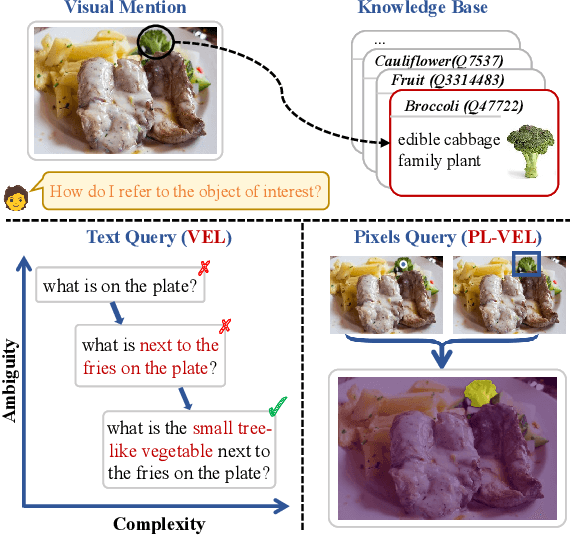
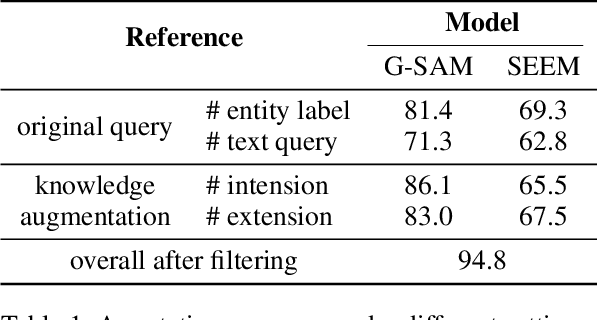
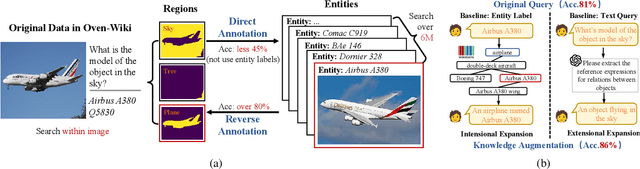
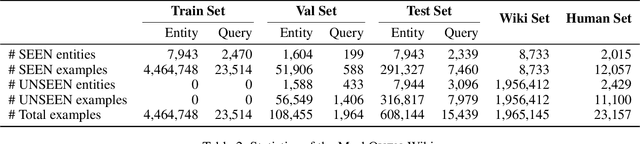
Visual Entity Linking (VEL) is a crucial task for achieving fine-grained visual understanding, matching objects within images (visual mentions) to entities in a knowledge base. Previous VEL tasks rely on textual inputs, but writing queries for complex scenes can be challenging. Visual inputs like clicks or bounding boxes offer a more convenient alternative. Therefore, we propose a new task, Pixel-Level Visual Entity Linking (PL-VEL), which uses pixel masks from visual inputs to refer to objects, supplementing reference methods for VEL. To facilitate research on this task, we have constructed the MaskOVEN-Wiki dataset through an entirely automatic reverse region-entity annotation framework. This dataset contains over 5 million annotations aligning pixel-level regions with entity-level labels, which will advance visual understanding towards fine-grained. Moreover, as pixel masks correspond to semantic regions in an image, we enhance previous patch-interacted attention with region-interacted attention by a visual semantic tokenization approach. Manual evaluation results indicate that the reverse annotation framework achieved a 94.8% annotation success rate. Experimental results show that models trained on this dataset improved accuracy by 18 points compared to zero-shot models. Additionally, the semantic tokenization method achieved a 5-point accuracy improvement over the trained baseline.
Pruning via Merging: Compressing LLMs via Manifold Alignment Based Layer Merging
Jun 24, 2024While large language models (LLMs) excel in many domains, their complexity and scale challenge deployment in resource-limited environments. Current compression techniques, such as parameter pruning, often fail to effectively utilize the knowledge from pruned parameters. To address these challenges, we propose Manifold-Based Knowledge Alignment and Layer Merging Compression (MKA), a novel approach that uses manifold learning and the Normalized Pairwise Information Bottleneck (NPIB) measure to merge similar layers, reducing model size while preserving essential performance. We evaluate MKA on multiple benchmark datasets and various LLMs. Our findings show that MKA not only preserves model performance but also achieves substantial compression ratios, outperforming traditional pruning methods. Moreover, when coupled with quantization, MKA delivers even greater compression. Specifically, on the MMLU dataset using the Llama3-8B model, MKA achieves a compression ratio of 43.75% with a minimal performance decrease of only 2.82\%. The proposed MKA method offers a resource-efficient and performance-preserving model compression technique for LLMs.
From Instance Training to Instruction Learning: Task Adapters Generation from Instructions
Jun 18, 2024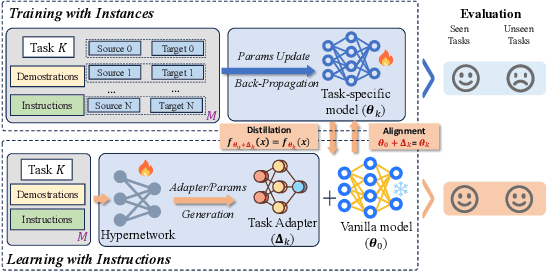
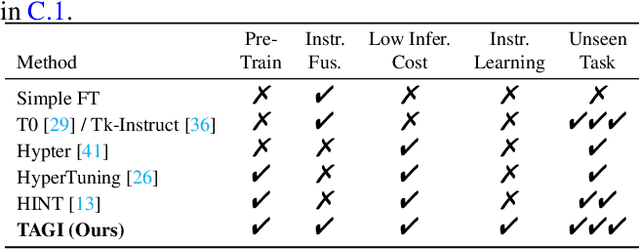
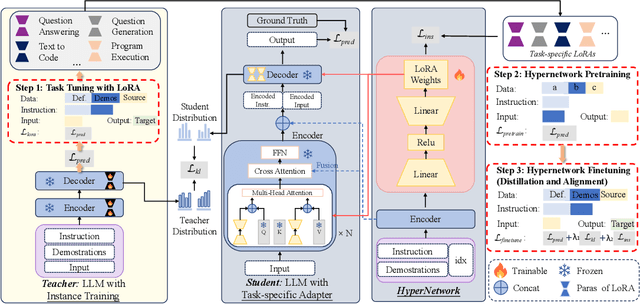
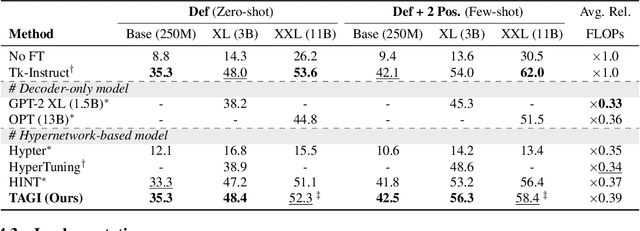
Large language models (LLMs) have acquired the ability to solve general tasks by utilizing instruction finetuning (IFT). However, IFT still relies heavily on instance training of extensive task data, which greatly limits the adaptability of LLMs to real-world scenarios where labeled task instances are scarce and broader task generalization becomes paramount. Contrary to LLMs, humans acquire skills and complete tasks not merely through repeated practice but also by understanding and following instructional guidelines. This paper is dedicated to simulating human learning to address the shortcomings of instance training, focusing on instruction learning to enhance cross-task generalization. Within this context, we introduce Task Adapters Generation from Instructions (TAGI), which automatically constructs the task-specific model in a parameter generation manner based on the given task instructions without retraining for unseen tasks. Specifically, we utilize knowledge distillation to enhance the consistency between TAGI developed through Learning with Instruction and task-specific models developed through Training with Instance, by aligning the labels, output logits, and adapter parameters between them. TAGI is endowed with cross-task generalization capabilities through a two-stage training process that includes hypernetwork pretraining and finetuning. We evaluate TAGI on the Super-Natural Instructions and P3 datasets. The experimental results demonstrate that TAGI can match or even outperform traditional meta-trained models and other hypernetwork models, while significantly reducing computational requirements.