 Add to Chrome
 Add to Firefox
 Add to Edge
DTCCL: Disengagement-Triggered Contrastive Continual Learning for Autonomous Bus Planners
Dec 22, 2025
Autonomous buses run on fixed routes but must operate in open, dynamic urban environments. Disengagement events on these routes are often geographically concentrated and typically arise from planner failures in highly interactive regions. Such policy-level failures are difficult to correct using conventional imitation learning, which easily overfits to sparse disengagement data. To address this issue, this paper presents a Disengagement-Triggered Contrastive Continual Learning (DTCCL) framework that enables autonomous buses to improve planning policies through real-world operation. Each disengagement triggers cloud-based data augmentation that generates positive and negative samples by perturbing surrounding agents while preserving route context. Contrastive learning refines policy representations to better distinguish safe and unsafe behaviors, and continual updates are applied in a cloud-edge loop without human supervision. Experiments on urban bus routes demonstrate that DTCCL improves overall planning performance by 48.6 percent compared with direct retraining, validating its effectiveness for scalable, closed-loop policy improvement in autonomous public transport.

Recent Progress in Energy Management of Connected Hybrid Electric Vehicles Using Reinforcement Learning
Aug 28, 2023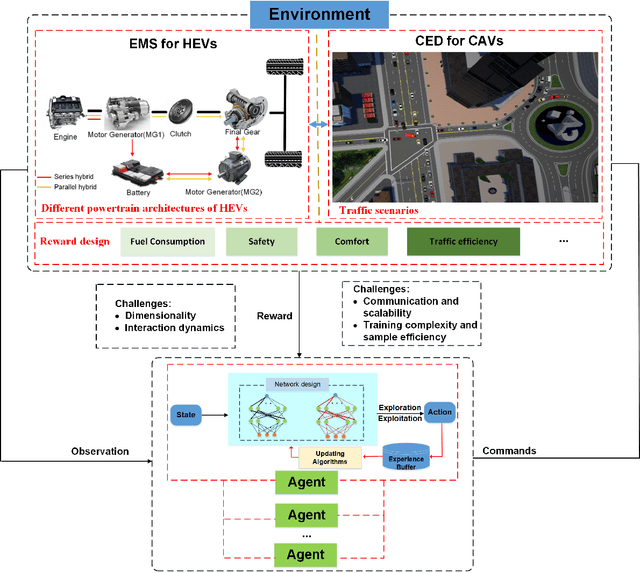
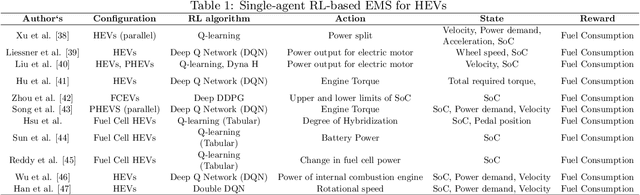
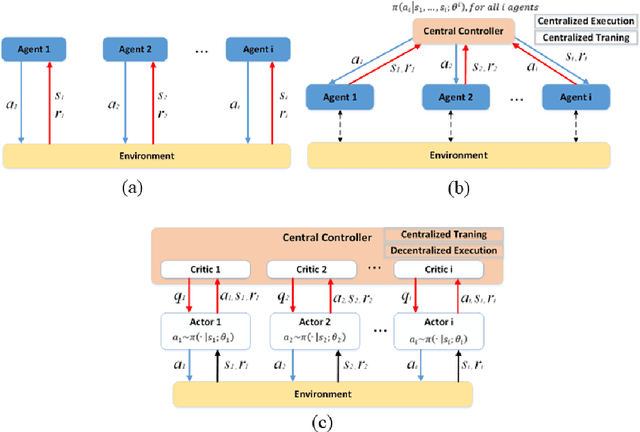
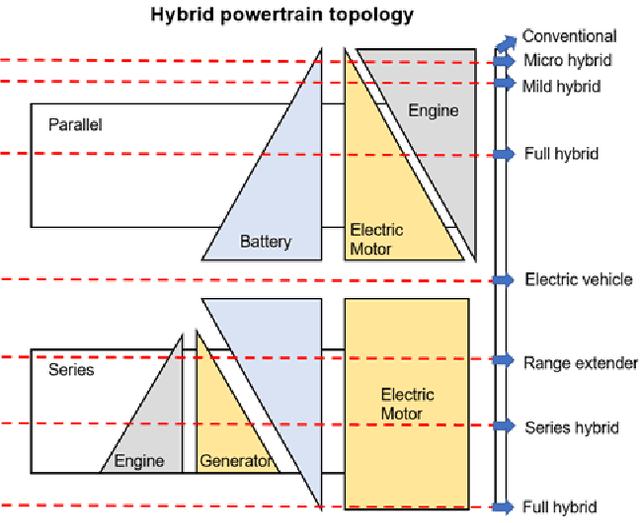
The growing adoption of hybrid electric vehicles (HEVs) presents a transformative opportunity for revolutionizing transportation energy systems. The shift towards electrifying transportation aims to curb environmental concerns related to fossil fuel consumption. This necessitates efficient energy management systems (EMS) to optimize energy efficiency. The evolution of EMS from HEVs to connected hybrid electric vehicles (CHEVs) represent a pivotal shift. For HEVs, EMS now confronts the intricate energy cooperation requirements of CHEVs, necessitating advanced algorithms for route optimization, charging coordination, and load distribution. Challenges persist in both domains, including optimal energy utilization for HEVs, and cooperative eco-driving control (CED) for CHEVs across diverse vehicle types. Reinforcement learning (RL) stands out as a promising tool for addressing these challenges at hand. Specifically, within the realm of CHEVs, the application of multi-agent reinforcement learning (MARL) emerges as a powerful approach for effectively tackling the intricacies of CED control. Despite extensive research, few reviews span from individual vehicles to multi-vehicle scenarios. This review bridges the gap, highlighting challenges, advancements, and potential contributions of RL-based solutions for future sustainable transportation systems.