 Add to Chrome
 Add to Firefox
 Add to Edge
RadioTrace: Transmitter-Aware Diffusion for Radio Map Estimation without Deployment-Time Fine-Tuning
Jul 23, 2026
Radio map (RM) estimation aims to reconstruct the spatial distribution of wireless signal characteristics, such as received signal strength (RSS), from sparse measurements, a task that is critical for spectrum management, interference mitigation, and localization in modern wireless networks. Traditional approaches, including interpolation and deep learning, either struggle to capture complex propagation effects or require large-scale retraining for each new sampling pattern, which limits their generalization. More recently, prior-based methods have combined pre-trained generative models with measurements to reduce the need for deployment-time model fine-tuning, but they typically treat the prior as a simple regularizer and lack explicit transmitter-aware integration. In this paper, we propose RadioTrace, a novel RM estimation framework without deployment-time fine-tuning that tightly integrates sparse RSS measurements with a frozen pre-trained diffusion prior. RadioTrace incorporates transmitter (Tx) location estimation directly into the denoising loop, iteratively refining Tx coordinates based on reconstruction quality to guide the generative process. To further enhance robustness, we introduce a propagation-guided K-means initialization that mitigates poor local minima in the Tx update and provides a geometry-consistent starting point. Moreover, we provide a stochastic stability analysis for the Tx-coordinate refinement component, showing that the Tx update remains stable under perturbations induced by diffusion sampling and Tx-map relaxation. Extensive experiments demonstrate that RadioTrace achieves competitive performance with state-of-the-art learning-based methods under random sampling, and maintains strong reconstruction quality under restricted-area sampling, highlighting its adaptability, robustness, and practical relevance.

RECAST: Model Reconstruction via Counterfactual-Aware Wasserstein Geometry under Limited Data
Jun 26, 2026Counterfactual explanations (CFs) help understand machine learning models by identifying minimal input changes that would lead to alternative model outcomes. Recent work demonstrates their utility for reconstructing black-box models, enabling third-party auditing of opaque decision systems for fairness and accountability. Still, CF-based reconstruction may suffer from decision boundary shifts, overfitting, and restrictive assumptions requiring online query access to target platforms. We propose REconstruction via Counterfactual-Aware waSserstein opTimization (RECAST) under limited data and restricted access, a behavioral surrogate model based on Wasserstein barycentric prototypes. Our approach addresses decision boundary shifts by incorporating CFs as informative, though less representative, samples for both classes, maintaining high surrogate fidelity in low-sample regimes without requiring online access during reconstruction. To enhance fairness auditing, our method enables systematic group fairness diagnostics. Experiments on real-world datasets and various setups show that RECAST effectively achieves high fidelity and query efficiency, as well as stable results even when the access is limited and noisy.
Residual-Space Evolutionary Optimization via Flow-based Generative Models
Jun 18, 2026Data editing with generative methods typically requires differentiable objectives and gradient-based search. However, these assumptions break down in flow-based settings, where edits are performed through forward and backward integration and often involve non-differentiable or black-box objectives. We introduce residual-space evolutionary optimization, a model-agnostic framework that addresses this gap by combining flow-based generative editing with evolutionary algorithms. Building on the observation that conditional flow matching (CFM) can disentangle condition-controlled factors from instance-specific residuals, our framework directly operates in residual space and separates two complementary search regimes: self-pollination performs local exploitation through feature-preserving residual refinement, and cross-pollination promotes broader exploration by recombining residuals across heterogeneous samples. As a proof of concept, we validate on MorphoMNIST, a benchmark dataset for counterfactual generation, and on crystal data, demonstrating that this exploration--exploitation decomposition provides a useful mechanism for balancing target alignment, instance preservation, and diversity, and extends beyond images to real-world scientific domains.
Counterfactual Transport Flows for Offline Conservative Trajectory Refinement
Jun 08, 2026Offline reinforcement learning (RL) offers a path to policy improvement from logged data alone, using historical returns or other measurable outcomes as world feedback. A key difficulty is improving observed behavior without extrapolating beyond what the offline data supports. We propose \emph{counterfactual transport flows}, a source-conditioned trajectory refinement framework for offline decision-making guided by world feedback. Given a low-feedback candidate trajectory, we construct local preference pairs from offline data by retrieving nearby trajectories in latent trajectory space with higher task-specific feedback, and use them as weak supervision for conservative refinement. The framework learns instance-specific refinement directions: at inference time, a refinement strength parameter controls how far the candidate trajectory is transported, enabling a trade-off between preserving the original behavior and applying stronger improvement. Experiments on D4RL benchmarks, including AntMaze and MuJoCo tasks, show that our method improves behavior from historical returns as world feedback, while providing interpretable trajectory-level refinement paths.
ReCoVR: Closing the Loop in Interactive Composed Video Retrieval
May 11, 2026Composed video retrieval (CoVR) searches for target videos using a reference video and a modification text, but existing methods are restricted to a single interaction round and cannot support the progressive nature of real-world visual search. To bridge this gap, we first formalize interactive composed video retrieval, a multi-turn extension of CoVR, where users progressively refine their search intent through natural-language feedback across turns. Adapting existing interactive retrieval methods to this setting reveals two structural weaknesses: reliance on a single retrieval channel and an open-loop retrieval design that consumes user feedback but does not diagnose whether its own retrieval trajectory is drifting or stagnating. To address these limitations, we propose ReCoVR (Reflexive Composed Video Retrieval), a dual-pathway architecture built on reflexive perception, where the system treats its retrieval history as diagnostic evidence alongside user feedback. Specifically, an Intent Pathway routes heterogeneous feedback to complementary retrieval channels, while a Reflection Pathway performs trajectory-level reflection to monitor result evolution and correct retrieval errors across turns. Experiments on multiple benchmarks show that ReCoVR consistently outperforms interactive baselines, notably achieving 74.30% R@1 after just one interactive round on the WebVid-CoVR-Test dataset.
AgentSelect: Benchmark for Narrative Query-to-Agent Recommendation
Mar 04, 2026LLM agents are rapidly becoming the practical interface for task automation, yet the ecosystem lacks a principled way to choose among an exploding space of deployable configurations. Existing LLM leaderboards and tool/agent benchmarks evaluate components in isolation and remain fragmented across tasks, metrics, and candidate pools, leaving a critical research gap: there is little query-conditioned supervision for learning to recommend end-to-end agent configurations that couple a backbone model with a toolkit. We address this gap with AgentSelect, a benchmark that reframes agent selection as narrative query-to-agent recommendation over capability profiles and systematically converts heterogeneous evaluation artifacts into unified, positive-only interaction data. AgentSelectcomprises 111,179 queries, 107,721 deployable agents, and 251,103 interaction records aggregated from 40+ sources, spanning LLM-only, toolkit-only, and compositional agents. Our analyses reveal a regime shift from dense head reuse to long-tail, near one-off supervision, where popularity-based CF/GNN methods become fragile and content-aware capability matching is essential. We further show that Part~III synthesized compositional interactions are learnable, induce capability-sensitive behavior under controlled counterfactual edits, and improve coverage over realistic compositions; models trained on AgentSelect also transfer to a public agent marketplace (MuleRun), yielding consistent gains on an unseen catalog. Overall, AgentSelect provides the first unified data and evaluation infrastructure for agent recommendation, which establishes a reproducible foundation to study and accelerate the emerging agent ecosystem.
Classifier Reconstruction Through Counterfactual-Aware Wasserstein Prototypes
Dec 11, 2025Counterfactual explanations provide actionable insights by identifying minimal input changes required to achieve a desired model prediction. Beyond their interpretability benefits, counterfactuals can also be leveraged for model reconstruction, where a surrogate model is trained to replicate the behavior of a target model. In this work, we demonstrate that model reconstruction can be significantly improved by recognizing that counterfactuals, which typically lie close to the decision boundary, can serve as informative though less representative samples for both classes. This is particularly beneficial in settings with limited access to labeled data. We propose a method that integrates original data samples with counterfactuals to approximate class prototypes using the Wasserstein barycenter, thereby preserving the underlying distributional structure of each class. This approach enhances the quality of the surrogate model and mitigates the issue of decision boundary shift, which commonly arises when counterfactuals are naively treated as ordinary training instances. Empirical results across multiple datasets show that our method improves fidelity between the surrogate and target models, validating its effectiveness.
sam-llm: interpretable lane change trajectoryprediction via parametric finetuning
Sep 03, 2025This work introduces SAM-LLM, a novel hybrid architecture that bridges the gap between the contextual reasoning of Large Language Models (LLMs) and the physical precision of kinematic lane change models for autonomous driving. The system is designed for interpretable lane change trajectory prediction by finetuning an LLM to output the core physical parameters of a trajectory model instead of raw coordinates. For lane-keeping scenarios, the model predicts discrete coordinates, but for lane change maneuvers, it generates the parameters for an enhanced Sinusoidal Acceleration Model (SAM), including lateral displacement, maneuver duration, initial lateral velocity, and longitudinal velocity change. This parametric approach yields a complete, continuous, and physically plausible trajectory model that is inherently interpretable and computationally efficient, achieving an 80% reduction in output size compared to coordinate-based methods. The SAM-LLM achieves a state-of-the-art overall intention prediction accuracy of 98.73%, demonstrating performance equivalent to traditional LLM predictors while offering significant advantages in explainability and resource efficiency.
1LoRA: Summation Compression for Very Low-Rank Adaptation
Mar 11, 2025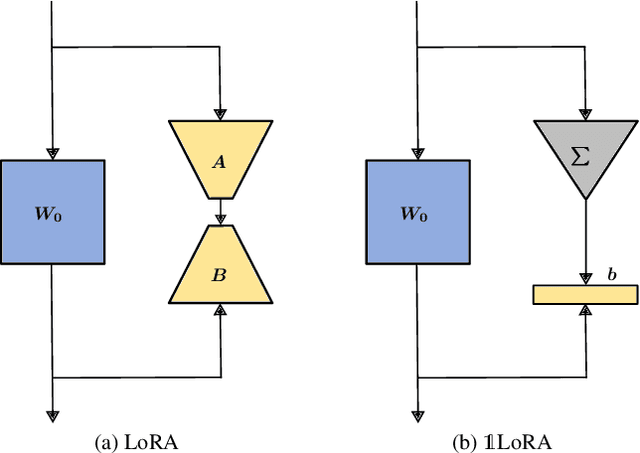
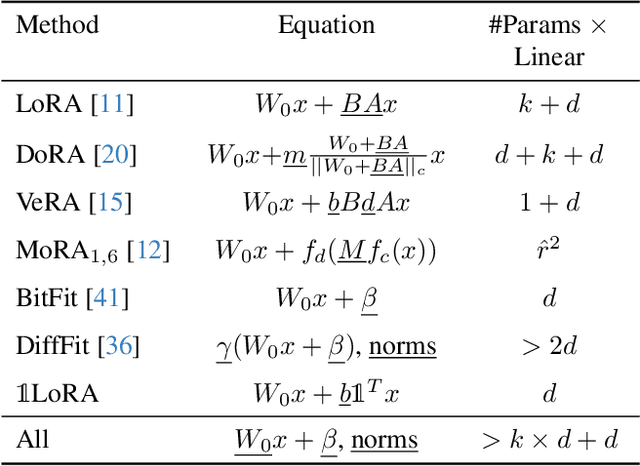
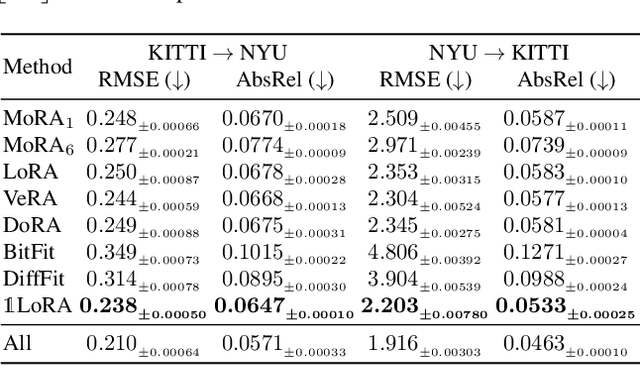
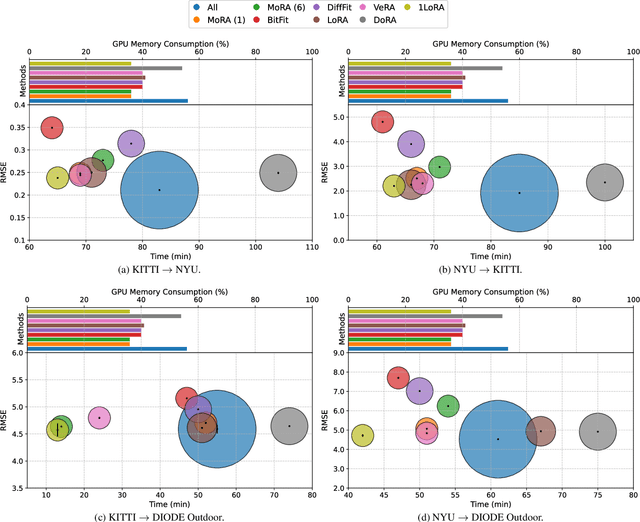
Parameter-Efficient Fine-Tuning (PEFT) methods have transformed the approach to fine-tuning large models for downstream tasks by enabling the adjustment of significantly fewer parameters than those in the original model matrices. In this work, we study the "very low rank regime", where we fine-tune the lowest amount of parameters per linear layer for each considered PEFT method. We propose 1LoRA (Summation Low-Rank Adaptation), a compute, parameter and memory efficient fine-tuning method which uses the feature sum as fixed compression and a single trainable vector as decompression. Differently from state-of-the-art PEFT methods like LoRA, VeRA, and the recent MoRA, 1LoRA uses fewer parameters per layer, reducing the memory footprint and the computational cost. We extensively evaluate our method against state-of-the-art PEFT methods on multiple fine-tuning tasks, and show that our method not only outperforms them, but is also more parameter, memory and computationally efficient. Moreover, thanks to its memory efficiency, 1LoRA allows to fine-tune more evenly across layers, instead of focusing on specific ones (e.g. attention layers), improving performance further.
MRI Reconstruction with Regularized 3D Diffusion Model (R3DM)
Dec 25, 2024Magnetic Resonance Imaging (MRI) is a powerful imaging technique widely used for visualizing structures within the human body and in other fields such as plant sciences. However, there is a demand to develop fast 3D-MRI reconstruction algorithms to show the fine structure of objects from under-sampled acquisition data, i.e., k-space data. This emphasizes the need for efficient solutions that can handle limited input while maintaining high-quality imaging. In contrast to previous methods only using 2D, we propose a 3D MRI reconstruction method that leverages a regularized 3D diffusion model combined with optimization method. By incorporating diffusion based priors, our method improves image quality, reduces noise, and enhances the overall fidelity of 3D MRI reconstructions. We conduct comprehensive experiments analysis on clinical and plant science MRI datasets. To evaluate the algorithm effectiveness for under-sampled k-space data, we also demonstrate its reconstruction performance with several undersampling patterns, as well as with in- and out-of-distribution pre-trained data. In experiments, we show that our method improves upon tested competitors.