 Add to Chrome
 Add to Firefox
 Add to Edge
OpenPM: Auditable Point-in-Time Evaluation for LLM Portfolio-Management Agents
Aug 06, 2026
Large language models are increasingly used to read markets, assess risk, and allocate capital. However, reported results for LLM trading agents can be inflated by look-ahead leakage, optimistic execution, and risk mandates that are described but not enforced. We present OpenPM, an auditable point-in-time evaluation framework for LLM portfolio-management agents. In OpenPM, an agent manages a \$1M long-only book over the S\&P 500 universe using market data at five-minute intervals. Every record visible to the agent must be available at the decision time. Natural-language risk mandates are converted into typed constraints and enforced on the executed portfolio. Each run produces audit artifacts, including a contamination certificate, a cost-sensitivity curve, and a constraint-adherence report. We also build a reference agent named the tiered allocator, where typed analysts score candidates, a constructor LLM proposes weights, and a deterministic critic guarantees feasibility. We isolate constructor behavior by capturing analyst evidence once and replaying it across constructor models. In our short-window case study, stronger constructors show modest and model-dependent gains over equal weighting on the same pool, but analyst quality matters more than constructor choice, and turnover is the main cost driver. All returns are upper bounds on a single frozen window without market impact, not validated alpha.

AEL: Agent Evolving Learning for Open-Ended Environments
Apr 23, 2026LLM agents increasingly operate in open-ended environments spanning hundreds of sequential episodes, yet they remain largely stateless: each task is solved from scratch without converting past experience into better future behavior. The central obstacle is not \emph{what} to remember but \emph{how to use} what has been remembered, including which retrieval policy to apply, how to interpret prior outcomes, and when the current strategy itself must change. We introduce \emph{Agent Evolving Learning} (\ael{}), a two-timescale framework that addresses this obstacle. At the fast timescale, a Thompson Sampling bandit learns which memory retrieval policy to apply at each episode; at the slow timescale, LLM-driven reflection diagnoses failure patterns and injects causal insights into the agent's decision prompt, giving it an interpretive frame for the evidence it retrieves. On a sequential portfolio benchmark (10 sector-diverse tickers, 208 episodes, 5 random seeds), \ael{} achieves a Sharpe ratio of 2.13$\pm$0.47, outperforming five published self-improving methods and all non-LLM baselines while maintaining the lowest variance among all LLM-based approaches. A nine-variant ablation reveals a ``less is more'' pattern: memory and reflection together produce a 58\% cumulative improvement over the stateless baseline, yet every additional mechanism we test (planner evolution, per-tool selection, cold-start initialization, skill extraction, and three credit assignment methods) \emph{degrades} performance. This demonstrates that the bottleneck in agent self-improvement is \emph{self-diagnosing how to use} experience rather than adding architectural complexity. Code and data: https://github.com/WujiangXu/AEL.
SLMRec: Empowering Small Language Models for Sequential Recommendation
May 28, 2024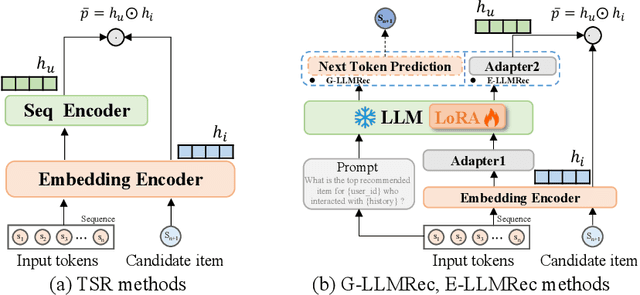
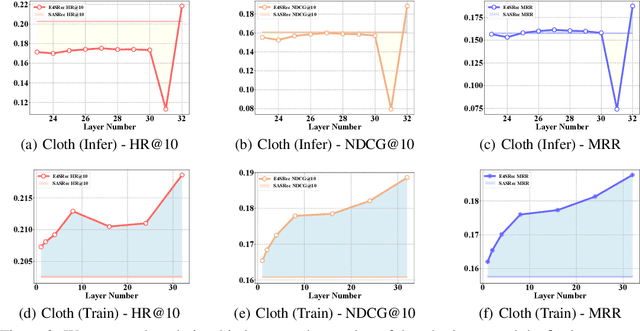
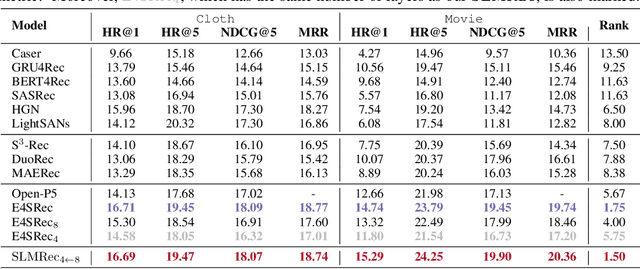
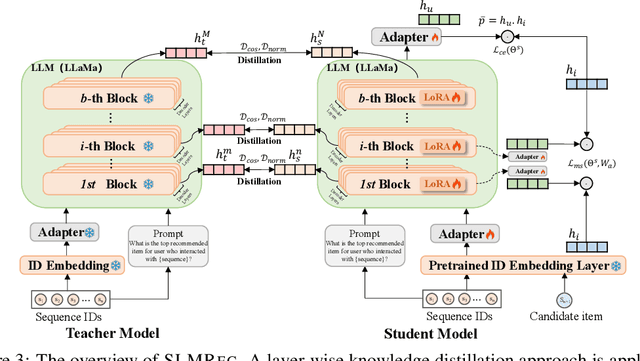
The sequential Recommendation (SR) task involves predicting the next item a user is likely to interact with, given their past interactions. The SR models examine the sequence of a user's actions to discern more complex behavioral patterns and temporal dynamics. Recent research demonstrates the great impact of LLMs on sequential recommendation systems, either viewing sequential recommendation as language modeling or serving as the backbone for user representation. Although these methods deliver outstanding performance, there is scant evidence of the necessity of a large language model and how large the language model is needed, especially in the sequential recommendation scene. Meanwhile, due to the huge size of LLMs, it is inefficient and impractical to apply a LLM-based model in real-world platforms that often need to process billions of traffic logs daily. In this paper, we explore the influence of LLMs' depth by conducting extensive experiments on large-scale industry datasets. Surprisingly, we discover that most intermediate layers of LLMs are redundant. Motivated by this insight, we empower small language models for SR, namely SLMRec, which adopt a simple yet effective knowledge distillation method. Moreover, SLMRec is orthogonal to other post-training efficiency techniques, such as quantization and pruning, so that they can be leveraged in combination. Comprehensive experimental results illustrate that the proposed SLMRec model attains the best performance using only 13% of the parameters found in LLM-based recommendation models, while simultaneously achieving up to 6.6x and 8.0x speedups in training and inference time costs, respectively.