 Add to Chrome
 Add to Firefox
 Add to Edge
Library Reachability in LSR-Synth: How Anti-Memorization Design Changes the Measurement of Symbolic Discovery
Jul 30, 2026
Existing benchmarks for scientific equation discovery are largely composed of well-known equations available in the public domain, making it difficult to determine whether a model is discovering laws from data or merely recalling answers from its training corpus. LSR-Synth mitigates this problem by introducing novel synthetic terms into established scientific mechanisms and filtering the resulting tasks for novelty, solvability, and scientific plausibility. This paper examines a narrower measurement question: can these tasks further distinguish scientific priors supplied by language models from conventional operator search that does not access task semantics? We construct a semantics-free baseline using a fixed vocabulary with publicly documented provenance, and assess the role of candidate coverage through semantic blinding, library weakening, and matched operator-family knockouts. Under the current task snapshot, search budget, and scoring protocol, the fixed vocabulary already covers most tasks, while language-model-generated candidates rarely expand the set of solvable instances. Their marginal contribution becomes substantial only when vocabulary coverage is selectively disrupted. Strict out-of-distribution evaluation lowers the absolute success rates of all methods but does not alter this relationship. These findings neither invalidate LSR-Synth's controls against memorization of complete formulas nor imply that language-model priors are generally unhelpful. Rather, they support a more limited conclusion: most current tasks remain suitable for evaluating the fitting and recombination of previously unseen expressions, but are insufficient on their own to identify contributions from priors beyond a fixed search space.

Adapting Embedding Models for Agent Capability Retrieval
Jul 19, 2026Open agent marketplaces list native agents, tool bundles, and reusable skill packages in the same search interface, yet practitioners still have little guidance on how to retrieve across this mixed catalog. We study whether off-the-shelf retrieval models, trained for general text retrieval, can be adapted to match user queries to executable agent capabilities, and whether the learned signal transfers beyond the benchmark used for tuning. We fine-tune three open retrieval backbones, BGE-base, KaLM-v1.5, and EasyRec, on AgentSelect, which represents marketplace-visible units as capability profiles derived from public metadata, and test transfer on two catalogs not seen during training: MuleRun native agents and a ClawHub benchmark of 50 skills with 1,000 queries. Adaptation helps on both catalogs. Code and data will be released upon publication.
MatMind: A Structure-Activity Knowledge-Driven Generative Foundation Model for Materials Science
Jun 05, 2026Progress in AI-driven crystal materials science has so far been carried by narrow architectures purpose-built for individual tasks -- graph neural networks for property prediction, diffusion and flow-matching models for crystal generation -- each excelling within its niche yet unable to act as a shared backbone across the full spectrum of materials problems. Generative large language models offer a fundamentally different paradigm, in which structural representation, quantitative prediction, and structure-activity reasoning can be unified within one model, but the materials community has yet to see this paradigm realized at a level competitive with established narrow specialists. Here we present MatMind, a generative foundation model purpose-built for crystal materials science under this paradigm, developed through the coordinated activation of structure-activity knowledge and physics-informed feedback within a progressive training framework -- combining structure-activity knowledge injection, a dual-head architecture that jointly trains language reasoning and numerical regression in a shared representation space, and multi-objective physics-informed reinforcement learning over stability, novelty, and structural diversity. Across three task families, MatMind attains the lowest mean absolute error on energy above hull, bulk modulus, and band gap -- surpassing graph neural network predictors purpose-built for these tasks -- reaches an S.U.N. rate of 65.3% on unconditional crystal generation, and achieves a comparable multiplicative improvement on magnetization-density-conditioned generation, where only 21 positive samples exist within over 600000 training entries. By matching or surpassing narrow specialists on their own ground while operating within a single unified model, MatMind shows that the LLM-based paradigm can serve as a viable backbone for crystal materials science going forward.
Rethinking VLM Representation for VLA Initialization
May 25, 2026Vision-Language-Action (VLA) models widely adopt pretrained Vision-Language Models (VLMs) as policy backbones, yet it remains unclear what kind of pretrained VLM representation is useful as a VLA initialization. In this paper, we study VLA initialization as a controlled representation-design problem along three axes: capability-level embodied VQA supervision, parameter-update strategy, and robot-data pretraining. Our experiments show that the original pretrained VLM representation is a key source of action performance. However, embodied VQA adaptation does not yield uniform gains: its benefit depends on downstream bottlenecks, and gains from different capability domains are not simply additive. For update strategy, LoRA provides a more reliable initialization than Full Finetune, indicating that overly reshaping the pretrained representation can weaken VLA initialization. Robot-data pretraining further improves VLA initialization, with the strongest variant obtained by staged LoRA-based training. Together, these findings suggest that effective VLM-to-VLA adaptation should inject action-relevant embodied and robot-trajectory signals while preserving the pretrained VLM representation that remains useful for action learning.
AgentSelect: Benchmark for Narrative Query-to-Agent Recommendation
Mar 04, 2026LLM agents are rapidly becoming the practical interface for task automation, yet the ecosystem lacks a principled way to choose among an exploding space of deployable configurations. Existing LLM leaderboards and tool/agent benchmarks evaluate components in isolation and remain fragmented across tasks, metrics, and candidate pools, leaving a critical research gap: there is little query-conditioned supervision for learning to recommend end-to-end agent configurations that couple a backbone model with a toolkit. We address this gap with AgentSelect, a benchmark that reframes agent selection as narrative query-to-agent recommendation over capability profiles and systematically converts heterogeneous evaluation artifacts into unified, positive-only interaction data. AgentSelectcomprises 111,179 queries, 107,721 deployable agents, and 251,103 interaction records aggregated from 40+ sources, spanning LLM-only, toolkit-only, and compositional agents. Our analyses reveal a regime shift from dense head reuse to long-tail, near one-off supervision, where popularity-based CF/GNN methods become fragile and content-aware capability matching is essential. We further show that Part~III synthesized compositional interactions are learnable, induce capability-sensitive behavior under controlled counterfactual edits, and improve coverage over realistic compositions; models trained on AgentSelect also transfer to a public agent marketplace (MuleRun), yielding consistent gains on an unseen catalog. Overall, AgentSelect provides the first unified data and evaluation infrastructure for agent recommendation, which establishes a reproducible foundation to study and accelerate the emerging agent ecosystem.
Perceive Anything: Recognize, Explain, Caption, and Segment Anything in Images and Videos
Jun 05, 2025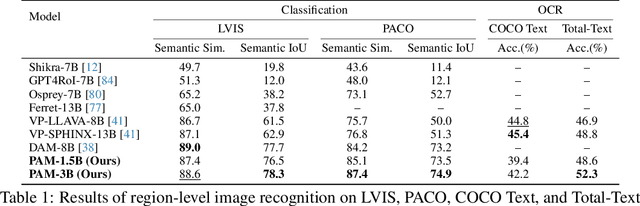

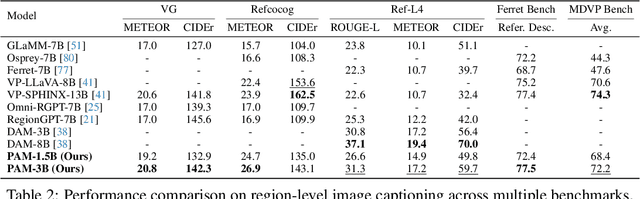
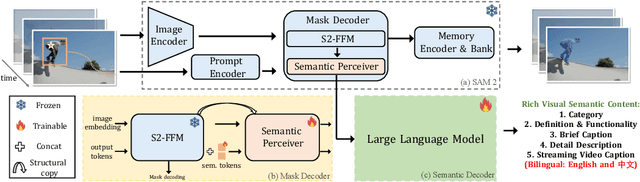
We present Perceive Anything Model (PAM), a conceptually straightforward and efficient framework for comprehensive region-level visual understanding in images and videos. Our approach extends the powerful segmentation model SAM 2 by integrating Large Language Models (LLMs), enabling simultaneous object segmentation with the generation of diverse, region-specific semantic outputs, including categories, label definition, functional explanations, and detailed captions. A key component, Semantic Perceiver, is introduced to efficiently transform SAM 2's rich visual features, which inherently carry general vision, localization, and semantic priors into multi-modal tokens for LLM comprehension. To support robust multi-granularity understanding, we also develop a dedicated data refinement and augmentation pipeline, yielding a high-quality dataset of 1.5M image and 0.6M video region-semantic annotations, including novel region-level streaming video caption data. PAM is designed for lightweightness and efficiency, while also demonstrates strong performance across a diverse range of region understanding tasks. It runs 1.2-2.4x faster and consumes less GPU memory than prior approaches, offering a practical solution for real-world applications. We believe that our effective approach will serve as a strong baseline for future research in region-level visual understanding.
First Token Probability Guided RAG for Telecom Question Answering
Jan 11, 2025Large Language Models (LLMs) have garnered significant attention for their impressive general-purpose capabilities. For applications requiring intricate domain knowledge, Retrieval-Augmented Generation (RAG) has shown a distinct advantage in incorporating domain-specific information into LLMs. However, existing RAG research has not fully addressed the challenges of Multiple Choice Question Answering (MCQA) in telecommunications, particularly in terms of retrieval quality and mitigating hallucinations. To tackle these challenges, we propose a novel first token probability guided RAG framework. This framework leverages confidence scores to optimize key hyperparameters, such as chunk number and chunk window size, while dynamically adjusting the context. Our method starts by retrieving the most relevant chunks and generates a single token as the potential answer. The probabilities of all options are then normalized to serve as confidence scores, which guide the dynamic adjustment of the context. By iteratively optimizing the hyperparameters based on these confidence scores, we can continuously improve RAG performance. We conducted experiments to validate the effectiveness of our framework, demonstrating its potential to enhance accuracy in domain-specific MCQA tasks.
LoFi: Vision-Aided Label Generator for Wi-Fi Localization and Tracking
Dec 06, 2024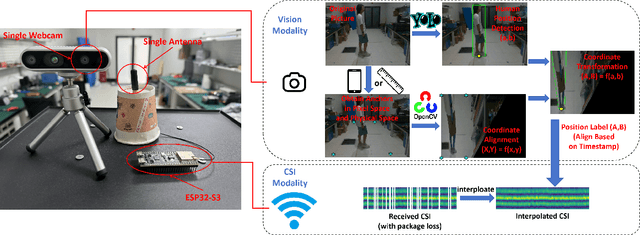

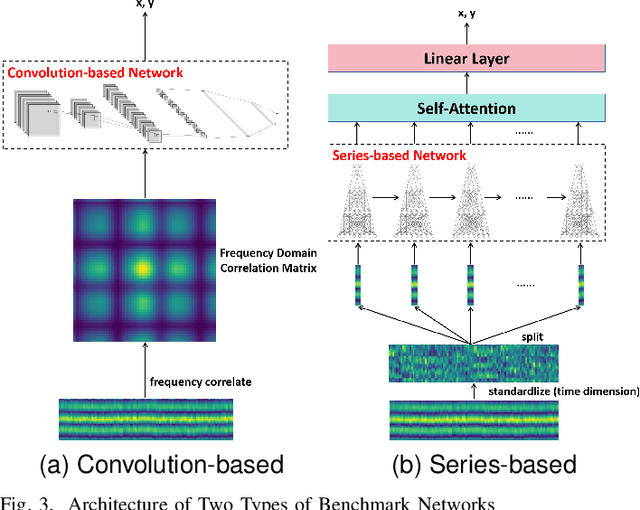
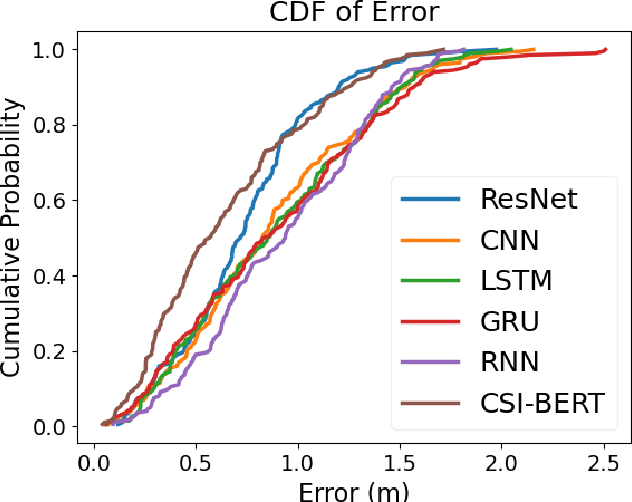
Wi-Fi localization and tracking has shown immense potential due to its privacy-friendliness, wide coverage, permeability, independence from lighting conditions, and low cost. Current methods can be broadly categorized as model-based and data-driven approaches, where data-driven methods show better performance and have less requirement for specialized devices, but struggle with limited datasets for training. Due to limitations in current data collection methods, most datasets only provide coarse-grained ground truth (GT) or limited amount of label points, which greatly hinders the development of data-driven methods. Even though lidar can provide accurate GT, their high cost makes them inaccessible to many users. To address these challenges, we propose LoFi, a vision-aided label generator for Wi-Fi localization and tracking, which can generate ground truth position coordinates solely based on 2D images. The easy and quick data collection method also helps data-driven based methods deploy in practice, since Wi-Fi is a low-generalization modality and when using relevant methods, it always requires fine-tuning the model using newly collected data. Based on our method, we also collect a Wi-Fi tracking and localization dataset using ESP32-S3 and a webcam. To facilitate future research, we will make our code and dataset publicly available upon publication.
KNN-MMD: Cross Domain Wi-Fi Sensing Based on Local Distribution Alignment
Dec 06, 2024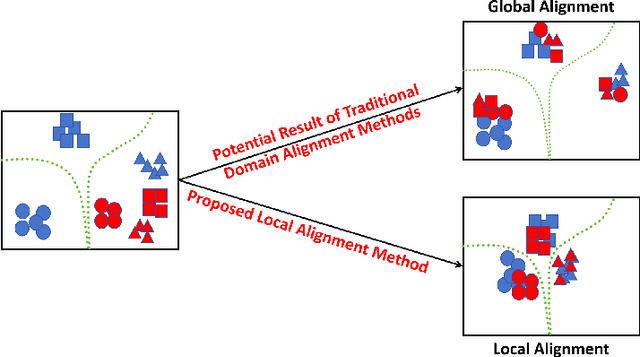


As a key technology in Integrated Sensing and Communications (ISAC), Wi-Fi sensing has gained widespread application in various settings such as homes, offices, and public spaces. By analyzing the patterns of Channel State Information (CSI), we can obtain information about people's actions for tasks like person identification, gesture recognition, and fall detection. However, the CSI is heavily influenced by the environment, such that even minor environmental changes can significantly alter the CSI patterns. This will cause the performance deterioration and even failure when applying the Wi-Fi sensing model trained in one environment to another. To address this problem, we introduce a K-Nearest Neighbors Maximum Mean Discrepancy (KNN-MMD) model, a few-shot method for cross-domain Wi-Fi sensing. We propose a local distribution alignment method within each category, which outperforms traditional Domain Adaptation (DA) methods based on global alignment. Besides, our method can determine when to stop training, which cannot be realized by most DA methods. As a result, our method is more stable and can be better used in practice. The effectiveness of our method are evaluated in several cross-domain Wi-Fi sensing tasks, including gesture recognition, person identification, fall detection, and action recognition, using both a public dataset and a self-collected dataset. In one-shot scenario, our method achieves accuracy of 93.26%, 81.84%, 77.62%, and 75.30% in the four tasks respectively. To facilitate future research, we will make our code and dataset publicly available upon publication.
CrossFi: A Cross Domain Wi-Fi Sensing Framework Based on Siamese Network
Aug 21, 2024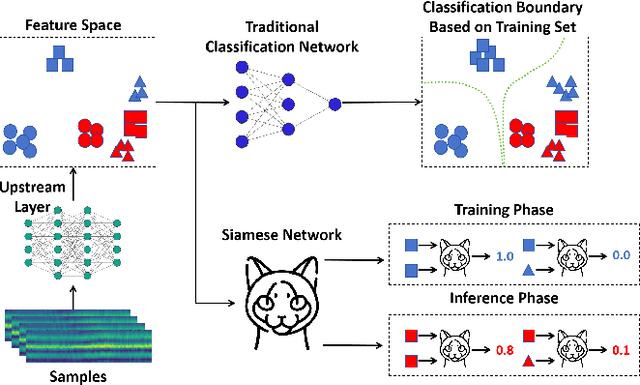
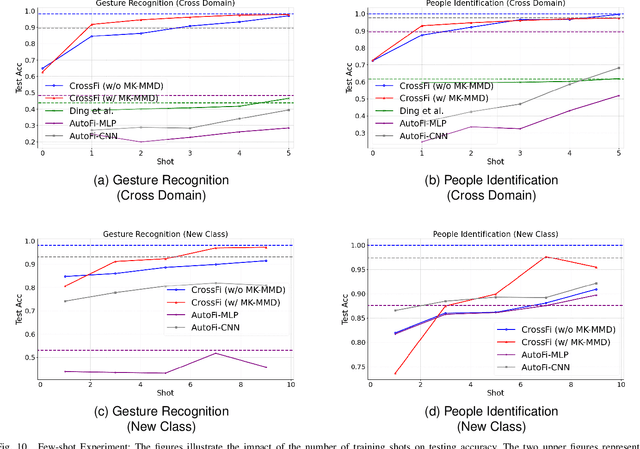
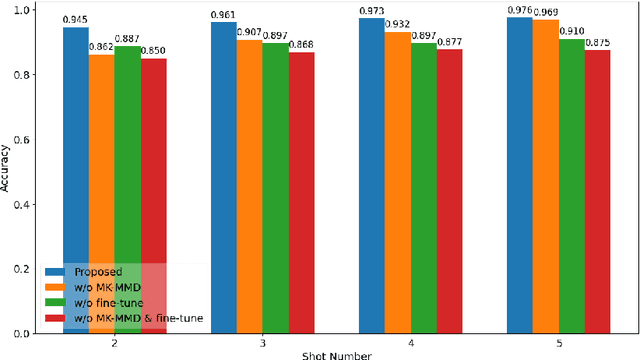
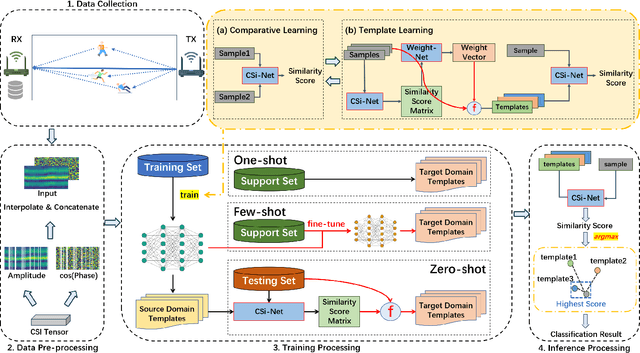
In recent years, Wi-Fi sensing has garnered significant attention due to its numerous benefits, such as privacy protection, low cost, and penetration ability. Extensive research has been conducted in this field, focusing on areas such as gesture recognition, people identification, and fall detection. However, many data-driven methods encounter challenges related to domain shift, where the model fails to perform well in environments different from the training data. One major factor contributing to this issue is the limited availability of Wi-Fi sensing datasets, which makes models learn excessive irrelevant information and over-fit to the training set. Unfortunately, collecting large-scale Wi-Fi sensing datasets across diverse scenarios is a challenging task. To address this problem, we propose CrossFi, a siamese network-based approach that excels in both in-domain scenario and cross-domain scenario, including few-shot, zero-shot scenarios, and even works in few-shot new-class scenario where testing set contains new categories. The core component of CrossFi is a sample-similarity calculation network called CSi-Net, which improves the structure of the siamese network by using an attention mechanism to capture similarity information, instead of simply calculating the distance or cosine similarity. Based on it, we develop an extra Weight-Net that can generate a template for each class, so that our CrossFi can work in different scenarios. Experimental results demonstrate that our CrossFi achieves state-of-the-art performance across various scenarios. In gesture recognition task, our CrossFi achieves an accuracy of 98.17% in in-domain scenario, 91.72% in one-shot cross-domain scenario, 64.81% in zero-shot cross-domain scenario, and 84.75% in one-shot new-class scenario. To facilitate future research, we will release the code for our model upon publication.