 Add to Chrome
 Add to Firefox
 Add to Edge
DiffusionDriveV2: Reinforcement Learning-Constrained Truncated Diffusion Modeling in End-to-End Autonomous Driving
Dec 08, 2025
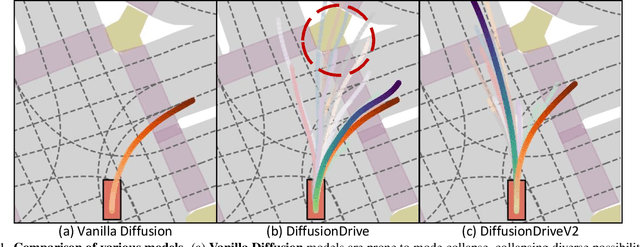
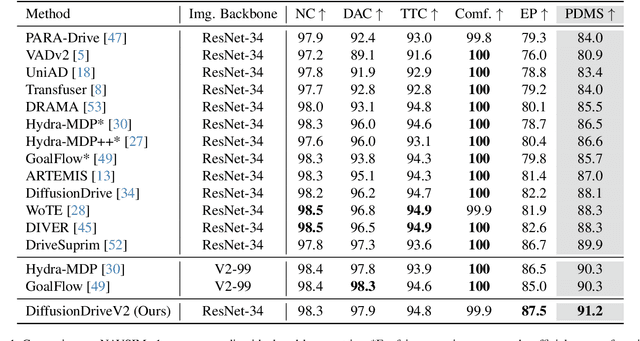
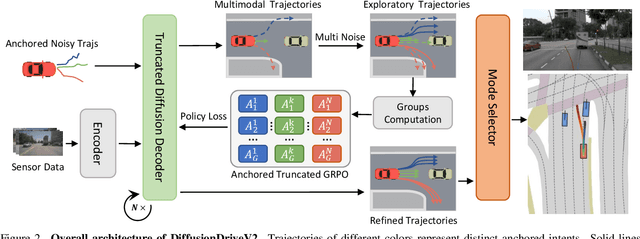
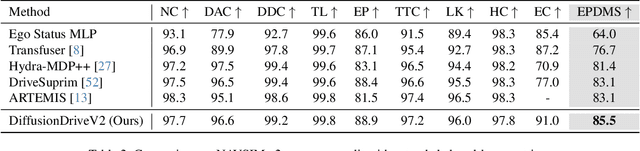
Generative diffusion models for end-to-end autonomous driving often suffer from mode collapse, tending to generate conservative and homogeneous behaviors. While DiffusionDrive employs predefined anchors representing different driving intentions to partition the action space and generate diverse trajectories, its reliance on imitation learning lacks sufficient constraints, resulting in a dilemma between diversity and consistent high quality. In this work, we propose DiffusionDriveV2, which leverages reinforcement learning to both constrain low-quality modes and explore for superior trajectories. This significantly enhances the overall output quality while preserving the inherent multimodality of its core Gaussian Mixture Model. First, we use scale-adaptive multiplicative noise, ideal for trajectory planning, to promote broad exploration. Second, we employ intra-anchor GRPO to manage advantage estimation among samples generated from a single anchor, and inter-anchor truncated GRPO to incorporate a global perspective across different anchors, preventing improper advantage comparisons between distinct intentions (e.g., turning vs. going straight), which can lead to further mode collapse. DiffusionDriveV2 achieves 91.2 PDMS on the NAVSIM v1 dataset and 85.5 EPDMS on the NAVSIM v2 dataset in closed-loop evaluation with an aligned ResNet-34 backbone, setting a new record. Further experiments validate that our approach resolves the dilemma between diversity and consistent high quality for truncated diffusion models, achieving the best trade-off. Code and model will be available at https://github.com/hustvl/DiffusionDriveV2

Gait Recognition via Collaborating Discriminative and Generative Diffusion Models
Nov 09, 2025Gait recognition offers a non-intrusive biometric solution by identifying individuals through their walking patterns. Although discriminative models have achieved notable success in this domain, the full potential of generative models remains largely underexplored. In this paper, we introduce \textbf{CoD$^2$}, a novel framework that combines the data distribution modeling capabilities of diffusion models with the semantic representation learning strengths of discriminative models to extract robust gait features. We propose a Multi-level Conditional Control strategy that incorporates both high-level identity-aware semantic conditions and low-level visual details. Specifically, the high-level condition, extracted by the discriminative extractor, guides the generation of identity-consistent gait sequences, whereas low-level visual details, such as appearance and motion, are preserved to enhance consistency. Furthermore, the generated sequences facilitate the discriminative extractor's learning, enabling it to capture more comprehensive high-level semantic features. Extensive experiments on four datasets (SUSTech1K, CCPG, GREW, and Gait3D) demonstrate that CoD$^2$ achieves state-of-the-art performance and can be seamlessly integrated with existing discriminative methods, yielding consistent improvements.
TransLight: Image-Guided Customized Lighting Control with Generative Decoupling
Aug 20, 2025Most existing illumination-editing approaches fail to simultaneously provide customized control of light effects and preserve content integrity. This makes them less effective for practical lighting stylization requirements, especially in the challenging task of transferring complex light effects from a reference image to a user-specified target image. To address this problem, we propose TransLight, a novel framework that enables high-fidelity and high-freedom transfer of light effects. Extracting the light effect from the reference image is the most critical and challenging step in our method. The difficulty lies in the complex geometric structure features embedded in light effects that are highly coupled with content in real-world scenarios. To achieve this, we first present Generative Decoupling, where two fine-tuned diffusion models are used to accurately separate image content and light effects, generating a newly curated, million-scale dataset of image-content-light triplets. Then, we employ IC-Light as the generative model and train our model with our triplets, injecting the reference lighting image as an additional conditioning signal. The resulting TransLight model enables customized and natural transfer of diverse light effects. Notably, by thoroughly disentangling light effects from reference images, our generative decoupling strategy endows TransLight with highly flexible illumination control. Experimental results establish TransLight as the first method to successfully transfer light effects across disparate images, delivering more customized illumination control than existing techniques and charting new directions for research in illumination harmonization and editing.
Snap-Snap: Taking Two Images to Reconstruct 3D Human Gaussians in Milliseconds
Aug 20, 2025Reconstructing 3D human bodies from sparse views has been an appealing topic, which is crucial to broader the related applications. In this paper, we propose a quite challenging but valuable task to reconstruct the human body from only two images, i.e., the front and back view, which can largely lower the barrier for users to create their own 3D digital humans. The main challenges lie in the difficulty of building 3D consistency and recovering missing information from the highly sparse input. We redesign a geometry reconstruction model based on foundation reconstruction models to predict consistent point clouds even input images have scarce overlaps with extensive human data training. Furthermore, an enhancement algorithm is applied to supplement the missing color information, and then the complete human point clouds with colors can be obtained, which are directly transformed into 3D Gaussians for better rendering quality. Experiments show that our method can reconstruct the entire human in 190 ms on a single NVIDIA RTX 4090, with two images at a resolution of 1024x1024, demonstrating state-of-the-art performance on the THuman2.0 and cross-domain datasets. Additionally, our method can complete human reconstruction even with images captured by low-cost mobile devices, reducing the requirements for data collection. Demos and code are available at https://hustvl.github.io/Snap-Snap/.
LENS: Learning to Segment Anything with Unified Reinforced Reasoning
Aug 19, 2025Text-prompted image segmentation enables fine-grained visual understanding and is critical for applications such as human-computer interaction and robotics. However, existing supervised fine-tuning methods typically ignore explicit chain-of-thought (CoT) reasoning at test time, which limits their ability to generalize to unseen prompts and domains. To address this issue, we introduce LENS, a scalable reinforcement-learning framework that jointly optimizes the reasoning process and segmentation in an end-to-end manner. We propose unified reinforcement-learning rewards that span sentence-, box-, and segment-level cues, encouraging the model to generate informative CoT rationales while refining mask quality. Using a publicly available 3-billion-parameter vision-language model, i.e., Qwen2.5-VL-3B-Instruct, LENS achieves an average cIoU of 81.2% on the RefCOCO, RefCOCO+, and RefCOCOg benchmarks, outperforming the strong fine-tuned method, i.e., GLaMM, by up to 5.6%. These results demonstrate that RL-driven CoT reasoning serves as a robust prior for text-prompted segmentation and offers a practical path toward more generalizable Segment Anything models. Code is available at https://github.com/hustvl/LENS.
Turbo-VAED: Fast and Stable Transfer of Video-VAEs to Mobile Devices
Aug 12, 2025There is a growing demand for deploying large generative AI models on mobile devices. For recent popular video generative models, however, the Variational AutoEncoder (VAE) represents one of the major computational bottlenecks. Both large parameter sizes and mismatched kernels cause out-of-memory errors or extremely slow inference on mobile devices. To address this, we propose a low-cost solution that efficiently transfers widely used video VAEs to mobile devices. (1) We analyze redundancy in existing VAE architectures and get empirical design insights. By integrating 3D depthwise separable convolutions into our model, we significantly reduce the number of parameters. (2) We observe that the upsampling techniques in mainstream video VAEs are poorly suited to mobile hardware and form the main bottleneck. In response, we propose a decoupled 3D pixel shuffle scheme that slashes end-to-end delay. Building upon these, we develop a universal mobile-oriented VAE decoder, Turbo-VAED. (3) We propose an efficient VAE decoder training method. Since only the decoder is used during deployment, we distill it to Turbo-VAED instead of retraining the full VAE, enabling fast mobile adaptation with minimal performance loss. To our knowledge, our method enables real-time 720p video VAE decoding on mobile devices for the first time. This approach is widely applicable to most video VAEs. When integrated into four representative models, with training cost as low as $95, it accelerates original VAEs by up to 84.5x at 720p resolution on GPUs, uses as low as 17.5% of original parameter count, and retains 96.9% of the original reconstruction quality. Compared to mobile-optimized VAEs, Turbo-VAED achieves a 2.9x speedup in FPS and better reconstruction quality on the iPhone 16 Pro. The code and models will soon be available at https://github.com/hustvl/Turbo-VAED.
ReCogDrive: A Reinforced Cognitive Framework for End-to-End Autonomous Driving
Jun 09, 2025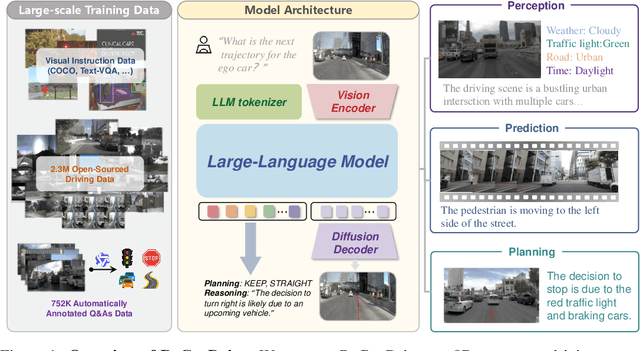
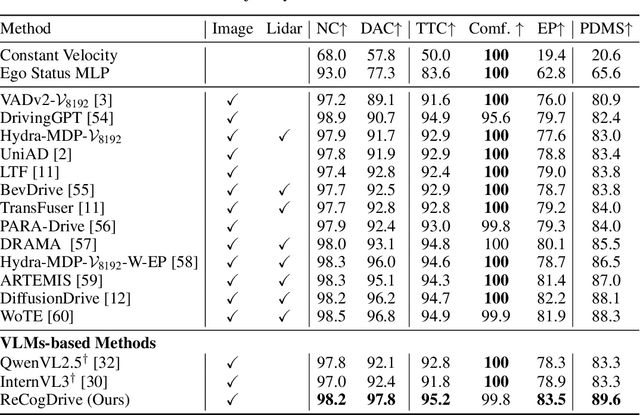
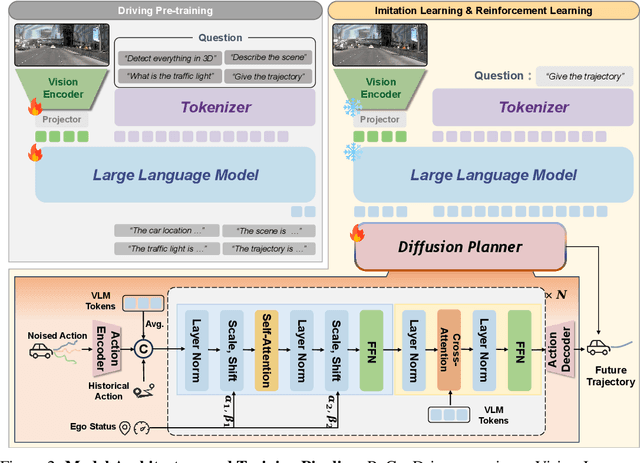
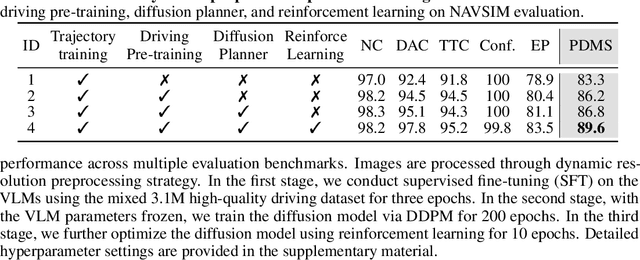
Although end-to-end autonomous driving has made remarkable progress, its performance degrades significantly in rare and long-tail scenarios. Recent approaches attempt to address this challenge by leveraging the rich world knowledge of Vision-Language Models (VLMs), but these methods suffer from several limitations: (1) a significant domain gap between the pre-training data of VLMs and real-world driving data, (2) a dimensionality mismatch between the discrete language space and the continuous action space, and (3) imitation learning tends to capture the average behavior present in the dataset, which may be suboptimal even dangerous. In this paper, we propose ReCogDrive, an autonomous driving system that integrates VLMs with diffusion planner, which adopts a three-stage paradigm for training. In the first stage, we use a large-scale driving question-answering datasets to train the VLMs, mitigating the domain discrepancy between generic content and real-world driving scenarios. In the second stage, we employ a diffusion-based planner to perform imitation learning, mapping representations from the latent language space to continuous driving actions. Finally, we fine-tune the diffusion planner using reinforcement learning with NAVSIM non-reactive simulator, enabling the model to generate safer, more human-like driving trajectories. We evaluate our approach on the planning-oriented NAVSIM benchmark, achieving a PDMS of 89.6 and setting a new state-of-the-art that surpasses the previous vision-only SOTA by 5.6 PDMS.
Genesis: Multimodal Driving Scene Generation with Spatio-Temporal and Cross-Modal Consistency
Jun 09, 2025We present Genesis, a unified framework for joint generation of multi-view driving videos and LiDAR sequences with spatio-temporal and cross-modal consistency. Genesis employs a two-stage architecture that integrates a DiT-based video diffusion model with 3D-VAE encoding, and a BEV-aware LiDAR generator with NeRF-based rendering and adaptive sampling. Both modalities are directly coupled through a shared latent space, enabling coherent evolution across visual and geometric domains. To guide the generation with structured semantics, we introduce DataCrafter, a captioning module built on vision-language models that provides scene-level and instance-level supervision. Extensive experiments on the nuScenes benchmark demonstrate that Genesis achieves state-of-the-art performance across video and LiDAR metrics (FVD 16.95, FID 4.24, Chamfer 0.611), and benefits downstream tasks including segmentation and 3D detection, validating the semantic fidelity and practical utility of the generated data.
PixelHacker: Image Inpainting with Structural and Semantic Consistency
Apr 30, 2025Image inpainting is a fundamental research area between image editing and image generation. Recent state-of-the-art (SOTA) methods have explored novel attention mechanisms, lightweight architectures, and context-aware modeling, demonstrating impressive performance. However, they often struggle with complex structure (e.g., texture, shape, spatial relations) and semantics (e.g., color consistency, object restoration, and logical correctness), leading to artifacts and inappropriate generation. To address this challenge, we design a simple yet effective inpainting paradigm called latent categories guidance, and further propose a diffusion-based model named PixelHacker. Specifically, we first construct a large dataset containing 14 million image-mask pairs by annotating foreground and background (potential 116 and 21 categories, respectively). Then, we encode potential foreground and background representations separately through two fixed-size embeddings, and intermittently inject these features into the denoising process via linear attention. Finally, by pre-training on our dataset and fine-tuning on open-source benchmarks, we obtain PixelHacker. Extensive experiments show that PixelHacker comprehensively outperforms the SOTA on a wide range of datasets (Places2, CelebA-HQ, and FFHQ) and exhibits remarkable consistency in both structure and semantics. Project page at https://hustvl.github.io/PixelHacker.
STP4D: Spatio-Temporal-Prompt Consistent Modeling for Text-to-4D Gaussian Splatting
Apr 25, 2025Text-to-4D generation is rapidly developing and widely applied in various scenarios. However, existing methods often fail to incorporate adequate spatio-temporal modeling and prompt alignment within a unified framework, resulting in temporal inconsistencies, geometric distortions, or low-quality 4D content that deviates from the provided texts. Therefore, we propose STP4D, a novel approach that aims to integrate comprehensive spatio-temporal-prompt consistency modeling for high-quality text-to-4D generation. Specifically, STP4D employs three carefully designed modules: Time-varying Prompt Embedding, Geometric Information Enhancement, and Temporal Extension Deformation, which collaborate to accomplish this goal. Furthermore, STP4D is among the first methods to exploit the Diffusion model to generate 4D Gaussians, combining the fine-grained modeling capabilities and the real-time rendering process of 4DGS with the rapid inference speed of the Diffusion model. Extensive experiments demonstrate that STP4D excels in generating high-fidelity 4D content with exceptional efficiency (approximately 4.6s per asset), surpassing existing methods in both quality and speed.