 Add to Chrome
 Add to Firefox
 Add to Edge
DiffusionDriveV2: Reinforcement Learning-Constrained Truncated Diffusion Modeling in End-to-End Autonomous Driving
Dec 08, 2025
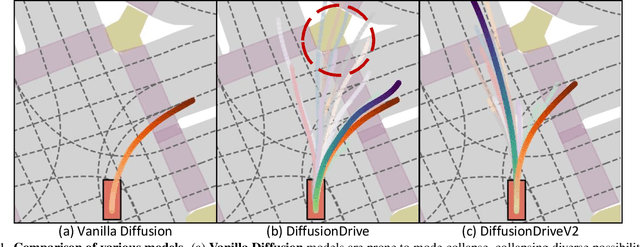
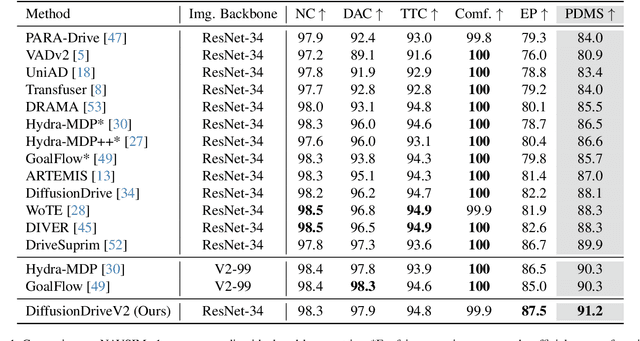
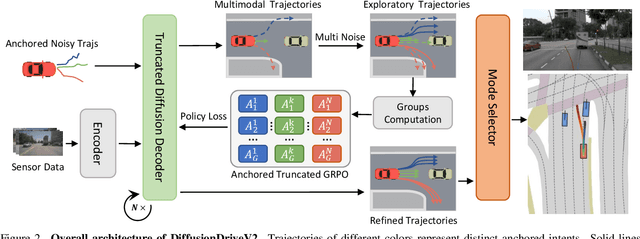
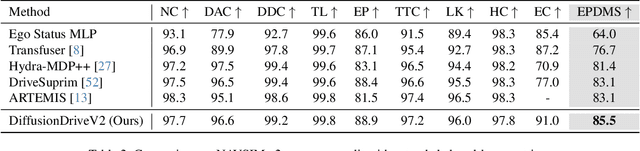
Generative diffusion models for end-to-end autonomous driving often suffer from mode collapse, tending to generate conservative and homogeneous behaviors. While DiffusionDrive employs predefined anchors representing different driving intentions to partition the action space and generate diverse trajectories, its reliance on imitation learning lacks sufficient constraints, resulting in a dilemma between diversity and consistent high quality. In this work, we propose DiffusionDriveV2, which leverages reinforcement learning to both constrain low-quality modes and explore for superior trajectories. This significantly enhances the overall output quality while preserving the inherent multimodality of its core Gaussian Mixture Model. First, we use scale-adaptive multiplicative noise, ideal for trajectory planning, to promote broad exploration. Second, we employ intra-anchor GRPO to manage advantage estimation among samples generated from a single anchor, and inter-anchor truncated GRPO to incorporate a global perspective across different anchors, preventing improper advantage comparisons between distinct intentions (e.g., turning vs. going straight), which can lead to further mode collapse. DiffusionDriveV2 achieves 91.2 PDMS on the NAVSIM v1 dataset and 85.5 EPDMS on the NAVSIM v2 dataset in closed-loop evaluation with an aligned ResNet-34 backbone, setting a new record. Further experiments validate that our approach resolves the dilemma between diversity and consistent high quality for truncated diffusion models, achieving the best trade-off. Code and model will be available at https://github.com/hustvl/DiffusionDriveV2

Bridging the Initialization Gap: A Co-Optimization Framework for Mixed-Size Global Placement
Nov 13, 2025Global placement is a critical step with high computational complexity in VLSI physical design. Modern analytical placers formulate the placement problem as a nonlinear optimization, where initialization strongly affects both convergence behavior and final placement quality. However, existing initialization methods exhibit a trade-off: area-aware initializers account for cell areas but are computationally expensive and can dominate total runtime, while fast point-based initializers ignore cell area, leading to a modeling gap that impairs convergence and solution quality. We propose a lightweight co-optimization framework that bridges this initialization gap through two strategies. First, an area-hint refinement initializer incorporates heuristic cell area information into a signed graph signal by augmenting the netlist graph with virtual nodes and negative-weight edges, yielding an area-aware and spectrally smooth placement initialization. Second, a macro-schedule placement procedure progressively restores area constraints, enabling a smooth transition from the refined initializer to the full area-aware objective and producing high-quality placement results. We evaluate the framework on macro-heavy ISPD2005 academic benchmarks and two real-world industrial designs across two technology nodes (12 cases in total). Experimental results show that our method consistently improves half-perimeter wirelength (HPWL) over point-based initializers in 11 out of 12 cases, achieving up to 2.2% HPWL reduction, while running approximately 100 times faster than the state-of-the-art area-aware initializer.