 Add to Chrome
 Add to Firefox
 Add to Edge
ReWorld: Learning Better Representations for World Action Models
Jun 25, 2026
World Action Models (WAMs) model future environment evolution under action conditioning, offering a scalable paradigm for autonomous driving. However, existing approaches focus largely on model architecture design, and how a WAM can efficiently learn better world representations for planning remains underexplored. To address this gap, we propose ReWorld, the first representation learning framework specifically designed for autonomous-driving world action models. In WAMs, standard training supervises only the output ends of the generation and planning modules, leaving the intermediate representations that carry world knowledge to be shaped only indirectly, as byproducts of fitting these outputs. The core idea of ReWorld is to treat intermediate representations as direct targets of optimization, shaping them along three complementary dimensions. On the Video DiT responsible for generation, we impose future-predictive supervision on its intermediate representations. On the Action DiT responsible for planning, we first align its intermediate representations cross-modally with the video world representation, then further shape them to be discriminative around safety-critical boundaries via hard-negative supervision. In addition, we systematically analyze the effectiveness of existing representation learning methods in video generation world models, and discuss why their performance is limited on this task. Experiments on nuScenes and NAVSIM show that ReWorld improves fine-tuned video generation by 23.9% in FVD (81.3 to 61.9), raises closed-loop PDMS from 89.1 to 90.4 without any post-training such as RL or post-processing, and accelerates from-scratch convergence by approximately 2x.

Zero-shot Tweet-Level Stance Detection Enhanced by External Knowledge and Reflective Chain-of-Thought Reasoning
Jun 25, 2026Zero-shot tweet-level stance detection confronts two primary challenges: (1) mitigating the context sparsity inherent in short texts, and (2) establishing the relevance between implicit targets and textual content. While existing methods primarily focus on incorporating external knowledge, they neglect the intrinsic semantic cues embedded within key intra-textual entities. Furthermore, current models exhibit limited capability in determining the relevance of unseen targets to the given text, thereby struggling to differentiate between "neutral" and "irrelevant" stance labels. To address these issues, we first construct a four-class, multi-topic Japanese tweet dataset. To our knowledge, this is the first Japanese tweet-level dataset for stance detection. We then propose KIRP, a zero-shot stance detection framework. It integrates external knowledge with entity reorganization for data augmentation and employs prompt chaining for reasoning. Specifically, the framework incorporates knowledge graphs to supplement and reorganize key textual entities, while reflective Chain-of-Thought (CoT) reasoning extracts and validates implicit targets. To better distinguish "neutral" from "irrelevant" labels, we adopt stance-aware contrastive learning to capture discriminative features and design a three-layer iterative prototype network for fine-grained classification. Experimental results on SemEval-2016, WT-WT, and KIRP-D show that KIRP achieves state-of-the-art performance. KIRP obtains F1 scores of 84.05% (three-class) on SemEval-2016, and 84.99% and 79.18% (four-class) on WT-WT and KIRP-D, respectively.
CausalDrive: Real-time Causal World Models for Autonomous Driving
Jun 13, 2026World models have emerged as a promising paradigm for scaling autonomous driving (AD) data, yet existing video generative models fall short as interactive simulators. Layout-conditioned renderers rely on "oracle" future trajectories of all background agents, rendering them strictly non-reactive. Conversely, pure action-conditioned predictors lack semantic control over complex interactions and suffer from prohibitive diffusion latencies, hindering closed-loop policy learning. To bridge this gap, we present CausalDrive, a controllable, real-time foundation driving world renderer. CausalDrive operates solely on the initial front-view frame, the ego-vehicle's trajectory, and a macroscopic text prompt. By excluding future NPC layouts, we compel the model to intrinsically predict causal interactions, enabling text-driven control over Driving Sociology, allowing users to dynamically orchestrate diverse counterfactual reactions to identical ego-actions. To overcome the efficiency bottleneck and address the covariate shift in autoregressive generation, we propose a novel Context-Forced DMD architecture. This combines continuous flow-matching with a self-correcting distillation objective, achieving interactive speeds of 12 FPS. This breakthrough transforms the passive video generator into a playable neural simulator. We demonstrate its versatility across three downstream applications: (1) generative closed-loop evaluation with significantly mitigated collision artifacts, (2) large-scale Reinforcement Learning (RL) post-training driven by a Video2Reward module, and (3) real-time human-in-the-loop simulation. Extensive experiments validate that policies trained within CausalDrive's reactive scenarios exhibit superior interaction capabilities in the real world.
UniDriveVLA: Unifying Understanding, Perception, and Action Planning for Autonomous Driving
Apr 02, 2026Vision-Language-Action (VLA) models have recently emerged in autonomous driving, with the promise of leveraging rich world knowledge to improve the cognitive capabilities of driving systems. However, adapting such models for driving tasks currently faces a critical dilemma between spatial perception and semantic reasoning. Consequently, existing VLA systems are forced into suboptimal compromises: directly adopting 2D Vision-Language Models yields limited spatial perception, whereas enhancing them with 3D spatial representations often impairs the native reasoning capacity of VLMs. We argue that this dilemma largely stems from the coupled optimization of spatial perception and semantic reasoning within shared model parameters. To overcome this, we propose UniDriveVLA, a Unified Driving Vision-Language-Action model based on Mixture-of-Transformers that addresses the perception-reasoning conflict via expert decoupling. Specifically, it comprises three experts for driving understanding, scene perception, and action planning, which are coordinated through masked joint attention. In addition, we combine a sparse perception paradigm with a three-stage progressive training strategy to improve spatial perception while maintaining semantic reasoning capability. Extensive experiments show that UniDriveVLA achieves state-of-the-art performance in open-loop evaluation on nuScenes and closed-loop evaluation on Bench2Drive. Moreover, it demonstrates strong performance across a broad range of perception, prediction, and understanding tasks, including 3D detection, online mapping, motion forecasting, and driving-oriented VQA, highlighting its broad applicability as a unified model for autonomous driving. Code and model have been released at https://github.com/xiaomi-research/unidrivevla
Toward Physically Consistent Driving Video World Models under Challenging Trajectories
Mar 25, 2026Video generation models have shown strong potential as world models for autonomous driving simulation. However, existing approaches are primarily trained on real-world driving datasets, which mostly contain natural and safe driving scenarios. As a result, current models often fail when conditioned on challenging or counterfactual trajectories-such as imperfect trajectories generated by simulators or planning systems-producing videos with severe physical inconsistencies and artifacts. To address this limitation, we propose PhyGenesis, a world model designed to generate driving videos with high visual fidelity and strong physical consistency. Our framework consists of two key components: (1) a physical condition generator that transforms potentially invalid trajectory inputs into physically plausible conditions, and (2) a physics-enhanced video generator that produces high-fidelity multi-view driving videos under these conditions. To effectively train these components, we construct a large-scale, physics-rich heterogeneous dataset. Specifically, in addition to real-world driving videos, we generate diverse challenging driving scenarios using the CARLA simulator, from which we derive supervision signals that guide the model to learn physically grounded dynamics under extreme conditions. This challenging-trajectory learning strategy enables trajectory correction and promotes physically consistent video generation. Extensive experiments demonstrate that PhyGenesis consistently outperforms state-of-the-art methods, especially on challenging trajectories. Our project page is available at: https://wm-research.github.io/PhyGenesis/.
DriveLaW:Unifying Planning and Video Generation in a Latent Driving World
Dec 31, 2025World models have become crucial for autonomous driving, as they learn how scenarios evolve over time to address the long-tail challenges of the real world. However, current approaches relegate world models to limited roles: they operate within ostensibly unified architectures that still keep world prediction and motion planning as decoupled processes. To bridge this gap, we propose DriveLaW, a novel paradigm that unifies video generation and motion planning. By directly injecting the latent representation from its video generator into the planner, DriveLaW ensures inherent consistency between high-fidelity future generation and reliable trajectory planning. Specifically, DriveLaW consists of two core components: DriveLaW-Video, our powerful world model that generates high-fidelity forecasting with expressive latent representations, and DriveLaW-Act, a diffusion planner that generates consistent and reliable trajectories from the latent of DriveLaW-Video, with both components optimized by a three-stage progressive training strategy. The power of our unified paradigm is demonstrated by new state-of-the-art results across both tasks. DriveLaW not only advances video prediction significantly, surpassing best-performing work by 33.3% in FID and 1.8% in FVD, but also achieves a new record on the NAVSIM planning benchmark.
CorrectAD: A Self-Correcting Agentic System to Improve End-to-end Planning in Autonomous Driving
Nov 17, 2025End-to-end planning methods are the de facto standard of the current autonomous driving system, while the robustness of the data-driven approaches suffers due to the notorious long-tail problem (i.e., rare but safety-critical failure cases). In this work, we explore whether recent diffusion-based video generation methods (a.k.a. world models), paired with structured 3D layouts, can enable a fully automated pipeline to self-correct such failure cases. We first introduce an agent to simulate the role of product manager, dubbed PM-Agent, which formulates data requirements to collect data similar to the failure cases. Then, we use a generative model that can simulate both data collection and annotation. However, existing generative models struggle to generate high-fidelity data conditioned on 3D layouts. To address this, we propose DriveSora, which can generate spatiotemporally consistent videos aligned with the 3D annotations requested by PM-Agent. We integrate these components into our self-correcting agentic system, CorrectAD. Importantly, our pipeline is an end-to-end model-agnostic and can be applied to improve any end-to-end planner. Evaluated on both nuScenes and a more challenging in-house dataset across multiple end-to-end planners, CorrectAD corrects 62.5% and 49.8% of failure cases, reducing collision rates by 39% and 27%, respectively.
Rethinking Driving World Model as Synthetic Data Generator for Perception Tasks
Oct 22, 2025Recent advancements in driving world models enable controllable generation of high-quality RGB videos or multimodal videos. Existing methods primarily focus on metrics related to generation quality and controllability. However, they often overlook the evaluation of downstream perception tasks, which are $\mathbf{really\ crucial}$ for the performance of autonomous driving. Existing methods usually leverage a training strategy that first pretrains on synthetic data and finetunes on real data, resulting in twice the epochs compared to the baseline (real data only). When we double the epochs in the baseline, the benefit of synthetic data becomes negligible. To thoroughly demonstrate the benefit of synthetic data, we introduce Dream4Drive, a novel synthetic data generation framework designed for enhancing the downstream perception tasks. Dream4Drive first decomposes the input video into several 3D-aware guidance maps and subsequently renders the 3D assets onto these guidance maps. Finally, the driving world model is fine-tuned to produce the edited, multi-view photorealistic videos, which can be used to train the downstream perception models. Dream4Drive enables unprecedented flexibility in generating multi-view corner cases at scale, significantly boosting corner case perception in autonomous driving. To facilitate future research, we also contribute a large-scale 3D asset dataset named DriveObj3D, covering the typical categories in driving scenarios and enabling diverse 3D-aware video editing. We conduct comprehensive experiments to show that Dream4Drive can effectively boost the performance of downstream perception models under various training epochs. Project: $\href{https://wm-research.github.io/Dream4Drive/}{this\ https\ URL}$
ReCogDrive: A Reinforced Cognitive Framework for End-to-End Autonomous Driving
Jun 09, 2025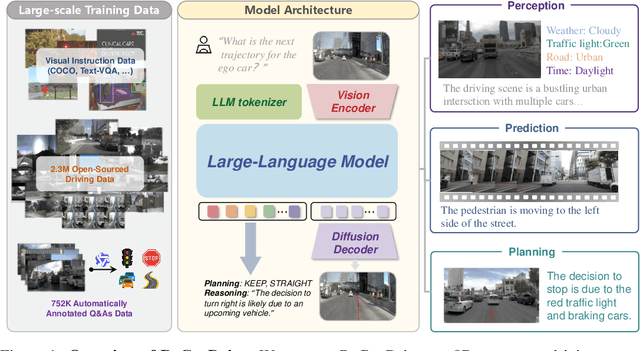
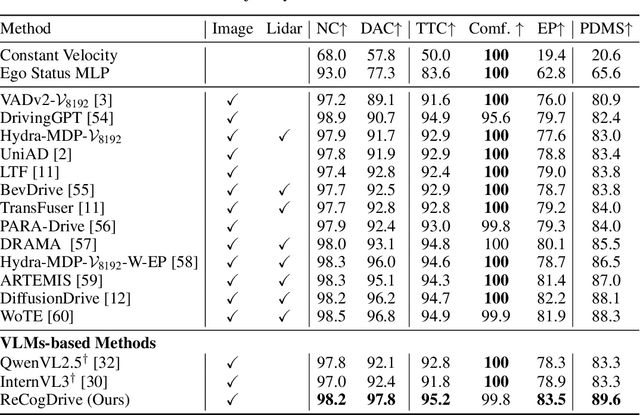
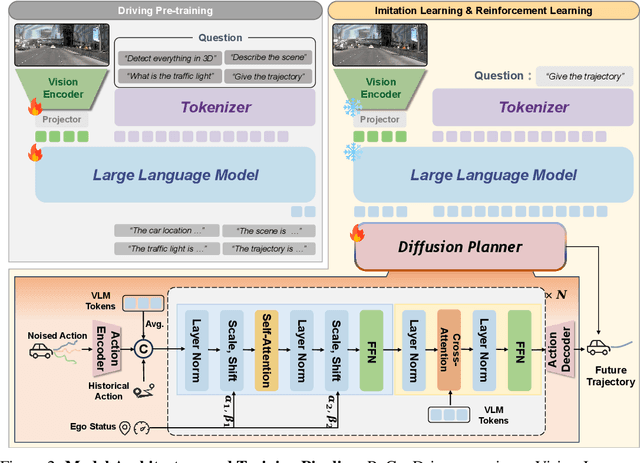
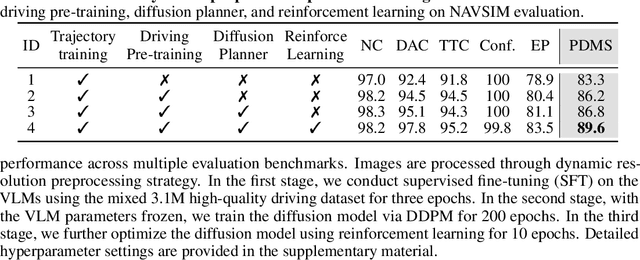
Although end-to-end autonomous driving has made remarkable progress, its performance degrades significantly in rare and long-tail scenarios. Recent approaches attempt to address this challenge by leveraging the rich world knowledge of Vision-Language Models (VLMs), but these methods suffer from several limitations: (1) a significant domain gap between the pre-training data of VLMs and real-world driving data, (2) a dimensionality mismatch between the discrete language space and the continuous action space, and (3) imitation learning tends to capture the average behavior present in the dataset, which may be suboptimal even dangerous. In this paper, we propose ReCogDrive, an autonomous driving system that integrates VLMs with diffusion planner, which adopts a three-stage paradigm for training. In the first stage, we use a large-scale driving question-answering datasets to train the VLMs, mitigating the domain discrepancy between generic content and real-world driving scenarios. In the second stage, we employ a diffusion-based planner to perform imitation learning, mapping representations from the latent language space to continuous driving actions. Finally, we fine-tune the diffusion planner using reinforcement learning with NAVSIM non-reactive simulator, enabling the model to generate safer, more human-like driving trajectories. We evaluate our approach on the planning-oriented NAVSIM benchmark, achieving a PDMS of 89.6 and setting a new state-of-the-art that surpasses the previous vision-only SOTA by 5.6 PDMS.
Genesis: Multimodal Driving Scene Generation with Spatio-Temporal and Cross-Modal Consistency
Jun 09, 2025We present Genesis, a unified framework for joint generation of multi-view driving videos and LiDAR sequences with spatio-temporal and cross-modal consistency. Genesis employs a two-stage architecture that integrates a DiT-based video diffusion model with 3D-VAE encoding, and a BEV-aware LiDAR generator with NeRF-based rendering and adaptive sampling. Both modalities are directly coupled through a shared latent space, enabling coherent evolution across visual and geometric domains. To guide the generation with structured semantics, we introduce DataCrafter, a captioning module built on vision-language models that provides scene-level and instance-level supervision. Extensive experiments on the nuScenes benchmark demonstrate that Genesis achieves state-of-the-art performance across video and LiDAR metrics (FVD 16.95, FID 4.24, Chamfer 0.611), and benefits downstream tasks including segmentation and 3D detection, validating the semantic fidelity and practical utility of the generated data.