 Add to Chrome
 Add to Firefox
 Add to Edge
When the Same Musical Knowledge Forgets Differently: A Clean Probe of Pathway-Dependent Forgetting
Jun 17, 2026
A model can learn that the piano piece Für Elise is calm and reflective by listening to the audio or by reading a text description, but does it matter which route that knowledge took when it is later at risk of being forgotten? Forgetting research in multimodal models measures what knowledge is lost under adaptation, yet has not asked whether acquisition route affects how easily that knowledge is forgotten. We call this untested premise the Pathway-Invariant Assumption. Music understanding enables a clean test because a music clip and a canonical text description can be aligned to the same perceptual content, allowing the same knowledge unit to enter a model through listening or reading while the target remains fixed. Across multiple architecturally distinct audio-language models, we observe a consistent asymmetry: text-pathway knowledge is forgotten more than matched audio-pathway knowledge under identical adaptation pressure. To attribute this effect to route rather than confounds, we introduce the Paired Pathway Controlled Protocol (PPCP), a three-phase design that establishes matched pathway baselines, activates both pathways under symmetric supervision on the same knowledge pool, and applies identical forgetting pressure to both pathways. The gap is stable across models and gain-controlled analyses, persists when contradictory overwrite is replaced by correct-label cross-domain learning, remains under single-modality pressure, and is not removed by lightweight replay. Two independent routing-depth controls confirm that the effect is not explained by architectural depth, pointing to input representation as the dominant factor. Under PPCP, our results demonstrate that forgetting is highly route-dependent, establishing acquisition route as a new analytical dimension for forgetting research and multimodal system design.

Trans-RAG: Query-Centric Vector Transformation for Secure Cross-Organizational Retrieval
Apr 10, 2026Retrieval Augmented Generation (RAG) systems deployed across organizational boundaries face fundamental tensions between security, accuracy, and efficiency. Current encryption methods expose plaintext during decryption, while federated architectures prevent resource integration and incur substantial overhead. We introduce Trans-RAG, implementing a novel vector space language paradigm where each organization's knowledge exists in a mathematically isolated semantic space. At the core lies vector2Trans, a multi-stage transformation technique that enables queries to dynamically "speak" each organization's vector space "language" through query-centric transformations, eliminating decryption overhead while maintaining native retrieval efficiency. Security evaluations demonstrate near-orthogonal vector spaces with 89.90° angular separation and 99.81% isolation rates. Experiments across 8 retrievers, 3 datasets, and 3 LLMs show minimal accuracy degradation (3.5% decrease in nDCG@10) and significant efficiency improvements over homomorphic encryption.
STIndex: A Context-Aware Multi-Dimensional Spatiotemporal Information Extraction System
Apr 07, 2026Extracting structured knowledge from unstructured data still faces practical limitations: entity and event extraction pipelines remain brittle, knowledge graph construction requires costly ontology engineering, and cross-domain generalization is rarely production-ready. In contrast, space and time provide universal contextual anchors that naturally align heterogeneous information and benefit downstream tasks such as retrieval and reasoning. We introduce \textbf{STIndex}, an end-to-end system that structures unstructured content into a multidimensional spatiotemporal data warehouse. Users define domain-specific analysis dimensions with configurable hierarchies, while large language models perform context-aware extraction and grounding. \textbf{STIndex} integrates document-level memory, geocoding correction, and quality validation, and offers an interactive analytics dashboard for visualization, clustering, burst detection, and entity network analysis. In evaluation on a public health benchmark, \textbf{STIndex} improves spatiotemporal entity extraction F1 by 4.37\% (GPT-4o-mini) and 3.60\% (Qwen3-8B). A live demonstration and open-source code are available at https://stindex.ai4wa.com/dashboard.
MV2UV: Generating High-quality UV Texture Maps with Multiview Prompts
Mar 16, 2026Generating high-quality textures for 3D assets is a challenging task. Existing multiview texture generation methods suffer from the multiview inconsistency and missing textures on unseen parts, while UV inpainting texture methods do not generalize well due to insufficient UV data and cannot well utilize 2D image diffusion priors. In this paper, we propose a new method called MV2UV that combines 2D generative priors from multiview generation and the inpainting ability of UV refinement to get high-quality texture maps. Our key idea is to adopt a UV space generative model that simultaneously inpaints unseen parts of multiview images while resolving the inconsistency of multiview images. Experiments show that our method enables a better texture generation quality than existing methods, especially in unseen occluded and multiview-inconsistent parts.
CRAFT: Calibrated Reasoning with Answer-Faithful Traces via Reinforcement Learning for Multi-Hop Question Answering
Feb 01, 2026Retrieval-augmented generation (RAG) is widely used to ground Large Language Models (LLMs) for multi-hop question answering. Recent work mainly focused on improving answer accuracy via fine-tuning and structured or reinforcement-based optimization. However, reliable reasoning in response generation faces three challenges: 1) Reasoning Collapse. Reasoning in multi-hop QA is inherently complex due to multi-hop composition and is further destabilized by noisy retrieval. 2) Reasoning-answer inconsistency. Due to the intrinsic uncertainty of LLM generation and exposure to evidence--distractor mixtures, models may produce correct answers that are not faithfully supported by their intermediate reasoning or evidence. 3) Loss of format control. Traditional chain-of-thought generation often deviates from required structured output formats, leading to incomplete or malformed structured content. To address these challenges, we propose CRAFT (Calibrated Reasoning with Answer-Faithful Traces), a Group Relative Policy Optimization (GRPO) based reinforcement learning framework that trains models to perform faithful reasoning during response generation. CRAFT employs dual reward mechanisms to optimize multi-hop reasoning: deterministic rewards ensure structural correctness while judge-based rewards verify semantic faithfulness. This optimization framework supports controllable trace variants that enable systematic analysis of how structure and scale affect reasoning performance and faithfulness. Experiments on three multi-hop QA benchmarks show that CRAFT improves both answer accuracy and reasoning faithfulness across model scales, with the CRAFT 7B model achieving competitive performance with closed-source LLMs across multiple reasoning trace settings.
UniSH: Unifying Scene and Human Reconstruction in a Feed-Forward Pass
Jan 03, 2026We present UniSH, a unified, feed-forward framework for joint metric-scale 3D scene and human reconstruction. A key challenge in this domain is the scarcity of large-scale, annotated real-world data, forcing a reliance on synthetic datasets. This reliance introduces a significant sim-to-real domain gap, leading to poor generalization, low-fidelity human geometry, and poor alignment on in-the-wild videos. To address this, we propose an innovative training paradigm that effectively leverages unlabeled in-the-wild data. Our framework bridges strong, disparate priors from scene reconstruction and HMR, and is trained with two core components: (1) a robust distillation strategy to refine human surface details by distilling high-frequency details from an expert depth model, and (2) a two-stage supervision scheme, which first learns coarse localization on synthetic data, then fine-tunes on real data by directly optimizing the geometric correspondence between the SMPL mesh and the human point cloud. This approach enables our feed-forward model to jointly recover high-fidelity scene geometry, human point clouds, camera parameters, and coherent, metric-scale SMPL bodies, all in a single forward pass. Extensive experiments demonstrate that our model achieves state-of-the-art performance on human-centric scene reconstruction and delivers highly competitive results on global human motion estimation, comparing favorably against both optimization-based frameworks and HMR-only methods. Project page: https://murphylmf.github.io/UniSH/
MeshRipple: Structured Autoregressive Generation of Artist-Meshes
Dec 09, 2025Meshes serve as a primary representation for 3D assets. Autoregressive mesh generators serialize faces into sequences and train on truncated segments with sliding-window inference to cope with memory limits. However, this mismatch breaks long-range geometric dependencies, producing holes and fragmented components. To address this critical limitation, we introduce MeshRipple, which expands a mesh outward from an active generation frontier, akin to a ripple on a surface. MeshRipple rests on three key innovations: a frontier-aware BFS tokenization that aligns the generation order with surface topology; an expansive prediction strategy that maintains coherent, connected surface growth; and a sparse-attention global memory that provides an effectively unbounded receptive field to resolve long-range topological dependencies. This integrated design enables MeshRipple to generate meshes with high surface fidelity and topological completeness, outperforming strong recent baselines.
Serving Large Language Models on Huawei CloudMatrix384
Jun 15, 2025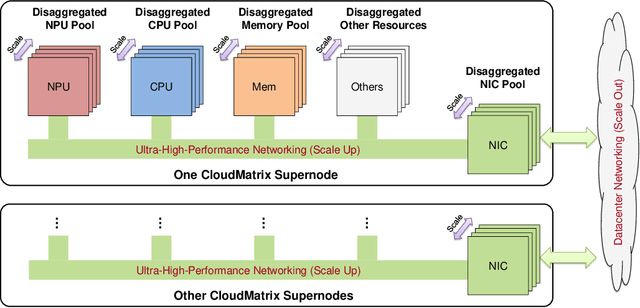
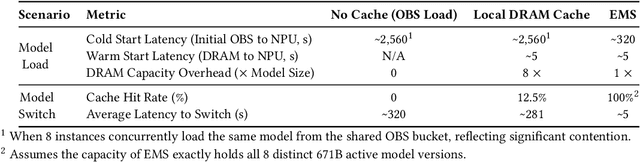
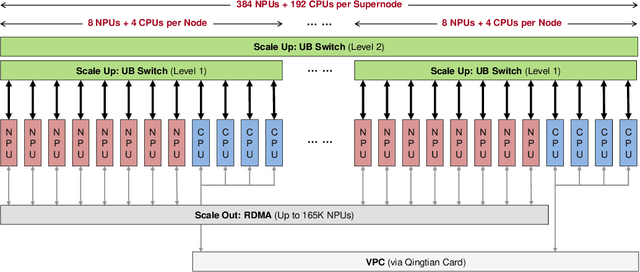
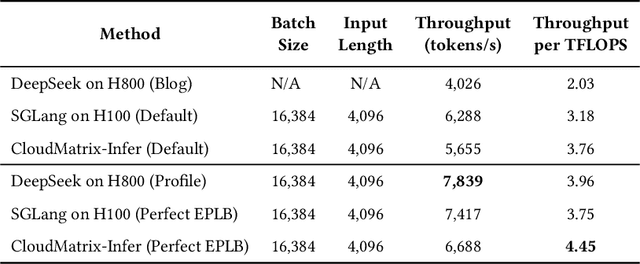
The rapid evolution of large language models (LLMs), driven by growing parameter scales, adoption of mixture-of-experts (MoE) architectures, and expanding context lengths, imposes unprecedented demands on AI infrastructure. Traditional AI clusters face limitations in compute intensity, memory bandwidth, inter-chip communication, and latency, compounded by variable workloads and strict service-level objectives. Addressing these issues requires fundamentally redesigned hardware-software integration. This paper introduces Huawei CloudMatrix, a next-generation AI datacenter architecture, realized in the production-grade CloudMatrix384 supernode. It integrates 384 Ascend 910C NPUs and 192 Kunpeng CPUs interconnected via an ultra-high-bandwidth Unified Bus (UB) network, enabling direct all-to-all communication and dynamic pooling of resources. These features optimize performance for communication-intensive operations, such as large-scale MoE expert parallelism and distributed key-value cache access. To fully leverage CloudMatrix384, we propose CloudMatrix-Infer, an advanced LLM serving solution incorporating three core innovations: a peer-to-peer serving architecture that independently scales prefill, decode, and caching; a large-scale expert parallelism strategy supporting EP320 via efficient UB-based token dispatch; and hardware-aware optimizations including specialized operators, microbatch-based pipelining, and INT8 quantization. Evaluation with the DeepSeek-R1 model shows CloudMatrix-Infer achieves state-of-the-art efficiency: prefill throughput of 6,688 tokens/s per NPU and decode throughput of 1,943 tokens/s per NPU (<50 ms TPOT). It effectively balances throughput and latency, sustaining 538 tokens/s even under stringent 15 ms latency constraints, while INT8 quantization maintains model accuracy across benchmarks.
CMMLoc: Advancing Text-to-PointCloud Localization with Cauchy-Mixture-Model Based Framework
Mar 05, 2025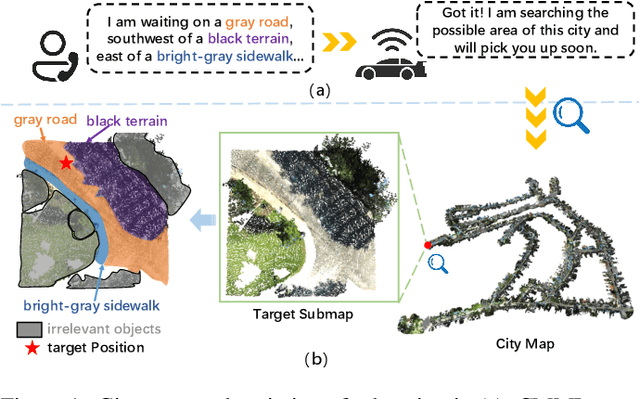
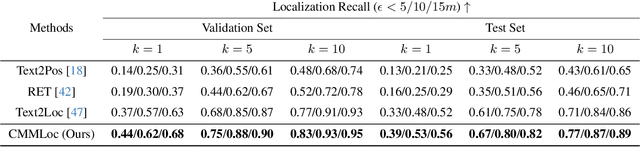
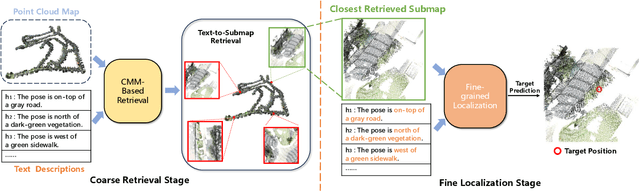
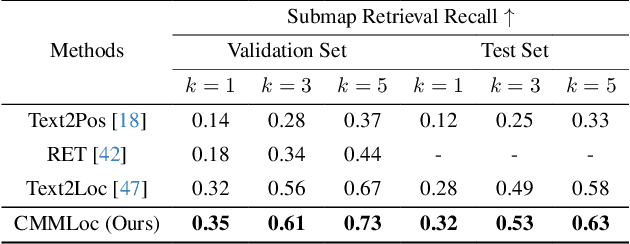
The goal of point cloud localization based on linguistic description is to identify a 3D position using textual description in large urban environments, which has potential applications in various fields, such as determining the location for vehicle pickup or goods delivery. Ideally, for a textual description and its corresponding 3D location, the objects around the 3D location should be fully described in the text description. However, in practical scenarios, e.g., vehicle pickup, passengers usually describe only the part of the most significant and nearby surroundings instead of the entire environment. In response to this $\textbf{partially relevant}$ challenge, we propose $\textbf{CMMLoc}$, an uncertainty-aware $\textbf{C}$auchy-$\textbf{M}$ixture-$\textbf{M}$odel ($\textbf{CMM}$) based framework for text-to-point-cloud $\textbf{Loc}$alization. To model the uncertain semantic relations between text and point cloud, we integrate CMM constraints as a prior during the interaction between the two modalities. We further design a spatial consolidation scheme to enable adaptive aggregation of different 3D objects with varying receptive fields. To achieve precise localization, we propose a cardinal direction integration module alongside a modality pre-alignment strategy, helping capture the spatial relationships among objects and bringing the 3D objects closer to the text modality. Comprehensive experiments validate that CMMLoc outperforms existing methods, achieving state-of-the-art results on the KITTI360Pose dataset. Codes are available in this GitHub repository https://github.com/kevin301342/CMMLoc.
SafeEmbodAI: a Safety Framework for Mobile Robots in Embodied AI Systems
Sep 03, 2024Embodied AI systems, including AI-powered robots that autonomously interact with the physical world, stand to be significantly advanced by Large Language Models (LLMs), which enable robots to better understand complex language commands and perform advanced tasks with enhanced comprehension and adaptability, highlighting their potential to improve embodied AI capabilities. However, this advancement also introduces safety challenges, particularly in robotic navigation tasks. Improper safety management can lead to failures in complex environments and make the system vulnerable to malicious command injections, resulting in unsafe behaviours such as detours or collisions. To address these issues, we propose \textit{SafeEmbodAI}, a safety framework for integrating mobile robots into embodied AI systems. \textit{SafeEmbodAI} incorporates secure prompting, state management, and safety validation mechanisms to secure and assist LLMs in reasoning through multi-modal data and validating responses. We designed a metric to evaluate mission-oriented exploration, and evaluations in simulated environments demonstrate that our framework effectively mitigates threats from malicious commands and improves performance in various environment settings, ensuring the safety of embodied AI systems. Notably, In complex environments with mixed obstacles, our method demonstrates a significant performance increase of 267\% compared to the baseline in attack scenarios, highlighting its robustness in challenging conditions.