 Add to Chrome
 Add to Firefox
 Add to Edge
Trans-RAG: Query-Centric Vector Transformation for Secure Cross-Organizational Retrieval
Apr 10, 2026
Retrieval Augmented Generation (RAG) systems deployed across organizational boundaries face fundamental tensions between security, accuracy, and efficiency. Current encryption methods expose plaintext during decryption, while federated architectures prevent resource integration and incur substantial overhead. We introduce Trans-RAG, implementing a novel vector space language paradigm where each organization's knowledge exists in a mathematically isolated semantic space. At the core lies vector2Trans, a multi-stage transformation technique that enables queries to dynamically "speak" each organization's vector space "language" through query-centric transformations, eliminating decryption overhead while maintaining native retrieval efficiency. Security evaluations demonstrate near-orthogonal vector spaces with 89.90° angular separation and 99.81% isolation rates. Experiments across 8 retrievers, 3 datasets, and 3 LLMs show minimal accuracy degradation (3.5% decrease in nDCG@10) and significant efficiency improvements over homomorphic encryption.

Depth Any Panoramas: A Foundation Model for Panoramic Depth Estimation
Dec 18, 2025
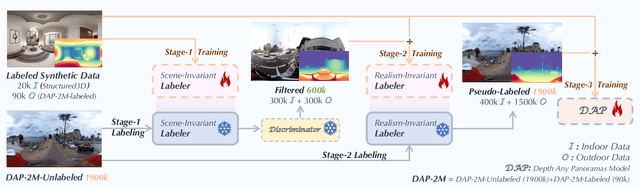
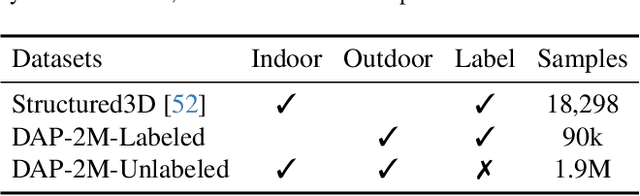
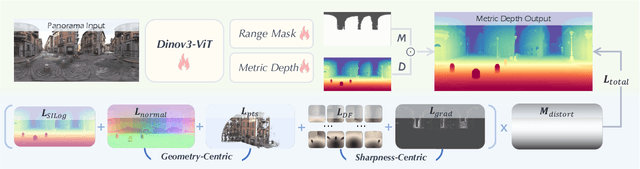
In this work, we present a panoramic metric depth foundation model that generalizes across diverse scene distances. We explore a data-in-the-loop paradigm from the view of both data construction and framework design. We collect a large-scale dataset by combining public datasets, high-quality synthetic data from our UE5 simulator and text-to-image models, and real panoramic images from the web. To reduce domain gaps between indoor/outdoor and synthetic/real data, we introduce a three-stage pseudo-label curation pipeline to generate reliable ground truth for unlabeled images. For the model, we adopt DINOv3-Large as the backbone for its strong pre-trained generalization, and introduce a plug-and-play range mask head, sharpness-centric optimization, and geometry-centric optimization to improve robustness to varying distances and enforce geometric consistency across views. Experiments on multiple benchmarks (e.g., Stanford2D3D, Matterport3D, and Deep360) demonstrate strong performance and zero-shot generalization, with particularly robust and stable metric predictions in diverse real-world scenes. The project page can be found at: \href{https://insta360-research-team.github.io/DAP_website/} {https://insta360-research-team.github.io/DAP\_website/}
Cultivating Game Sense for Yourself: Making VLMs Gaming Experts
Mar 27, 2025Developing agents capable of fluid gameplay in first/third-person games without API access remains a critical challenge in Artificial General Intelligence (AGI). Recent efforts leverage Vision Language Models (VLMs) as direct controllers, frequently pausing the game to analyze screens and plan action through language reasoning. However, this inefficient paradigm fundamentally restricts agents to basic and non-fluent interactions: relying on isolated VLM reasoning for each action makes it impossible to handle tasks requiring high reactivity (e.g., FPS shooting) or dynamic adaptability (e.g., ACT combat). To handle this, we propose a paradigm shift in gameplay agent design: instead of directly controlling gameplay, VLM develops specialized execution modules tailored for tasks like shooting and combat. These modules handle real-time game interactions, elevating VLM to a high-level developer. Building upon this paradigm, we introduce GameSense, a gameplay agent framework where VLM develops task-specific game sense modules by observing task execution and leveraging vision tools and neural network training pipelines. These modules encapsulate action-feedback logic, ranging from direct action rules to neural network-based decisions. Experiments demonstrate that our framework is the first to achieve fluent gameplay in diverse genres, including ACT, FPS, and Flappy Bird, setting a new benchmark for game-playing agents.
360VFI: A Dataset and Benchmark for Omnidirectional Video Frame Interpolation
Jul 19, 2024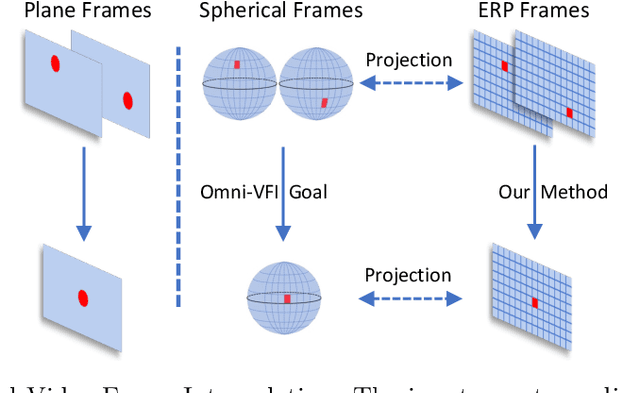


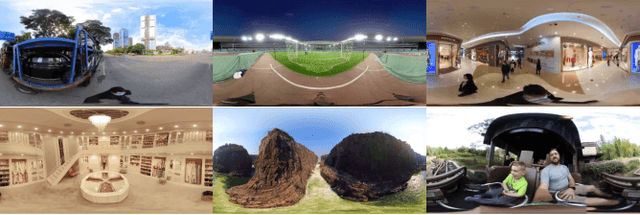
With the development of VR-related techniques, viewers can enjoy a realistic and immersive experience through a head-mounted display, while omnidirectional video with a low frame rate can lead to user dizziness. However, the prevailing plane frame interpolation methodologies are unsuitable for Omnidirectional Video Interpolation, chiefly due to the lack of models tailored to such videos with strong distortion, compounded by the scarcity of valuable datasets for Omnidirectional Video Frame Interpolation. In this paper, we introduce the benchmark dataset, 360VFI, for Omnidirectional Video Frame Interpolation. We present a practical implementation that introduces a distortion prior from omnidirectional video into the network to modulate distortions. We especially propose a pyramid distortion-sensitive feature extractor that uses the unique characteristics of equirectangular projection (ERP) format as prior information. Moreover, we devise a decoder that uses an affine transformation to facilitate the synthesis of intermediate frames further. 360VFI is the first dataset and benchmark that explores the challenge of Omnidirectional Video Frame Interpolation. Through our benchmark analysis, we presented four different distortion conditions scenes in the proposed 360VFI dataset to evaluate the challenge triggered by distortion during interpolation. Besides, experimental results demonstrate that Omnidirectional Video Interpolation can be effectively improved by modeling for omnidirectional distortion.