 Add to Chrome
 Add to Firefox
 Add to Edge
HiLoRA: Hierarchical Low-Rank Adaptation for Personalized Federated Learning
Mar 03, 2026
Vision Transformers (ViTs) have been widely adopted in vision tasks due to their strong transferability. In Federated Learning (FL), where full fine-tuning is communication heavy, Low-Rank Adaptation (LoRA) provides an efficient and communication-friendly way to adapt ViTs. However, existing LoRA-based federated tuning methods overlook latent client structures in real-world settings, limiting shared representation learning and hindering effective adaptation to unseen clients. To address this, we propose HiLoRA, a hierarchical LoRA framework that places adapters at three levels: root, cluster, and leaf, each designed to capture global, subgroup, and client-specific knowledge, respectively. Through cross-tier orthogonality and cascaded optimization, HiLoRA separates update subspaces and aligns each tier with its residual personalized objective. In particular, we develop a LoRA-Subspace Adaptive Clustering mechanism that infers latent client groups via subspace similarity analysis, thereby facilitating knowledge sharing across structurally aligned clients. Theoretically, we establish a tier-wise generalization analysis that supports HiLoRA's design. Experiments on ViT backbones with CIFAR-100 and DomainNet demonstrate consistent improvements in both personalization and generalization.

Serving Large Language Models on Huawei CloudMatrix384
Jun 15, 2025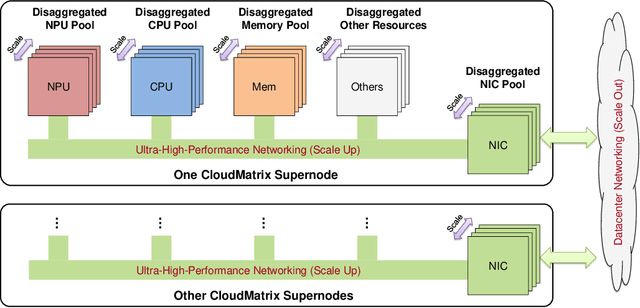
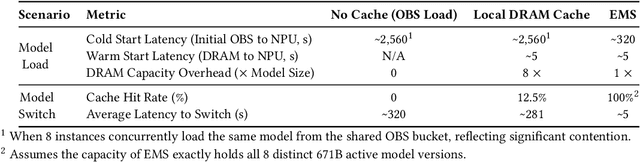
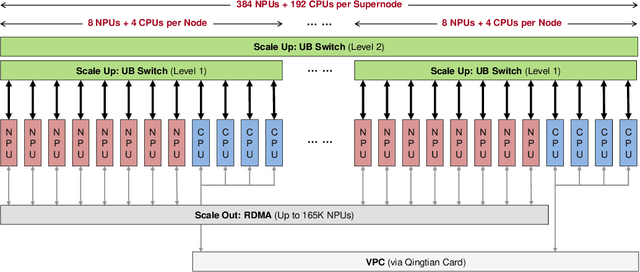
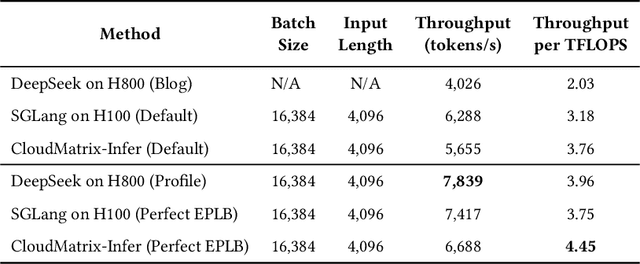
The rapid evolution of large language models (LLMs), driven by growing parameter scales, adoption of mixture-of-experts (MoE) architectures, and expanding context lengths, imposes unprecedented demands on AI infrastructure. Traditional AI clusters face limitations in compute intensity, memory bandwidth, inter-chip communication, and latency, compounded by variable workloads and strict service-level objectives. Addressing these issues requires fundamentally redesigned hardware-software integration. This paper introduces Huawei CloudMatrix, a next-generation AI datacenter architecture, realized in the production-grade CloudMatrix384 supernode. It integrates 384 Ascend 910C NPUs and 192 Kunpeng CPUs interconnected via an ultra-high-bandwidth Unified Bus (UB) network, enabling direct all-to-all communication and dynamic pooling of resources. These features optimize performance for communication-intensive operations, such as large-scale MoE expert parallelism and distributed key-value cache access. To fully leverage CloudMatrix384, we propose CloudMatrix-Infer, an advanced LLM serving solution incorporating three core innovations: a peer-to-peer serving architecture that independently scales prefill, decode, and caching; a large-scale expert parallelism strategy supporting EP320 via efficient UB-based token dispatch; and hardware-aware optimizations including specialized operators, microbatch-based pipelining, and INT8 quantization. Evaluation with the DeepSeek-R1 model shows CloudMatrix-Infer achieves state-of-the-art efficiency: prefill throughput of 6,688 tokens/s per NPU and decode throughput of 1,943 tokens/s per NPU (<50 ms TPOT). It effectively balances throughput and latency, sustaining 538 tokens/s even under stringent 15 ms latency constraints, while INT8 quantization maintains model accuracy across benchmarks.