 Add to Chrome
 Add to Firefox
 Add to Edge
Translating Signals to Languages for sEMG-Based Activity Recognition
May 21, 2026
Surface electromyography (sEMG) signal-based activity recognition has attracted increasing research attention in recent years. To develop accurate sEMG signal-based activity recognizers, numerous approaches have been proposed. Some studies focus on designing larger and more expressive model architectures to enhance the representational capacity of sEMG signals, while others aim to enrich model priors through large-scale pretraining, thereby improving recognition performance. Recently, large language models (LLMs) have shown remarkable generalization and reasoning capabilities in natural language processing, whose implicit knowledge, learned from extensive linguistic descriptions of actions, opens new possibilities for interpreting sEMG signals and inferring activity intentions. Motivated by this, we propose LLM-sEMG, a novel framework that leverages LLMs as sEMG activity recognizers. Within this framework, we design a language-oriented mapping mechanism that converts continuous sEMG sequences into sEMG language, integrating several strategies to further facilitate the signal-to-language mapping process. Extensive experiments demonstrate that the proposed framework achieves highly accurate sEMG signal-based activity recognition using large language models.

MicroscopyMatching: Towards a Ready-to-use Framework for Microscopy Image Analysis in Diverse Conditions
May 14, 2026Analyzing microscopy images to extract biological object properties (e.g., their morphological organization, temporal dynamics, and population density) is fundamental to various biomedical research. Yet conducting this manually is costly and time-consuming. Though deep learning-based approaches have been explored to automate this process, the substantial diversity of microscopy analysis settings in practice (including variations of biological object types, sample processing protocols, imaging equipment, and analysis tasks, etc.) often renders them ineffective. As a result, these approaches typically require extensive adaptation for different settings, which, however, can impose burdens that are often practically unsustainable for laboratories, forcing biomedical researchers to still commonly rely on manual analysis, thereby severely bottlenecking the pace of biomedical research progress. This situation has created a pressing and long-standing need for a reliable and broadly applicable microscopy image analysis tool, yet such a tool is still missing. To address this gap, we present the first ready-to-use microscopy image analysis framework, MicroscopyMatching, that can reliably perform key analysis tasks (including segmentation, tracking, and counting) across diverse microscopy analysis settings. From a fundamentally different perspective, MicroscopyMatching reformulates diverse microscopy image analysis tasks as a unified matching problem, effectively handling this problem by exploiting the robust matching capability from pre-trained latent diffusion models.
Is Monitoring Enough? Strategic Agent Selection For Stealthy Attack in Multi-Agent Discussions
Mar 22, 2026Multi-agent discussions have been widely adopted, motivating growing efforts to develop attacks that expose their vulnerabilities. In this work, we study a practical yet largely unexplored attack scenario, the discussion-monitored scenario, where anomaly detectors continuously monitor inter-agent communications and block detected adversarial messages. Although existing attacks are effective without discussion monitoring, we show that they exhibit detectable patterns and largely fail under such monitoring constraints. But does this imply that monitoring alone is sufficient to secure multi-agent discussions? To answer this question, we develop a novel attack method explicitly tailored to the discussion-monitored scenario. Extensive experiments demonstrate that effective attacks remain possible even under continuous monitoring, indicating that monitoring alone does not eliminate adversarial risks.
When Visual Privacy Protection Meets Multimodal Large Language Models
Mar 14, 2026The emergence of Multimodal Large Language Models (MLLMs) and the widespread usage of MLLM cloud services such as GPT-4V raised great concerns about privacy leakage in visual data. As these models are typically deployed in cloud services, users are required to submit their images and videos, posing serious privacy risks. However, how to tackle such privacy concerns is an under-explored problem. Thus, in this paper, we aim to conduct a new investigation to protect visual privacy when enjoying the convenience brought by MLLM services. We address the practical case where the MLLM is a "black box", i.e., we only have access to its input and output without knowing its internal model information. To tackle such a challenging yet demanding problem, we propose a novel framework, in which we carefully design the learning objective with Pareto optimality to seek a better trade-off between visual privacy and MLLM's performance, and propose critical-history enhanced optimization to effectively optimize the framework with the black-box MLLM. Our experiments show that our method is effective on different benchmarks.
Decentralized Autoregressive Generation
Jan 06, 2026We present a theoretical analysis of decentralization of autoregressive generation. We define the Decentralized Discrete Flow Matching objective, by expressing probability generating velocity as a linear combination of expert flows. We also conduct experiments demonstrating the equivalence between decentralized and centralized training settings for multimodal language models across diverse set of benchmarks. Specifically, we compare two distinct paradigms: LLaVA and InternVL 2.5-1B, which uses a fixed CLIP vision encoder and performs full-parameter fine-tuning (ViT+MLP+LLM) during the instruction tuning stage.
Learning to Generate Cross-Task Unexploitable Examples
Dec 15, 2025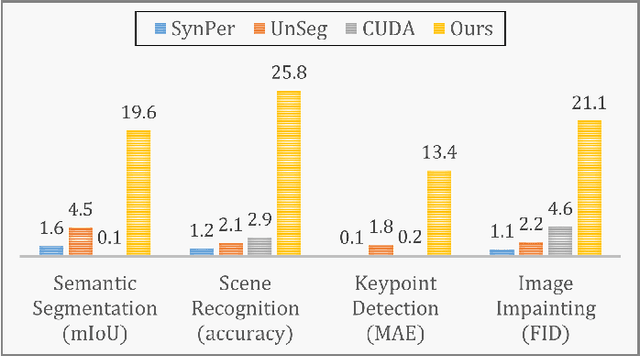
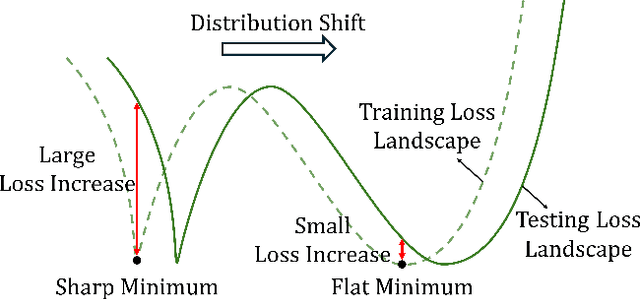
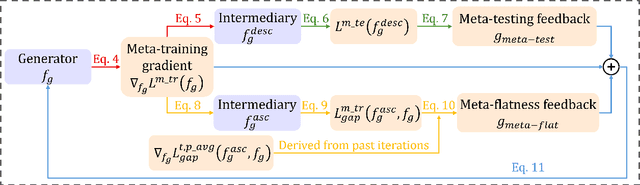
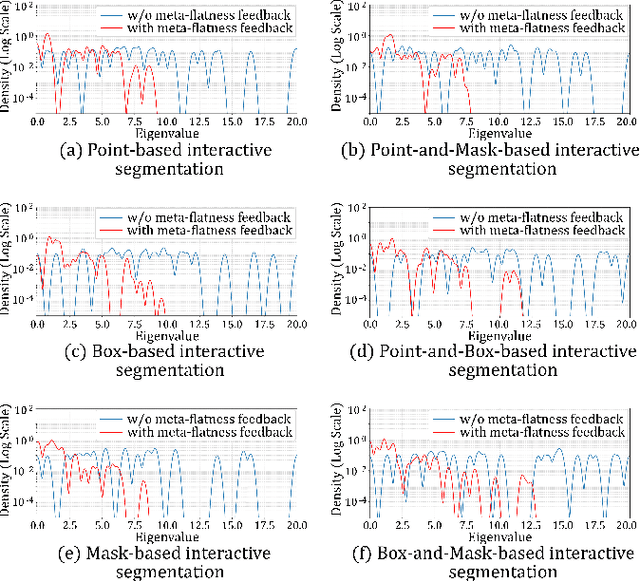
Unexploitable example generation aims to transform personal images into their unexploitable (unlearnable) versions before they are uploaded online, thereby preventing unauthorized exploitation of online personal images. Recently, this task has garnered significant research attention due to its critical relevance to personal data privacy. Yet, despite recent progress, existing methods for this task can still suffer from limited practical applicability, as they can fail to generate examples that are broadly unexploitable across different real-world computer vision tasks. To deal with this problem, in this work, we propose a novel Meta Cross-Task Unexploitable Example Generation (MCT-UEG) framework. At the core of our framework, to optimize the unexploitable example generator for effectively producing broadly unexploitable examples, we design a flat-minima-oriented meta training and testing scheme. Extensive experiments show the efficacy of our framework.
TSTMotion: Training-free Scene-aware Text-to-motion Generation
May 05, 2025
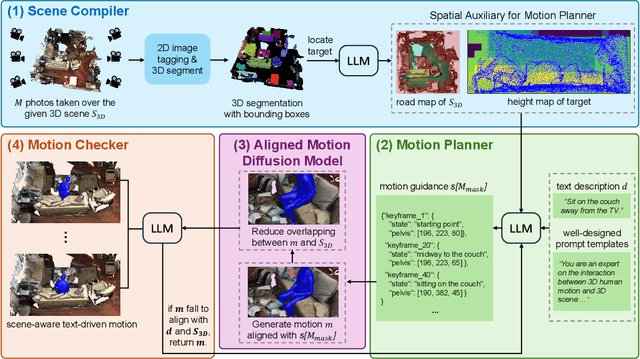
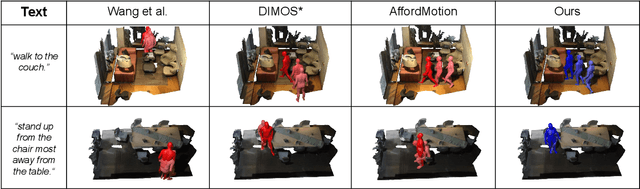

Text-to-motion generation has recently garnered significant research interest, primarily focusing on generating human motion sequences in blank backgrounds. However, human motions commonly occur within diverse 3D scenes, which has prompted exploration into scene-aware text-to-motion generation methods. Yet, existing scene-aware methods often rely on large-scale ground-truth motion sequences in diverse 3D scenes, which poses practical challenges due to the expensive cost. To mitigate this challenge, we are the first to propose a \textbf{T}raining-free \textbf{S}cene-aware \textbf{T}ext-to-\textbf{Motion} framework, dubbed as \textbf{TSTMotion}, that efficiently empowers pre-trained blank-background motion generators with the scene-aware capability. Specifically, conditioned on the given 3D scene and text description, we adopt foundation models together to reason, predict and validate a scene-aware motion guidance. Then, the motion guidance is incorporated into the blank-background motion generators with two modifications, resulting in scene-aware text-driven motion sequences. Extensive experiments demonstrate the efficacy and generalizability of our proposed framework. We release our code in \href{https://tstmotion.github.io/}{Project Page}.
CMMLoc: Advancing Text-to-PointCloud Localization with Cauchy-Mixture-Model Based Framework
Mar 05, 2025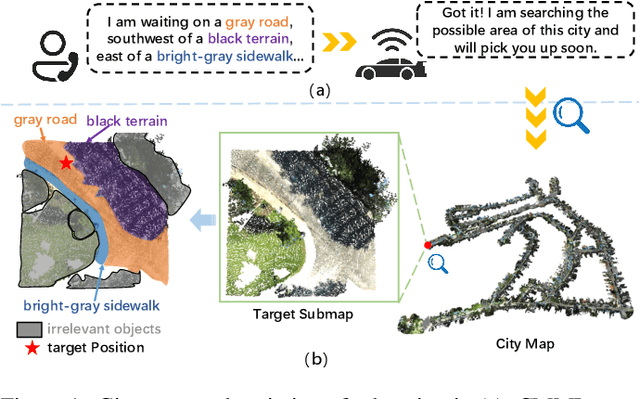
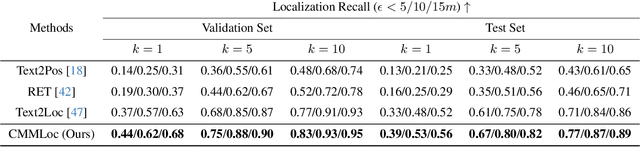
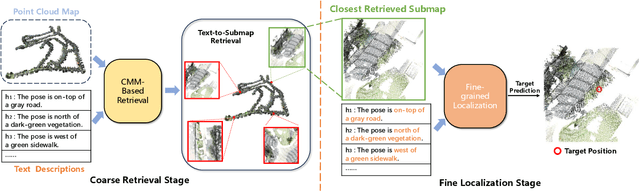
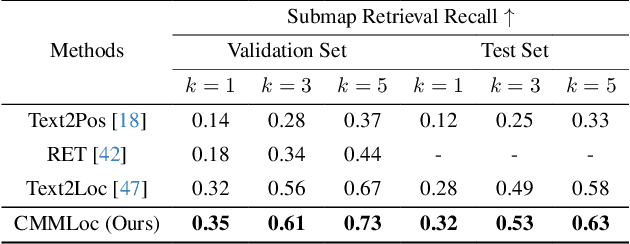
The goal of point cloud localization based on linguistic description is to identify a 3D position using textual description in large urban environments, which has potential applications in various fields, such as determining the location for vehicle pickup or goods delivery. Ideally, for a textual description and its corresponding 3D location, the objects around the 3D location should be fully described in the text description. However, in practical scenarios, e.g., vehicle pickup, passengers usually describe only the part of the most significant and nearby surroundings instead of the entire environment. In response to this $\textbf{partially relevant}$ challenge, we propose $\textbf{CMMLoc}$, an uncertainty-aware $\textbf{C}$auchy-$\textbf{M}$ixture-$\textbf{M}$odel ($\textbf{CMM}$) based framework for text-to-point-cloud $\textbf{Loc}$alization. To model the uncertain semantic relations between text and point cloud, we integrate CMM constraints as a prior during the interaction between the two modalities. We further design a spatial consolidation scheme to enable adaptive aggregation of different 3D objects with varying receptive fields. To achieve precise localization, we propose a cardinal direction integration module alongside a modality pre-alignment strategy, helping capture the spatial relationships among objects and bringing the 3D objects closer to the text modality. Comprehensive experiments validate that CMMLoc outperforms existing methods, achieving state-of-the-art results on the KITTI360Pose dataset. Codes are available in this GitHub repository https://github.com/kevin301342/CMMLoc.
HyLiFormer: Hyperbolic Linear Attention for Skeleton-based Human Action Recognition
Feb 09, 2025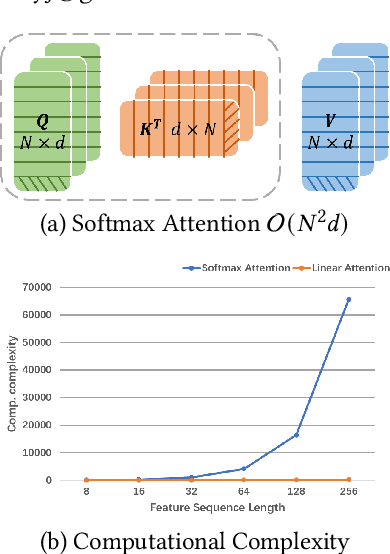
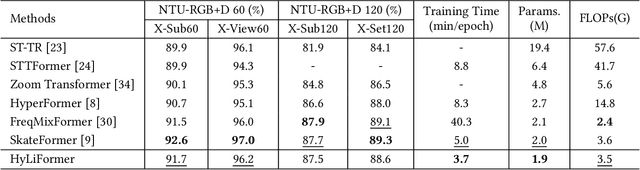


Transformers have demonstrated remarkable performance in skeleton-based human action recognition, yet their quadratic computational complexity remains a bottleneck for real-world applications. To mitigate this, linear attention mechanisms have been explored but struggle to capture the hierarchical structure of skeleton data. Meanwhile, the Poincar\'e model, as a typical hyperbolic geometry, offers a powerful framework for modeling hierarchical structures but lacks well-defined operations for existing mainstream linear attention. In this paper, we propose HyLiFormer, a novel hyperbolic linear attention Transformer tailored for skeleton-based action recognition. Our approach incorporates a Hyperbolic Transformation with Curvatures (HTC) module to map skeleton data into hyperbolic space and a Hyperbolic Linear Attention (HLA) module for efficient long-range dependency modeling. Theoretical analysis and extensive experiments on NTU RGB+D and NTU RGB+D 120 datasets demonstrate that HyLiFormer significantly reduces computational complexity while preserving model accuracy, making it a promising solution for efficiency-critical applications.
DisC-GS: Discontinuity-aware Gaussian Splatting
May 24, 2024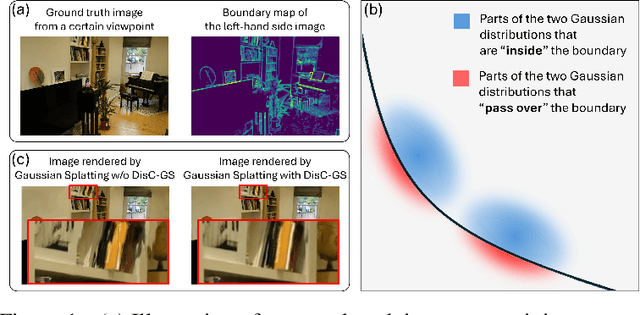
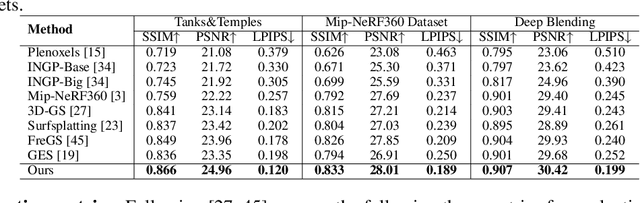

Recently, Gaussian Splatting, a method that represents a 3D scene as a collection of Gaussian distributions, has gained significant attention in addressing the task of novel view synthesis. In this paper, we highlight a fundamental limitation of Gaussian Splatting: its inability to accurately render discontinuities and boundaries in images due to the continuous nature of Gaussian distributions. To address this issue, we propose a novel framework enabling Gaussian Splatting to perform discontinuity-aware image rendering. Additionally, we introduce a B\'ezier-boundary gradient approximation strategy within our framework to keep the ``differentiability'' of the proposed discontinuity-aware rendering process. Extensive experiments demonstrate the efficacy of our framework.