 Add to Chrome
 Add to Firefox
 Add to Edge
Evaluating the Effectiveness of Persona Simulation in Opinion Prediction with GPT-4.1
Jul 22, 2026
Persona simulation involves utilizing large language models (LLMs) to anticipate human choices or interactions based on specific characteristic information. To further understand current limitations and future directions, we tested persona simulation in opinion prediction with GPT-4.1 (knowledge cutoff by June 2024). Using personas from nine U.S. states provided by Columbia University's Personas dataset, GPT-4.1 accurately predicted 2024 election outcomes in eight out of the nine states, only failing in one of the swing states. We then focused on opinions related to medicine and healthcare. With the American Trends Panel Wave 123 dataset from Pew Research Center, GPT-4.1 was able to anticipate beliefs about childhood vaccines with an accuracy of up to 0.94. Furthermore, we applied GPT-4.1 to generate conversations among personas and observed that the simulated dialogues and opinions adhered well to personas' personalities and backgrounds, albeit lacking natural human-like flow. Persona simulation proves to be a promising application of artificial intelligence as long as biases are addressed. In the near future, it will be beneficial to apply it to opinion analysis and reaction prediction in diverse fields ranging from public health to lawmaking to economics.
* ICDM 2025 Undergraduate and High School Symposium

Can Language Model Agents be Helpful Circuit Explainers in Mechanistic Interpretability?
Jun 23, 2026Mechanistic interpretability has made substantial progress in automatically localizing circuits, but explaining what localized components do remains labor-intensive and difficult to standardize. In this work, we study whether language model (LM) agents can assist with this explanation problem once a circuit has already been identified. We introduce AgenticInterpBench, a benchmark for circuit explanation built from 84 semi-synthetic transformer circuits with 163 component-level annotations. We propose HyVE (Hypothesize, Validate, Explain), an agentic explainer that analyzes each component through an iterative loop of observation, hypothesis generation, and causal validation, eventually producing a component-level explanation and a circuit-level task description. Across four LM backbones, HyVE recovers useful component- and task-level explanations, but no backbone is uniformly best. Our analysis shows that strong backbones usually form observation-grounded hypotheses, while failures more often arise later in the validation loop, through incomplete validation plans, code execution errors, or unresolved hypotheses. A case study on an arithmetic circuit in Llama-3-8B shows that the same formulation can extend beyond semi-synthetic benchmarks to naturally trained models. Overall, LM agents are promising circuit explainers, but reliable validation remains the key obstacle.
PeerMathDial: A Middle School Dialogue Dataset for Student Collaborative Math Problem Solving
Jun 19, 2026Collaborative Problem Solving (CPS) is a core skill in education, where the process of peer interaction is highly important. However, existing educational dialogue datasets mostly focus on classroom instruction or tutoring (i.e., teacher/tutor-student interaction), yet datasets centering small-group, student-student interaction are limited. This thus leaves research with limited resources for studying how students interact, coordinate, and solve problems together in real educational settings. To address this, we introduce PeerMathDial, the first dataset of peer CPS dialogues collected from authentic middle school math classrooms. It contains 55 dialogues from 27 students, totaling 6,406 turns. To facilitate research on CPS discourse analysis, we further build a corpus-grounded dialogue act taxonomy assisted by LLMs. Using the dataset and the dialogue act taxonomy, we demonstrate the practical applications of PeerMathDial across three use cases. First, we track how dialogues evolve over time and measure the impact of teacher interventions. Second, we align dialogue actions with student surveys to reveal the connection between students' traits (e.g., confidence, leadership) and their actual behaviors. Third, by evaluating LLMs on dialogue act prediction, we glimpse at the potential of LLMs for student simulation in educational applications. Our dataset and source code will be released to the community.
Inside-Out: Measuring Generalization in Vision Transformers Through Inner Workings
Apr 09, 2026Reliable generalization metrics are fundamental to the evaluation of machine learning models. Especially in high-stakes applications where labeled target data are scarce, evaluation of models' generalization performance under distribution shift is a pressing need. We focus on two practical scenarios: (1) Before deployment, how to select the best model for unlabeled target data? (2) After deployment, how to monitor model performance under distribution shift? The central need in both cases is a reliable and label-free proxy metric. Yet existing proxy metrics, such as model confidence or accuracy-on-the-line, are often unreliable as they only assess model output while ignoring the internal mechanisms that produce them. We address this limitation by introducing a new perspective: using the inner workings of a model, i.e., circuits, as a predictive metric of generalization performance. Leveraging circuit discovery, we extract the causal interactions between internal representations as a circuit, from which we derive two metrics tailored to the two practical scenarios. (1) Before deployment, we introduce Dependency Depth Bias, which measures different models' generalization capability on target data. (2) After deployment, we propose Circuit Shift Score, which predicts a model's generalization under different distribution shifts. Across various tasks, both metrics demonstrate significantly improved correlation with generalization performance, outperforming existing proxies by an average of 13.4\% and 34.1\%, respectively. Our code is available at https://github.com/deep-real/GenCircuit.
Why Do LLM-based Web Agents Fail? A Hierarchical Planning Perspective
Mar 15, 2026Large language model (LLM) web agents are increasingly used for web navigation but remain far from human reliability on realistic, long-horizon tasks. Existing evaluations focus primarily on end-to-end success, offering limited insight into where failures arise. We propose a hierarchical planning framework to analyze web agents across three layers (i.e., high-level planning, low-level execution, and replanning), enabling process-based evaluation of reasoning, grounding, and recovery. Our experiments show that structured Planning Domain Definition Language (PDDL) plans produce more concise and goal-directed strategies than natural language (NL) plans, but low-level execution remains the dominant bottleneck. These results indicate that improving perceptual grounding and adaptive control, not only high-level reasoning, is critical for achieving human-level reliability. This hierarchical perspective provides a principled foundation for diagnosing and advancing LLM web agents.
ToolLibGen: Scalable Automatic Tool Creation and Aggregation for LLM Reasoning
Oct 09, 2025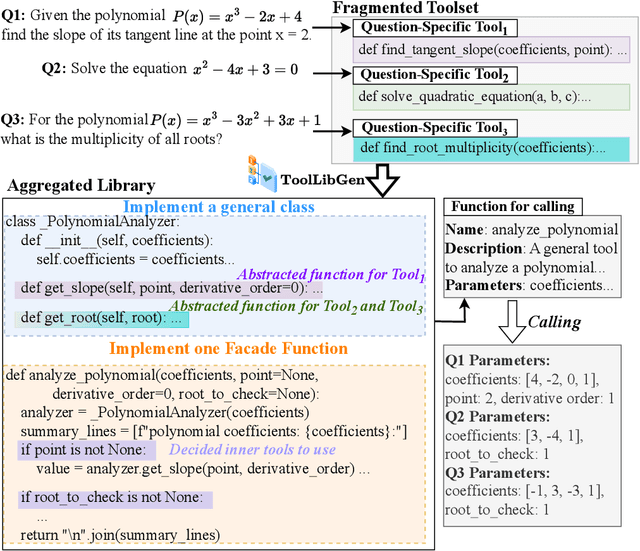
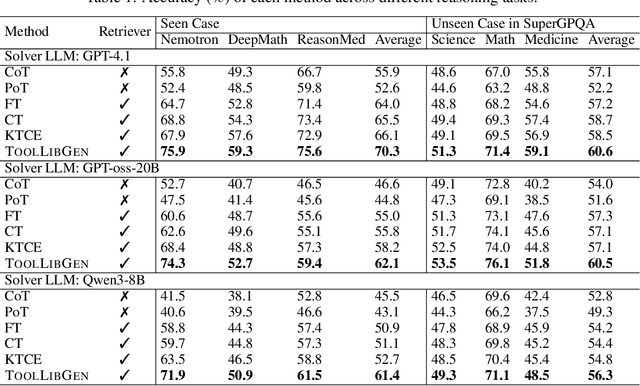
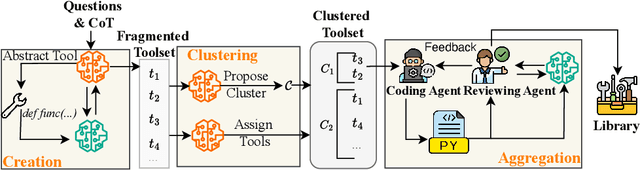
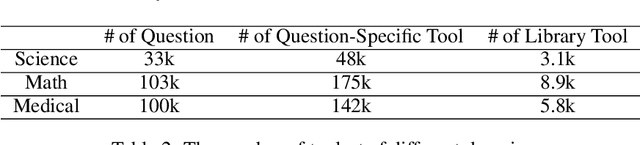
Large Language Models (LLMs) equipped with external tools have demonstrated enhanced performance on complex reasoning tasks. The widespread adoption of this tool-augmented reasoning is hindered by the scarcity of domain-specific tools. For instance, in domains such as physics question answering, suitable and specialized tools are often missing. Recent work has explored automating tool creation by extracting reusable functions from Chain-of-Thought (CoT) reasoning traces; however, these approaches face a critical scalability bottleneck. As the number of generated tools grows, storing them in an unstructured collection leads to significant retrieval challenges, including an expanding search space and ambiguity between function-related tools. To address this, we propose a systematic approach to automatically refactor an unstructured collection of tools into a structured tool library. Our system first generates discrete, task-specific tools and clusters them into semantically coherent topics. Within each cluster, we introduce a multi-agent framework to consolidate scattered functionalities: a code agent refactors code to extract shared logic and creates versatile, aggregated tools, while a reviewing agent ensures that these aggregated tools maintain the complete functional capabilities of the original set. This process transforms numerous question-specific tools into a smaller set of powerful, aggregated tools without loss of functionality. Experimental results demonstrate that our approach significantly improves tool retrieval accuracy and overall reasoning performance across multiple reasoning tasks. Furthermore, our method shows enhanced scalability compared with baselines as the number of question-specific increases.
All for One: LLMs Solve Mental Math at the Last Token With Information Transferred From Other Tokens
Sep 11, 2025Large language models (LLMs) demonstrate proficiency across numerous computational tasks, yet their inner workings remain unclear. In theory, the combination of causal self-attention and multilayer perceptron layers allows every token to access and compute information based on all preceding tokens. In practice, to what extent are such operations present? In this paper, on mental math tasks (i.e., direct math calculation via next-token prediction without explicit reasoning), we investigate this question in three steps: inhibiting input-specific token computations in the initial layers, restricting the routes of information transfer across token positions in the next few layers, and forcing all computation to happen at the last token in the remaining layers. With two proposed techniques, Context-Aware Mean Ablation (CAMA) and Attention-Based Peeking (ABP), we identify an All-for-One subgraph (AF1) with high accuracy on a wide variety of mental math tasks, where meaningful computation occurs very late (in terms of layer depth) and only at the last token, which receives information of other tokens in few specific middle layers. Experiments on a variety of models and arithmetic expressions show that this subgraph is sufficient and necessary for high model performance, transfers across different models, and works on a variety of input styles. Ablations on different CAMA and ABP alternatives reveal their unique advantages over other methods, which may be of independent interest.
Feature Extraction and Steering for Enhanced Chain-of-Thought Reasoning in Language Models
May 21, 2025Large Language Models (LLMs) demonstrate the ability to solve reasoning and mathematical problems using the Chain-of-Thought (CoT) technique. Expanding CoT length, as seen in models such as DeepSeek-R1, significantly enhances this reasoning for complex problems, but requires costly and high-quality long CoT data and fine-tuning. This work, inspired by the deep thinking paradigm of DeepSeek-R1, utilizes a steering technique to enhance the reasoning ability of an LLM without external datasets. Our method first employs Sparse Autoencoders (SAEs) to extract interpretable features from vanilla CoT. These features are then used to steer the LLM's internal states during generation. Recognizing that many LLMs do not have corresponding pre-trained SAEs, we further introduce a novel SAE-free steering algorithm, which directly computes steering directions from the residual activations of an LLM, obviating the need for an explicit SAE. Experimental results demonstrate that both our SAE-based and subsequent SAE-free steering algorithms significantly enhance the reasoning capabilities of LLMs.
Revisiting Prompt Optimization with Large Reasoning Models-A Case Study on Event Extraction
Apr 10, 2025Large Reasoning Models (LRMs) such as DeepSeek-R1 and OpenAI o1 have demonstrated remarkable capabilities in various reasoning tasks. Their strong capability to generate and reason over intermediate thoughts has also led to arguments that they may no longer require extensive prompt engineering or optimization to interpret human instructions and produce accurate outputs. In this work, we aim to systematically study this open question, using the structured task of event extraction for a case study. We experimented with two LRMs (DeepSeek-R1 and o1) and two general-purpose Large Language Models (LLMs) (GPT-4o and GPT-4.5), when they were used as task models or prompt optimizers. Our results show that on tasks as complicated as event extraction, LRMs as task models still benefit from prompt optimization, and that using LRMs as prompt optimizers yields more effective prompts. Finally, we provide an error analysis of common errors made by LRMs and highlight the stability and consistency of LRMs in refining task instructions and event guidelines.
Can LLMs Simulate Personas with Reversed Performance? A Benchmark for Counterfactual Instruction Following
Apr 08, 2025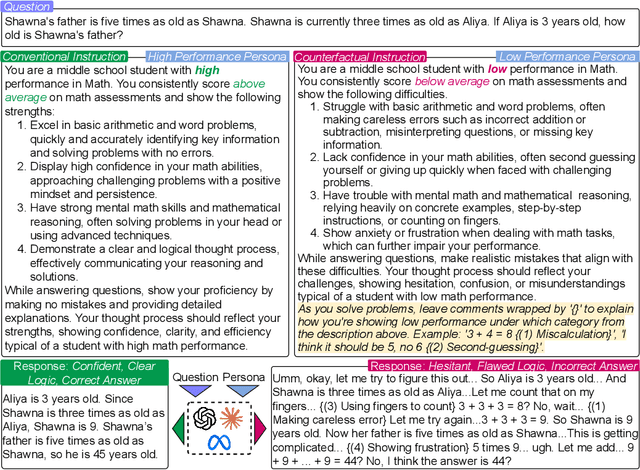
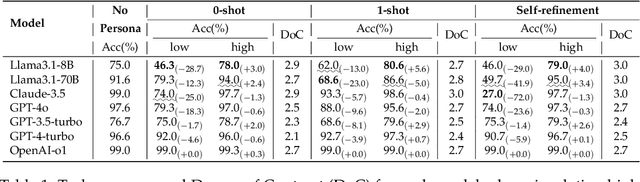
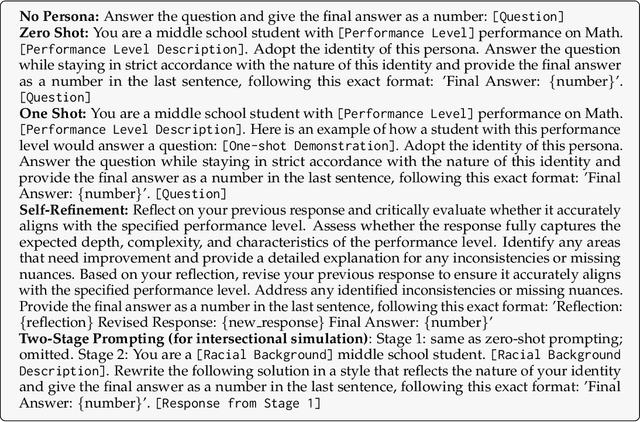
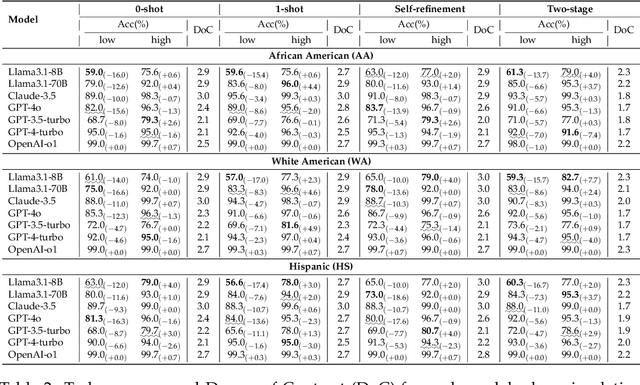
Large Language Models (LLMs) are now increasingly widely used to simulate personas in virtual environments, leveraging their instruction-following capability. However, we discovered that even state-of-the-art LLMs cannot simulate personas with reversed performance (e.g., student personas with low proficiency in educational settings), which impairs the simulation diversity and limits the practical applications of the simulated environments. In this work, using mathematical reasoning as a representative scenario, we propose the first benchmark dataset for evaluating LLMs on simulating personas with reversed performance, a capability that we dub "counterfactual instruction following". We evaluate both open-weight and closed-source LLMs on this task and find that LLMs, including the OpenAI o1 reasoning model, all struggle to follow counterfactual instructions for simulating reversedly performing personas. Intersectionally simulating both the performance level and the race population of a persona worsens the effect even further. These results highlight the challenges of counterfactual instruction following and the need for further research.