 Add to Chrome
 Add to Firefox
 Add to Edge
RMTransformer: Accurate Radio Map Construction and Coverage Prediction
Jan 11, 2025



Radio map, or pathloss map prediction, is a crucial method for wireless network modeling and management. By leveraging deep learning to construct pathloss patterns from geographical maps, an accurate digital replica of the transmission environment could be established with less computational overhead and lower prediction error compared to traditional model-driven techniques. While existing state-of-the-art (SOTA) methods predominantly rely on convolutional architectures, this paper introduces a hybrid transformer-convolution model, termed RMTransformer, to enhance the accuracy of radio map prediction. The proposed model features a multi-scale transformer-based encoder for efficient feature extraction and a convolution-based decoder for precise pixel-level image reconstruction. Simulation results demonstrate that the proposed scheme significantly improves prediction accuracy, and over a 30% reduction in root mean square error (RMSE) is achieved compared to typical SOTA approaches.

MinMo: A Multimodal Large Language Model for Seamless Voice Interaction
Jan 10, 2025


Recent advancements in large language models (LLMs) and multimodal speech-text models have laid the groundwork for seamless voice interactions, enabling real-time, natural, and human-like conversations. Previous models for voice interactions are categorized as native and aligned. Native models integrate speech and text processing in one framework but struggle with issues like differing sequence lengths and insufficient pre-training. Aligned models maintain text LLM capabilities but are often limited by small datasets and a narrow focus on speech tasks. In this work, we introduce MinMo, a Multimodal Large Language Model with approximately 8B parameters for seamless voice interaction. We address the main limitations of prior aligned multimodal models. We train MinMo through multiple stages of speech-to-text alignment, text-to-speech alignment, speech-to-speech alignment, and duplex interaction alignment, on 1.4 million hours of diverse speech data and a broad range of speech tasks. After the multi-stage training, MinMo achieves state-of-the-art performance across various benchmarks for voice comprehension and generation while maintaining the capabilities of text LLMs, and also facilitates full-duplex conversation, that is, simultaneous two-way communication between the user and the system. Moreover, we propose a novel and simple voice decoder that outperforms prior models in voice generation. The enhanced instruction-following capabilities of MinMo supports controlling speech generation based on user instructions, with various nuances including emotions, dialects, and speaking rates, and mimicking specific voices. For MinMo, the speech-to-text latency is approximately 100ms, full-duplex latency is approximately 600ms in theory and 800ms in practice. The MinMo project web page is https://funaudiollm.github.io/minmo, and the code and models will be released soon.
RadioTransformer: Accurate Radio Map Construction and Coverage Prediction
Jan 09, 2025Radio map, or pathloss map prediction, is a crucial method for wireless network modeling and management. By leveraging deep learning to construct pathloss patterns from geographical maps, an accurate digital replica of the transmission environment could be established with less computational overhead and lower prediction error compared to traditional model-driven techniques. While existing state-of-the-art (SOTA) methods predominantly rely on convolutional architectures, this paper introduces a hybrid transformer-convolution model, termed RadioTransformer, to enhance the accuracy of radio map prediction. The proposed model features a multi-scale transformer-based encoder for efficient feature extraction and a convolution-based decoder for precise pixel-level image reconstruction. Simulation results demonstrate that the proposed scheme significantly improves prediction accuracy, and over a 30% reduction in root mean square error (RMSE) is achieved compared to typical SOTA approaches.
LeviTor: 3D Trajectory Oriented Image-to-Video Synthesis
Dec 19, 2024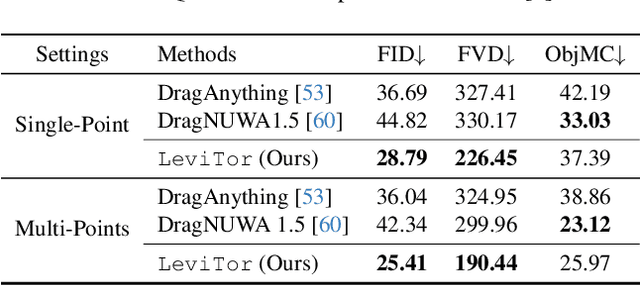
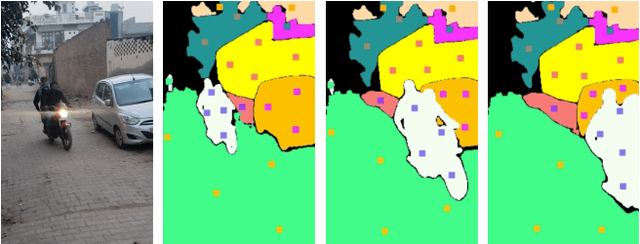
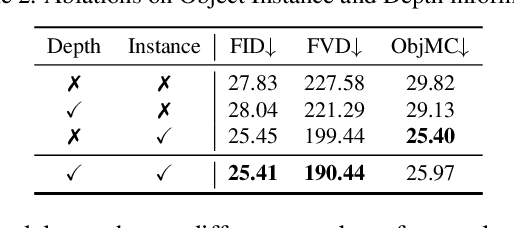
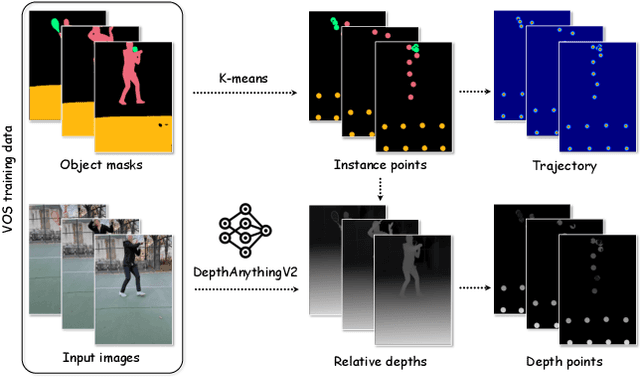
The intuitive nature of drag-based interaction has led to its growing adoption for controlling object trajectories in image-to-video synthesis. Still, existing methods that perform dragging in the 2D space usually face ambiguity when handling out-of-plane movements. In this work, we augment the interaction with a new dimension, i.e., the depth dimension, such that users are allowed to assign a relative depth for each point on the trajectory. That way, our new interaction paradigm not only inherits the convenience from 2D dragging, but facilitates trajectory control in the 3D space, broadening the scope of creativity. We propose a pioneering method for 3D trajectory control in image-to-video synthesis by abstracting object masks into a few cluster points. These points, accompanied by the depth information and the instance information, are finally fed into a video diffusion model as the control signal. Extensive experiments validate the effectiveness of our approach, dubbed LeviTor, in precisely manipulating the object movements when producing photo-realistic videos from static images. Project page: https://ppetrichor.github.io/levitor.github.io/
AniDoc: Animation Creation Made Easier
Dec 18, 2024The production of 2D animation follows an industry-standard workflow, encompassing four essential stages: character design, keyframe animation, in-betweening, and coloring. Our research focuses on reducing the labor costs in the above process by harnessing the potential of increasingly powerful generative AI. Using video diffusion models as the foundation, AniDoc emerges as a video line art colorization tool, which automatically converts sketch sequences into colored animations following the reference character specification. Our model exploits correspondence matching as an explicit guidance, yielding strong robustness to the variations (e.g., posture) between the reference character and each line art frame. In addition, our model could even automate the in-betweening process, such that users can easily create a temporally consistent animation by simply providing a character image as well as the start and end sketches. Our code is available at: https://yihao-meng.github.io/AniDoc_demo.
CosyVoice 2: Scalable Streaming Speech Synthesis with Large Language Models
Dec 13, 2024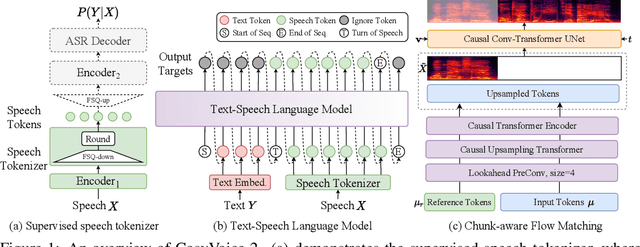
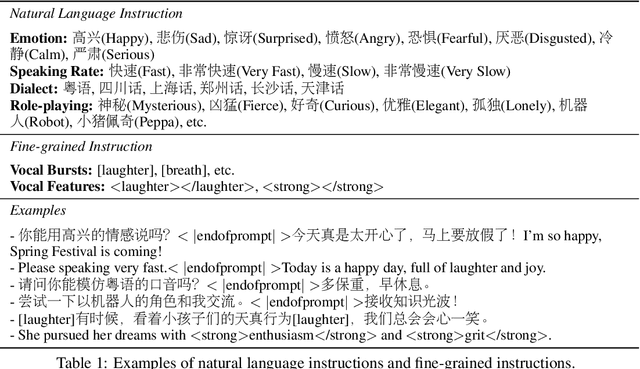
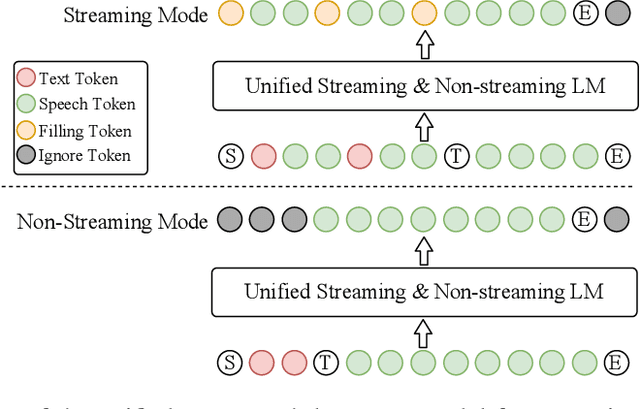
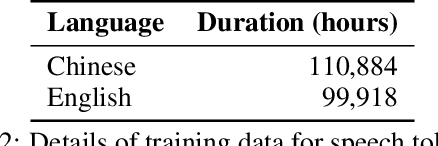
In our previous work, we introduced CosyVoice, a multilingual speech synthesis model based on supervised discrete speech tokens. By employing progressive semantic decoding with two popular generative models, language models (LMs) and Flow Matching, CosyVoice demonstrated high prosody naturalness, content consistency, and speaker similarity in speech in-context learning. Recently, significant progress has been made in multi-modal large language models (LLMs), where the response latency and real-time factor of speech synthesis play a crucial role in the interactive experience. Therefore, in this report, we present an improved streaming speech synthesis model, CosyVoice 2, which incorporates comprehensive and systematic optimizations. Specifically, we introduce finite-scalar quantization to improve the codebook utilization of speech tokens. For the text-speech LM, we streamline the model architecture to allow direct use of a pre-trained LLM as the backbone. In addition, we develop a chunk-aware causal flow matching model to support various synthesis scenarios, enabling both streaming and non-streaming synthesis within a single model. By training on a large-scale multilingual dataset, CosyVoice 2 achieves human-parity naturalness, minimal response latency, and virtually lossless synthesis quality in the streaming mode. We invite readers to listen to the demos at https://funaudiollm.github.io/cosyvoice2.
Multi-Functional RIS Integrated Sensing and Communications for 6G Networks
Dec 02, 2024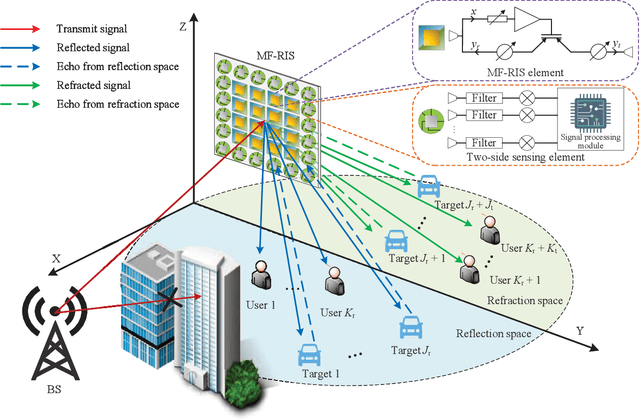
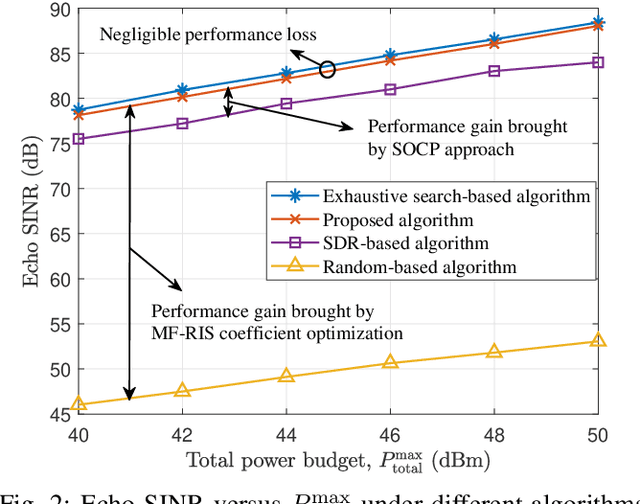
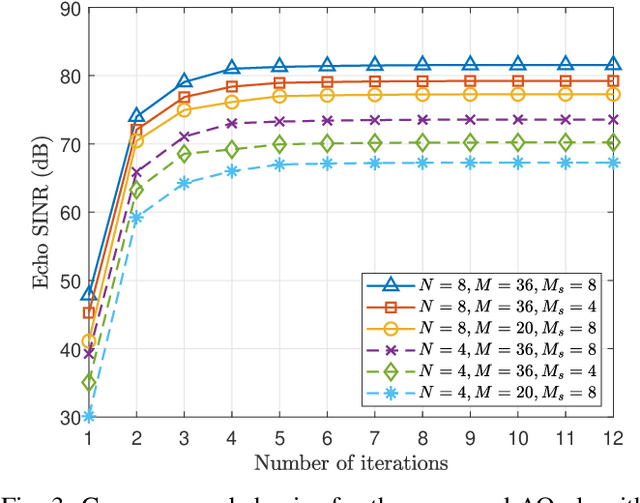
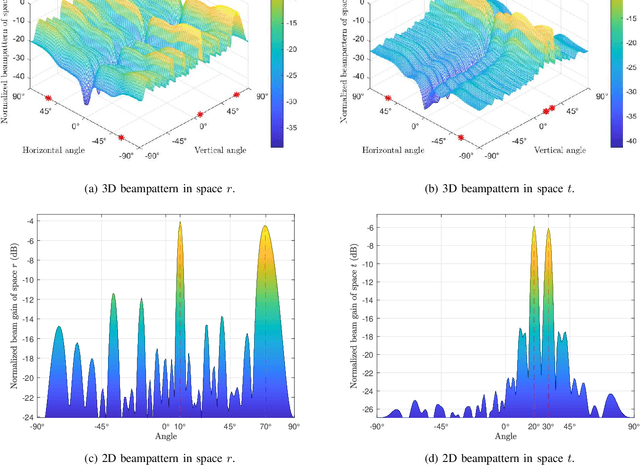
In this paper, we propose a novel multi-functional reconfigurable intelligent surface (MF-RIS) that supports signal reflection, refraction, amplification, and target sensing simultaneously. Our MF-RIS aims to enhance integrated communication and sensing (ISAC) systems, particularly in multi-user and multi-target scenarios. Equipped with reflection and refraction components (i.e., amplifiers and phase shifters), MF-RIS is able to adjust the amplitude and phase shift of both communication and sensing signals on demand. Additionally, with the assistance of sensing elements, MF-RIS is capable of capturing the echo signals from multiple targets, thereby mitigating the signal attenuation typically associated with multi-hop links. We propose a MF-RIS-enabled multi-user and multi-target ISAC system, and formulate an optimization problem to maximize the signal-to-interference-plus-noise ratio (SINR) of sensing targets. This problem involves jointly optimizing the transmit beamforming and MF-RIS configurations, subject to constraints on the communication rate, total power budget, and MF-RIS coefficients. We decompose the formulated non-convex problem into three sub-problems, and then solve them via an efficient iterative algorithm. Simulation results demonstrate that: 1) The performance of MF-RIS varies under different operating protocols, and energy splitting (ES) exhibits the best performance in the considered MF-RIS-enabled multi-user multi-target ISAC system; 2) Under the same total power budget, the proposed MF-RIS with ES protocol attains 52.2%, 73.5% and 60.86% sensing SINR gains over active RIS, passive RIS, and simultaneously transmitting and reflecting RIS (STAR-RIS), respectively; 3) The number of sensing elements will no longer improve sensing performance after exceeding a certain number.
MovieBench: A Hierarchical Movie Level Dataset for Long Video Generation
Nov 22, 2024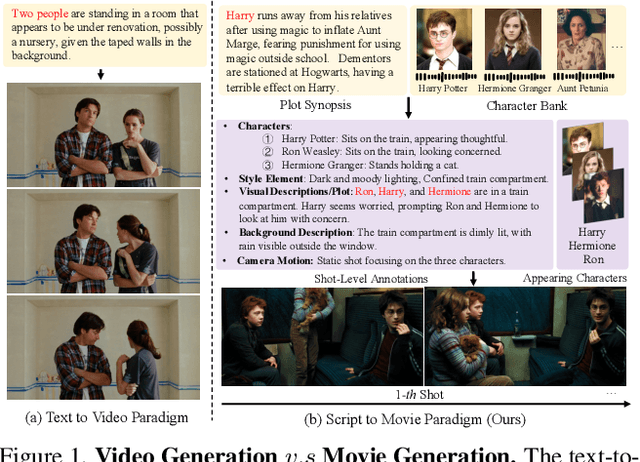


Recent advancements in video generation models, like Stable Video Diffusion, show promising results, but primarily focus on short, single-scene videos. These models struggle with generating long videos that involve multiple scenes, coherent narratives, and consistent characters. Furthermore, there is no publicly available dataset tailored for the analysis, evaluation, and training of long video generation models. In this paper, we present MovieBench: A Hierarchical Movie-Level Dataset for Long Video Generation, which addresses these challenges by providing unique contributions: (1) movie-length videos featuring rich, coherent storylines and multi-scene narratives, (2) consistency of character appearance and audio across scenes, and (3) hierarchical data structure contains high-level movie information and detailed shot-level descriptions. Experiments demonstrate that MovieBench brings some new insights and challenges, such as maintaining character ID consistency across multiple scenes for various characters. The dataset will be public and continuously maintained, aiming to advance the field of long video generation. Data can be found at: https://weijiawu.github.io/MovieBench/.
SEAGULL: No-reference Image Quality Assessment for Regions of Interest via Vision-Language Instruction Tuning
Nov 15, 2024

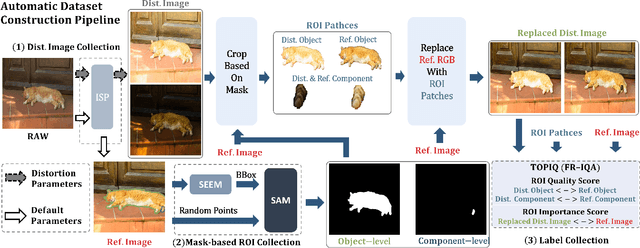
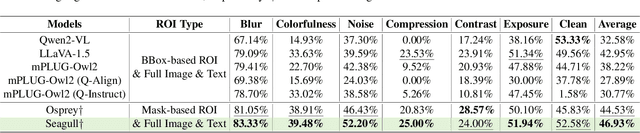
Existing Image Quality Assessment (IQA) methods achieve remarkable success in analyzing quality for overall image, but few works explore quality analysis for Regions of Interest (ROIs). The quality analysis of ROIs can provide fine-grained guidance for image quality improvement and is crucial for scenarios focusing on region-level quality. This paper proposes a novel network, SEAGULL, which can SEe and Assess ROIs quality with GUidance from a Large vision-Language model. SEAGULL incorporates a vision-language model (VLM), masks generated by Segment Anything Model (SAM) to specify ROIs, and a meticulously designed Mask-based Feature Extractor (MFE) to extract global and local tokens for specified ROIs, enabling accurate fine-grained IQA for ROIs. Moreover, this paper constructs two ROI-based IQA datasets, SEAGULL-100w and SEAGULL-3k, for training and evaluating ROI-based IQA. SEAGULL-100w comprises about 100w synthetic distortion images with 33 million ROIs for pre-training to improve the model's ability of regional quality perception, and SEAGULL-3k contains about 3k authentic distortion ROIs to enhance the model's ability to perceive real world distortions. After pre-training on SEAGULL-100w and fine-tuning on SEAGULL-3k, SEAGULL shows remarkable performance on fine-grained ROI quality assessment. Code and datasets are publicly available at the https://github.com/chencn2020/Seagull.
MagicQuill: An Intelligent Interactive Image Editing System
Nov 14, 2024Image editing involves a variety of complex tasks and requires efficient and precise manipulation techniques. In this paper, we present MagicQuill, an integrated image editing system that enables swift actualization of creative ideas. Our system features a streamlined yet functionally robust interface, allowing for the articulation of editing operations (e.g., inserting elements, erasing objects, altering color) with minimal input. These interactions are monitored by a multimodal large language model (MLLM) to anticipate editing intentions in real time, bypassing the need for explicit prompt entry. Finally, we apply a powerful diffusion prior, enhanced by a carefully learned two-branch plug-in module, to process editing requests with precise control. Experimental results demonstrate the effectiveness of MagicQuill in achieving high-quality image edits. Please visit https://magic-quill.github.io to try out our system.