 Add to Chrome
 Add to Firefox
 Add to Edge
Beyond Content Relevance: Evaluating Instruction Following in Retrieval Models
Oct 31, 2024
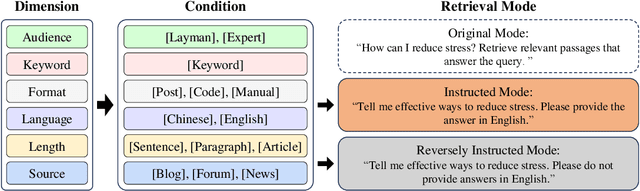
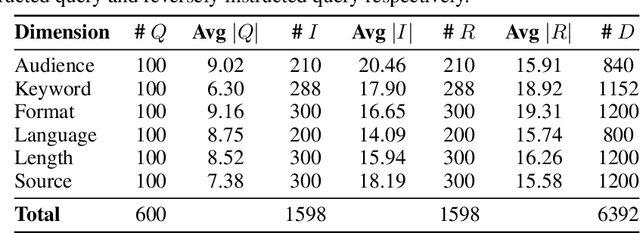
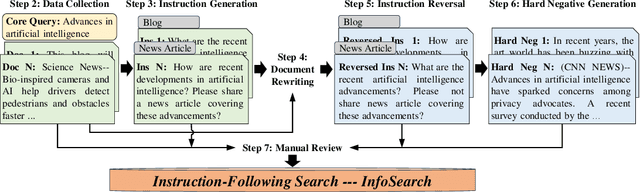
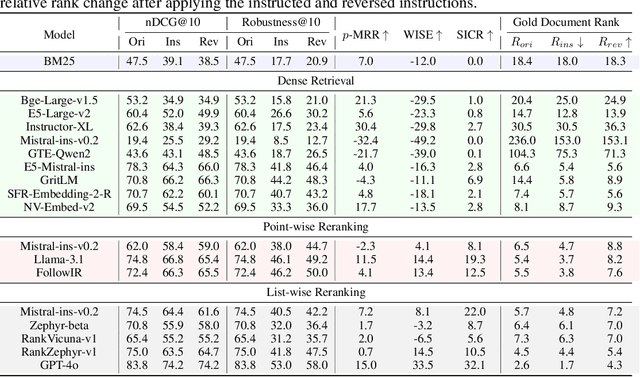
Instruction-following capabilities in large language models (LLMs) have significantly progressed, enabling more complex user interactions through detailed prompts. However, retrieval systems have not matched these advances, most of them still relies on traditional lexical and semantic matching techniques that fail to fully capture user intent. Recent efforts have introduced instruction-aware retrieval models, but these primarily focus on intrinsic content relevance, which neglects the importance of customized preferences for broader document-level attributes. This study evaluates the instruction-following capabilities of various retrieval models beyond content relevance, including LLM-based dense retrieval and reranking models. We develop InfoSearch, a novel retrieval evaluation benchmark spanning six document-level attributes: Audience, Keyword, Format, Language, Length, and Source, and introduce novel metrics -- Strict Instruction Compliance Ratio (SICR) and Weighted Instruction Sensitivity Evaluation (WISE) to accurately assess the models' responsiveness to instructions. Our findings reveal that while reranking models generally surpass retrieval models in instruction following, they still face challenges in handling certain attributes. Moreover, although instruction fine-tuning and increased model size lead to better performance, most models fall short of achieving comprehensive instruction compliance as assessed by our benchmark.

Integration of Communication and Computational Imaging
Oct 29, 2024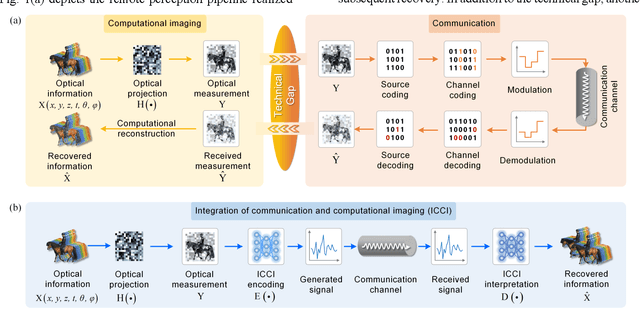
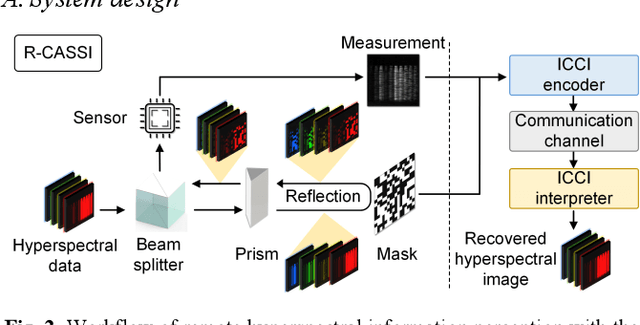
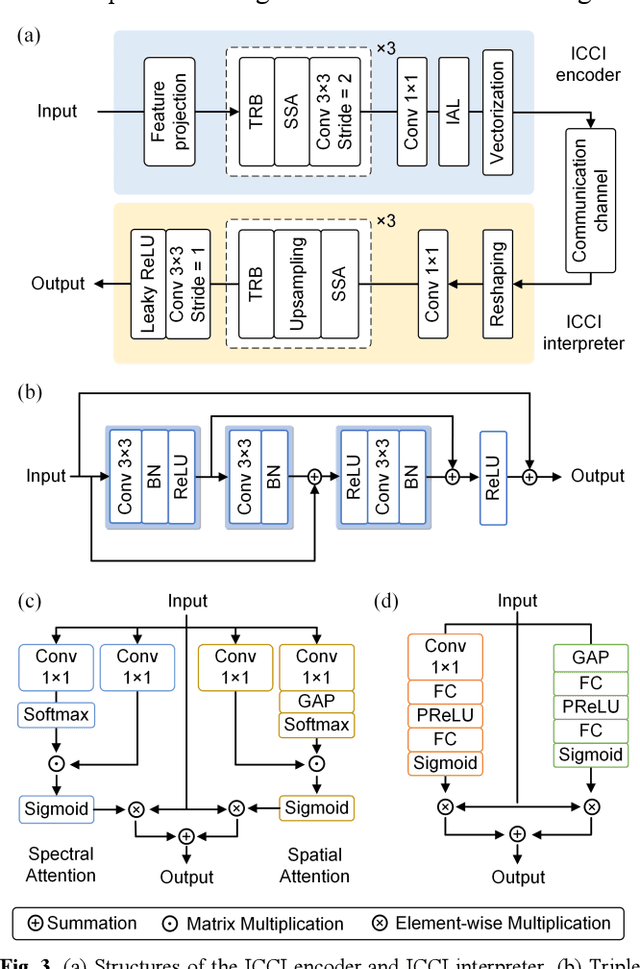
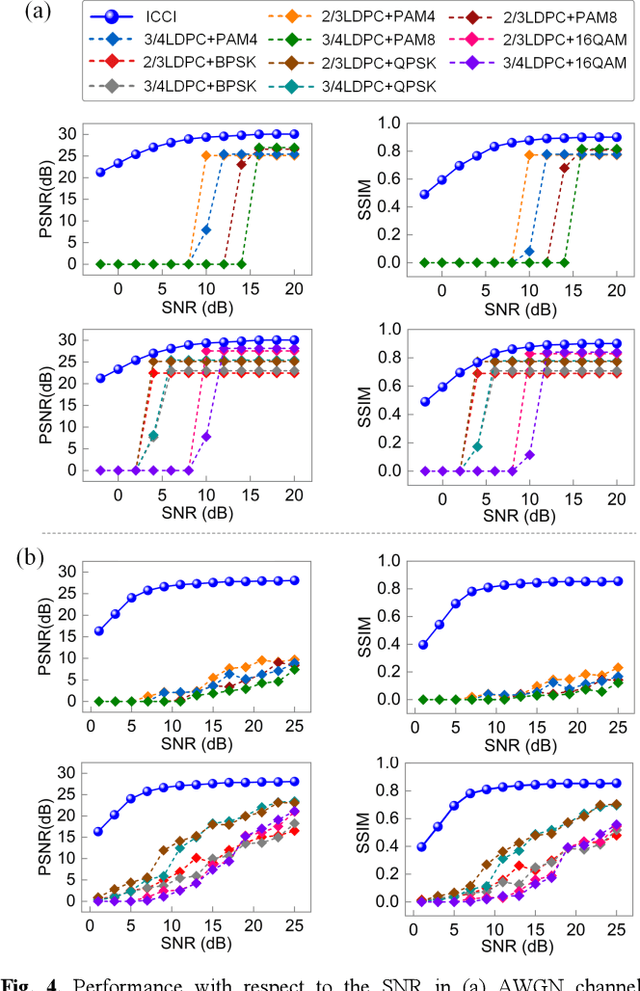
Communication enables the expansion of human visual perception beyond the limitations of time and distance, while computational imaging overcomes the constraints of depth and breadth. Although impressive achievements have been witnessed with the two types of technologies, the occlusive information flow between the two domains is a bottleneck hindering their ulterior progression. Herein, we propose a novel framework that integrates communication and computational imaging (ICCI) to break through the inherent isolation between communication and computational imaging for remote perception. By jointly considering the sensing and transmitting of remote visual information, the ICCI framework performs a full-link information transfer optimization, aiming to minimize information loss from the generation of the information source to the execution of the final vision tasks. We conduct numerical analysis and experiments to demonstrate the ICCI framework by integrating communication systems and snapshot compressive imaging systems. Compared with straightforward combination schemes, which sequentially execute sensing and transmitting, the ICCI scheme shows greater robustness against channel noise and impairments while achieving higher data compression. Moreover, an 80 km 27-band hyperspectral video perception with a rate of 30 fps is experimentally achieved. This new ICCI remote perception paradigm offers a highefficiency solution for various real-time computer vision tasks.
CLAP. I. Resolving miscalibration for deep learning-based galaxy photometric redshift estimation
Oct 25, 2024


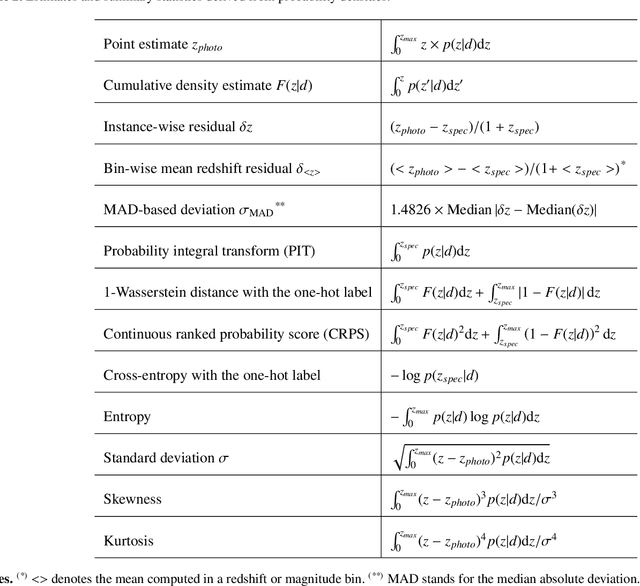
Obtaining well-calibrated photometric redshift probability densities for galaxies without a spectroscopic measurement remains a challenge. Deep learning discriminative models, typically fed with multi-band galaxy images, can produce outputs that mimic probability densities and achieve state-of-the-art accuracy. However, such models may be affected by miscalibration that would result in discrepancies between the model outputs and the actual distributions of true redshifts. Our work develops a novel method called the Contrastive Learning and Adaptive KNN for Photometric Redshift (CLAP) that resolves this issue. It leverages supervised contrastive learning (SCL) and k-nearest neighbours (KNN) to construct and calibrate raw probability density estimates, and implements a refitting procedure to resume end-to-end discriminative models ready to produce final estimates for large-scale imaging data. The harmonic mean is adopted to combine an ensemble of estimates from multiple realisations for improving accuracy. Our experiments demonstrate that CLAP takes advantage of both deep learning and KNN, outperforming benchmark methods on the calibration of probability density estimates and retaining high accuracy and computational efficiency. With reference to CLAP, we point out that miscalibration is particularly sensitive to the method-induced excessive correlations among data instances in addition to the unaccounted-for epistemic uncertainties. Reducing the uncertainties may not guarantee the removal of miscalibration due to the presence of such excessive correlations, yet this is a problem for conventional deep learning methods rather than CLAP. These discussions underscore the robustness of CLAP for obtaining photometric redshift probability densities required by astrophysical and cosmological applications. This is the first paper in our series on CLAP.
Calibrating Deep Neural Network using Euclidean Distance
Oct 23, 2024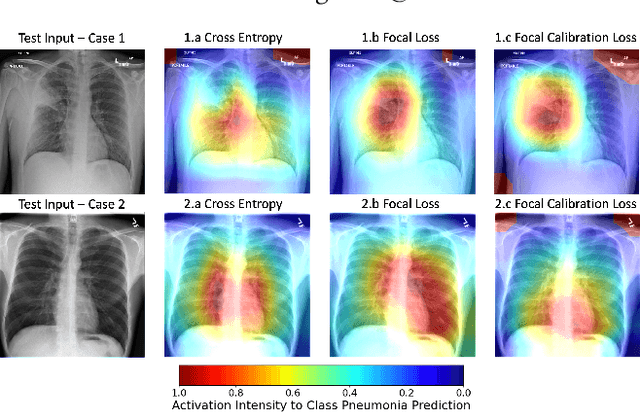
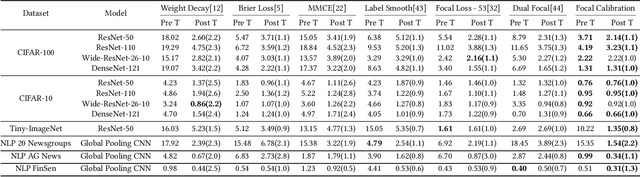

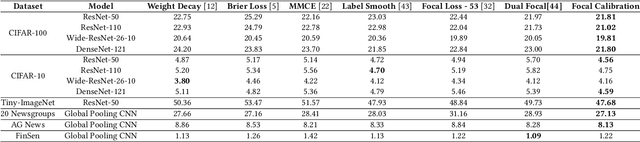
Uncertainty is a fundamental aspect of real-world scenarios, where perfect information is rarely available. Humans naturally develop complex internal models to navigate incomplete data and effectively respond to unforeseen or partially observed events. In machine learning, Focal Loss is commonly used to reduce misclassification rates by emphasizing hard-to-classify samples. However, it does not guarantee well-calibrated predicted probabilities and may result in models that are overconfident or underconfident. High calibration error indicates a misalignment between predicted probabilities and actual outcomes, affecting model reliability. This research introduces a novel loss function called Focal Calibration Loss (FCL), designed to improve probability calibration while retaining the advantages of Focal Loss in handling difficult samples. By minimizing the Euclidean norm through a strictly proper loss, FCL penalizes the instance-wise calibration error and constrains bounds. We provide theoretical validation for proposed method and apply it to calibrate CheXNet for potential deployment in web-based health-care systems. Extensive evaluations on various models and datasets demonstrate that our method achieves SOTA performance in both calibration and accuracy metrics.
Corrected Soft Actor Critic for Continuous Control
Oct 22, 2024
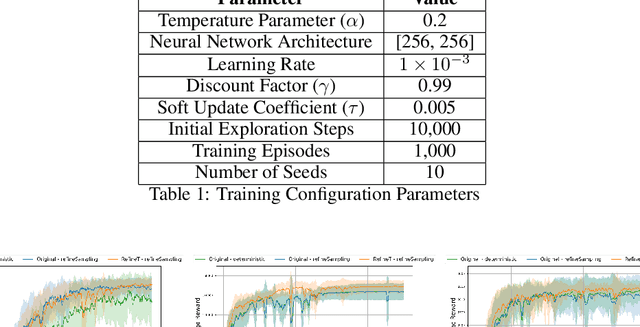


The Soft Actor-Critic (SAC) algorithm is known for its stability and high sample efficiency in deep reinforcement learning. However, the tanh transformation applied to sampled actions in SAC distorts the action distribution, hindering the selection of the most probable actions. This paper presents a novel action sampling method that directly identifies and selects the most probable actions within the transformed distribution, thereby addressing this issue. Extensive experiments on standard continuous control benchmarks demonstrate that the proposed method significantly enhances SAC's performance, resulting in faster convergence and higher cumulative rewards compared to the original algorithm.
MAC Revivo: Artificial Intelligence Paves the Way
Oct 21, 2024


The vast adoption of Wi-Fi and/or Bluetooth capabilities in Internet of Things (IoT) devices, along with the rapid growth of deployed smart devices, has caused significant interference and congestion in the industrial, scientific, and medical (ISM) bands. Traditional Wi-Fi Medium Access Control (MAC) design faces significant challenges in managing increasingly complex wireless environments while ensuring network Quality of Service (QoS) performance. This paper explores the potential integration of advanced Artificial Intelligence (AI) methods into the design of Wi-Fi MAC protocols. We propose AI-MAC, an innovative approach that employs machine learning algorithms to dynamically adapt to changing network conditions, optimize channel access, mitigate interference, and ensure deterministic latency. By intelligently predicting and managing interference, AI-MAC aims to provide a robust solution for next generation of Wi-Fi networks, enabling seamless connectivity and enhanced QoS. Our experimental results demonstrate that AI-MAC significantly reduces both interference and latency, paving the way for more reliable and efficient wireless communications in the increasingly crowded ISM band.
Real-time Stereo-based 3D Object Detection for Streaming Perception
Oct 16, 2024


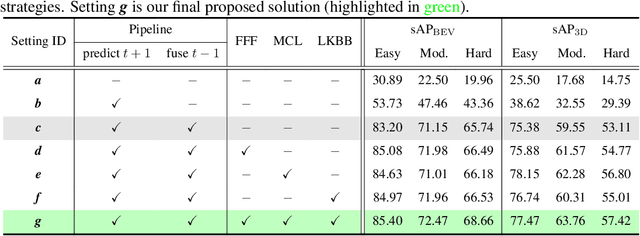
The ability to promptly respond to environmental changes is crucial for the perception system of autonomous driving. Recently, a new task called streaming perception was proposed. It jointly evaluate the latency and accuracy into a single metric for video online perception. In this work, we introduce StreamDSGN, the first real-time stereo-based 3D object detection framework designed for streaming perception. StreamDSGN is an end-to-end framework that directly predicts the 3D properties of objects in the next moment by leveraging historical information, thereby alleviating the accuracy degradation of streaming perception. Further, StreamDSGN applies three strategies to enhance the perception accuracy: (1) A feature-flow-based fusion method, which generates a pseudo-next feature at the current moment to address the misalignment issue between feature and ground truth. (2) An extra regression loss for explicit supervision of object motion consistency in consecutive frames. (3) A large kernel backbone with a large receptive field for effectively capturing long-range spatial contextual features caused by changes in object positions. Experiments on the KITTI Tracking dataset show that, compared with the strong baseline, StreamDSGN significantly improves the streaming average precision by up to 4.33%. Our code is available at https://github.com/weiyangdaren/streamDSGN-pytorch.
Dual-AEB: Synergizing Rule-Based and Multimodal Large Language Models for Effective Emergency Braking
Oct 11, 2024

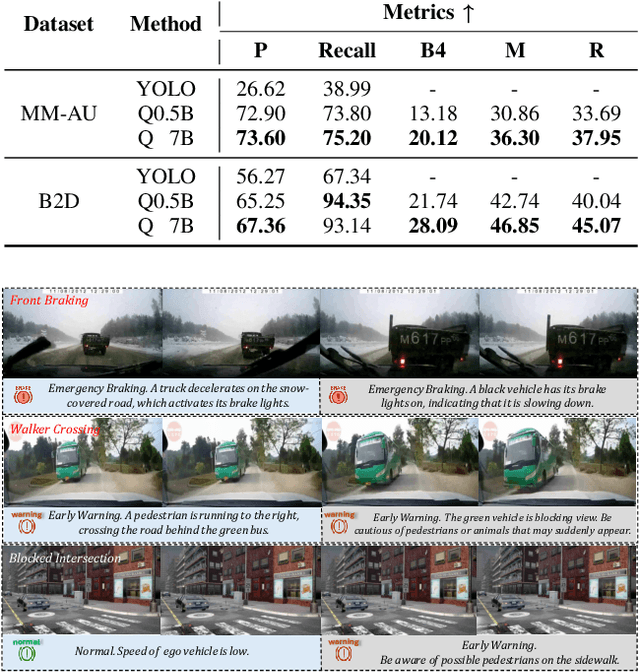

Automatic Emergency Braking (AEB) systems are a crucial component in ensuring the safety of passengers in autonomous vehicles. Conventional AEB systems primarily rely on closed-set perception modules to recognize traffic conditions and assess collision risks. To enhance the adaptability of AEB systems in open scenarios, we propose Dual-AEB, a system combines an advanced multimodal large language model (MLLM) for comprehensive scene understanding and a conventional rule-based rapid AEB to ensure quick response times. To the best of our knowledge, Dual-AEB is the first method to incorporate MLLMs within AEB systems. Through extensive experimentation, we have validated the effectiveness of our method. The source code will be available at https://github.com/ChipsICU/Dual-AEB.
ERCache: An Efficient and Reliable Caching Framework for Large-Scale User Representations in Meta's Ads System
Oct 09, 2024


The increasing complexity of deep learning models used for calculating user representations presents significant challenges, particularly with limited computational resources and strict service-level agreements (SLAs). Previous research efforts have focused on optimizing model inference but have overlooked a critical question: is it necessary to perform user model inference for every ad request in large-scale social networks? To address this question and these challenges, we first analyze user access patterns at Meta and find that most user model inferences occur within a short timeframe. T his observation reveals a triangular relationship among model complexity, embedding freshness, and service SLAs. Building on this insight, we designed, implemented, and evaluated ERCache, an efficient and robust caching framework for large-scale user representations in ads recommendation systems on social networks. ERCache categorizes cache into direct and failover types and applies customized settings and eviction policies for each model, effectively balancing model complexity, embedding freshness, and service SLAs, even considering the staleness introduced by caching. ERCache has been deployed at Meta for over six months, supporting more than 30 ranking models while efficiently conserving computational resources and complying with service SLA requirements.
The Accuracy Paradox in RLHF: When Better Reward Models Don't Yield Better Language Models
Oct 09, 2024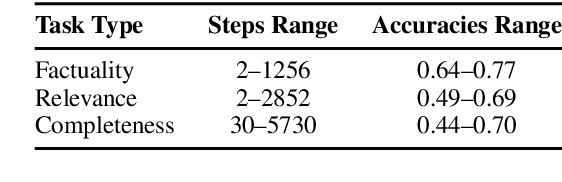
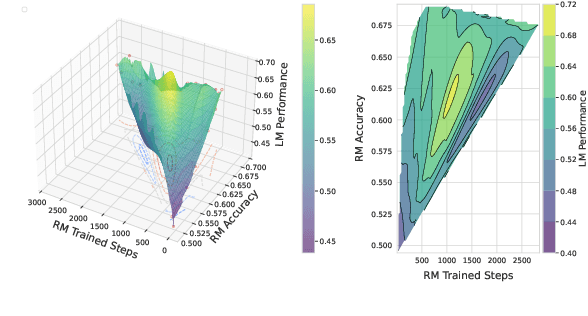
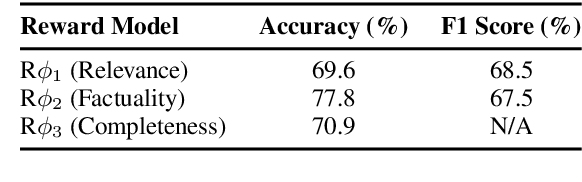
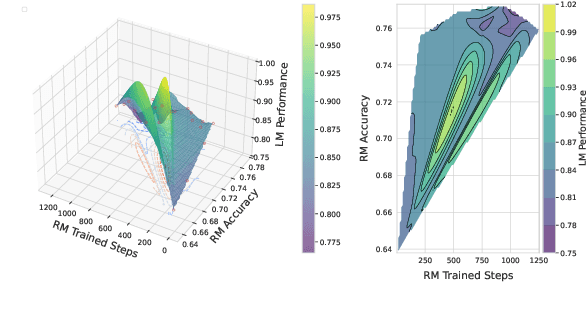
Reinforcement Learning from Human Feedback significantly enhances Natural Language Processing by aligning language models with human expectations. A critical factor in this alignment is the strength of reward models used during training. This study explores whether stronger reward models invariably lead to better language models. In this paper, through experiments on relevance, factuality, and completeness tasks using the QA-FEEDBACK dataset and reward models based on Longformer, we uncover a surprising paradox: language models trained with moderately accurate reward models outperform those guided by highly accurate ones. This challenges the widely held belief that stronger reward models always lead to better language models, and opens up new avenues for future research into the key factors driving model performance and how to choose the most suitable reward models. Code and additional details are available at [https://github.com/EIT-NLP/AccuracyParadox-RLHF](https://github.com/EIT-NLP/AccuracyParadox-RLHF).