 Add to Chrome
 Add to Firefox
 Add to Edge
PolicyTrim: Boosting Intrinsic Policy Efficiency of Vision-Language-Action Models
Jun 25, 2026
Vision-Language-Action (VLA) models provide a unified paradigm for robotic manipulation, yet their real-world deployment is often bottlenecked by execution efficiency. While existing efforts predominantly focus on compute-centric efficiency to reduce per-step inference latency, the intrinsic \textbf{policy efficiency} of these models remains largely unexplored. Policy efficiency is fundamentally affected by two factors, namely the effective executable length of predicted action chunks and the total physical steps required to complete a task. These two factors jointly determine the total number of forward inference calls during execution. We observe that current VLA policies struggle with planning unreliability and action redundancy, suffering from severe prediction degradation at the tail of action chunks and tending to generate unnecessarily redundant physical steps. To address this, we propose \textbf{PolicyTrim}, a reinforcement learning-based post-training framework that extends the reliable action chunk length and reduces redundant physical steps. For reliable chunk extension, we employ a dynamic exploration strategy that explicitly rewards the successful completion of longer executable lengths, progressively pushing the trustworthy prediction horizon to its empirical limit. For step efficiency, we design a redundancy-aware reward that directly favors successful task completions with fewer steps while penalizing unreproducible shortcuts, effectively eliminating redundant physical actions. Extensive experiments across three benchmarks and three VLA models demonstrate that PolicyTrim improves action chunk utilization by 3$\times$ and reduces physical execution steps by 51.4\%. Ultimately, our framework delivers up to a 5.83$\times$ end-to-end deployment speedup without compromising task success rates.

FlashNav: Ultra-Fast Policy Training for Robot Navigation within 20 Seconds
Jun 14, 2026Deep reinforcement learning has shown strong potential for robot navigation, but its practical deployment is still limited by the long wall-clock cost of policy training. This paper presents FlashNav, a GPU-first framework for ultra-fast range-based robot navigation training. To the best of our knowledge, FlashNav is the first DRL-based robot navigation framework that reaches seconds-level policy training, with the fastest deployable policy trained in less than 20 seconds. The key idea is to align simulation with the navigation MDP: FlashNav preserves the essential components for velocity-level navigation, including occupancy geometry, range sensing, goal-conditioned control, robot motion dynamics, collision handling, termination, and reset, while removing unnecessary rendering and high-fidelity physical details from the training loop. Built on a batched bitmap simulator and a fully GPU-resident training pipeline with our FastDSAC learner, FlashNav generates massive parallel navigation transitions entirely on GPU. Experiments on TurtleBot2 and Unitree Go2 show that FlashNav achieves a 100\% success-rate below 20 seconds on an RTX 5090 and remains within tens of seconds across desktop GPUs. The learned policies further transfer to physical wheeled and legged robots in static and dynamic indoor scenes, demonstrating that DRL-based navigation can be trained at seconds-level speed while preserving deployable obstacle-avoidance behavior.
Dynamic Execution Commitment of Vision-Language-Action Models
May 12, 2026Vision-Language-Action (VLA) models predominantly adopt action chunking, i.e., predicting and committing to a short horizon of consecutive low-level actions in a single forward pass, to amortize the inference cost of large-scale backbones and reduce per-step latency. However, committing these multi-step predictions to real-world execution requires balancing success rate against inference efficiency, a decision typically governed by fixed execution horizons tuned per task. Such heuristics ignore the state-dependent nature of predictive reliability, leading to brittle performance in dynamic or out-of-distribution settings. In this paper, we introduce A3, an Adaptive Action Acceptance mechanism that reframes dynamic execution commitment as a self-speculative prefix verification problem. A3 first computes a trajectory-wise consensus score of actions via group sampling, then selects a representative draft and prioritizes downstream verification. Specifically, it enforces: (1) consensus-ordered conditional invariance, which validates low-consensus actions by judging whether they remain consistent when re-decoded conditioned on high-consensus actions; and (2) prefix-closed sequential consistency, which guarantees physical rollout integrity by accepting only the longest continuous sequence of verified actions starting from the beginning. Consequently, the execution horizon emerges as the longest verifiable prefix satisfying both internal model logic and sequential execution constraints. Experiments across diverse VLA models and benchmarks demonstrate that A3 eliminates the need for manual horizon tuning while achieving a superior trade-off between execution robustness and inference throughput.
Do We Really Need Immediate Resets? Rethinking Collision Handling for Efficient Robot Navigation
May 04, 2026Should a single collision necessarily terminate an entire navigation episode? In most deep reinforcement learning (DRL) frameworks for robot navigation, this remains the standard practice: every collision immediately triggers a global environment reset and is penalized as a complete task failure. While a collision during deployment naturally indicates task failure, applying the same treatment during training prevents the agent from exploring challenging obstacle configurations, which slows learning progress in the early training phase. In this work, we challenge this convention and propose a Multi-Collision reset Budget (MCB) framework that decouples local collision termination from global environment resets, allowing the agent to retry difficult configurations within the same episode. Experiments on multiple simulated and real-world robotic platforms show that the framework accelerates early-stage exploration and improves both success rate and navigation efficiency over conventional single-collision reset baselines, with a small collision budget producing the largest gains.
Learning from Demonstration with Failure Awareness for Safe Robot Navigation
Apr 25, 2026Learning from demonstration is widely used for robot navigation, yet it suffers from a fundamental limitation: demonstrations consist predominantly of successful behaviors and provide limited coverage of unsafe states. This limitation leads to poor safety when the robot encounters scenarios beyond the demonstration distribution. Failure experiences, such as collisions, contain essential information about unsafe regions, but remain underutilized. The key difficulty lies in the fact that failure data do not provide valid guidance for action imitation, and their naive incorporation into policy learning often degrades performance. We address this challenge by proposing a failure-aware learning framework that explicitly decouples the roles of success and failure data. In this framework, failure experiences are used to shape value estimation in hazardous regions, while policy learning is restricted to successful demonstrations. This separation enables the effective use of failure data without corrupting policy behavior. We implement this design within an offline reinforcement learning (RL) setting and evaluate it in both simulation and real-world environments. The results show that our framework consistently reduces collision rates while preserving the task success rate, and demonstrate strong generalization across different environments and robot platforms.
MA-ROESL: Motion-aware Rapid Reward Optimization for Efficient Robot Skill Learning from Single Videos
May 13, 2025Vision-language models (VLMs) have demonstrated excellent high-level planning capabilities, enabling locomotion skill learning from video demonstrations without the need for meticulous human-level reward design. However, the improper frame sampling method and low training efficiency of current methods remain a critical bottleneck, resulting in substantial computational overhead and time costs. To address this limitation, we propose Motion-aware Rapid Reward Optimization for Efficient Robot Skill Learning from Single Videos (MA-ROESL). MA-ROESL integrates a motion-aware frame selection method to implicitly enhance the quality of VLM-generated reward functions. It further employs a hybrid three-phase training pipeline that improves training efficiency via rapid reward optimization and derives the final policy through online fine-tuning. Experimental results demonstrate that MA-ROESL significantly enhances training efficiency while faithfully reproducing locomotion skills in both simulated and real-world settings, thereby underscoring its potential as a robust and scalable framework for efficient robot locomotion skill learning from video demonstrations.
Enhancing Deep Reinforcement Learning-based Robot Navigation Generalization through Scenario Augmentation
Mar 03, 2025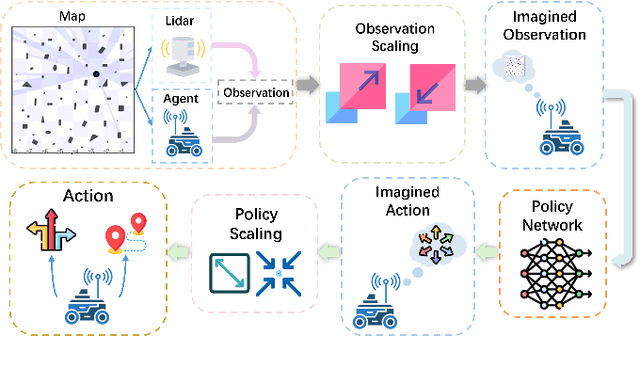
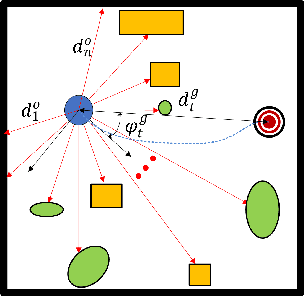
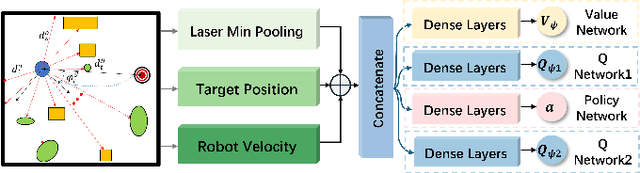
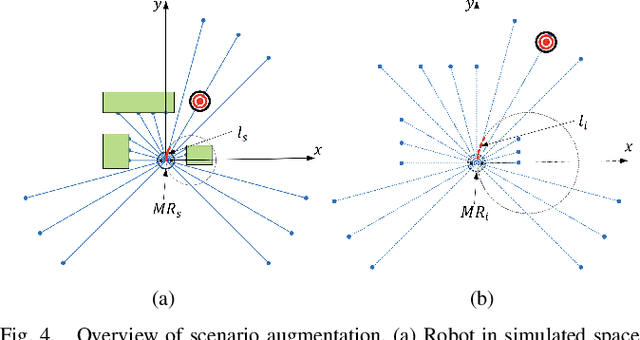
This work focuses on enhancing the generalization performance of deep reinforcement learning-based robot navigation in unseen environments. We present a novel data augmentation approach called scenario augmentation, which enables robots to navigate effectively across diverse settings without altering the training scenario. The method operates by mapping the robot's observation into an imagined space, generating an imagined action based on this transformed observation, and then remapping this action back to the real action executed in simulation. Through scenario augmentation, we conduct extensive comparative experiments to investigate the underlying causes of suboptimal navigation behaviors in unseen environments. Our analysis indicates that limited training scenarios represent the primary factor behind these undesired behaviors. Experimental results confirm that scenario augmentation substantially enhances the generalization capabilities of deep reinforcement learning-based navigation systems. The improved navigation framework demonstrates exceptional performance by producing near-optimal trajectories with significantly reduced navigation time in real-world applications.
Corrected Soft Actor Critic for Continuous Control
Oct 22, 2024
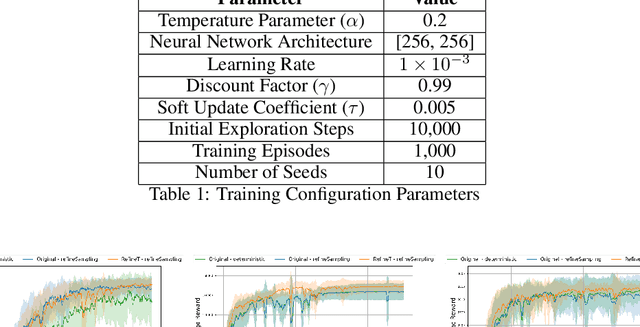


The Soft Actor-Critic (SAC) algorithm is known for its stability and high sample efficiency in deep reinforcement learning. However, the tanh transformation applied to sampled actions in SAC distorts the action distribution, hindering the selection of the most probable actions. This paper presents a novel action sampling method that directly identifies and selects the most probable actions within the transformed distribution, thereby addressing this issue. Extensive experiments on standard continuous control benchmarks demonstrate that the proposed method significantly enhances SAC's performance, resulting in faster convergence and higher cumulative rewards compared to the original algorithm.
Achieving Stable High-Speed Locomotion for Humanoid Robots with Deep Reinforcement Learning
Sep 25, 2024Humanoid robots offer significant versatility for performing a wide range of tasks, yet their basic ability to walk and run, especially at high velocities, remains a challenge. This letter presents a novel method that combines deep reinforcement learning with kinodynamic priors to achieve stable locomotion control (KSLC). KSLC promotes coordinated arm movements to counteract destabilizing forces, enhancing overall stability. Compared to the baseline method, KSLC provides more accurate tracking of commanded velocities and better generalization in velocity control. In simulation tests, the KSLC-enabled humanoid robot successfully tracked a target velocity of 3.5 m/s with reduced fluctuations. Sim-to-sim validation in a high-fidelity environment further confirmed its robust performance, highlighting its potential for real-world applications.