 Add to Chrome
 Add to Firefox
 Add to Edge
ASSCG: Just-Right Gating over Chattering for Fast-Slow LLM Planning in Autonomous Driving
Jun 24, 2026
Large language models (LLMs) can improve autonomous driving planning but are costly to query online, and existing fast-slow planners often rely on hand-designed triggering rules that either over-call the slow system or call it at the wrong times. We formulate slow-system invocation as a resource-aware sequential decision problem and propose the Adaptive Slow-System Control Gate (ASSCG), which makes frame-level Query/Cache/Drop decisions to refresh, reuse, or suppress slow guidance. ASSCG uses an RWKV backbone for efficient long-horizon gating and is trained with supervised fine-tuning followed by GRPO-style compute-aware reinforcement fine-tuning. We apply ASSCG to two different fast-slow architectures: (i) AsyncDriver on nuPlan Hard20 closed-loop evaluation, where ASSCG improves score to 67.28 (+2.28) while reducing average end-to-end inference latency by 60%; and (ii) a RecogDrive-based dual system that we build by replacing its original VLM-2B module with a lightweight ViT-based fast planner and adding an LLM slow planner, evaluated on NAVSIM, where ASSCG achieves 91.4 PDMS (+0.6) and increases average speed by 25%. The project page, including video visualizations and additional results, is available at https://williamxuanyu.github.io/asscg/.

AR Forcing: Towards Long-Horizon Robot Navigation World Model
May 29, 2026The diffusion based robot navigation world models are typically trained using parallel supervision, while autoregressive inference is employed during path planning. This results in a distribution shift between training and inference, which destabilizes the performance over long-horizon prediction. We propose AR Forcing, an autoregressive training strategy, which integrates the standard diffusion loss into the autoregressive training loop. At each step, the model uses its own predictions to update the context and optimize the single step noise prediction objective, thereby explicitly exposing the model to the inference state distribution during training. Our method does not require additional discriminators or distribution-matching losses, retains the original diffusion framework and sampler, and is easy to integrate. Experiments on multi-domain navigation datasets (RECON, SCAND, HuRoN, TartanDrive) show that compared with strong baselines, AR Forcing improved the consistency of generated images during long-horizon navigation and the accuracy of predicted trajectories, enhancing robustness of the model in complex known and unknown environments. We will release the code soon.
PROSPECT: Unified Streaming Vision-Language Navigation via Semantic--Spatial Fusion and Latent Predictive Representation
Mar 04, 2026Multimodal large language models (MLLMs) have advanced zero-shot end-to-end Vision-Language Navigation (VLN), yet robust navigation requires not only semantic understanding but also predictive modeling of environment dynamics and spatial structure. We propose PROSPECT, a unified streaming navigation agent that couples a streaming Vision-Language-Action (VLA) policy with latent predictive representation learning. PROSPECT uses CUT3R as a streaming 3D foundation spatial encoder to produce long-context, absolute-scale spatial features, and fuses them with SigLIP semantic features via cross-attention. During training, we introduce learnable stream query tokens that query the streaming context and predict next-step 2D and 3D latent features (rather than pixels or explicit modalities), supervised in the latent spaces of frozen SigLIP and CUT3R teachers. The predictive branch shapes internal representations without inference overhead. Experiments on VLN-CE benchmarks and real-robot deployment demonstrate state-of-the-art performance and improved long-horizon robustness under diverse lighting. We will release code for the community soon.
From Representational Complementarity to Dual Systems: Synergizing VLM and Vision-Only Backbones for End-to-End Driving
Feb 11, 2026Vision-Language-Action (VLA) driving augments end-to-end (E2E) planning with language-enabled backbones, yet it remains unclear what changes beyond the usual accuracy--cost trade-off. We revisit this question with 3--RQ analysis in RecogDrive by instantiating the system with a full VLM and vision-only backbones, all under an identical diffusion Transformer planner. RQ1: At the backbone level, the VLM can introduce additional subspaces upon the vision-only backbones. RQ2: This unique subspace leads to a different behavioral in some long-tail scenario: the VLM tends to be more aggressive whereas ViT is more conservative, and each decisively wins on about 2--3% of test scenarios; With an oracle that selects, per scenario, the better trajectory between the VLM and ViT branches, we obtain an upper bound of 93.58 PDMS. RQ3: To fully harness this observation, we propose HybridDriveVLA, which runs both ViT and VLM branches and selects between their endpoint trajectories using a learned scorer, improving PDMS to 92.10. Finally, DualDriveVLA implements a practical fast--slow policy: it runs ViT by default and invokes the VLM only when the scorer's confidence falls below a threshold; calling the VLM on 15% of scenarios achieves 91.00 PDMS while improving throughput by 3.2x. Code will be released.
Dual-AEB: Synergizing Rule-Based and Multimodal Large Language Models for Effective Emergency Braking
Oct 11, 2024

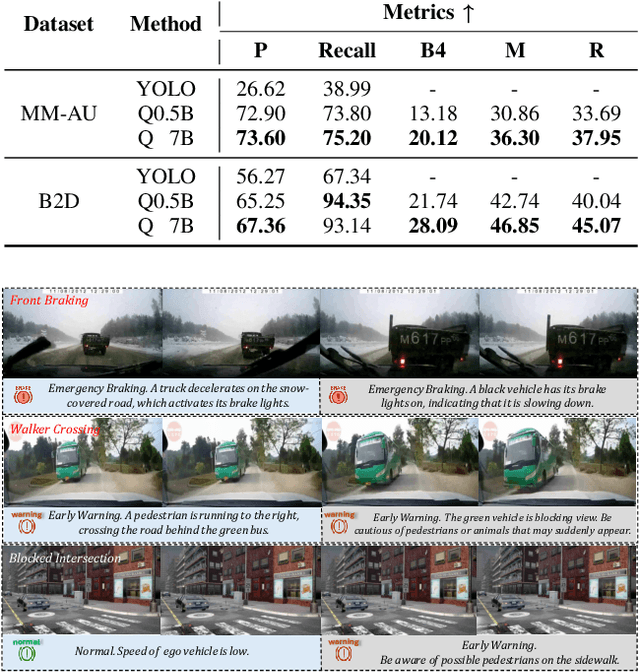

Automatic Emergency Braking (AEB) systems are a crucial component in ensuring the safety of passengers in autonomous vehicles. Conventional AEB systems primarily rely on closed-set perception modules to recognize traffic conditions and assess collision risks. To enhance the adaptability of AEB systems in open scenarios, we propose Dual-AEB, a system combines an advanced multimodal large language model (MLLM) for comprehensive scene understanding and a conventional rule-based rapid AEB to ensure quick response times. To the best of our knowledge, Dual-AEB is the first method to incorporate MLLMs within AEB systems. Through extensive experimentation, we have validated the effectiveness of our method. The source code will be available at https://github.com/ChipsICU/Dual-AEB.
Technical Report for Argoverse Challenges on 4D Occupancy Forecasting
Nov 27, 2023This report presents our Le3DE2E_Occ solution for 4D Occupancy Forecasting in Argoverse Challenges at CVPR 2023 Workshop on Autonomous Driving (WAD). Our solution consists of a strong LiDAR-based Bird's Eye View (BEV) encoder with temporal fusion and a two-stage decoder, which combines a DETR head and a UNet decoder. The solution was tested on the Argoverse 2 sensor dataset to evaluate the occupancy state 3 seconds in the future. Our solution achieved 18% lower L1 Error (3.57) than the baseline and got the 1 place on the 4D Occupancy Forecasting task in Argoverse Challenges at CVPR 2023.
ReIDTrack: Multi-Object Track and Segmentation Without Motion
Aug 03, 2023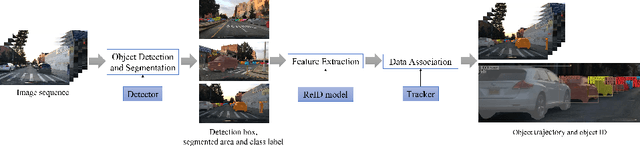
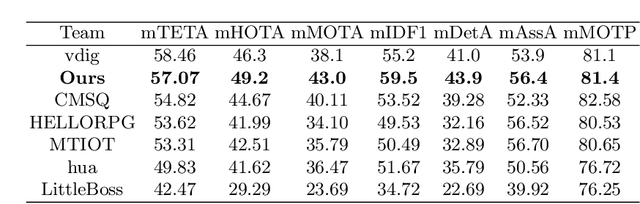
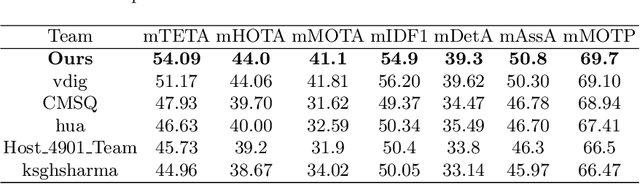
In recent years, dominant Multi-object tracking (MOT) and segmentation (MOTS) methods mainly follow the tracking-by-detection paradigm. Transformer-based end-to-end (E2E) solutions bring some ideas to MOT and MOTS, but they cannot achieve a new state-of-the-art (SOTA) performance in major MOT and MOTS benchmarks. Detection and association are two main modules of the tracking-by-detection paradigm. Association techniques mainly depend on the combination of motion and appearance information. As deep learning has been recently developed, the performance of the detection and appearance model is rapidly improved. These trends made us consider whether we can achieve SOTA based on only high-performance detection and appearance model. Our paper mainly focuses on exploring this direction based on CBNetV2 with Swin-B as a detection model and MoCo-v2 as a self-supervised appearance model. Motion information and IoU mapping were removed during the association. Our method wins 1st place on the MOTS track and wins 2nd on the MOT track in the CVPR2023 WAD workshop. We hope our simple and effective method can give some insights to the MOT and MOTS research community. Source code will be released under this git repository