 Add to Chrome
 Add to Firefox
 Add to Edge
Spark-to-Paper: End-to-End Research Paper Generation as a Composable Skill
Aug 12, 2026
Turning a research idea into a complete paper requires more than text generation: the system must retrieve literature, design and execute experiments, revise claims according to evidence, produce publication-ready figures, and maintain consistency across a long generation process. We present Spark-to-Paper, an end-to-end research paper generation system implemented as thirteen composable skills inside an existing coding assistant, without requiring a separate agent platform or orchestration service. Spark-to-Paper separates model-based judgment from deterministic operations that can be directly executed and checked. It further separates experiment planning from reporting, so that required evidence is specified before results are observed and manuscript claims are revised according to measured outcomes. To improve reliability over long research trajectories, the system combines deterministic integrity checks with self-critique and bounds a failure mode we call the Self-Refutation Loop, in which repeated experiments continue to reject the original research objective. Spark-to-Paper also produces editable vector figures through programmatic plotting for experimental results and code-based reconstruction for generated method diagrams. Across eight controlled research topics, Spark-to-Paper achieves 99.5% citation validity and 96.4% figure editability. A controlled ablation increases fabrication detection from 14% for a single-pass draft to 92% with the full integrity and review stack, while adversarial review achieves 74% precision. The full system uses 11.9M tokens, costs $8.1 per manuscript, and requires 3.2 hours on average. These results show that end-to-end research paper generation can be implemented as a lightweight, composable workflow inside existing coding assistants while keeping experimental evidence central to how claims are accepted, revised, or abandoned.

Calibrating Deep Neural Network using Euclidean Distance
Oct 23, 2024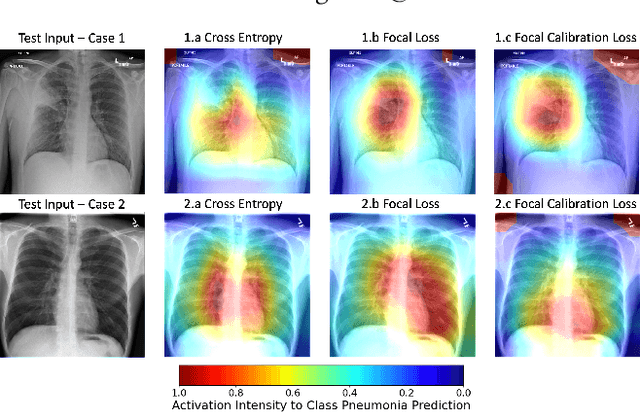
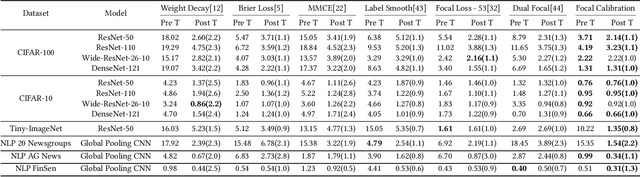

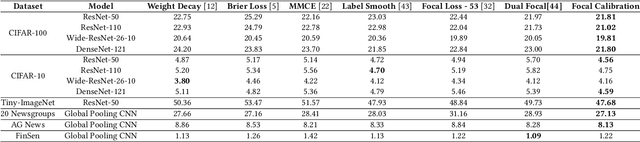
Uncertainty is a fundamental aspect of real-world scenarios, where perfect information is rarely available. Humans naturally develop complex internal models to navigate incomplete data and effectively respond to unforeseen or partially observed events. In machine learning, Focal Loss is commonly used to reduce misclassification rates by emphasizing hard-to-classify samples. However, it does not guarantee well-calibrated predicted probabilities and may result in models that are overconfident or underconfident. High calibration error indicates a misalignment between predicted probabilities and actual outcomes, affecting model reliability. This research introduces a novel loss function called Focal Calibration Loss (FCL), designed to improve probability calibration while retaining the advantages of Focal Loss in handling difficult samples. By minimizing the Euclidean norm through a strictly proper loss, FCL penalizes the instance-wise calibration error and constrains bounds. We provide theoretical validation for proposed method and apply it to calibrate CheXNet for potential deployment in web-based health-care systems. Extensive evaluations on various models and datasets demonstrate that our method achieves SOTA performance in both calibration and accuracy metrics.
Boosting Certificate Robustness for Time Series Classification with Efficient Self-Ensemble
Sep 04, 2024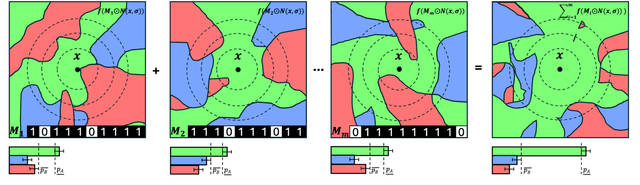
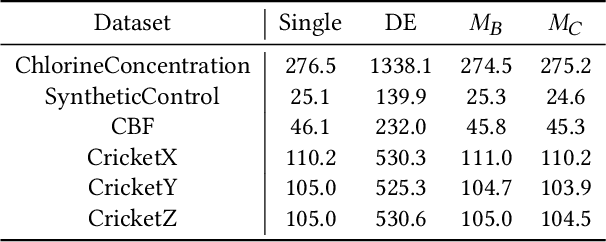
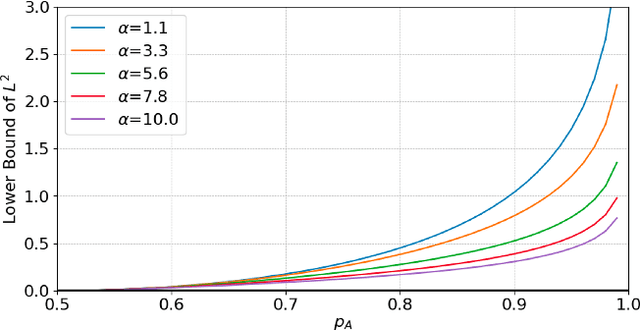
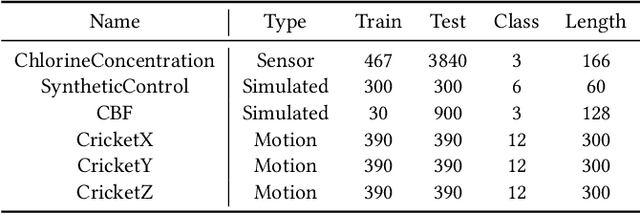
Recently, the issue of adversarial robustness in the time series domain has garnered significant attention. However, the available defense mechanisms remain limited, with adversarial training being the predominant approach, though it does not provide theoretical guarantees. Randomized Smoothing has emerged as a standout method due to its ability to certify a provable lower bound on robustness radius under $\ell_p$-ball attacks. Recognizing its success, research in the time series domain has started focusing on these aspects. However, existing research predominantly focuses on time series forecasting, or under the non-$\ell_p$ robustness in statistic feature augmentation for time series classification~(TSC). Our review found that Randomized Smoothing performs modestly in TSC, struggling to provide effective assurances on datasets with poor robustness. Therefore, we propose a self-ensemble method to enhance the lower bound of the probability confidence of predicted labels by reducing the variance of classification margins, thereby certifying a larger radius. This approach also addresses the computational overhead issue of Deep Ensemble~(DE) while remaining competitive and, in some cases, outperforming it in terms of robustness. Both theoretical analysis and experimental results validate the effectiveness of our method, demonstrating superior performance in robustness testing compared to baseline approaches.