 Add to Chrome
 Add to Firefox
 Add to Edge
Open X-Embodiment: Robotic Learning Datasets and RT-X Models
Oct 17, 2023
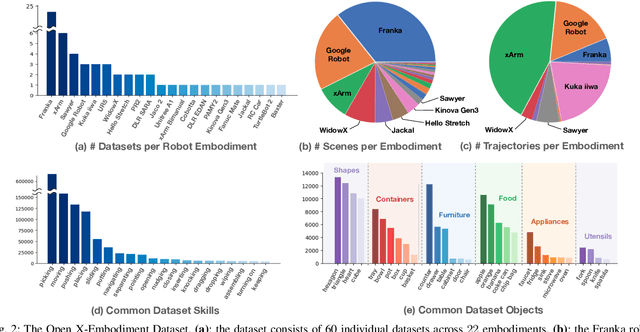
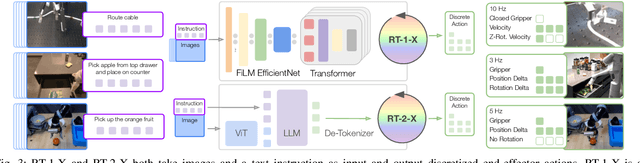


Large, high-capacity models trained on diverse datasets have shown remarkable successes on efficiently tackling downstream applications. In domains from NLP to Computer Vision, this has led to a consolidation of pretrained models, with general pretrained backbones serving as a starting point for many applications. Can such a consolidation happen in robotics? Conventionally, robotic learning methods train a separate model for every application, every robot, and even every environment. Can we instead train generalist X-robot policy that can be adapted efficiently to new robots, tasks, and environments? In this paper, we provide datasets in standardized data formats and models to make it possible to explore this possibility in the context of robotic manipulation, alongside experimental results that provide an example of effective X-robot policies. We assemble a dataset from 22 different robots collected through a collaboration between 21 institutions, demonstrating 527 skills (160266 tasks). We show that a high-capacity model trained on this data, which we call RT-X, exhibits positive transfer and improves the capabilities of multiple robots by leveraging experience from other platforms. More details can be found on the project website $\href{https://robotics-transformer-x.github.io}{\text{robotics-transformer-x.github.io}}$.

Towards Free Data Selection with General-Purpose Models
Oct 14, 2023A desirable data selection algorithm can efficiently choose the most informative samples to maximize the utility of limited annotation budgets. However, current approaches, represented by active learning methods, typically follow a cumbersome pipeline that iterates the time-consuming model training and batch data selection repeatedly. In this paper, we challenge this status quo by designing a distinct data selection pipeline that utilizes existing general-purpose models to select data from various datasets with a single-pass inference without the need for additional training or supervision. A novel free data selection (FreeSel) method is proposed following this new pipeline. Specifically, we define semantic patterns extracted from inter-mediate features of the general-purpose model to capture subtle local information in each image. We then enable the selection of all data samples in a single pass through distance-based sampling at the fine-grained semantic pattern level. FreeSel bypasses the heavy batch selection process, achieving a significant improvement in efficiency and being 530x faster than existing active learning methods. Extensive experiments verify the effectiveness of FreeSel on various computer vision tasks. Our code is available at https://github.com/yichen928/FreeSel.
LanguageMPC: Large Language Models as Decision Makers for Autonomous Driving
Oct 13, 2023Existing learning-based autonomous driving (AD) systems face challenges in comprehending high-level information, generalizing to rare events, and providing interpretability. To address these problems, this work employs Large Language Models (LLMs) as a decision-making component for complex AD scenarios that require human commonsense understanding. We devise cognitive pathways to enable comprehensive reasoning with LLMs, and develop algorithms for translating LLM decisions into actionable driving commands. Through this approach, LLM decisions are seamlessly integrated with low-level controllers by guided parameter matrix adaptation. Extensive experiments demonstrate that our proposed method not only consistently surpasses baseline approaches in single-vehicle tasks, but also helps handle complex driving behaviors even multi-vehicle coordination, thanks to the commonsense reasoning capabilities of LLMs. This paper presents an initial step toward leveraging LLMs as effective decision-makers for intricate AD scenarios in terms of safety, efficiency, generalizability, and interoperability. We aspire for it to serve as inspiration for future research in this field. Project page: https://sites.google.com/view/llm-mpc
Quantifying Agent Interaction in Multi-agent Reinforcement Learning for Cost-efficient Generalization
Oct 11, 2023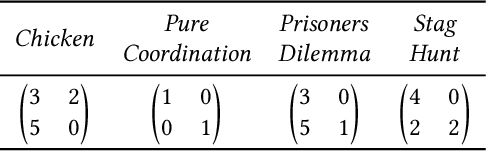
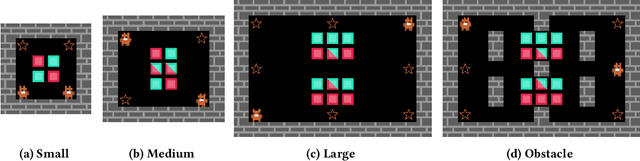
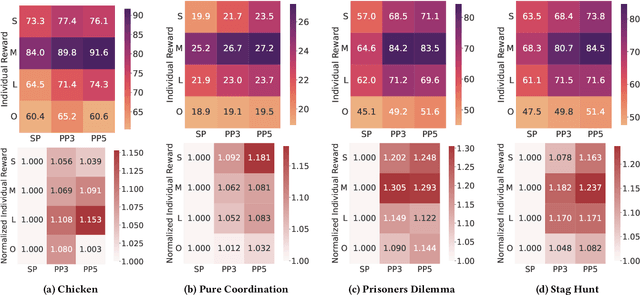

Generalization poses a significant challenge in Multi-agent Reinforcement Learning (MARL). The extent to which an agent is influenced by unseen co-players depends on the agent's policy and the specific scenario. A quantitative examination of this relationship sheds light on effectively training agents for diverse scenarios. In this study, we present the Level of Influence (LoI), a metric quantifying the interaction intensity among agents within a given scenario and environment. We observe that, generally, a more diverse set of co-play agents during training enhances the generalization performance of the ego agent; however, this improvement varies across distinct scenarios and environments. LoI proves effective in predicting these improvement disparities within specific scenarios. Furthermore, we introduce a LoI-guided resource allocation method tailored to train a set of policies for diverse scenarios under a constrained budget. Our results demonstrate that strategic resource allocation based on LoI can achieve higher performance than uniform allocation under the same computation budget.
Long-Term Dynamic Window Approach for Kinodynamic Local Planning in Static and Crowd Environments
Oct 04, 2023Local planning for a differential wheeled robot is designed to generate kinodynamic feasible actions that guide the robot to a goal position along the navigation path while avoiding obstacles. Reactive, predictive, and learning-based methods are widely used in local planning. However, few of them can fit static and crowd environments while satisfying kinodynamic constraints simultaneously. To solve this problem, we propose a novel local planning method. The method applies a long-term dynamic window approach to generate an initial trajectory and then optimizes it with graph optimization. The method can plan actions under the robot's kinodynamic constraints in real time while allowing the generated actions to be safer and more jitterless. Experimental results show that the proposed method adapts well to crowd and static environments and outperforms most SOTA approaches.
* 9 pages, 7 figures
Adaptive Spatio-Temporal Voxels Based Trajectory Planning for Autonomous Driving in Highway Traffic Flow
Oct 04, 2023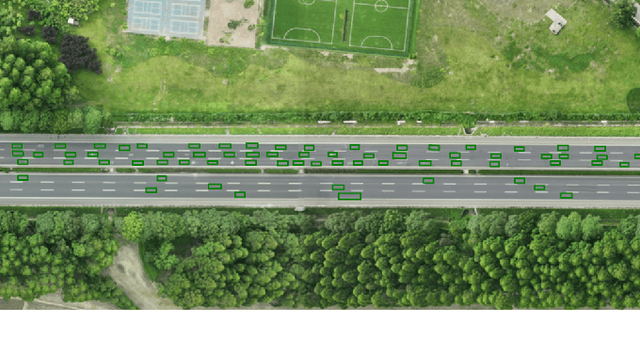
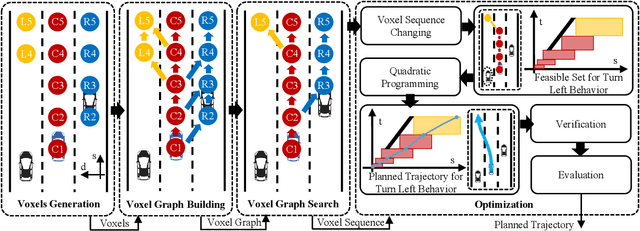
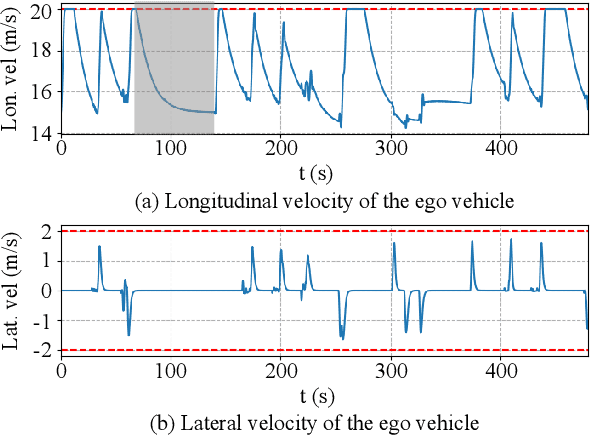
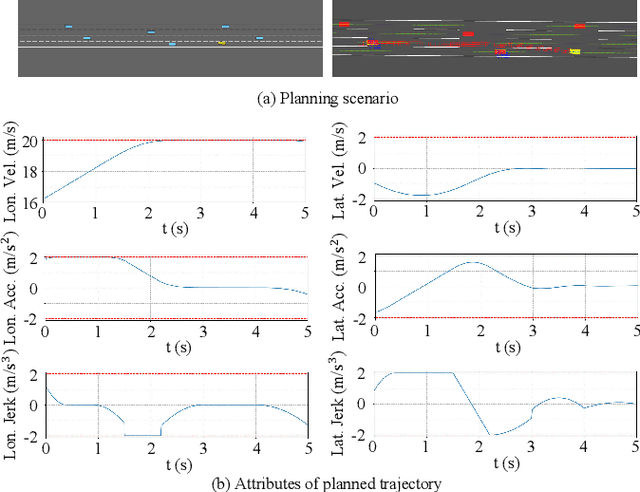
Trajectory planning is crucial for the safe driving of autonomous vehicles in highway traffic flow. Currently, some advanced trajectory planning methods utilize spatio-temporal voxels to construct feasible regions and then convert trajectory planning into optimization problem solving based on the feasible regions. However, these feasible region construction methods cannot adapt to the changes in dynamic environments, making them difficult to apply in complex traffic flow. In this paper, we propose a trajectory planning method based on adaptive spatio-temporal voxels which improves the construction of feasible regions and trajectory optimization while maintaining the quadratic programming form. The method can adjust feasible regions and trajectory planning according to real-time traffic flow and environmental changes, realizing vehicles to drive safely in complex traffic flow. The proposed method has been tested in both open-loop and closed-loop environments, and the test results show that our method outperforms the current planning methods.
* 8 pages, 5 figures
Human-oriented Representation Learning for Robotic Manipulation
Oct 04, 2023Humans inherently possess generalizable visual representations that empower them to efficiently explore and interact with the environments in manipulation tasks. We advocate that such a representation automatically arises from simultaneously learning about multiple simple perceptual skills that are critical for everyday scenarios (e.g., hand detection, state estimate, etc.) and is better suited for learning robot manipulation policies compared to current state-of-the-art visual representations purely based on self-supervised objectives. We formalize this idea through the lens of human-oriented multi-task fine-tuning on top of pre-trained visual encoders, where each task is a perceptual skill tied to human-environment interactions. We introduce Task Fusion Decoder as a plug-and-play embedding translator that utilizes the underlying relationships among these perceptual skills to guide the representation learning towards encoding meaningful structure for what's important for all perceptual skills, ultimately empowering learning of downstream robotic manipulation tasks. Extensive experiments across a range of robotic tasks and embodiments, in both simulations and real-world environments, show that our Task Fusion Decoder consistently improves the representation of three state-of-the-art visual encoders including R3M, MVP, and EgoVLP, for downstream manipulation policy-learning. Project page: https://sites.google.com/view/human-oriented-robot-learning
RSRD: A Road Surface Reconstruction Dataset and Benchmark for Safe and Comfortable Autonomous Driving
Oct 03, 2023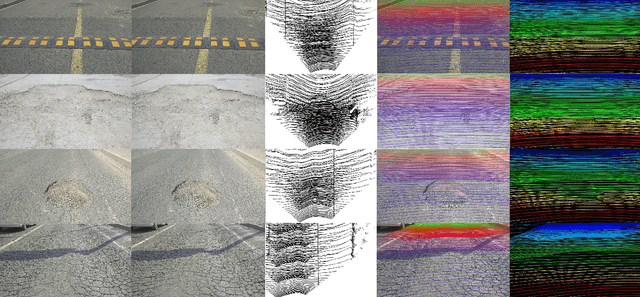
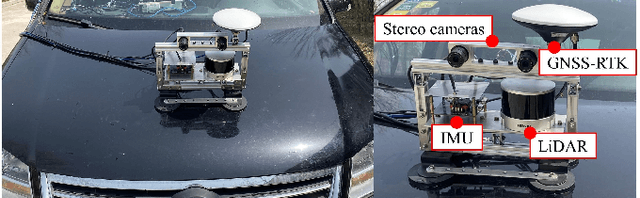
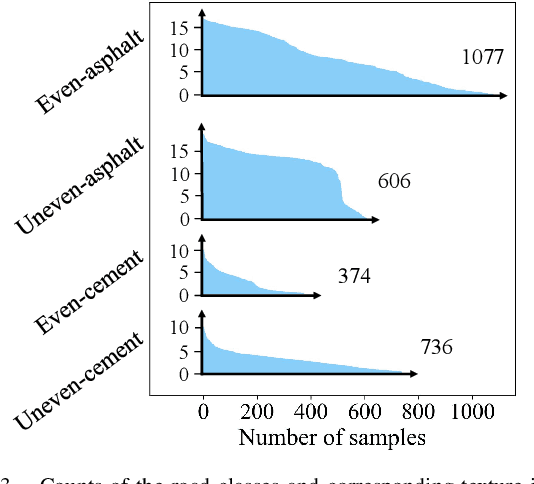
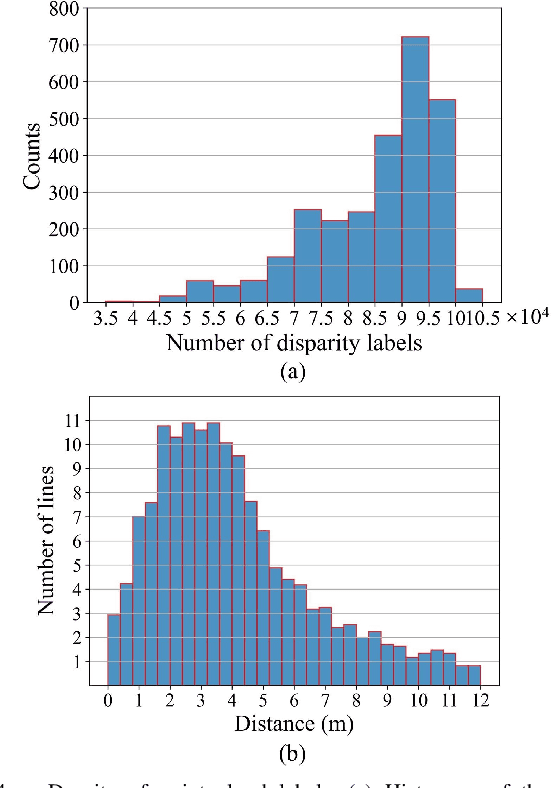
This paper addresses the growing demands for safety and comfort in intelligent robot systems, particularly autonomous vehicles, where road conditions play a pivotal role in overall driving performance. For example, reconstructing road surfaces helps to enhance the analysis and prediction of vehicle responses for motion planning and control systems. We introduce the Road Surface Reconstruction Dataset (RSRD), a real-world, high-resolution, and high-precision dataset collected with a specialized platform in diverse driving conditions. It covers common road types containing approximately 16,000 pairs of stereo images, original point clouds, and ground-truth depth/disparity maps, with accurate post-processing pipelines to ensure its quality. Based on RSRD, we further build a comprehensive benchmark for recovering road profiles through depth estimation and stereo matching. Preliminary evaluations with various state-of-the-art methods reveal the effectiveness of our dataset and the challenge of the task, underscoring substantial opportunities of RSRD as a valuable resource for advancing techniques, e.g., multi-view stereo towards safe autonomous driving. The dataset and demo videos are available at https://thu-rsxd.com/rsrd/
Pre-training on Synthetic Driving Data for Trajectory Prediction
Sep 20, 2023Accumulating substantial volumes of real-world driving data proves pivotal in the realm of trajectory forecasting for autonomous driving. Given the heavy reliance of current trajectory forecasting models on data-driven methodologies, we aim to tackle the challenge of learning general trajectory forecasting representations under limited data availability. We propose to augment both HD maps and trajectories and apply pre-training strategies on top of them. Specifically, we take advantage of graph representations of HD-map and apply vector transformations to reshape the maps, to easily enrich the limited number of scenes. Additionally, we employ a rule-based model to generate trajectories based on augmented scenes; thus enlarging the trajectories beyond the collected real ones. To foster the learning of general representations within this augmented dataset, we comprehensively explore the different pre-training strategies, including extending the concept of a Masked AutoEncoder (MAE) for trajectory forecasting. Extensive experiments demonstrate the effectiveness of our data expansion and pre-training strategies, which outperform the baseline prediction model by large margins, e.g. 5.04%, 3.84% and 8.30% in terms of $MR_6$, $minADE_6$ and $minFDE_6$.
Guided Online Distillation: Promoting Safe Reinforcement Learning by Offline Demonstration
Sep 18, 2023

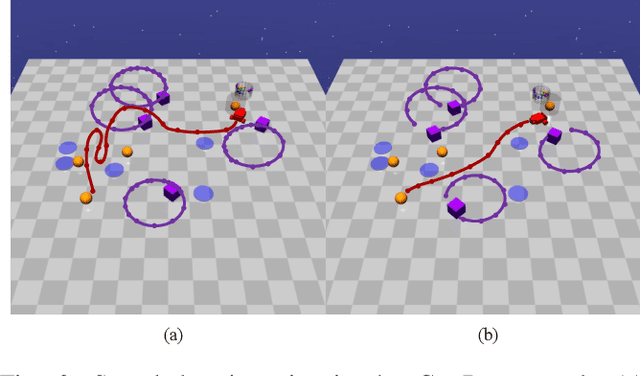
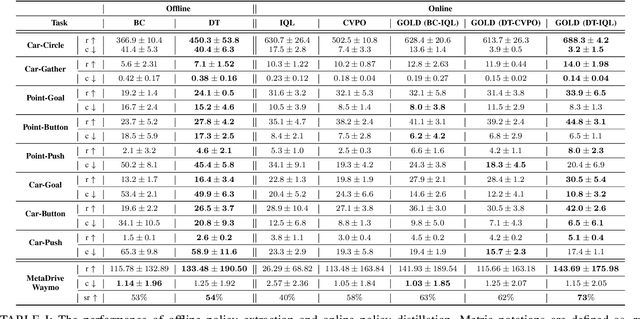
Safe Reinforcement Learning (RL) aims to find a policy that achieves high rewards while satisfying cost constraints. When learning from scratch, safe RL agents tend to be overly conservative, which impedes exploration and restrains the overall performance. In many realistic tasks, e.g. autonomous driving, large-scale expert demonstration data are available. We argue that extracting expert policy from offline data to guide online exploration is a promising solution to mitigate the conserveness issue. Large-capacity models, e.g. decision transformers (DT), have been proven to be competent in offline policy learning. However, data collected in real-world scenarios rarely contain dangerous cases (e.g., collisions), which makes it prohibitive for the policies to learn safety concepts. Besides, these bulk policy networks cannot meet the computation speed requirements at inference time on real-world tasks such as autonomous driving. To this end, we propose Guided Online Distillation (GOLD), an offline-to-online safe RL framework. GOLD distills an offline DT policy into a lightweight policy network through guided online safe RL training, which outperforms both the offline DT policy and online safe RL algorithms. Experiments in both benchmark safe RL tasks and real-world driving tasks based on the Waymo Open Motion Dataset (WOMD) demonstrate that GOLD can successfully distill lightweight policies and solve decision-making problems in challenging safety-critical scenarios.