 Add to Chrome
 Add to Firefox
 Add to Edge
NLGCL: Naturally Existing Neighbor Layers Graph Contrastive Learning for Recommendation
Jul 10, 2025
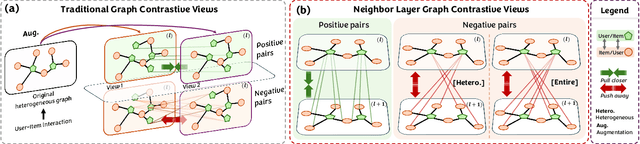
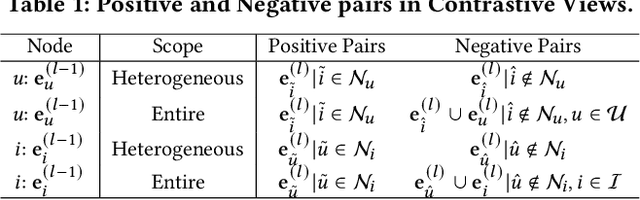
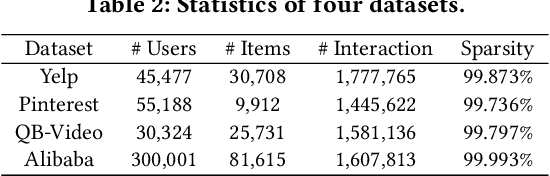
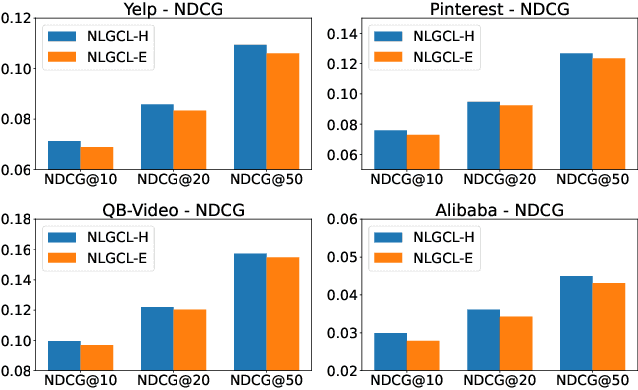
Graph Neural Networks (GNNs) are widely used in collaborative filtering to capture high-order user-item relationships. To address the data sparsity problem in recommendation systems, Graph Contrastive Learning (GCL) has emerged as a promising paradigm that maximizes mutual information between contrastive views. However, existing GCL methods rely on augmentation techniques that introduce semantically irrelevant noise and incur significant computational and storage costs, limiting effectiveness and efficiency. To overcome these challenges, we propose NLGCL, a novel contrastive learning framework that leverages naturally contrastive views between neighbor layers within GNNs. By treating each node and its neighbors in the next layer as positive pairs, and other nodes as negatives, NLGCL avoids augmentation-based noise while preserving semantic relevance. This paradigm eliminates costly view construction and storage, making it computationally efficient and practical for real-world scenarios. Extensive experiments on four public datasets demonstrate that NLGCL outperforms state-of-the-art baselines in effectiveness and efficiency.

Atherosclerosis through Hierarchical Explainable Neural Network Analysis
Jul 10, 2025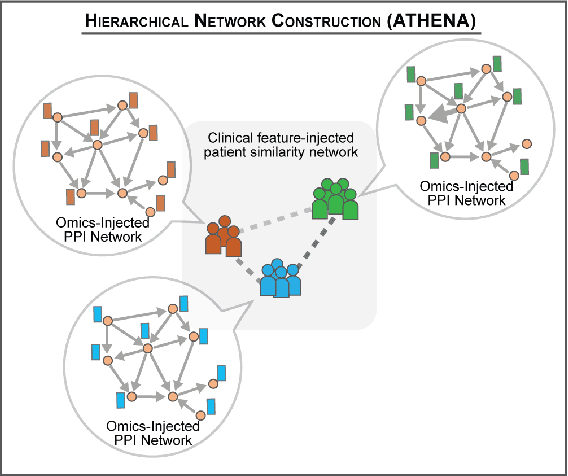

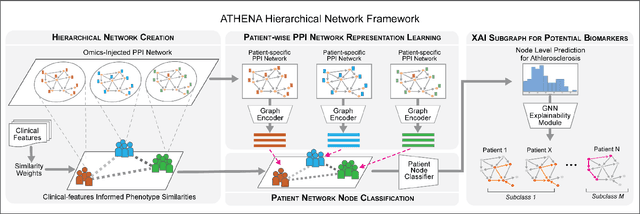
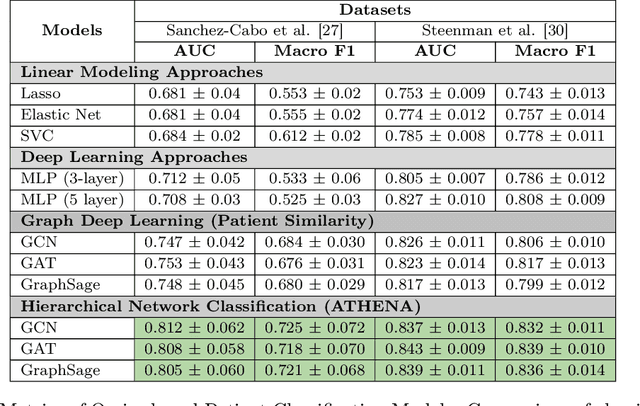
In this work, we study the problem pertaining to personalized classification of subclinical atherosclerosis by developing a hierarchical graph neural network framework to leverage two characteristic modalities of a patient: clinical features within the context of the cohort, and molecular data unique to individual patients. Current graph-based methods for disease classification detect patient-specific molecular fingerprints, but lack consistency and comprehension regarding cohort-wide features, which are an essential requirement for understanding pathogenic phenotypes across diverse atherosclerotic trajectories. Furthermore, understanding patient subtypes often considers clinical feature similarity in isolation, without integration of shared pathogenic interdependencies among patients. To address these challenges, we introduce ATHENA: Atherosclerosis Through Hierarchical Explainable Neural Network Analysis, which constructs a novel hierarchical network representation through integrated modality learning; subsequently, it optimizes learned patient-specific molecular fingerprints that reflect individual omics data, enforcing consistency with cohort-wide patterns. With a primary clinical dataset of 391 patients, we demonstrate that this heterogeneous alignment of clinical features with molecular interaction patterns has significantly boosted subclinical atherosclerosis classification performance across various baselines by up to 13% in area under the receiver operating curve (AUC) and 20% in F1 score. Taken together, ATHENA enables mechanistically-informed patient subtype discovery through explainable AI (XAI)-driven subnetwork clustering; this novel integration framework strengthens personalized intervention strategies, thereby improving the prediction of atherosclerotic disease progression and management of their clinical actionable outcomes.
Platform for Representation and Integration of multimodal Molecular Embeddings
Jul 10, 2025Existing machine learning methods for molecular (e.g., gene) embeddings are restricted to specific tasks or data modalities, limiting their effectiveness within narrow domains. As a result, they fail to capture the full breadth of gene functions and interactions across diverse biological contexts. In this study, we have systematically evaluated knowledge representations of biomolecules across multiple dimensions representing a task-agnostic manner spanning three major data sources, including omics experimental data, literature-derived text data, and knowledge graph-based representations. To distinguish between meaningful biological signals from chance correlations, we devised an adjusted variant of Singular Vector Canonical Correlation Analysis (SVCCA) that quantifies signal redundancy and complementarity across different data modalities and sources. These analyses reveal that existing embeddings capture largely non-overlapping molecular signals, highlighting the value of embedding integration. Building on this insight, we propose Platform for Representation and Integration of multimodal Molecular Embeddings (PRISME), a machine learning based workflow using an autoencoder to integrate these heterogeneous embeddings into a unified multimodal representation. We validated this approach across various benchmark tasks, where PRISME demonstrated consistent performance, and outperformed individual embedding methods in missing value imputations. This new framework supports comprehensive modeling of biomolecules, advancing the development of robust, broadly applicable multimodal embeddings optimized for downstream biomedical machine learning applications.
Lost in Pronunciation: Detecting Chinese Offensive Language Disguised by Phonetic Cloaking Replacement
Jul 10, 2025Phonetic Cloaking Replacement (PCR), defined as the deliberate use of homophonic or near-homophonic variants to hide toxic intent, has become a major obstacle to Chinese content moderation. While this problem is well-recognized, existing evaluations predominantly rely on rule-based, synthetic perturbations that ignore the creativity of real users. We organize PCR into a four-way surface-form taxonomy and compile \ours, a dataset of 500 naturally occurring, phonetically cloaked offensive posts gathered from the RedNote platform. Benchmarking state-of-the-art LLMs on this dataset exposes a serious weakness: the best model reaches only an F1-score of 0.672, and zero-shot chain-of-thought prompting pushes performance even lower. Guided by error analysis, we revisit a Pinyin-based prompting strategy that earlier studies judged ineffective and show that it recovers much of the lost accuracy. This study offers the first comprehensive taxonomy of Chinese PCR, a realistic benchmark that reveals current detectors' limits, and a lightweight mitigation technique that advances research on robust toxicity detection.
Structure and Smoothness Constrained Dual Networks for MR Bias Field Correction
Jul 02, 2025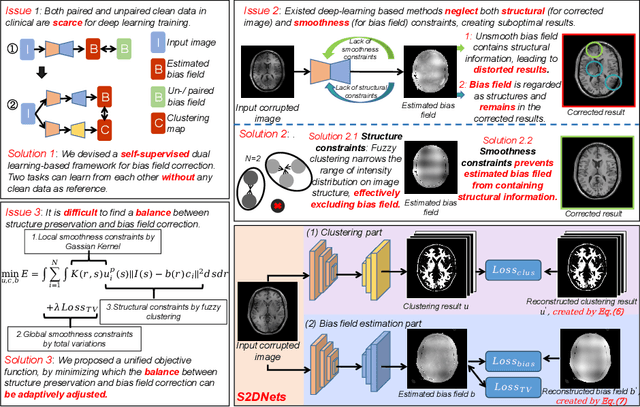
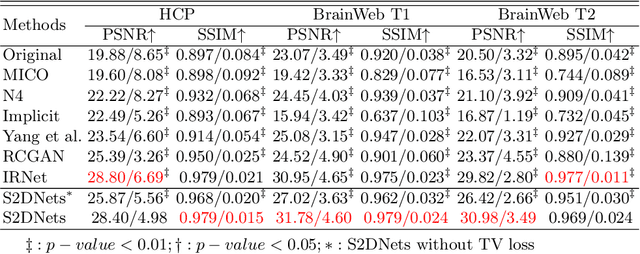
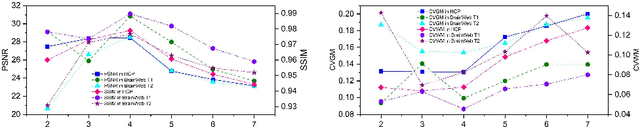
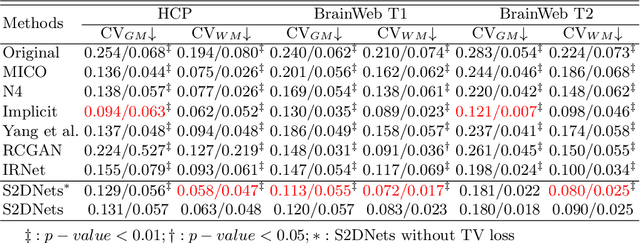
MR imaging techniques are of great benefit to disease diagnosis. However, due to the limitation of MR devices, significant intensity inhomogeneity often exists in imaging results, which impedes both qualitative and quantitative medical analysis. Recently, several unsupervised deep learning-based models have been proposed for MR image improvement. However, these models merely concentrate on global appearance learning, and neglect constraints from image structures and smoothness of bias field, leading to distorted corrected results. In this paper, novel structure and smoothness constrained dual networks, named S2DNets, are proposed aiming to self-supervised bias field correction. S2DNets introduce piece-wise structural constraints and smoothness of bias field for network training to effectively remove non-uniform intensity and retain much more structural details. Extensive experiments executed on both clinical and simulated MR datasets show that the proposed model outperforms other conventional and deep learning-based models. In addition to comparison on visual metrics, downstream MR image segmentation tasks are also used to evaluate the impact of the proposed model. The source code is available at: https://github.com/LeongDong/S2DNets}{https://github.com/LeongDong/S2DNets.
* 11 pages, 3 figures, accepted by MICCAI
UltraAD: Fine-Grained Ultrasound Anomaly Classification via Few-Shot CLIP Adaptation
Jun 24, 2025Precise anomaly detection in medical images is critical for clinical decision-making. While recent unsupervised or semi-supervised anomaly detection methods trained on large-scale normal data show promising results, they lack fine-grained differentiation, such as benign vs. malignant tumors. Additionally, ultrasound (US) imaging is highly sensitive to devices and acquisition parameter variations, creating significant domain gaps in the resulting US images. To address these challenges, we propose UltraAD, a vision-language model (VLM)-based approach that leverages few-shot US examples for generalized anomaly localization and fine-grained classification. To enhance localization performance, the image-level token of query visual prototypes is first fused with learnable text embeddings. This image-informed prompt feature is then further integrated with patch-level tokens, refining local representations for improved accuracy. For fine-grained classification, a memory bank is constructed from few-shot image samples and corresponding text descriptions that capture anatomical and abnormality-specific features. During training, the stored text embeddings remain frozen, while image features are adapted to better align with medical data. UltraAD has been extensively evaluated on three breast US datasets, outperforming state-of-the-art methods in both lesion localization and fine-grained medical classification. The code will be released upon acceptance.
Fiber Signal Denoising Algorithm using Hybrid Deep Learning Networks
Jun 18, 2025With the applicability of optical fiber-based distributed acoustic sensing (DAS) systems, effective signal processing and analysis approaches are needed to promote its popularization in the field of intelligent transportation systems (ITS). This paper presents a signal denoising algorithm using a hybrid deep-learning network (HDLNet). Without annotated data and time-consuming labeling, this self-supervised network runs in parallel, combining an autoencoder for denoising (DAE) and a long short-term memory (LSTM) for sequential processing. Additionally, a line-by-line matching algorithm for vehicle detection and tracking is introduced, thus realizing the complete processing of fiber signal denoising and feature extraction. Experiments were carried out on a self-established real highway tunnel dataset, showing that our proposed hybrid network yields more satisfactory denoising performance than Spatial-domain DAE.
Large Language Models Enhanced by Plug and Play Syntactic Knowledge for Aspect-based Sentiment Analysis
Jun 15, 2025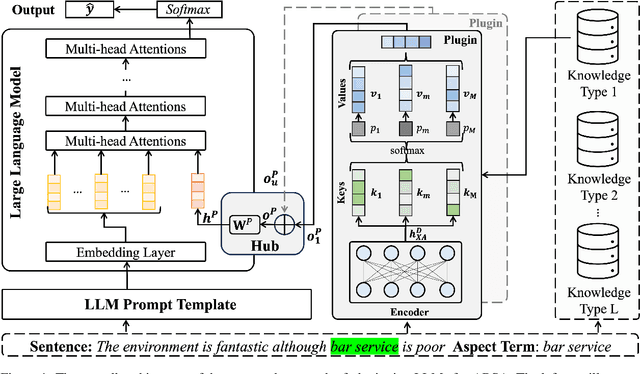
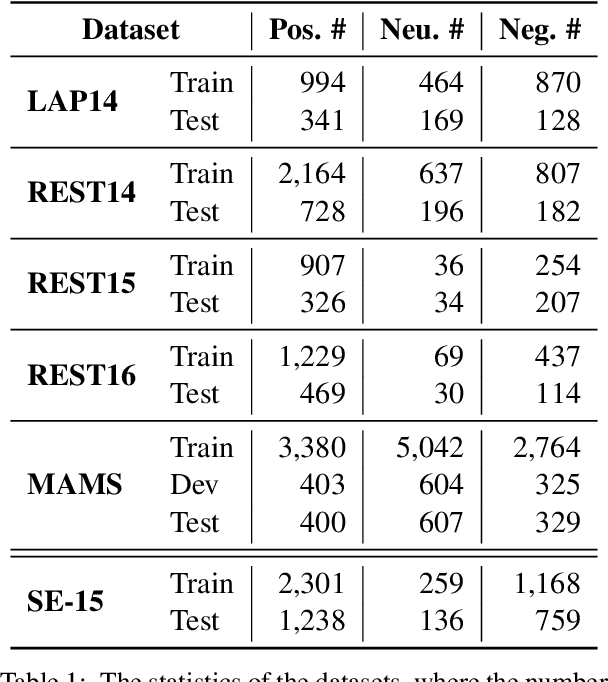
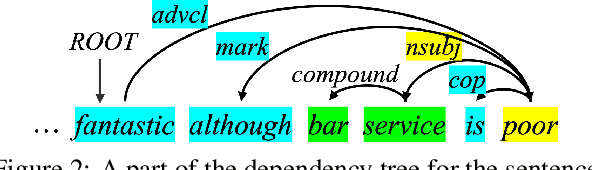
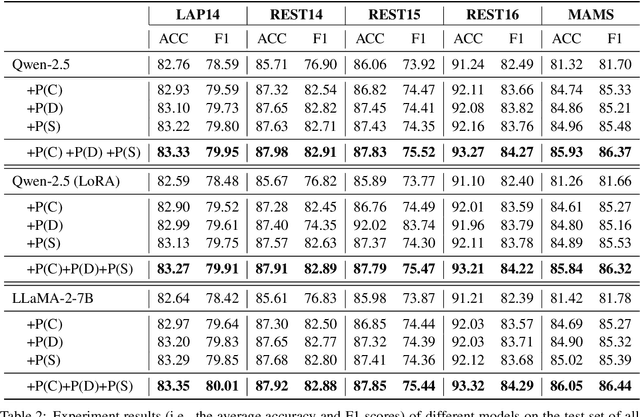
Aspect-based sentiment analysis (ABSA) generally requires a deep understanding of the contextual information, including the words associated with the aspect terms and their syntactic dependencies. Most existing studies employ advanced encoders (e.g., pre-trained models) to capture such context, especially large language models (LLMs). However, training these encoders is resource-intensive, and in many cases, the available data is insufficient for necessary fine-tuning. Therefore it is challenging for learning LLMs within such restricted environments and computation efficiency requirement. As a result, it motivates the exploration of plug-and-play methods that adapt LLMs to ABSA with minimal effort. In this paper, we propose an approach that integrates extendable components capable of incorporating various types of syntactic knowledge, such as constituent syntax, word dependencies, and combinatory categorial grammar (CCG). Specifically, we propose a memory module that records syntactic information and is incorporated into LLMs to instruct the prediction of sentiment polarities. Importantly, this encoder acts as a versatile, detachable plugin that is trained independently of the LLM. We conduct experiments on benchmark datasets, which show that our approach outperforms strong baselines and previous approaches, thus demonstrates its effectiveness.
Improving Speech Enhancement with Multi-Metric Supervision from Learned Quality Assessment
Jun 13, 2025Speech quality assessment (SQA) aims to predict the perceived quality of speech signals under a wide range of distortions. It is inherently connected to speech enhancement (SE), which seeks to improve speech quality by removing unwanted signal components. While SQA models are widely used to evaluate SE performance, their potential to guide SE training remains underexplored. In this work, we investigate a training framework that leverages a SQA model, trained to predict multiple evaluation metrics from a public SE leaderboard, as a supervisory signal for SE. This approach addresses a key limitation of conventional SE objectives, such as SI-SNR, which often fail to align with perceptual quality and generalize poorly across evaluation metrics. Moreover, it enables training on real-world data where clean references are unavailable. Experiments on both simulated and real-world test sets show that SQA-guided training consistently improves performance across a range of quality metrics.
Time-IMM: A Dataset and Benchmark for Irregular Multimodal Multivariate Time Series
Jun 12, 2025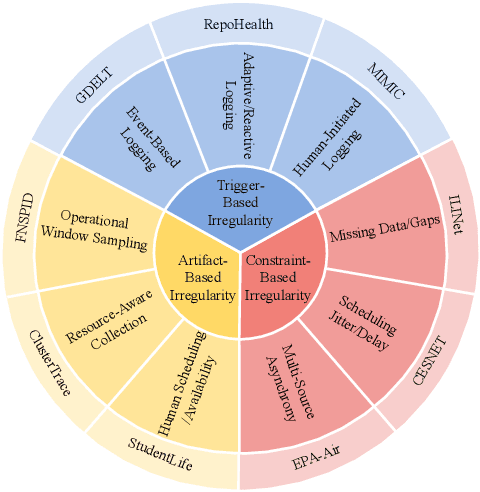
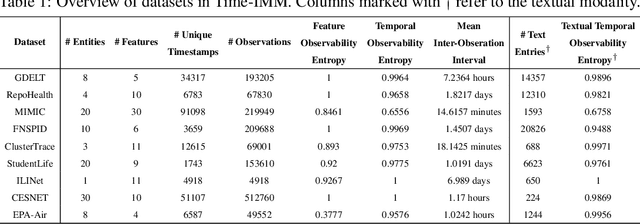
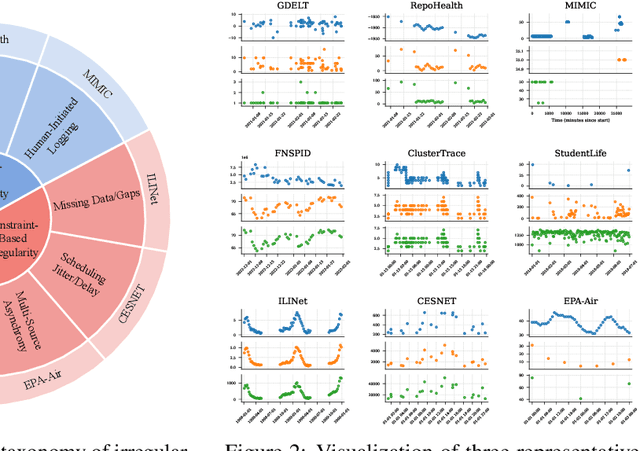
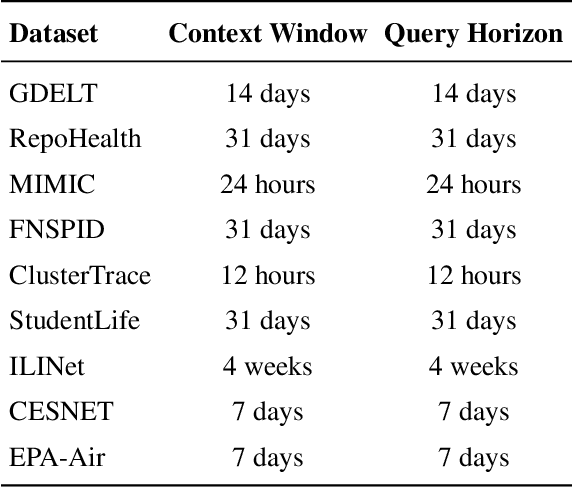
Time series data in real-world applications such as healthcare, climate modeling, and finance are often irregular, multimodal, and messy, with varying sampling rates, asynchronous modalities, and pervasive missingness. However, existing benchmarks typically assume clean, regularly sampled, unimodal data, creating a significant gap between research and real-world deployment. We introduce Time-IMM, a dataset specifically designed to capture cause-driven irregularity in multimodal multivariate time series. Time-IMM represents nine distinct types of time series irregularity, categorized into trigger-based, constraint-based, and artifact-based mechanisms. Complementing the dataset, we introduce IMM-TSF, a benchmark library for forecasting on irregular multimodal time series, enabling asynchronous integration and realistic evaluation. IMM-TSF includes specialized fusion modules, including a timestamp-to-text fusion module and a multimodality fusion module, which support both recency-aware averaging and attention-based integration strategies. Empirical results demonstrate that explicitly modeling multimodality on irregular time series data leads to substantial gains in forecasting performance. Time-IMM and IMM-TSF provide a foundation for advancing time series analysis under real-world conditions. The dataset is publicly available at https://www.kaggle.com/datasets/blacksnail789521/time-imm/data, and the benchmark library can be accessed at https://anonymous.4open.science/r/IMMTSF_NeurIPS2025.