 Add to Chrome
 Add to Firefox
 Add to Edge
Ask to Be Sure: Informative Interactions for Confident Multi-Turn LLM Recommendation
Aug 16, 2026
Recent advances in large language models (LLMs) have enabled their use as conversational recommender systems (CRS), demonstrating strong recommendation accuracy and natural dialogue. However, guiding multi-turn interactions to elicit user preferences effectively remains challenging. Existing approaches either use separate reinforcement learning agents with templated interactions or optimize for interactivity judged by another LLM, without measuring how much useful information is actually gained. We propose a new approach that quantifies the effectiveness of each interaction by the reduction in the assistant's uncertainty, measured via entropy over recommendations. We apply this entropy reduction as a reward---without relying on ground-truth recommendations, which are often unavailable in real-world scenarios---to fine-tune the LLM, enabling strategic interaction generation. Empirical results with supervised fine-tuning (SFT) and direct preference optimization (DPO) on the INSPIRED and ReDial datasets show that our method improves both recommendation quality and conversational efficiency.

Scaling Automatic Research Agents via World Models
Aug 12, 2026Automating empirical research is a long-standing direction of AI. Recent automatic research (AutoResearch) agents bring this goal within reach, as modern LLMs show the capability to independently implement solutions and learn from the execution outcomes. Behind these gains, post-training (especially RL) plays a central role. In this paper, we identify a fundamental tension when scaling RL for these agents: the two components of every AutoResearch trajectory (agent generation and environment execution) scale in very different manners, since all generation shares compute through batching, while each execution occupies its exclusive sandbox and real machine time. As a result, the environment execution dominates the training cost and becomes the bottleneck as trajectories grow. To resolve this tension, we propose World Model RL (WMRL), which replaces environment execution with a world model to remove this bottleneck. Additionally, the world model can be imperfect, as its rewards are corrupted by bias and noise. Therefore, we further equip WMRL with two mitigations, Online Debiasing and Inverse-Variance Denoising, which offset the bias and suppress the noise respectively. Theoretically, we prove that both mitigations of WMRL strictly improve the convergence guarantee. Empirically, WMRL accelerates training by 3-4x on various tasks at different agent scales, while exceeding the performance of standard RL baselines. Moreover, our post-trained 4B and 9B agents outperform much larger open-weight agents of 48B and 120B on held-out benchmarks. Beyond AutoResearch, WMRL also transfers to post-training embodied VLA policies, which demonstrates the generalizability of our method.
DepthART: Scaling Foundation Monocular Depth to Tiny Models
Jul 19, 2026Recent geometric foundation models (e.g., Metric3D, Depth Anything and UniDepth) have substantially improved monocular depth estimation (MDE) in both cross-scene generalization and metric-scale prediction, yet these gains have not translated to tiny models. We bridge this gap with DepthART (Depth Anything Rethought for Tiny Models), which is a compact MDE model for on-device deployment across diverse scenes. We first identify two capacity-driven bottlenecks in tiny models: (i) overfitting to dataset-specific distribution bias and (ii) unstable metric adaptation under camera shift, where full fine-tuning easily damages transferable geometry. Accordingly, DepthART combines two simple but effective strategies: a bias-resistant data sampling scheme to reduce distribution bias under the same training budget, and a camera-conditioned fine-tuning protocol that freezes the distilled encoder and adjusts metric scale conditioned on intrinsics while better preserving cross-dataset generalization. Across datasets, DepthART consistently surpasses previous tiny baselines in both zero-shot generalization and metric accuracy (e.g., zero-shot $δ_1$=0.964 for DepthART-S on NYUD v2), and in some cases approaches heavy models. We further provide a scalable model family, with DepthART-S reaching 347/245 FPS (strict FP32) on an RTX A6000 at $224^2/448^2$, 102 FPS (TF32) on a Orin NX 8GB, and over 15 FPS (FP32) on a Jetson Nano 4GB.
Complementary Text-Guided Attention for Zero-Shot Adversarial Robustness
Mar 19, 2026Due to the impressive zero-shot capabilities, pre-trained vision-language models (e.g., CLIP), have attracted widespread attention and adoption across various domains. Nonetheless, CLIP has been observed to be susceptible to adversarial examples. Through experimental analysis, we have observed a phenomenon wherein adversarial perturbations induce shifts in text-guided attention. Building upon this observation, we propose a simple yet effective strategy: Text-Guided Attention for Zero-Shot Robustness (TGA-ZSR). This framework incorporates two components: Local Attention Refinement Module and Global Attention Constraint Module. Our goal is to maintain the generalization of the CLIP model and enhance its adversarial robustness. Additionally, the Global Attention Constraint Module acquires text-guided attention from both the target and original models using clean examples. Its objective is to maintain model performance on clean samples while enhancing overall robustness. However, we observe that the method occasionally focuses on irrelevant or spurious features, which can lead to suboptimal performance and undermine its robustness in certain scenarios. To overcome this limitation, we further propose a novel approach called Complementary Text-Guided Attention (Comp-TGA). This method integrates two types of foreground attention: attention guided by the class prompt and reversed attention driven by the non-class prompt. These complementary attention mechanisms allow the model to capture a more comprehensive and accurate representation of the foreground. The experiments validate that TGA-ZSR and Comp-TGA yield 9.58% and 11.95% improvements respectively, in zero-shot robust accuracy over the current state-of-the-art techniques across 16 datasets.
Near-Field Wideband Localization using TTD-Based Terahertz Extremely Large-Scale Arrays
Mar 17, 2026The synergy between extremely large-scale antenna arrays and terahertz technology in sixth-generation networks establishes a near-field wideband transmission environment, enabling the generation of highly focused beams. To leverage this capability for multi-source localization, we propose a direct localization method based on the curvature-of-arrival of spherical wavefronts for estimating the positions of multiple near-field users from wideband signals. Furthermore, to overcome the spatial-wideband effect, we introduce a hybrid analog/digital array architecture with true-timedelayers (TTDs). We derive a closed-form position error bound to characterize the fundamental estimation performance and optimize the analog coefficients of array by maximizing the trace of the Fisher information matrix to minimize this bound. Furthermore, we extend this method to a sub-optimal iterative method that jointly optimizes beam focusing and localization, without requiring prior knowledge of the source positions for array design. Simulation results show that the proposed array configuration design significantly enhances the performance of near-field wideband localization, while the presence of TTDs effectively mitigates the localization performance degradation caused by spatial-wideband effects.
Ultra-Massive MIMO with Orthogonal Chirp Division Multiplexing for Near-Field Sensing and Communication Integration
Dec 29, 2025This paper integrates the emerging ultra-massive multiple-input multiple-output (UM-MIMO) technique with orthogonal chirp division multiplexing (OCDM) waveform to tackle the challenging near-field integrated sensing and communication (ISAC) problem. Specifically, we conceive a comprehensive ISAC architecture, where an UM-MIMO base station adopts OCDM waveform for communications and a co-located sensing receiver adopts the frequency-modulated continuous wave (FMCW) detection principle to simplify the associated hardware. For sensing tasks, several OCDM subcarriers, namely, dedicated sensing subcarriers (DSSs), are each transmitted through a dedicated sensing antenna (DSA) within the transmit antenna array. By judiciously designing the DSS selection scheme and optimizing receiver parameters, the FMCW-based sensing receiver can decouple the echo signals from different DSAs with significantly reduced hardware complexity. This setup enables the estimation of ranges and velocities of near-field targets in an antenna-pairwise manner. Moreover, by leveraging the spatial diversity of UM-MIMO, we introduce the concept of virtual bistatic sensing (VIBS), which incorporates the estimates from multiple antenna pairs to achieve high-accuracy target positioning and three-dimensional velocity measurement. The VIBS paradigm is immune to hostile channel environments characterized by spatial non-stationarity and uncorrelated multipath environment. Furthermore, the channel estimation of UM-MIMO OCDM systems enhanced by the sensing results is investigated. Simulation results demonstrate that the proposed ISAC scheme enhances sensing accuracy, and also benefits communication performance.
You Never Know a Person, You Only Know Their Defenses: Detecting Levels of Psychological Defense Mechanisms in Supportive Conversations
Dec 17, 2025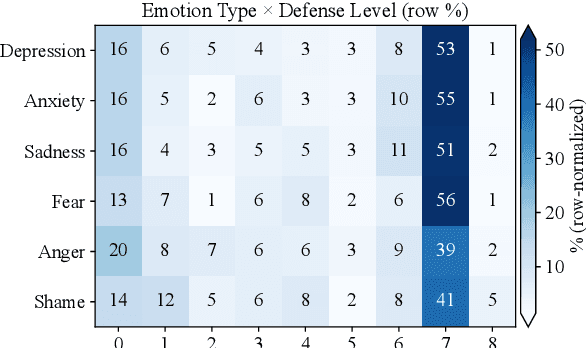
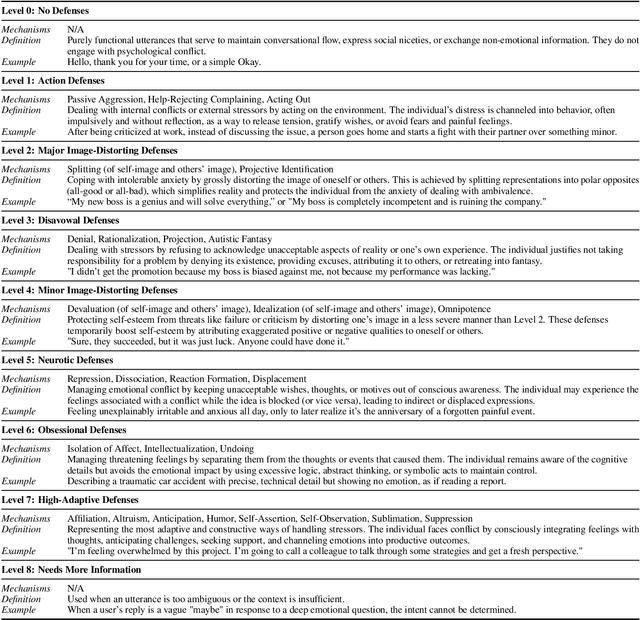
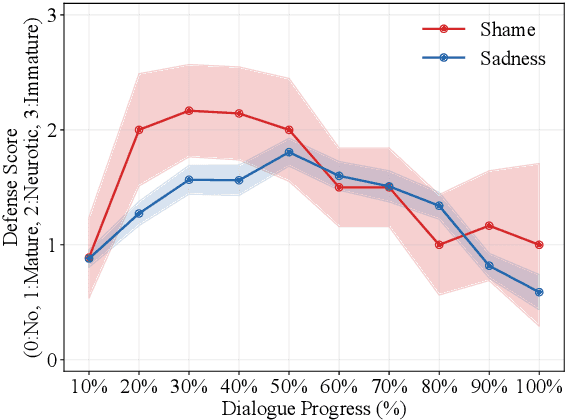
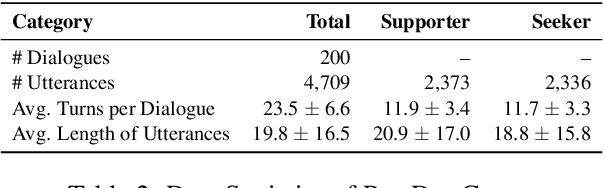
Psychological defenses are strategies, often automatic, that people use to manage distress. Rigid or overuse of defenses is negatively linked to mental health and shapes what speakers disclose and how they accept or resist help. However, defenses are complex and difficult to reliably measure, particularly in clinical dialogues. We introduce PsyDefConv, a dialogue corpus with help seeker utterances labeled for defense level, and DMRS Co-Pilot, a four-stage pipeline that provides evidence-based pre-annotations. The corpus contains 200 dialogues and 4709 utterances, including 2336 help seeker turns, with labeling and Cohen's kappa 0.639. In a counterbalanced study, the co-pilot reduced average annotation time by 22.4%. In expert review, it averaged 4.62 for evidence, 4.44 for clinical plausibility, and 4.40 for insight on a seven-point scale. Benchmarks with strong language models in zero-shot and fine-tuning settings demonstrate clear headroom, with the best macro F1-score around 30% and a tendency to overpredict mature defenses. Corpus analyses confirm that mature defenses are most common and reveal emotion-specific deviations. We will release the corpus, annotations, code, and prompts to support research on defensive functioning in language.
Benchmarking and Improving LVLMs on Event Extraction from Multimedia Documents
Sep 16, 2025The proliferation of multimedia content necessitates the development of effective Multimedia Event Extraction (M2E2) systems. Though Large Vision-Language Models (LVLMs) have shown strong cross-modal capabilities, their utility in the M2E2 task remains underexplored. In this paper, we present the first systematic evaluation of representative LVLMs, including DeepSeek-VL2 and the Qwen-VL series, on the M2E2 dataset. Our evaluations cover text-only, image-only, and cross-media subtasks, assessed under both few-shot prompting and fine-tuning settings. Our key findings highlight the following valuable insights: (1) Few-shot LVLMs perform notably better on visual tasks but struggle significantly with textual tasks; (2) Fine-tuning LVLMs with LoRA substantially enhances model performance; and (3) LVLMs exhibit strong synergy when combining modalities, achieving superior performance in cross-modal settings. We further provide a detailed error analysis to reveal persistent challenges in areas such as semantic precision, localization, and cross-modal grounding, which remain critical obstacles for advancing M2E2 capabilities.
Attribute Guidance With Inherent Pseudo-label For Occluded Person Re-identification
Aug 07, 2025Person re-identification (Re-ID) aims to match person images across different camera views, with occluded Re-ID addressing scenarios where pedestrians are partially visible. While pre-trained vision-language models have shown effectiveness in Re-ID tasks, they face significant challenges in occluded scenarios by focusing on holistic image semantics while neglecting fine-grained attribute information. This limitation becomes particularly evident when dealing with partially occluded pedestrians or when distinguishing between individuals with subtle appearance differences. To address this limitation, we propose Attribute-Guide ReID (AG-ReID), a novel framework that leverages pre-trained models' inherent capabilities to extract fine-grained semantic attributes without additional data or annotations. Our framework operates through a two-stage process: first generating attribute pseudo-labels that capture subtle visual characteristics, then introducing a dual-guidance mechanism that combines holistic and fine-grained attribute information to enhance image feature extraction. Extensive experiments demonstrate that AG-ReID achieves state-of-the-art results on multiple widely-used Re-ID datasets, showing significant improvements in handling occlusions and subtle attribute differences while maintaining competitive performance on standard Re-ID scenarios.
Hybrid RISs for Simultaneous Tunable Reflections and Sensing
Jul 22, 2025The concept of smart wireless environments envisions dynamic programmable propagation of information-bearing signals through the deployment of Reconfigurable Intelligent Surfaces (RISs). Typical RIS implementations include metasurfaces with passive unit elements capable to reflect their incident waves in controllable ways. However, this solely reflective operation induces significant challenges in the RIS orchestration from the wireless network. For example, channel estimation, which is essential for coherent RIS-empowered wireless communications, is quite challenging with the available solely reflecting RIS designs. This chapter reviews the emerging concept of Hybrid Reflecting and Sensing RISs (HRISs), which enables metasurfaces to reflect the impinging signal in a controllable manner, while simultaneously sensing a portion of it. The sensing capability of HRISs facilitates various network management functionalities, including channel parameter estimation and localization, while, most importantly, giving rise to computationally autonomous and self-configuring RISs. The implementation details of HRISs are first presented, which are then followed by a convenient mathematical model for characterizing their dual functionality. Then, two indicative applications of HRISs are discussed, one for simultaneous communications and sensing and another that showcases their usefulness for estimating the individual channels in the uplink of a multi-user HRIS-empowered communication system. For both of these applications, performance evaluation results are included validating the role of HRISs for sensing as well as integrated sensing and communications.