 Add to Chrome
 Add to Firefox
 Add to Edge
RetroAgent: Harnessing LLMs to Search Over Structured Memory for Agentic Retrosynthesis Planning
Jul 16, 2026
Multi-step retrosynthesis planning seeks to decompose a target molecule into commercially available building blocks through a sequence of feasible reactions. The vast combinatorial search space makes this task challenging even for expert chemists. Traditional methods combine tree search with offline-trained value networks that score candidates in isolation, without reasoning about complete multi-step routes. Recent work leverages Large Language Models (LLMs) for this task, but relies on simple interfaces that limit exploration of the full search space. We introduce RetroAgent, an LLM agent that bridges symbolic search and neural reasoning through a harness with structured memory. Through memory and chemistry tools, the agent observes the full search state, including explored routes, available alternatives, and properties of intermediates, enabling informed decisions grounded in both global progress and domain knowledge. Experiments on in-distribution and out-of-distribution benchmarks demonstrate that RetroAgent delivers strong performance and generalization.

ARLArena: A Unified Framework for Stable Agentic Reinforcement Learning
Feb 25, 2026Agentic reinforcement learning (ARL) has rapidly gained attention as a promising paradigm for training agents to solve complex, multi-step interactive tasks. Despite encouraging early results, ARL remains highly unstable, often leading to training collapse. This instability limits scalability to larger environments and longer interaction horizons, and constrains systematic exploration of algorithmic design choices. In this paper, we first propose ARLArena, a stable training recipe and systematic analysis framework that examines training stability in a controlled and reproducible setting. ARLArena first constructs a clean and standardized testbed. Then, we decompose policy gradient into four core design dimensions and assess the performance and stability of each dimension. Through this fine-grained analysis, we distill a unified perspective on ARL and propose SAMPO, a stable agentic policy optimization method designed to mitigate the dominant sources of instability in ARL. Empirically, SAMPO achieves consistently stable training and strong performance across diverse agentic tasks. Overall, this study provides a unifying policy gradient perspective for ARL and offers practical guidance for building stable and reproducible LLM-based agent training pipelines.
Utilizing the Score of Data Distribution for Hyperspectral Anomaly Detection
Jan 18, 2026Hyperspectral images (HSIs) are a type of image that contains abundant spectral information. As a type of real-world data, the high-dimensional spectra in hyperspectral images are actually determined by only a few factors, such as chemical composition and illumination. Thus, spectra in hyperspectral images are highly likely to satisfy the manifold hypothesis. Based on the hyperspectral manifold hypothesis, we propose a novel hyperspectral anomaly detection method (named ScoreAD) that leverages the time-dependent gradient field of the data distribution (i.e., the score), as learned by a score-based generative model (SGM). Our method first trains the SGM on the entire set of spectra from the hyperspectral image. At test time, each spectrum is passed through a perturbation kernel, and the resulting perturbed spectrum is fed into the trained SGM to obtain the estimated score. The manifold hypothesis of HSIs posits that background spectra reside on one or more low-dimensional manifolds. Conversely, anomalous spectra, owing to their unique spectral signatures, are considered outliers that do not conform to the background manifold. Based on this fundamental discrepancy in their manifold distributions, we leverage a generative SGM to achieve hyperspectral anomaly detection. Experiments on the four hyperspectral datasets demonstrate the effectiveness of the proposed method. The code is available at https://github.com/jiahuisheng/ScoreAD.
Time-IMM: A Dataset and Benchmark for Irregular Multimodal Multivariate Time Series
Jun 12, 2025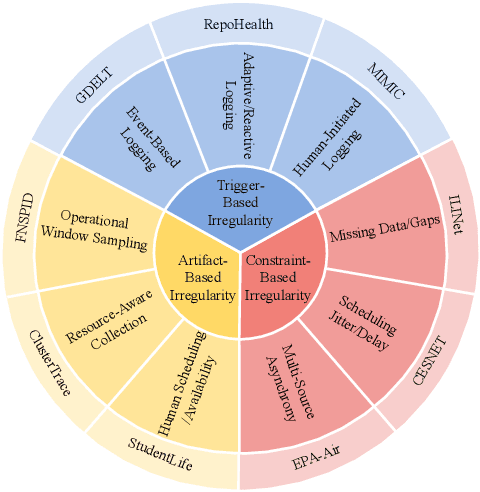
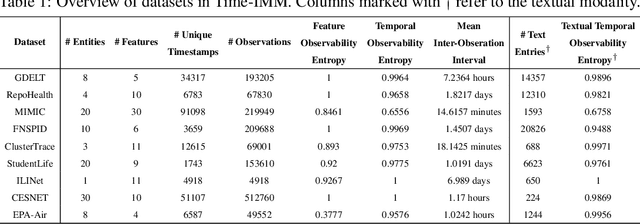
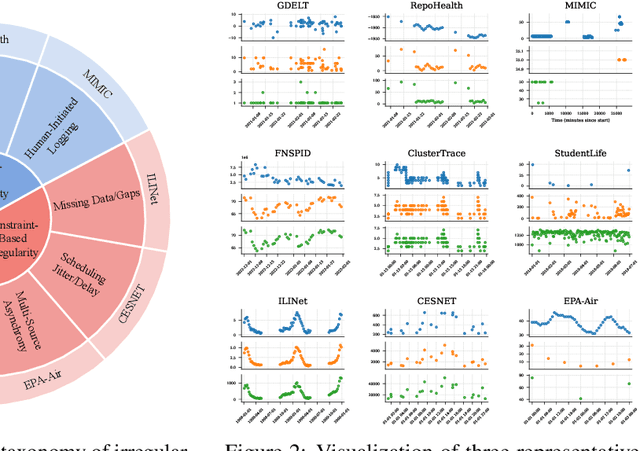
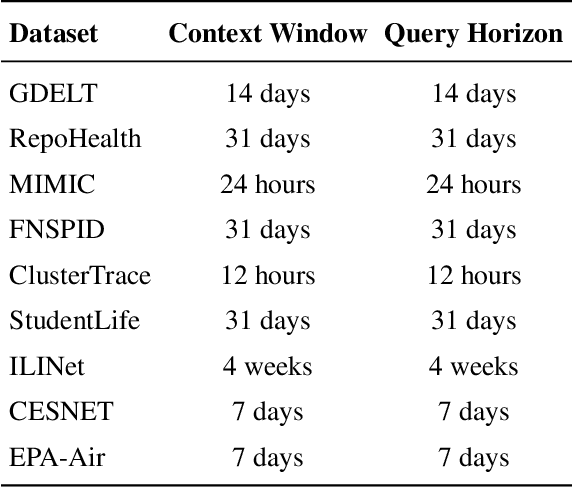
Time series data in real-world applications such as healthcare, climate modeling, and finance are often irregular, multimodal, and messy, with varying sampling rates, asynchronous modalities, and pervasive missingness. However, existing benchmarks typically assume clean, regularly sampled, unimodal data, creating a significant gap between research and real-world deployment. We introduce Time-IMM, a dataset specifically designed to capture cause-driven irregularity in multimodal multivariate time series. Time-IMM represents nine distinct types of time series irregularity, categorized into trigger-based, constraint-based, and artifact-based mechanisms. Complementing the dataset, we introduce IMM-TSF, a benchmark library for forecasting on irregular multimodal time series, enabling asynchronous integration and realistic evaluation. IMM-TSF includes specialized fusion modules, including a timestamp-to-text fusion module and a multimodality fusion module, which support both recency-aware averaging and attention-based integration strategies. Empirical results demonstrate that explicitly modeling multimodality on irregular time series data leads to substantial gains in forecasting performance. Time-IMM and IMM-TSF provide a foundation for advancing time series analysis under real-world conditions. The dataset is publicly available at https://www.kaggle.com/datasets/blacksnail789521/time-imm/data, and the benchmark library can be accessed at https://anonymous.4open.science/r/IMMTSF_NeurIPS2025.