 Add to Chrome
 Add to Firefox
 Add to Edge
TaoBench: Do Automated Theorem Prover LLMs Generalize Beyond MathLib?
Mar 13, 2026
Automated theorem proving (ATP) benchmarks largely consist of problems formalized in MathLib, so current ATP training and evaluation are heavily biased toward MathLib's definitional framework. However, frontier mathematics is often exploratory and prototype-heavy, relying on bespoke constructions that deviate from standard libraries. In this work, we evaluate the robustness of current ATP systems when applied to a novel definitional framework, specifically examining the performance gap between standard library problems and bespoke mathematical constructions. We introduce TaoBench, an undergraduate-level benchmark derived from Terence Tao's Analysis I, which formalizes analysis by constructing core mathematical concepts from scratch, without relying on standard Mathlib definitions, as well as by mixing from-scratch and MathLib constructions. For fair evaluation, we build an agentic pipeline that automatically extracts a compilable, self-contained local environment for each problem. To isolate the effect of definitional frameworks, we additionally translate every problem into a mathematically equivalent Mathlib formulation, yielding paired TaoBench-Mathlib statements for direct comparison. While state-of-the-art ATP models perform capably within the MathLib framework, performance drops by an average of roughly 26% on the definitionally equivalent Tao formulation. This indicates that the main bottleneck is limited generalization across definitional frameworks rather than task difficulty. TaoBench thus highlights a gap between benchmark performance and applicability, and provides a concrete foundation for developing and testing provers better aligned with research mathematics.

Platform for Representation and Integration of multimodal Molecular Embeddings
Jul 10, 2025Existing machine learning methods for molecular (e.g., gene) embeddings are restricted to specific tasks or data modalities, limiting their effectiveness within narrow domains. As a result, they fail to capture the full breadth of gene functions and interactions across diverse biological contexts. In this study, we have systematically evaluated knowledge representations of biomolecules across multiple dimensions representing a task-agnostic manner spanning three major data sources, including omics experimental data, literature-derived text data, and knowledge graph-based representations. To distinguish between meaningful biological signals from chance correlations, we devised an adjusted variant of Singular Vector Canonical Correlation Analysis (SVCCA) that quantifies signal redundancy and complementarity across different data modalities and sources. These analyses reveal that existing embeddings capture largely non-overlapping molecular signals, highlighting the value of embedding integration. Building on this insight, we propose Platform for Representation and Integration of multimodal Molecular Embeddings (PRISME), a machine learning based workflow using an autoencoder to integrate these heterogeneous embeddings into a unified multimodal representation. We validated this approach across various benchmark tasks, where PRISME demonstrated consistent performance, and outperformed individual embedding methods in missing value imputations. This new framework supports comprehensive modeling of biomolecules, advancing the development of robust, broadly applicable multimodal embeddings optimized for downstream biomedical machine learning applications.
Atherosclerosis through Hierarchical Explainable Neural Network Analysis
Jul 10, 2025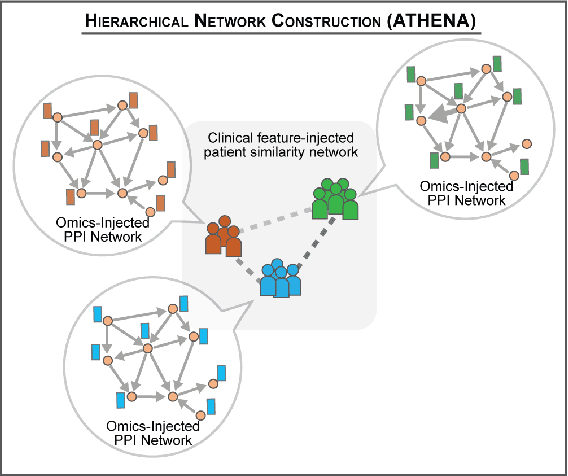

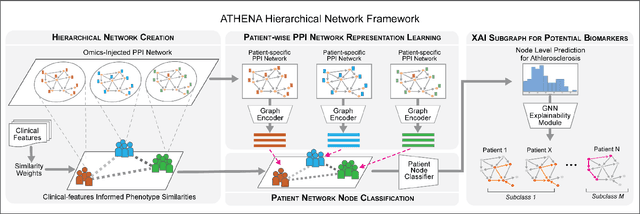
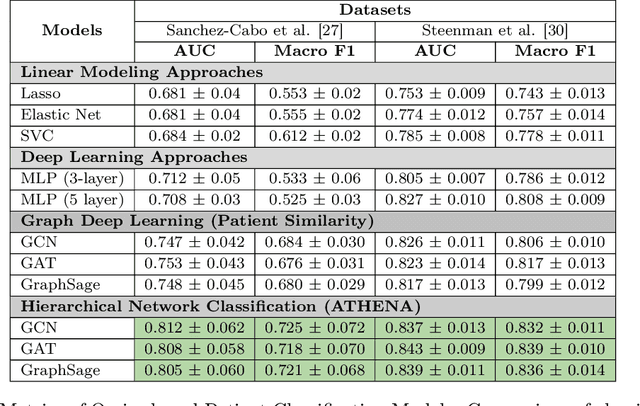
In this work, we study the problem pertaining to personalized classification of subclinical atherosclerosis by developing a hierarchical graph neural network framework to leverage two characteristic modalities of a patient: clinical features within the context of the cohort, and molecular data unique to individual patients. Current graph-based methods for disease classification detect patient-specific molecular fingerprints, but lack consistency and comprehension regarding cohort-wide features, which are an essential requirement for understanding pathogenic phenotypes across diverse atherosclerotic trajectories. Furthermore, understanding patient subtypes often considers clinical feature similarity in isolation, without integration of shared pathogenic interdependencies among patients. To address these challenges, we introduce ATHENA: Atherosclerosis Through Hierarchical Explainable Neural Network Analysis, which constructs a novel hierarchical network representation through integrated modality learning; subsequently, it optimizes learned patient-specific molecular fingerprints that reflect individual omics data, enforcing consistency with cohort-wide patterns. With a primary clinical dataset of 391 patients, we demonstrate that this heterogeneous alignment of clinical features with molecular interaction patterns has significantly boosted subclinical atherosclerosis classification performance across various baselines by up to 13% in area under the receiver operating curve (AUC) and 20% in F1 score. Taken together, ATHENA enables mechanistically-informed patient subtype discovery through explainable AI (XAI)-driven subnetwork clustering; this novel integration framework strengthens personalized intervention strategies, thereby improving the prediction of atherosclerotic disease progression and management of their clinical actionable outcomes.