 Add to Chrome
 Add to Firefox
 Add to Edge
VMix: Improving Text-to-Image Diffusion Model with Cross-Attention Mixing Control
Dec 30, 2024
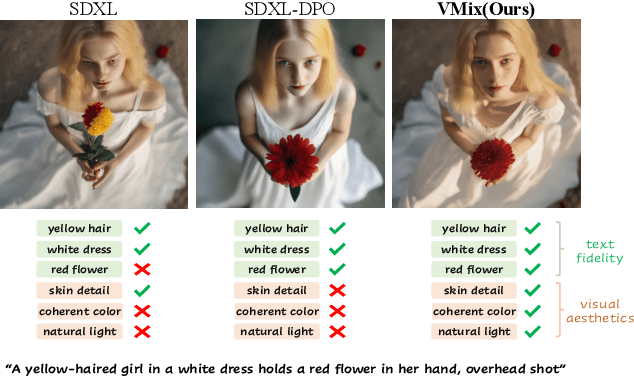
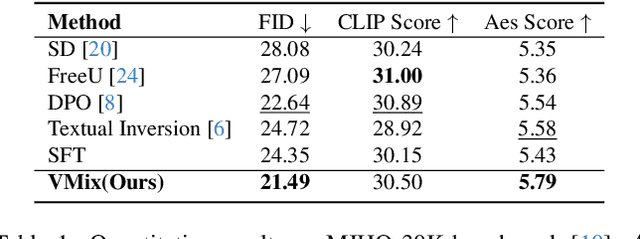
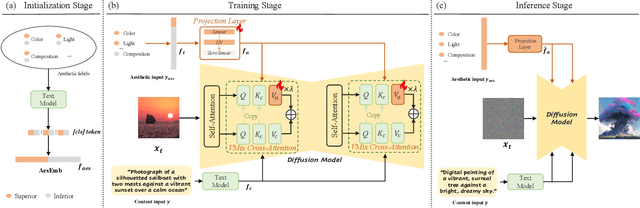
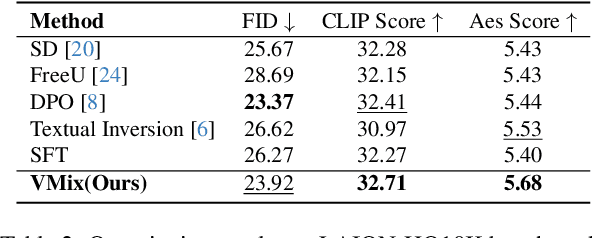
While diffusion models show extraordinary talents in text-to-image generation, they may still fail to generate highly aesthetic images. More specifically, there is still a gap between the generated images and the real-world aesthetic images in finer-grained dimensions including color, lighting, composition, etc. In this paper, we propose Cross-Attention Value Mixing Control (VMix) Adapter, a plug-and-play aesthetics adapter, to upgrade the quality of generated images while maintaining generality across visual concepts by (1) disentangling the input text prompt into the content description and aesthetic description by the initialization of aesthetic embedding, and (2) integrating aesthetic conditions into the denoising process through value-mixed cross-attention, with the network connected by zero-initialized linear layers. Our key insight is to enhance the aesthetic presentation of existing diffusion models by designing a superior condition control method, all while preserving the image-text alignment. Through our meticulous design, VMix is flexible enough to be applied to community models for better visual performance without retraining. To validate the effectiveness of our method, we conducted extensive experiments, showing that VMix outperforms other state-of-the-art methods and is compatible with other community modules (e.g., LoRA, ControlNet, and IPAdapter) for image generation. The project page is https://vmix-diffusion.github.io/VMix/.

Diving into Self-Evolving Training for Multimodal Reasoning
Dec 23, 2024
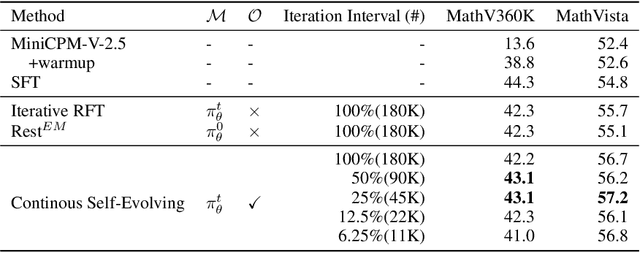


Reasoning ability is essential for Large Multimodal Models (LMMs). In the absence of multimodal chain-of-thought annotated data, self-evolving training, where the model learns from its own outputs, has emerged as an effective and scalable approach for enhancing reasoning abilities. Despite its growing usage, a comprehensive understanding of self-evolving training, particularly in the context of multimodal reasoning, remains limited. In this paper, we delve into the intricacies of self-evolving training for multimodal reasoning, pinpointing three key factors: Training Method, Reward Model, and Prompt Variation. We systematically examine each factor and explore how various configurations affect the training's effectiveness. Our analysis leads to a set of best practices for each factor, aimed at optimizing multimodal reasoning. Furthermore, we explore the Self-Evolution Dynamics during training and the impact of automatic balancing mechanisms in boosting performance. After all the investigations, we present a final recipe for self-evolving training in multimodal reasoning, encapsulating these design choices into a framework we call MSTaR (Multimodal Self-evolving Training for Reasoning), which is universally effective for models with different sizes on various benchmarks, e.g., surpassing the pre-evolved model significantly on 5 multimodal reasoning benchmarks without using additional human annotations, as demonstrated on MiniCPM-V-2.5 (8B), Phi-3.5-Vision (4B) and InternVL2 (2B). We believe this study fills a significant gap in the understanding of self-evolving training for multimodal reasoning and offers a robust framework for future research. Our policy and reward models, as well as the collected data, is released to facilitate further investigation in multimodal reasoning.
IDOL: Instant Photorealistic 3D Human Creation from a Single Image
Dec 19, 2024

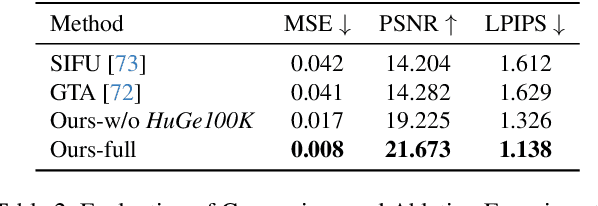

Creating a high-fidelity, animatable 3D full-body avatar from a single image is a challenging task due to the diverse appearance and poses of humans and the limited availability of high-quality training data. To achieve fast and high-quality human reconstruction, this work rethinks the task from the perspectives of dataset, model, and representation. First, we introduce a large-scale HUman-centric GEnerated dataset, HuGe100K, consisting of 100K diverse, photorealistic sets of human images. Each set contains 24-view frames in specific human poses, generated using a pose-controllable image-to-multi-view model. Next, leveraging the diversity in views, poses, and appearances within HuGe100K, we develop a scalable feed-forward transformer model to predict a 3D human Gaussian representation in a uniform space from a given human image. This model is trained to disentangle human pose, body shape, clothing geometry, and texture. The estimated Gaussians can be animated without post-processing. We conduct comprehensive experiments to validate the effectiveness of the proposed dataset and method. Our model demonstrates the ability to efficiently reconstruct photorealistic humans at 1K resolution from a single input image using a single GPU instantly. Additionally, it seamlessly supports various applications, as well as shape and texture editing tasks.
A recent evaluation on the performance of LLMs on radiation oncology physics using questions of randomly shuffled options
Dec 14, 2024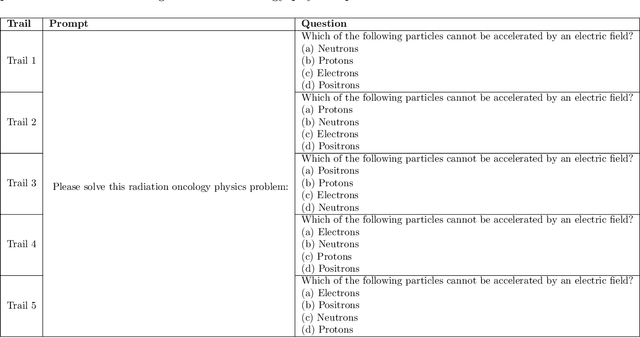
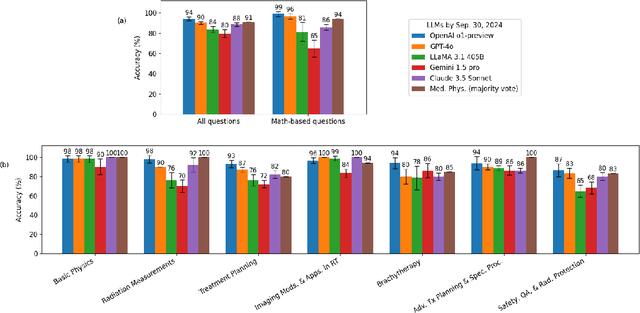
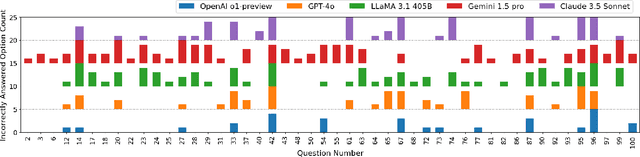
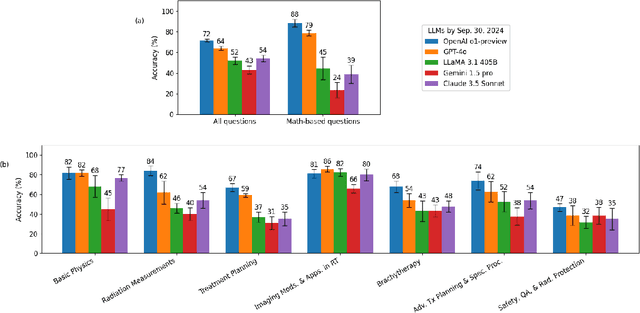
Purpose: We present an updated study evaluating the performance of large language models (LLMs) in answering radiation oncology physics questions, focusing on the latest released models. Methods: A set of 100 multiple-choice radiation oncology physics questions, previously created by us, was used for this study. The answer options of the questions were randomly shuffled to create "new" exam sets. Five LLMs -- OpenAI o1-preview, GPT-4o, LLaMA 3.1 (405B), Gemini 1.5 Pro, and Claude 3.5 Sonnet -- with the versions released before September 30, 2024, were queried using these new exams. To evaluate their deductive reasoning abilities, the correct answer options in the questions were replaced with "None of the above." Then, the explain-first and step-by-step instruction prompt was used to test if it improved their reasoning abilities. The performance of the LLMs was compared to medical physicists in majority-vote scenarios. Results: All models demonstrated expert-level performance on these questions, with o1-preview even surpassing medical physicists in majority-vote scenarios. When substituting the correct answer options with "None of the above," all models exhibited a considerable decline in performance, suggesting room for improvement. The explain-first and step-by-step instruction prompt helped enhance the reasoning abilities of LLaMA 3.1 (405B), Gemini 1.5 Pro, and Claude 3.5 Sonnet models. Conclusion: These latest LLMs demonstrated expert-level performance in answering radiation oncology physics questions, exhibiting great potential for assisting in radiation oncology physics education.
Just a Few Glances: Open-Set Visual Perception with Image Prompt Paradigm
Dec 14, 2024


To break through the limitations of pre-training models on fixed categories, Open-Set Object Detection (OSOD) and Open-Set Segmentation (OSS) have attracted a surge of interest from researchers. Inspired by large language models, mainstream OSOD and OSS methods generally utilize text as a prompt, achieving remarkable performance. Following SAM paradigm, some researchers use visual prompts, such as points, boxes, and masks that cover detection or segmentation targets. Despite these two prompt paradigms exhibit excellent performance, they also reveal inherent limitations. On the one hand, it is difficult to accurately describe characteristics of specialized category using textual description. On the other hand, existing visual prompt paradigms heavily rely on multi-round human interaction, which hinders them being applied to fully automated pipeline. To address the above issues, we propose a novel prompt paradigm in OSOD and OSS, that is, \textbf{Image Prompt Paradigm}. This brand new prompt paradigm enables to detect or segment specialized categories without multi-round human intervention. To achieve this goal, the proposed image prompt paradigm uses just a few image instances as prompts, and we propose a novel framework named \textbf{MI Grounding} for this new paradigm. In this framework, high-quality image prompts are automatically encoded, selected and fused, achieving the single-stage and non-interactive inference. We conduct extensive experiments on public datasets, showing that MI Grounding achieves competitive performance on OSOD and OSS benchmarks compared to text prompt paradigm methods and visual prompt paradigm methods. Moreover, MI Grounding can greatly outperform existing method on our constructed specialized ADR50K dataset.
A Decade of Deep Learning: A Survey on The Magnificent Seven
Dec 13, 2024Deep learning has fundamentally reshaped the landscape of artificial intelligence over the past decade, enabling remarkable achievements across diverse domains. At the heart of these developments lie multi-layered neural network architectures that excel at automatic feature extraction, leading to significant improvements in machine learning tasks. To demystify these advances and offer accessible guidance, we present a comprehensive overview of the most influential deep learning algorithms selected through a broad-based survey of the field. Our discussion centers on pivotal architectures, including Residual Networks, Transformers, Generative Adversarial Networks, Variational Autoencoders, Graph Neural Networks, Contrastive Language-Image Pre-training, and Diffusion models. We detail their historical context, highlight their mathematical foundations and algorithmic principles, and examine subsequent variants, extensions, and practical considerations such as training methodologies, normalization techniques, and learning rate schedules. Beyond historical and technical insights, we also address their applications, challenges, and potential research directions. This survey aims to serve as a practical manual for both newcomers seeking an entry point into cutting-edge deep learning methods and experienced researchers transitioning into this rapidly evolving domain.
STIV: Scalable Text and Image Conditioned Video Generation
Dec 10, 2024The field of video generation has made remarkable advancements, yet there remains a pressing need for a clear, systematic recipe that can guide the development of robust and scalable models. In this work, we present a comprehensive study that systematically explores the interplay of model architectures, training recipes, and data curation strategies, culminating in a simple and scalable text-image-conditioned video generation method, named STIV. Our framework integrates image condition into a Diffusion Transformer (DiT) through frame replacement, while incorporating text conditioning via a joint image-text conditional classifier-free guidance. This design enables STIV to perform both text-to-video (T2V) and text-image-to-video (TI2V) tasks simultaneously. Additionally, STIV can be easily extended to various applications, such as video prediction, frame interpolation, multi-view generation, and long video generation, etc. With comprehensive ablation studies on T2I, T2V, and TI2V, STIV demonstrate strong performance, despite its simple design. An 8.7B model with 512 resolution achieves 83.1 on VBench T2V, surpassing both leading open and closed-source models like CogVideoX-5B, Pika, Kling, and Gen-3. The same-sized model also achieves a state-of-the-art result of 90.1 on VBench I2V task at 512 resolution. By providing a transparent and extensible recipe for building cutting-edge video generation models, we aim to empower future research and accelerate progress toward more versatile and reliable video generation solutions.
KG-Retriever: Efficient Knowledge Indexing for Retrieval-Augmented Large Language Models
Dec 07, 2024Large language models with retrieval-augmented generation encounter a pivotal challenge in intricate retrieval tasks, e.g., multi-hop question answering, which requires the model to navigate across multiple documents and generate comprehensive responses based on fragmented information. To tackle this challenge, we introduce a novel Knowledge Graph-based RAG framework with a hierarchical knowledge retriever, termed KG-Retriever. The retrieval indexing in KG-Retriever is constructed on a hierarchical index graph that consists of a knowledge graph layer and a collaborative document layer. The associative nature of graph structures is fully utilized to strengthen intra-document and inter-document connectivity, thereby fundamentally alleviating the information fragmentation problem and meanwhile improving the retrieval efficiency in cross-document retrieval of LLMs. With the coarse-grained collaborative information from neighboring documents and concise information from the knowledge graph, KG-Retriever achieves marked improvements on five public QA datasets, showing the effectiveness and efficiency of our proposed RAG framework.
Mix-Modality Person Re-Identification: A New and Practical Paradigm
Dec 06, 2024Current visible-infrared cross-modality person re-identification research has only focused on exploring the bi-modality mutual retrieval paradigm, and we propose a new and more practical mix-modality retrieval paradigm. Existing Visible-Infrared person re-identification (VI-ReID) methods have achieved some results in the bi-modality mutual retrieval paradigm by learning the correspondence between visible and infrared modalities. However, significant performance degradation occurs due to the modality confusion problem when these methods are applied to the new mix-modality paradigm. Therefore, this paper proposes a Mix-Modality person re-identification (MM-ReID) task, explores the influence of modality mixing ratio on performance, and constructs mix-modality test sets for existing datasets according to the new mix-modality testing paradigm. To solve the modality confusion problem in MM-ReID, we propose a Cross-Identity Discrimination Harmonization Loss (CIDHL) adjusting the distribution of samples in the hyperspherical feature space, pulling the centers of samples with the same identity closer, and pushing away the centers of samples with different identities while aggregating samples with the same modality and the same identity. Furthermore, we propose a Modality Bridge Similarity Optimization Strategy (MBSOS) to optimize the cross-modality similarity between the query and queried samples with the help of the similar bridge sample in the gallery. Extensive experiments demonstrate that compared to the original performance of existing cross-modality methods on MM-ReID, the addition of our CIDHL and MBSOS demonstrates a general improvement.
Exploring the Generalization Capabilities of AID-based Bi-level Optimization
Nov 25, 2024Bi-level optimization has achieved considerable success in contemporary machine learning applications, especially for given proper hyperparameters. However, due to the two-level optimization structure, commonly, researchers focus on two types of bi-level optimization methods: approximate implicit differentiation (AID)-based and iterative differentiation (ITD)-based approaches. ITD-based methods can be readily transformed into single-level optimization problems, facilitating the study of their generalization capabilities. In contrast, AID-based methods cannot be easily transformed similarly but must stay in the two-level structure, leaving their generalization properties enigmatic. In this paper, although the outer-level function is nonconvex, we ascertain the uniform stability of AID-based methods, which achieves similar results to a single-level nonconvex problem. We conduct a convergence analysis for a carefully chosen step size to maintain stability. Combining the convergence and stability results, we give the generalization ability of AID-based bi-level optimization methods. Furthermore, we carry out an ablation study of the parameters and assess the performance of these methods on real-world tasks. Our experimental results corroborate the theoretical findings, demonstrating the effectiveness and potential applications of these methods.